

Little more than a day after the gavel came down on the climate summit in Baku, the global diplomacy tour has stopped off in Busan. Delegates from 175 countries have descended on South Korea’s second-largest city for what’s supposed to be the final round of talks aimed at clinching an international treaty on plastic.
“The moment of truth is here to end plastic pollution,” said Inger Andersen, executive director of the UN Environment Programme, at the start of the talks. “We have a historic moment to end the world’s plastic pollution crisis and protect our environment, our health, and our future.”
Fractious COP29 lands $300bn climate finance goal, dashing hopes of the poorest
But much work is needed to get there by this coming Sunday when the summit is scheduled to end. Deep divisions over what the treaty should tackle have hobbled negotiations so far, with little progress at the previous four meetings over the last two and a half years.
Ambassador Luis Vayas Valdivieso, chair of the plastics negotiations, said delegates should “harness every tool of multilateralism, every ounce of creativity, and every moment of dialogue to overcome our differences and craft a treaty as ambitious as our collective will allows”.
As they hopped off the metro at Busan’s futuristic convention centre – the venue of the talks – delegates were welcomed with a simple message on the advertising boards: “Cap plastic now”.
Full life-cycle
Yet plastic production is one of the most contentious issues being discussed here. The majority of countries around the table want an ambitious deal that includes measures to reduce the amount of plastic that is manufactured, as well as ways to deal with plastic waste. Most rich countries, Latin American and African nations, and small island states firmly hold this view.
“You cannot end or reduce plastic pollution without reducing plastic production. That is just a fact,” Graham Forbes, Greenpeace’s head of delegation at the plastics talks, told reporters on Monday. Speaking to Climate Home in Baku last week, Andersen said sustainable production and consumption of plastics would need to be defined as part of talks on the new treaty.
On Monday in Busan, she underlined that the UN resolution underpinning the talks should be a “guiding star”. The resolution indicated that the treaty would need to address “the full life cycle of plastics” – meaning from production through to consumption and waste.

UNEP executive director Inger Andersen at the opening plenary of the INC-5 talks in Busan, South Korea, where countries are set to reach an agreement on tackling plastic pollution. (Photo: IISD/ENB – Kiara Worth)
But a group of fossil-fuel producing nations, primarily led by Saudi Arabia, Russia and Iran, have been resisting any push to include production cuts, arguing that the treaty should only focus on demand-side measures like recycling.
Nearly all plastics are derived from oil and gas and, as the world gradually starts to wean itself off fossil fuels for energy, countries and companies that profit from carbon-based fuels view an expected ramp-up in plastic production as a lifeline for their industry.
David Azoulay, managing attorney for the Center for International Environmental Law (CIEL), told Climate Home that countries opposed to production curbs are trying to prevent any constraints from being imposed on their ability to extract fossil fuels.
“To be a little blunt, they want to ensure that this instrument either never sees the lights of day, or if it does, is as inefficient as the climate instruments that they have managed to block and paralyse for the past three decades,” he added.
COP16 hands power to Indigenous people but fails to bridge nature finance gap
Delaying tactics
At a plenary session on Monday morning, Andersen pleaded with delegates to “negotiate in good faith” and not to “lower the bar so that the treaty becomes meaningless”.
The chair, Vayas Valdivieso, said the clock was ticking and that “every minute” was needed to advance in Busan. Day one did not send a positive signal, however, as the plenary ran into overtime to sort out fraught procedural matters.
Fossil fuel-producing emerging economies first warned their counterparts against triggering a rule that allows for two-thirds majority voting when negotiators fail to reach agreements by consensus. “We cannot leave anyone behind,” said Saudi Arabia’s representative. “Consensus will ensure global ownership.”
Then the focus shifted to extensive discussions over which document should be used as the basis for discussions.
The latest round of negotiations back in April produced a monster-sized “compilation text” with countries’ disparate views nestled between nearly 3,700 brackets. In an attempt to make the negotiations more practical, Vayas Valdivieso took matters into his own hands ahead of the Busan summit and produced a more streamlined text with proposals on areas of convergence and suggestions on how to move things along.
Most countries were happy to proceed on that basis with Rwanda – the co-chair of the 68-nation-strong “high ambition coalition” – asking delegates to “get down to business” and the United States saying “we cannot continue to move in circles”.
But Saudi Arabia, Russia, Iran and Kuwait – on behalf of the so-called “like-minded” countries – lined up one after the other to say they could not accept the chair’s proposal in its current form.
After a three-hour suspension, a compromise was found. The chair’s document will be used as a “starting point” to facilitate discussions, while the “compilation text” remains on the table as a source countries can refer to in negotiations. By then the sun had long set in Busan and substantive negotiations hadn’t moved forward an inch.
CIEL’s Azoulay told Climate Home that what happened at Monday’s plenary session was part “muscle-flexing” and part “time-wasting” from the fossil fuel-producing bloc of nations set against plastic production cuts.
Countries that profess to be ambitious will need to “stand firm” when similar tactics appear again in the negotiating rooms, he added.
Having settled the ground rules, diplomats will now start negotiating behind-closed-doors in four separate groups each focusing on a cluster of issues at the heart of the treaty.
(Reporting by Matteo Civillini; editing by Megan Rowling and Joe Lo)
The post “Moment of truth” for plastic pollution as treaty talks get underway appeared first on Climate Home News.
“Moment of truth” for plastic pollution as treaty talks get underway

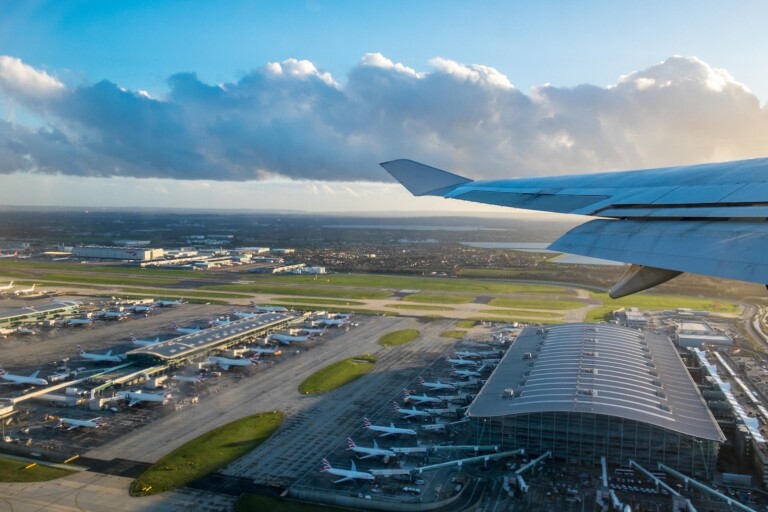
Aviation is on track to be responsible for 80% of the UK’s carbon dioxide (CO2) emissions by 2050, according to the Climate Change Committee (CCC).
Emissions from flying have more than doubled since 1990 – driven by rising passenger numbers – even as the climate impact of every other sector in the UK economy has fallen.
The UK does not have “credible” policies in place to reverse this trend of rising emissions, says the CCC in new advice to the government on future aviation policy.
The government has signalled its support for expanding Heathrow, the nation’s largest airport, while relying on “techno-fixes” such as “sustainable aviation fuels” (SAFs) to cut emissions.
Yet, even without Heathrow expansion, the CCC says aviation emissions are on track to be higher in 2050 than they are today – reaching 38m tonnes of CO2 (MtCO2).
As the chart below shows, this would account for most of the remaining CO2 from the UK economy, all of which would need to be removed from the atmosphere in order to meet the legal target of net-zero emissions.
Expanding Heathrow would add another 2.4MtCO2 in 2050, amounting to around 5% of all the UK’s emissions. (This would increase to 4.5MtCO2 when expansion is complete in 2054.)
With a final decision on Heathrow expansion expected by 2029, the government asked the CCC for its advice on whether the plan is compatible with the UK’s climate targets.
The CCC has concluded that the UK simply lacks sufficient policies to reduce aviation emissions and “expanding Heathrow would compound the problem”. In a press briefing, CCC chair Nigel Topping told journalists:
“The UK does not currently have a credible plan to reduce [aviation emissions] in line with net-zero, so that creates a serious challenge for meeting our climate commitments.”
The “jet-zero strategy”, launched by the previous Conservative government in 2022, set out plans to cut aviation emissions. However, the Labour government has since accepted that the strategy’s expectations for SAFs, electric planes and fuel-efficiency improvements were unrealistic.
The CCC says a “credible and robust net-zero policy framework for aviation” should be set out in a revised strategy, which is planned for 2027. Only then could Heathrow expansion be aligned with the net-zero goal, adds the committee.
As part of this new strategy, the CCC says the “aviation sector needs to take responsibility for its emissions”. It says policies should be designed based on the “polluter pays” principle, requiring the aviation industry to fund its own SAFs and CO2 removal.
Specifically, the committee says funding will be needed for “engineered removal” technologies, such as direct air carbon capture and storage (DACCS).
These technologies are currently “not yet available at the scale required”, but are vital for the kind of permanent CO2 removal needed to mop up aviation emissions, says the CCC.
(“Natural solutions” such as tree planting are the other main way CO2 is expected to be removed from the atmosphere. However, the CCC envisages these removals offsetting the remaining methane emissions from livestock agriculture in the UK, whereas it says “engineered removals” would be required to remove and store CO2 from flights.)
The CCC acknowledges that placing decarbonisation costs on airlines would likely lead to higher ticket prices. It estimates that this could mean an increase, in 2024 prices, of around £150 for a return trip to Alicante, Spain, and £400 for a return trip to New York by 2050.
However, it says this is preferable to a public spending approach, which would result in the roughly 50% of the population who do not fly paying for flight-related CO2 removals.
In addition, the committee notes that higher costs would help to manage demand for flights, which would otherwise be expected to increase considerably over the coming decades.
related

The post CCC: Heathrow expansion could push flights to ‘80% of UK emissions by 2050’ appeared first on Carbon Brief.
CCC: Heathrow expansion could push flights to ‘80% of UK emissions by 2050’
A fifth of the world’s greenhouse gas emissions are linked to international trade in goods and services, a new tracker shows, spotlighting a little-studied issue that researchers say should be tackled by the UN climate process.
Currently, as part of the Paris Agreement, every country is responsible for counting and reducing the planet-heating emissions that are produced within its territory. Manufacturing countries, for example, may have high emissions even if what they make is exported for consumption elsewhere.
But new analysis from the European Climate Foundation (ECF) and climate consultancy Matière, based on the tracker’s data, shows that some countries have a high footprint of “imported emissions” from goods and services they ship in. These emissions are often ignored in the places where the products are consumed because they are not formally counted under greenhouse gas inventories.
In the European Union, for example, while domestic emissions have declined since 2015, imported emissions have remained unchanged, the analysis shows. In some countries, like Austria or Sweden, they are as high as the country’s entire annual carbon footprint.
-
Türkiye says it has “final decision” at COP31 despite Australia running negotiations
COP31 President-Designate Murat Kurum told journalists that, while the two countries have been working well together, Türkiye has the final say over the Antalya summit -
As science comes under attack at UN talks, climate movement splits over how to respond
A rift over how IPCC messages are produced and turned into policy is creating tensions in the world’s most influential coalition of climate NGOs

Former EU lead climate negotiator Jacob Werksman said that under the Paris Agreement, these traded emissions are accounted for in the countries where they are originally produced, but importing countries can also take responsibility for their consumption.
“It starts with a wide recognition by many jurisdictions around the world that we need to know the carbon content of these products, and we then need to agree what is a fair, effective, transparent and relatively easy-to-implement way of measuring that carbon in traded products,” he told a launch event for the trade emissions tracker, which contains data for different countries, sectors and gases.
Trade and its role in addressing climate change has become a higher priority at UN climate talks after a push led by emerging economies including China, India and South Africa led to the first trade and climate change dialogue held this year at the mid-year session in Bonn.
At the upcoming COP31 UN summit in Antalya, some voluntary initiatives like the Brazil-led Integrated Forum on Climate Change and Trade are expected to continue, but the issue does not feature in Türkiye’s Action Agenda of climate initiatives and formal negotiations are not scheduled on the topic.
China: the world’s top emissions exporter
As a manufacturing powerhouse, China ranks first in the new tracker as the world’s top-emitting country, but the data shows that a large chunk of the country’s carbon emissions – an amount larger than Brazil’s entire annual carbon footprint – are linked to products that are exported and consumed abroad.
Russia, Brazil, the US and the EU rank as the top destinations for Chinese trade-related emissions, which are mostly linked to components for power generation, basic metals like copper and lead, and non-metallic minerals like graphite and phosphorus.
Yet China is also the world’s top emissions importer, related mostly to agricultural products, fossil fuels and minerals brought from the US, the EU, Japan and India, among others. The US ranks second by a close margin, with both countries importing about 1.6 billion tonnes of CO2 equivalent.
China’s industrial engine starts to break its fossil fuel habit
Richard Baron, ECF’s industrial policy and trade director, said Chinese clean energy products are key for reducing emissions around the world, adding that Europe is “not able to do without those technologies” for its energy transition.
“China has an emissions trading system that counts CO2 differently there. But if China and the EU were to agree on some kind of translation mechanism to say ‘this is how we measure it’, and companies can understand the protocol to navigate both markets, that would set the tone for a lot of other conversations,” he said at the platform’s launch event last week.
The analysis suggests that if the EU and China aligned their climate requirements for products, the resulting standards could influence trade flows representing about 7% of global emissions.
Baron said there’s “a plethora” of multilateral spaces to hold these discussions, including the climate and trade dialogue at the UN climate talks or the Climate Club at the Organisation for Economic Co-operation and Development (OECD), which seeks to cut industrial emissions.
Trade breaks into agenda of UN climate talks – but will it have teeth?
Controversial trade measures
Instruments like the Europe’s Carbon Border Adjustment Mechanism (CBAM) – a recent piece of legislation that penalises emissions-heavy imported products – are one tool that could be used to address trade-related emissions, said Antoine Oger, executive director at the Institute for European Environmental Policy.
He said a significant portion of imported emissions in Europe are already covered by CBAM, as it includes sectors like cement, iron and steel, fertilisers and aluminium. This then allows the EU “to engage in constructive dialogue with our trade partners”, he added.

But across diplomatic summits, including at UN climate talks, emerging economies have pushed back heavily against the CBAM and other trade measures. The most recent BRICS declaration adopted on Saturday by 11 such countries – including China, India and Russia – condemns “protectionism under the guise of environmental objectives”.
The declaration calls for the “elimination of such unlawful measures”, which they argue have “far-reaching negative implications for the human rights, including the rights to development, health and food security” of vulnerable communities.
“The question of responsibility is a political question,” Oger said. “These emissions exist – they are emitted somewhere to make a product that will be consumed elsewhere. So you can debate responsibility but the idea is for the two parts to recognise there’s a problem.”
The aim, he added “is not to point fingers, but to accept this is a reality of our emissions profiles and ask what we can do about it”.
The post International trade linked to 20% of global emissions – but imports ignored appeared first on Climate Home News.
International trade linked to 20% of global emissions – but imports ignored
All the ambulance services in England experienced some of their busiest-ever days during this summer’s record-breaking June heatwave, according to data obtained by Carbon Brief.
In June, temperatures climbed past 37C in parts of the country as authorities declared only the second ever “red” extreme heat warning.
Four out of 10 NHS ambulance services, including London’s, responded to unprecedented numbers of life-threatening emergencies on at least one day from 23-27 June.
Another two services – in the south-west and east of the country – received their highest volume of 999 calls on record.
Ambulance services provided data on their busiest days since records began, in response to freedom-of-information (FOI) requests from Carbon Brief.
The results show how demand during the June heatwave exceeded levels seen during the traditionally busy winter season in other years – and even the height of the Covid-19 pandemic – for many services.
Heat demand
Extreme heat ramps up the risk of numerous life-threatening conditions, including heart disease and respiratory problems.
England experienced record-breaking temperatures at the end of June, with the whole country covered by amber or red “heat health alerts” from the government.
A red alert, which was issued for the entire Midlands and south of England, indicates “significant risk to life for even the healthy population”. This was only the second time such an alert has been triggered.
Researchers calculated that there were nearly 3,000 heat-related deaths in the UK this summer. There has also been unprecedented demand for A&E departments and some ambulance services.
To investigate the strain facing ambulances, Carbon Brief sent FOI requests to the 10 NHS ambulance trusts in England, asking for lists of their busiest days.
This covered both the total volume of 999 calls and “category 1” responses – referring to incidents involving “life-threatening injuries and illnesses”, such as heart attacks.
The chart below shows the busiest days on record for England’s ambulances, including both total calls and category 1 responses. Most services were able to provide records back to the 2010s. (See: Methodology.)
The five-day period from 23-27 June is overrepresented in these results, with at least two heatwave days ranking in the top 20 for every service in the country.
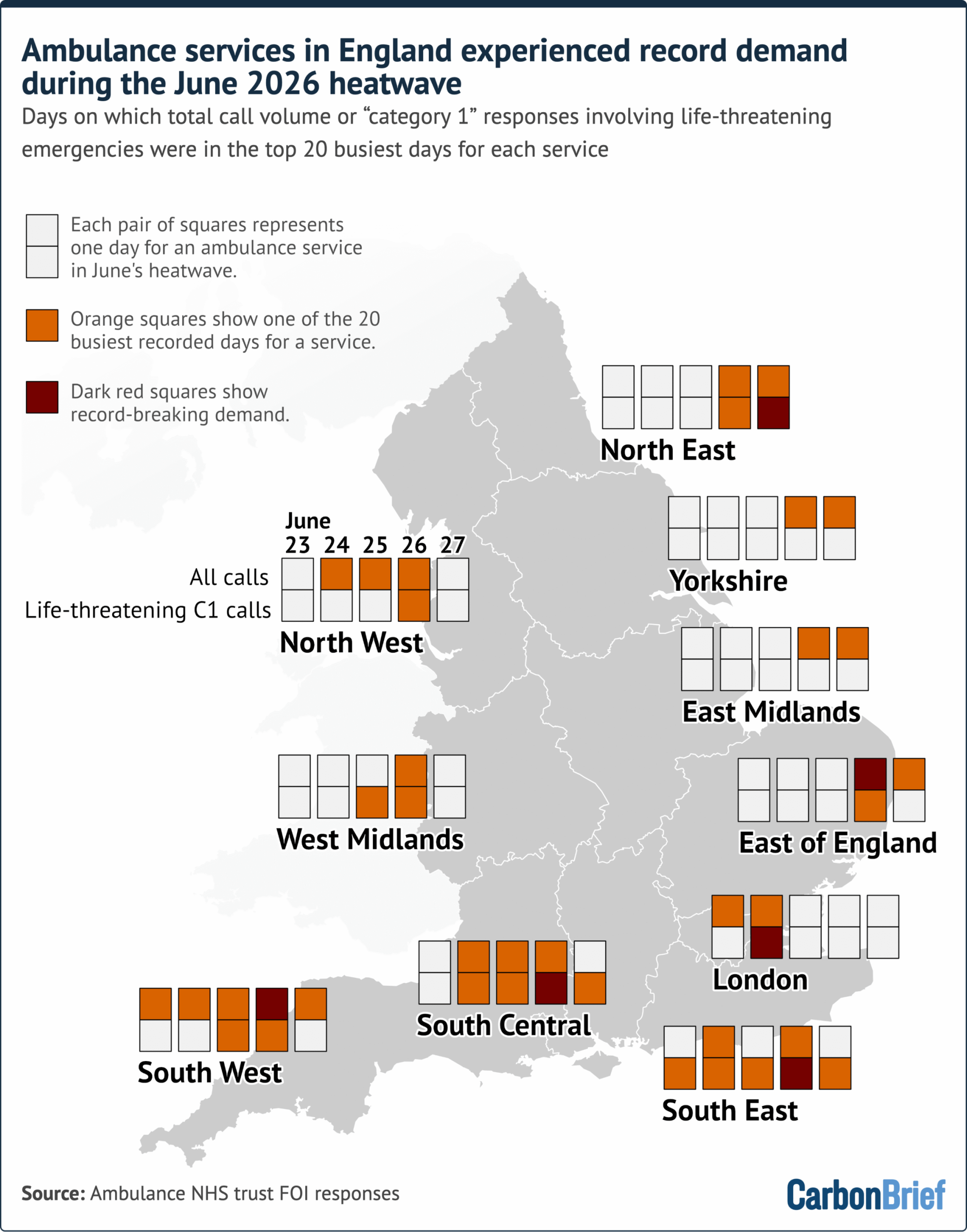
This trend is especially pronounced in the south and east of England, where June temperatures exceeded 36C and even approached 38C in some regions.
London, South East Coast, South Central and North East ambulance services all reported daily records for responding to life-threatening emergencies during the heatwave.
For the South East Coast and South Central services – which cover a region stretching from Oxfordshire to Kent – 25, 26 and 27 June all saw unprecedented numbers of category 1 callouts.
South Western and East of England services both saw record numbers of 999 calls on 26 June, the same day the highest-ever June UK temperature was reported in Norfolk.
It is worth noting that demand for ambulance services – including category 1 calls – has been growing for many years, driven by factors such as an ageing population, more complex health conditions and growing mental-health pressures.
This helps to explain why dates from before the 2020s are rare in the top rankings provided to Carbon Brief.
Beyond the heatwave, 2026 as a whole is on track to be a record year for ambulance demand.
‘Stifling heat’
On 26 June, the busiest day of the heatwave, ambulances across England responded to 4,084 life-threatening emergencies.
The average daily volume of such incidents is normally around 2,500 during the summer months.
Stu Holliday, head of emergency preparedness, resilience and response at North East Ambulance Service, tells Carbon Brief:
“During periods of hot weather, we typically see an increase in calls from people affected by dehydration, heat exhaustion and heatstroke, as well as those whose existing health conditions, particularly heart and respiratory illnesses, can be made worse by prolonged high temperatures.
“Older people, young children and pregnant people can be especially vulnerable.”
Ambulance teams are generally busier in the winter because cold weather and seasonal illnesses drive up the number of severe medical emergencies.
However, the data from June shows that extremely hot days are starting to match or even edge out cold ones as the busiest days. This is a trend seen across the healthcare system.
While not every service provided records back to 2019, the data broadly shows that ambulances were busier during the heatwave than at the height of the Covid-19 pandemic.
As well as patients, heatwaves put pressure on ambulance workers. The UNISON union has warned of crews facing “stifling heat with faulty or no air conditioning” and “back-to-back callouts” due to increased demand.
Methodology
Carbon Brief requested data on the top 50 busiest days for England’s 10 main ambulance services.
These are: London; South East Coast; South Central; South Western; West Midlands; East Midlands; East of England; North East; Yorkshire; and North West.
Data was requested for as far back as service records go. Most were able to provide records going back to some point in the 2010s, with the exception of North East and South Central, which only had records from 2021 and 2022 onwards, respectively.
Rising annual demand for ambulance services means that most of the busiest days for ambulances have been in the 2020s. For example, all but four of the busiest days for category 1 emergencies reported to Carbon Brief were in the 2020s.
Carbon Brief requested data on ambulance demand for all the UK nations. In Scotland and Northern Ireland – where temperatures are cooler – services did not see call volumes reach the top 50 rankings during the June heatwave. The Welsh Ambulance Service did not respond to Carbon Brief’s request.
related

Revealed: More than 1,000 NHS operations cancelled due to record UK heatwaves

Climate change is driving a ‘shift’ in childhood malaria risk across Africa
Q&A: How heat-related deaths are counted by scientists and public health authorities

Guest post: France’s June heatwave caused more than 2,700 heat-related deaths
The post Revealed: England’s June 2026 heatwave sparked record demand for ambulances appeared first on Carbon Brief.
Revealed: England’s June 2026 heatwave sparked record demand for ambulances



-
Climate Change1 year ago
Guest post: Why China is still building new coal – and when it might stop
-

 Greenhouse Gases2 years ago
嘉宾来稿:满足中国增长的用电需求 光伏加储能“比新建煤电更实惠”
-
Greenhouse Gases1 year ago
Guest post: Why China is still building new coal – and when it might stop
-

 Climate Change2 years ago
嘉宾来稿:满足中国增长的用电需求 光伏加储能“比新建煤电更实惠”
-

 Renewable Energy11 months ago
Sending Progressive Philanthropist George Soros to Prison?
-
Climate Change2 years ago
Bill Discounting Climate Change in Florida’s Energy Policy Awaits DeSantis’ Approval
-
Greenhouse Gases1 year ago
嘉宾来稿:探究火山喷发如何影响气候预测
-

 Carbon Footprint2 years ago
US SEC’s Climate Disclosure Rules Spur Renewed Interest in Carbon Credits