

2024年5月,尽管用电需求持续增长,清洁能源发电量占到中国全国总发电量的44%,创下历史新高;燃煤发电量占比降至53%,达到历史低点。
基于官方数据和其他数据,Carbon Brief 的新分析揭示了煤炭在能源结构中占比下降的真实程度。
2023年5月,煤炭在中国发电量中所占比例为60%。一年后,这一数字下降了7个百分点。
该分析揭示的其他关键信息包括:
- 国家统计局按发电方式分列的月度发电量数据现在对风能和太阳能发电量计入非常有局限性。例如,它未纳入“分布式”屋顶光伏和较小的集中式太阳能发电站,因此只能捕捉到约一半的太阳能发电量。
- 国家统计局的月度总发电量为718太瓦时(TWh),而国家能源局报告提出月度电力需求为775太瓦时,两者的差距显著。实际上,由于发电厂和电网损耗,发电量肯定应高于需求量。
- 媒体报道曾猜测,创纪录的新增可再生能源装机容量会在5月份触及电网上限,但新数据显示情况并非如此。
- 2024年5月,中国电力需求同比增长49太瓦时(7.2%)。
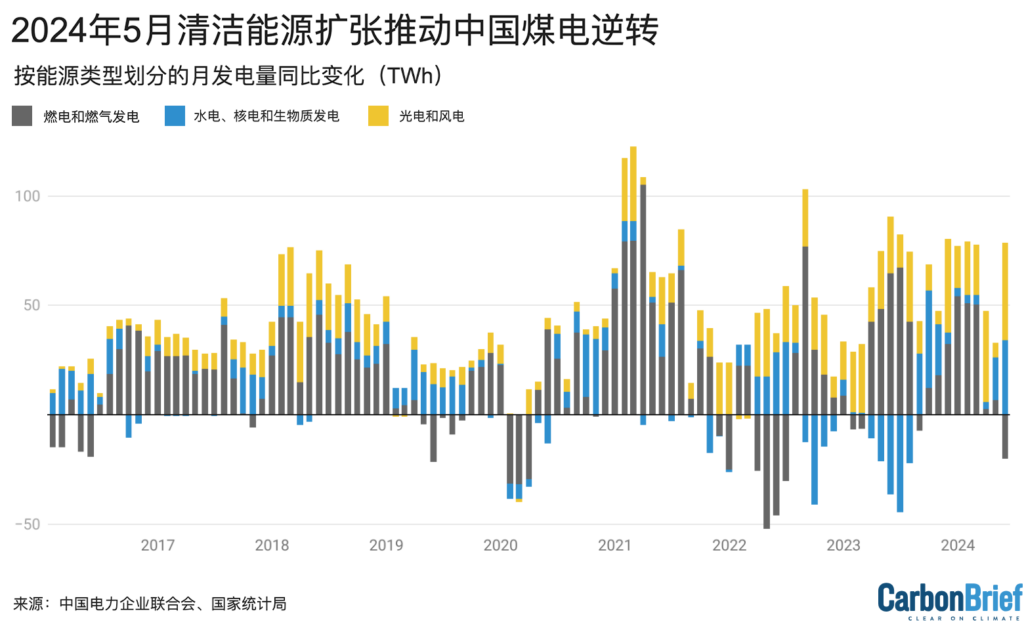
- 与此同时,清洁能源发电量创纪录地增长了78太瓦时,其中太阳能发电量创纪录地增长了41太瓦时(78%),水力发电量从早些时候干旱造成的低点回升了34太瓦时(39%),风力发电量小幅增长了4太瓦时(5%)。
- 随着清洁能源的增长超过电力需求增长,化石燃料发电量被迫回落,出现了自2019年新冠大流行以来最大的月度降幅。天然气发电量下降了4太瓦时(16%),燃煤发电量下降了16太瓦时(4%)。
- 化石燃料发电量的下降意味着电力行业的CO2排放量下降了3.6%,而电力行业的CO2排放量约占中国温室气体排放总量的五分之二,是近年来排放增长的主要来源。

从2024年3月开始,中国化石燃料和水泥行业的CO2排放量由增变减。新的研究结果表明,这一趋势仍在继续。
如果目前风能和太阳能的快速部署得以继续,那么中国的CO2排放量很可能会继续下降,从而使2023年成为中国碳达峰的一年。
月度数据差异
国家统计局每月都会公布中国按发电方式分列的发电量数据。2024年5月的数据是在近一个月前的6月中旬公布,并被广泛报道。
然而,这些数据的局限性越来越大,因为其中不包括“分布式”光伏电站,如家庭和企业屋顶上安装的光伏系统。本文的分析表明,这使得大约一半的太阳能发电总量被遗漏。
如果仔细审视用电量,国家统计局发电量数据不完整这一事实显而易见:国家能源局报告的5月份用电量为775太瓦时,而国家统计局报告的发电量仅为718太瓦时。实际上,由于发电厂和输电过程中的损耗,发电量肯定远远大于用电量。
国家统计局报告的太阳能和风能发电量似乎很少,这引起了人们的困惑,并导致有报道声称中国的风能和太阳能发电表现不佳。
中电联收集的“利用率”数据可跟踪风能和太阳能发电的表现,显示相对于最大潜力的实际出力。这些数据通常包含在国家能源局发布的月度统计数据中。
国家能源局因在5月份发布的数据中略过了利用率,这导致彭博社和路透社猜测背后原因可能是风能和太阳能数据不佳。这一猜测在中电联直接提供其数据后基本被证明不成立,因为太阳能发电利用率大幅上升;风能利用率虽然下降,但在正常的年度变化范围内。
另一个数据集追踪了由于电网灵活性低而浪费的太阳能和风能发电量的比例,结果显示两者分别小幅增长了0.8和1.7个百分点。这对电厂运营者来说是个问题,但该升幅远未达到会显著影响利用率的程度——消纳率的年际变化幅度通常超过5%。
现在有足够的数据来破解国家统计局发电数据的局限性,并描绘出中国5月份发电结构的全貌。
首先值得一提的是,国家统计局的数据是以30天为一个月进行归一化处理的,这造成了部分数据不匹配。本文剩余部分使用归一化后的30天数据。
除了使用国家统计局数据,还可根据报告的装机容量和利用率来估算太阳能和风能发电量。通过将这些估计值与其他技术的报告发电量相结合,得出总发电量为783太瓦时,同比增长8%。
报告的750太瓦时用电量(按30天为一个月进行归一化)与估计的783太瓦时发电量相符,另有4.2%的差异是由于传输损耗造成的。
目前尚无输电损耗的月度数据,但2023年的平均值为4.5%,与报告的用电量和预估发电量之间的差距非常吻合。
创纪录的结果
综合各种数据可以看出,2024年5月太阳能发电量创纪录地增长了78%,远高于不完整的国家统计局数据中29%的同比增幅。
太阳能发电装机容量增加52%至691吉瓦(gigawatt),产能利用率从16%提高到19%,太阳能发电量从2023年5月的53太瓦时增至2024年5月的94太瓦时,增加了41太瓦时,创下中国各发电方式发电量中最大的增幅。
水电发电量的增幅位居第二,虽然发电量仅增长了1%,但利用率却从31%跃升至41%,因为该行业正从2022年至2023年创纪录的干旱中恢复过来。这使得水电发电量增加了39%(34太瓦时),达到115太瓦时。
风电装机大幅增长了21%,但其利用率却有所下降,这可能是由于风力条件逐月变化所致。因此,发电量的增幅相对较小,仅为5%(4太瓦时),达到83太瓦时。核电和生物质发电的发电量也有小幅增长,但核电站的利用率从87%下降到85%。
如下图所示,清洁能源发电量总计增长了78太瓦时。这足以超过49太瓦时的需求增长。
因此,尽管燃气发电装机增加了9%,但发电量却大幅下降16%,利用率急剧下降了24%。燃煤发电装机增加了3%,但发电量却下降了3.7%,平均利用率下降了7%。需求下降可能会抑制过去两年火热的对新建煤炭产能的投资。
燃煤和燃气发电量的变化,加之燃煤电厂热耗率的轻微下降,意味着电力行业的CO2排放量下降了3.6%。
在发电量发生上述变化后,中国的发电结构在2024年5月已大幅减少了对化石燃料的依赖。如下图所示,燃煤发电份额从去年同期的60%降至53%,是有记录以来的最低份额。
与此同时,太阳能发电占比从去年同期的7%上升到12%,创历史最高纪录。其余为风电(11%)、水电(15%)、核电(5%)、天然气发电(3%)和生物质发电(2%)。

非化石能源的总体份额达到创纪录的44%,间歇性可再生能源(太阳能和风能)的比例也创下新高,达到23%。
如上图所示,尽管需求不断增长,但太阳能和风能在中国电力结构中的份额正在迅速增加。2016年5月,它们仅占总量的7%。
与此同时,2024年5月,清洁能源发电装机继续强劲增长,新增太阳能发电装机19吉瓦 ,风电3吉瓦 ,核电1.2吉瓦。
在2024年的前五个月,中国新增了约79吉瓦的太阳能和20吉瓦的风能。如下图所示,这两个新增发电装机数字比去年分别增长了29%和21%,而去年的数字已经创下历史新高。
就太阳能发电具体而言,2024年5月的月新增装机高于4月,与2023年5月相比也有同比增长。

太阳能发电量的快速增长表明,太阳能产能的激增正在提供新的电力供应,其规模足以满足中国大部分的需求增长。
这进一步印证了中国的CO2排放量正处于结构性下降时期的观点。
如果清洁能源的新增装机保持在2023年和2024年初的水平,那么CO2排放量可能会持续下降,这将确定2023年是中国实现碳达峰的一年。
由于中国将在明年初宣布新的气候目标,政府对清洁能源增长的雄心水平仍有待观察。
关于数据
风能和太阳能发电量,以及按燃料划分的火电发电量系通过将每月末的发电装机乘月利用率计算得出,数据来自万得金融终端提供的中电联报告数据。
火电、水电和核电的总发电量来源于国家统计局的月度发布数据。由于无法获得生物质发电的月度利用率数据,因此采用2023年的年平均利用率52%。
发电产生的碳排放量估算基于中国最新的2018年国家温室气体排放清单中的排放因子,以及国家能源局公布的燃煤电厂月平均热耗率,并假设燃气电厂平均热耗率为50%。



The post 分析:中国清洁能源发展使五月燃煤发电份额降至53%的历史低点 appeared first on Carbon Brief.

Patrick Schröder is a senior research fellow at Chatham House’s Environment and Society Centre.
A climate summit serious about implementation cannot afford to leave major emissions reductions off the table. Yet, that is the risk COP31 faces unless it makes reducing raw material use central to the way countries decarbonise their economies.
On the sidelines of the UN General Assembly in New York last week, COP31 host Türkiye laid out proposals to accelerate emissions cuts in the next decade. Its plans include global goals to increase the share of recycled products in material use to at least 15% (up from 6.9% in 2025) and halve waste generation by 2035.
COP31 offers an opportunity to connect efforts to improve material circularity with stronger national climate commitments and mitigation pathways. But these targets could be a lot more ambitious.
The case for circularity
The Paris Agreement cannot be delivered through cleaner electricity alone. We must also reduce the emissions that are embedded in the way we extract resources, manufacture products, build infrastructure and dispose of waste.
Circularity principles are pivotal to credible mitigation pathways: designing technologies and products to last, repairing and reusing them, and reducing demand for virgin resources.
The scale of the opportunity is striking. A recent European Environment Agency review found that adopting such principles could deliver average global emissions reductions potential of 52% in the waste sector against a business-as-usual scenario, 48% in construction and buildings, 28% in transport and mobility, 26% in industry and 24% in agriculture.
-
Recycling could meet half of Europe’s critical mineral needs by 2050
A new report by an EU-funded research project says the bloc could harness its “urban mines” to reduce its dependence on China for energy transition minerals -
China maximises battery recycling to shore up critical mineral supplies
Beijing is bracing for a tsunami of spent EV batteries by taking steps to boost recycling – a strategy that could also cut its reliance on imports of clean energy minerals -
The Canadian city betting on recycling rare earths for the energy transition
As countries scramble to secure critical minerals, Kingston’s burgeoning clean tech ecosystem is attracting startups to create circular supply chains and reduce reliance on China


These figures make a compelling case for raising circularity ambitions across the economy, offering the promise of far more than better recycling bins.
In fact, recycling minerals used in cleantech equipment, for example, illustrate the extent of the emissions savings available. The carbon footprint of minerals and metals recovered from secondary sources is up to 80% lower than those produced from new mining and processing, according to the International Energy Agency.
A major EU-funded project estimates that recovered materials could substitute up to 56% of Europe’s primary critical raw material requirements by 2050, provided they achieve the necessary quality. The main takeaway goes beyond Europe: yesterday’s products can become tomorrow’s strategic resources while mitigating climate change.
In this light, a target to increase the share of recovered material use to 15% isn’t enough.
The evidence-based Circularity Gap Report found a 17% target by 2032 is possible and could unlock additional emissions reductions amounting to several gigatonnes of CO2.
Reducing material demand
A higher circularity metric is only part of the answer, however. An economy can increase its recycling rate at the same time as extracting more primary materials if total material demand keeps growing.
The tougher issue governments need to address is identifying what reductions in primary material use are needed.
The Circularity Gap Report uses an indicative benchmark of eight tonnes of virgin materials consumed per person annually. This is already being translated into policy: Germany’s 2024 circular economy strategy aims to reduce primary resource consumption, with the German Federal Environment Agency identifying six to eight tonnes per person as an ambitious target.

Reducing primary material demand will require a closer integration of energy and resource policies. Efficient EVs charged with solar power can complement better public transport and walkable cities, while batteries designed to be repaired and reused for stationary energy storage before being recycled will reduce the materials footprint of transport and clean energy services.
Coordinated infrastructure development and urban planning can prevent unnecessary overbuild, while renovating existing building stock reduces demand for new steel, cement and aluminium, which are emissions-intensive to produce. Connecting industrial waste heat to district heating networks can further reduce energy demand and emissions.
What governments should agree at COP31
COP31 can translate this approach into three concrete commitments.
First, governments should agree a stronger circularity ambition, supported by material-footprint indicators and milestones. The presidency should seek recognition of these priorities in negotiated outcomes, alongside concrete delivery partnerships under its COP31 Action Agenda.
Second, countries should include quantified circular economy measures in their updated nationally determined contributions (NDCs) and implementation plans. Such measures should include reuse, material efficiency and circularity targets, as well as transparent estimates of emissions savings that avoid double counting across sectors. By the end of 2025, countries had developed 101 national circular economy roadmaps and action plans, yet these often remained disconnected from their NDCs.
-
Self-taught mechanics give second life to Jordan’s glut of spent EV batteries
As EV sales boom in Jordan, a lack of formal infrastructure for dealing with end-of-life batteries is leading to some innovative solutions -
Indian start-ups mine e-waste for battery minerals but growing industry has a dark side
Recycling e-waste can unlock a vast and sustainable supply of transition minerals but in India the sector relies on a neglected informal economy


Third, climate finance should support the delivery of circular solutions such as material recovery at scale, investments into circular critical mineral value chains beyond mining, developing a circular plastics economy, and designing buildings and cities that support material reuse. Developing countries need technology, affordable finance and support to deliver these ambitions, including for the informal workers whose livelihoods depend on recovering and recycling materials.
The test for COP31 is to reach an agreement that can start the transformation of our production and consumption systems and how they are financed.
A headline circularity target will achieve little without policies that address absolute resource demand and deliver measurable emissions cuts. But COP31 offers an opportunity to make circularity a central element of climate policy, with targets strong enough to matter and institutions equipped to deliver them.
The post COP31 must aim higher to cut emissions from the use of materials appeared first on Climate Home News.
COP31 must aim higher to cut emissions from the use of materials
An exceptional El Niño is building. The World Meteorological Organization (WMO) says it has intensified to very strong levels and is likely to last at least through February 2027. If its current trajectory holds, it could become stronger than anything seen since WMO monitoring began four decades ago.
That is bad news for agriculture. El Niño – a naturally occurring weather phenomenon – can scramble rainfall patterns across the world, bringing drought to some regions and floods to others. And this time it is unfolding against the backdrop of a significantly hotter climate, with farmers already contending with unreliable growing seasons, extreme heat and less predictable rainfall because of global warming.
El Niño expected to bring next record-hot year as soon as 2027
We are seeing the consequences already. In Sri Lanka, drought linked to El Niño has dried wells and reservoirs and cut into crops and farmer incomes. Indonesia is experiencing its worst wildfire season in 11 years, with prolonged drought and extreme heat exacerbated by El Niño. And in Peru, authorities are preparing for the opposite extreme: intense rains, flooding and landslides which the national civil-defence agency says could affect around 1.2 million people.
These impacts will multiply as El Niño intensifies.
And yet, just as the risks to food production are rising, the money available to help farmers withstand them is shrinking.
10% funding decline in 2024
A forthcoming analysis from the Food and Agriculture Organization (FAO) shows that climate-related development finance for agrifood systems is moving in the wrong direction. In 2024, the latest year for which data is available, it fell by 10 percent compared with a 2 percent overall decline. The sectors that put food on our tables — crops, livestock, forestry and fisheries — received just 5 percent.
Yet this is precisely the moment when climate investment in agriculture needs to grow, not shrink. It can help communities adapt, build resilience and protect food security, while unlocking larger flows of public and private finance. Agriculture feeds us, supports the livelihoods of well over a billion people, and is often the first sector hit by drought, floods and extreme heat. Cutting that investment now is a false economy.
One failed harvest can plant the seed for the next crisis, forcing farmers to eat the seed they have saved for planting, sell livestock or tools, or take on debt. It can also deepen food insecurity, disrupt supply chains and drive up prices, showing up months later in supermarket aisles far away.
The Central American Dry Corridor, stretching through much of the region, shows both how exposed farmers are, and what investment can do. Based on an analysis of 41 years of satellite observations, FAO finds that some crop and pasture areas there face more than a 50 percent chance of agricultural drought over the coming months.
About half of Central America’s 1.9 million producers of maize, beans and other basic grains live in the Dry Corridor. Many grow food both for sale and for their own families. When a harvest fails, they lose both income and dinner.
El Salvador project conserves water and soil
In El Salvador, which lies within the Dry Corridor, more than 50,000 farmers have adopted practices to better withstand drought and increasingly unreliable rainfall through RECLIMA, a project financed by the Green Climate Fund and implemented by FAO in partnership with the government of El Salvador. It has substantial national co-financing, including from the country’s Environmental Investment Fund.
El Niño can intensify El Salvador’s annual mid-season dry spell, known as the canícula, turning it into a longer, harsher drought just as maize needs water most.
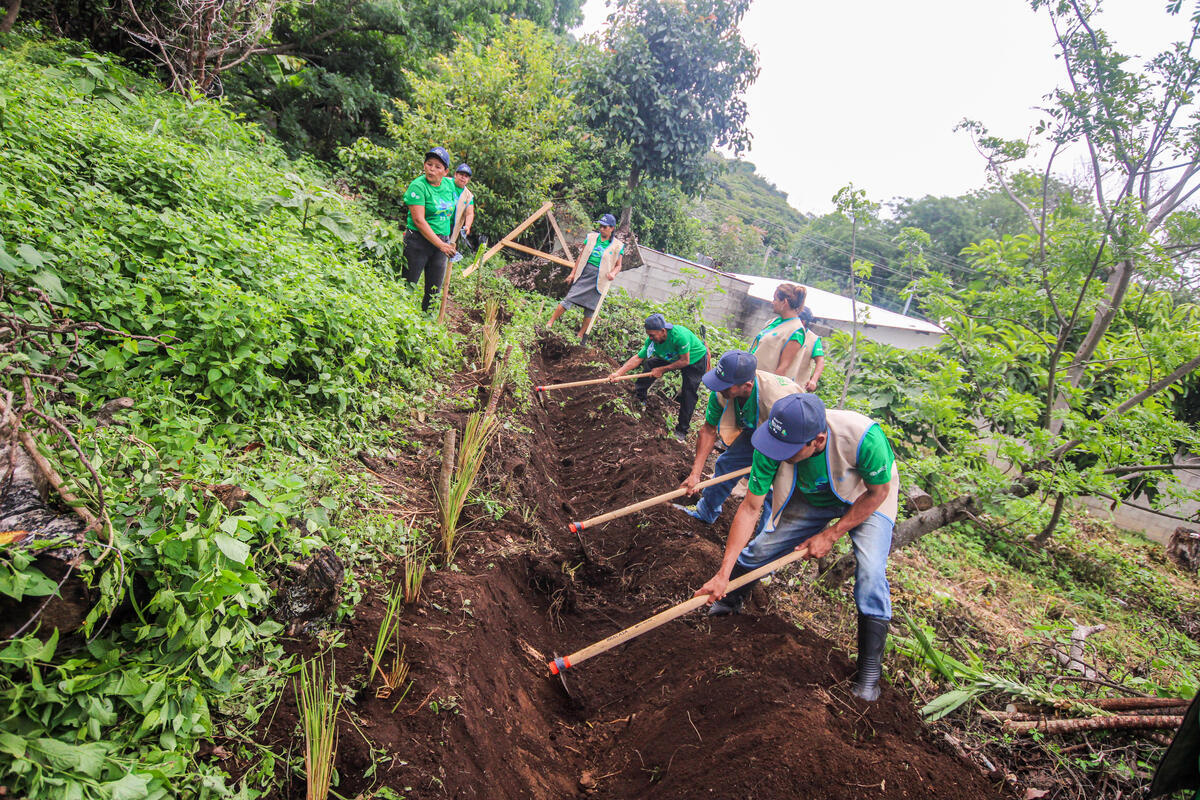
For María Cristina Corvera de López, a second-generation farmer in rural Nahualapa, adapting means changing how every drop of rain is captured and used. She plants trees alongside her crops to provide shade and minimise evaporation and uses simple irrigation channels and a homemade drip system to conserve water. Instead of burning stalks, leaves and husks after harvest, as generations before her did, she turns them into mulch to hold moisture in the soil.
“The effects of climate change are a constant challenge,” she says. But the new techniques have made her farm more resilient to El Niño as well. Where she once harvested about 50 bags of maize per acre, she now gets around 80, even during droughts. It’s enough to feed her family and sell the surplus.
Managing risk now cuts future costs
Together, these adaptations can mean the difference between losing a crop and getting through a dry season with enough food, seed and income to plant again. They are also the result of climate finance invested before disaster strikes.
RECLIMA shows what that kind of adaptation investment can buy. Adaptation accounted for 45 percent of climate-related development finance to agrifood systems in 2024, and multilateral development banks are directing more agricultural finance towards resilience. That shift reflects a growing recognition that adaptation is a form of risk management, not just a development cost.
We need much more of it. The same investments that help farmers withstand El Niño also enable them to adapt to a hotter, more unpredictable future. Cutting investment in the people who produce our food just as climate risks intensify does not save money. It simply pushes a much larger bill into the next harvest, the next food crisis, and the next El Niño.
The post As El Niño intensifies, we should be investing more in the world’s farmers appeared first on Climate Home News.
As El Niño intensifies, we should be investing more in the world’s farmers
An area of Amazon forest roughly the size of the US state of New Jersey has remained standing due to Luiz Inácio Lula da Silva’s leadership of Brazil, according to Carbon Brief analysis.
Lula beat Jair Bolsonaro in the 2022 election to become president of the nation that is home to nearly 60% of the Amazon rainforest.
Forest loss surged during Bolsonaro’s far-right presidency and dropped sharply under the left-wing Lula, with Amazon deforestation likely to hit its lowest level on record this year.
Now, as another presidential election approaches, Lula is facing off against Bolsonaro’s son, Flávio Bolsonaro, whose “anti-environmental” policies are similar to his father’s.
Carbon Brief’s analysis suggests that at least 20,000 square kilometres (km2) of deforestation has been avoided since Lula took office and prioritised Amazon protection.
The analysis is based on modelling by an international research team of an alternative scenario in which Brazil’s flagship forest code legislation was not enforced – a proxy for Jair Bolsonaro’s leadership.
Experts tell Carbon Brief that this estimate is likely “conservative” and that actual deforestation under Bolsonaro could have been “much higher”.
With Lula and Flávio Bolsonaro tied in the polls, the upcoming election is expected to significantly shape the level of environmental action in the world’s fourth-largest emitter, whose emissions are largely driven by deforestation.
‘Brazil is back’
When Jair Bolsonaro was president of Brazil between 2019 and 2022, he championed the nation’s powerful agribusiness sector and oversaw an unprecedented increase in Amazon deforestation.
Bolsonaro weakened regulations, slashed federal agency budgets and empowered illegal activities in the Amazon, while attacking Indigenous and environmental groups.
This meant that the forest code – Brazil’s flagship legislation that requires landowners to preserve and restore forest on their property – was not properly enforced.
After Lula’s presidential victory in 2022, he promised to target “zero deforestation” by 2030, telling the COP27 UN climate summit that “Brazil is back”.
Lula rolled back Bolsonaro’s wave of deregulation and reinstated a deforestation “action plan”. Led by celebrated environmentalist Marina Silva, the environment ministry scaled up enforcement and policing activities in the Amazon.
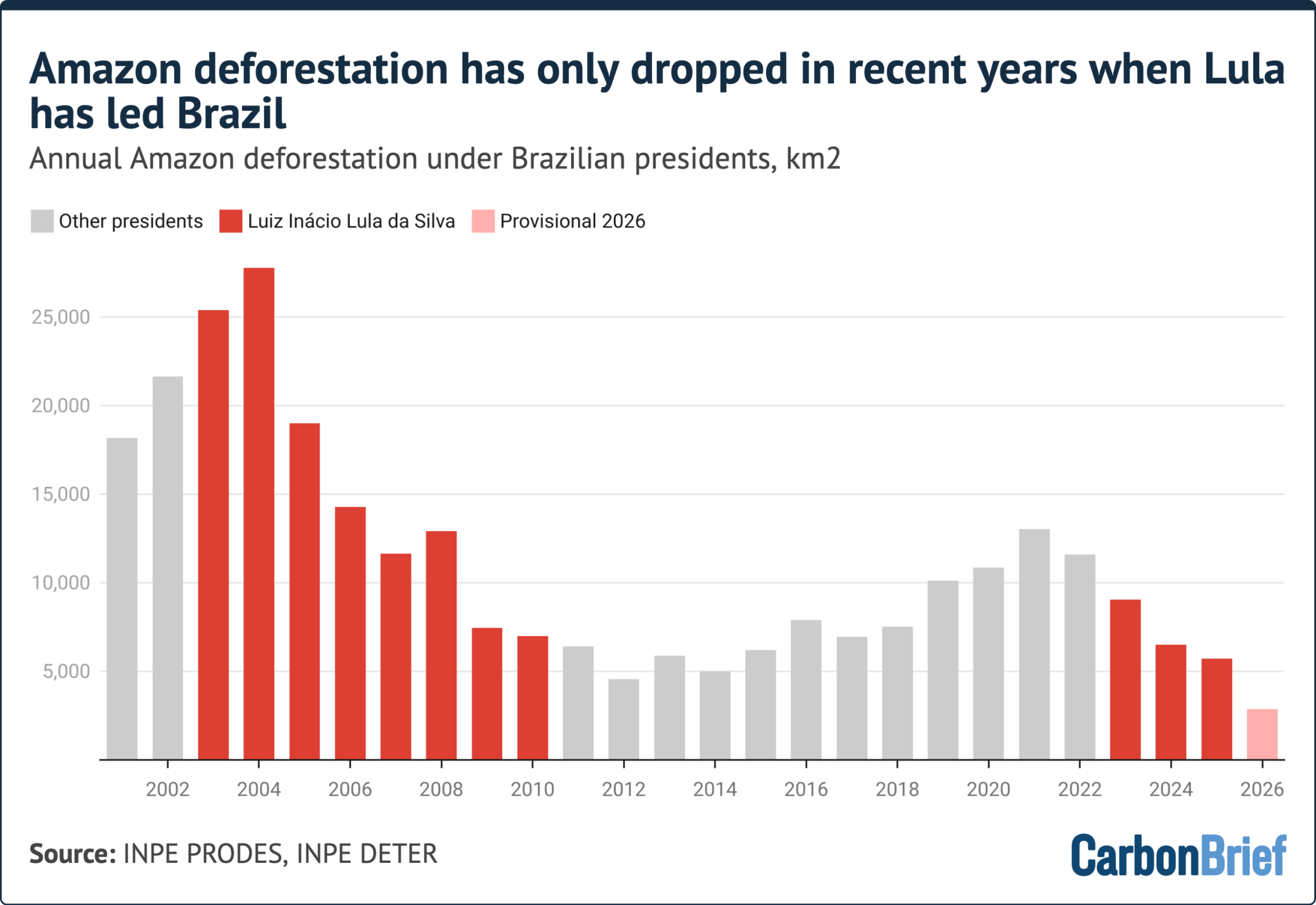
As a result, annual deforestation in the Amazon has more than halved from 11,594km2 per year in 2022 to 5,731km2 in 2025.
Data from August 2025 to July 2026 – the timespan used in government records – is yet to be released, but preliminary satellite alerts put the deforestation figure at 2,874km2.
While the final figure is likely to be higher, experts still think Amazon deforestation in 2026 could hit its lowest level since records began in 1988.
New Jersey-sized forest
Compared to a scenario in which Bolsonaro won in 2022, Carbon Brief analysis suggests that at least 20,000km2 of Amazon forest remains standing today due to Lula’s leadership.
This area – roughly the size of Wales, Belize, Slovenia or the US state of New Jersey – is indicated by the grey area in the chart below.
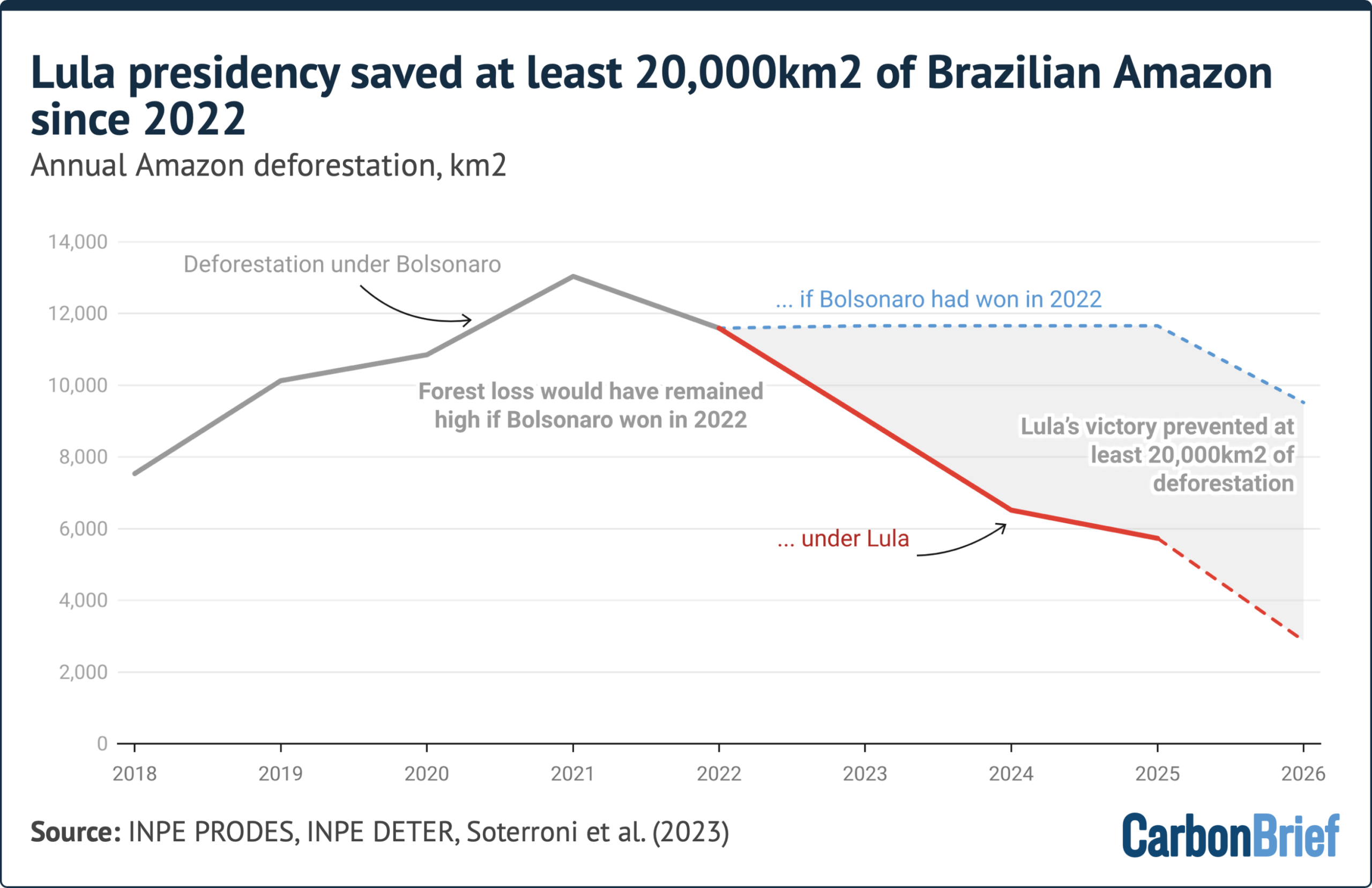
This analysis is based on a 2023 study on the role of nature-based solutions in Brazil’s pathway to net-zero emissions. This was a refined update of a 2018 study that used the same GLOBIOM-Brazil model, from researchers at the University of Oxford, the International Institute for Applied Systems Analysis and Brazil’s National Institute for Space Research (INPE).
It is based on a comparison of forest code implementation with a “baseline” scenario in which the code is not enforced, reflecting the kind of weak governance seen under the Bolsonaro administration. (See Carbon Brief’s 2022 article for more details of this modelling.)
Dr Aline Soterroni, a University of Oxford researcher who led the 2023 analysis, tells Carbon Brief that the reversal seen under Lula “shows how quickly deforestation can respond to political will”.
However, she stresses that the modelling of the “no forest code” scenario is “relatively conservative”, with deforestation remaining high but not rising.
Deforestation in this scenario – used here as a proxy for a Bolsonaro election win – is tempered by slower demand growth for Brazilian beef and soy, says Soterroni. She notes that the scenario also does not capture the potential for illegal forest clearing in response to weak governance.
Indeed, some experts anticipated in 2022 that a Bolsonaro victory would send deforestation rates rising to near-record levels.
Claudio Angelo, international policy coordinator at Brazil’s Climate Observatory, tells Carbon Brief that if Bolsonaro had won in 2022, “we have reason to believe [this would have resulted] in much higher rates than during his first term”.
Angelo says the “political signal” would likely have driven an “explosion of wildcat mining” and illegal deforestation in the Amazon. He also points to efforts – including by Flávio Bolsonaro – to formally dismantle the forest code in the Brazilian congress, during Jair Bolsonaro’s first term.
Soterroni notes that deforestation rates did not immediately drop following Lula’s election, as suggested by modelling of a full “forest code compliance” scenario. She says this reflects the “gradual and imperfect process” of restoring and enforcing the law.
Nevertheless, she tells Carbon Brief:
“The key message from our modelling is the contrast between these trajectories: weak environmental governance keeps deforestation substantially higher than full implementation of the forest code. That message remains relevant today.”
Election significance
With Jair Bolsonaro in prison for plotting a coup after losing the 2022 election, his son Flávio Bolsonaro, a senator for Rio de Janeiro, is standing against Lula in the upcoming contest for president.
There are 13 candidates, but Flávio Bolsonaro and Lula are by far the frontrunners and are currently neck-and-neck in opinion polls.
If Lula wins, experts say he is likely to continue with the “zero deforestation by 2030” agenda that has already had a pronounced impact on forest loss.
As the chart below shows, periods when Amazon deforestation fell in recent history all occurred during Lula’s three terms as president.
In contrast, experts say Flávio Bolsonaro, a climate sceptic who has indicated he will continue his father’s political agenda and favour agribusiness and mining, will likely drive a surge in deforestation. Angelo tells Carbon Brief:
“At the risk of sounding alarmist, I’ve been saying that Lula’s re-election is the only thing standing between us and a wide destruction of the Amazon.”
A Bolsonaro win would be a “tremendous disaster”, says Dr Patricia Pinho, deputy science director at the Amazon Environmental Research Institute, adding:
“I don’t think we can afford four years of increasing deforestation [and] violence against Indigenous peoples.”
Dr David Lapola, an ecologist focused on Amazon research at the University of Campinas in Brazil, says he believes deforestation “would certainly rise” and Brazil’s climate and deforestation goals “would be thrown in the trash bin”. He tells Carbon Brief:
“The Bolsonaro administration in the 2019-2022 period showed that the deconstruction of environmental policies and institutes can be done very, very quickly.
“In a matter of a few months, they can destroy what has been constructed over decades of environmental policy and activism in Brazil.”
‘Greenest’ policies
Lula has the “greenest” policy proposals of Brazil’s six top-polling presidential candidates, according to analysis by the Climate Observatory.
The analysis identifies 16 “positive and detailed” environmental commitments in Lula’s proposals, including reaffirming his “zero deforestation by 2030” goal.
Flávio Bolsonaro, on the other hand, has one positive environmental commitment and seven “clearly anti-environmental” proposals.
The right-wing politician has committed to zero “illegal” deforestation by 2029. However, he has also previously led an attempt to change the forest code, opening up large tracts of previously out-of-bounds forest for legal clearance by extractive industries.
Given this, Angelo tells Carbon Brief that he is sceptical about the 2029 pledge.
“The only way you can trust him on this is to think that he is going to revoke the forest code and make all illegal deforestation legal.”

Lula is also the only major candidate to list a clear target for cutting national emissions, sticking with Brazil’s existing goal to cut emissions by 59-67% by 2035, compared to 2005 levels.
Overall, the Climate Observatory notes that climate change and environmental issues “are off the radar for most candidates”, who are instead focusing on the economy and security issues.
Pinho adds that deforestation and the Amazon have not been at the “forefront” of this election, compared to 2022.
If Bolsonaro wins, up to 95% of the Amazon would fall under the leadership of right-wing national governments – including those in Bolivia, Colombia, Ecuador and Peru – reported Mongabay. It noted that presidents in all these nations “explicitly favour agribusiness and mining over environmental conservation”.
If no candidate receives a majority of votes in the first round of Brazil’s election on 4 October, a runoff will take place on 25 October, as has happened at every presidential election since 1998.
Soy moratorium and Brazilian congress
Other factors will also play a role in future deforestation in Brazil, regardless of the next president.
One is the effective end of the Amazon soy moratorium. This is a voluntary agreement signed by companies committing to not buy soya beans grown on land in the Brazilian Amazon that was deforested after 2008.
Conservation organisation WWF’s international director general, Kirsten Schuijt, previously described it as the “most impactful voluntary supply chain policy ever implemented”.
However, major grain traders withdrew from the agreement earlier this year, effectively bringing it to an end. Pinho describes this move as a “huge destruction” of Brazil’s environmental protections.
Research shows the moratorium prevented around 18,000km2 of deforestation in its first decade of operation from 2005-16.
In contrast, a 2026 study estimated that the end of the moratorium could result in 14,000km2 of additional deforestation in the Amazon by 2036.
Alongside choosing a new president on 4 October, Brazilian voters will elect state governors and members of congress, which will also factor into future environmental impacts.
Right-leaning parties, including the far-right Liberal Party linked to the Bolsonaros, currently hold half the seats of the two chambers of congress.
This has led to conflict between lawmakers and Lula. For example, in 2025, congress bypassed Lula’s veto of several aspects of a controversial piece of legislation dubbed the “devastation bill”.
Pinho says that the potential for a right-wing congress and president would be “devastating for the environmental and climate agenda”.
Lapola notes that a Flávio Bolsonaro presidency “would consolidate the view in Brazil that environmental protection is solely a matter of political preference, and not a crucial need of all people”. He adds:
“Land pillage, destruction of precious biodiversity and scorning of Indigenous peoples simply cannot be a nation’s project in the 21st century. We have got to be smarter than that, for sure.”
related
Q&A: What change of power in Colombia could mean for world’s fossil-fuel transition

Brazil’s biodiversity pledge: Six key takeaways for nature and climate change

COP30: Could Brazil’s ‘Tropical Forest Forever’ fund help tackle climate change?
Guest post: How Caribbean states are shaping climate legislation
The post Analysis: Lula presidency saved at least 20,000km2 of Brazilian Amazon since 2022 appeared first on Carbon Brief.
Analysis: Lula presidency saved at least 20,000km2 of Brazilian Amazon since 2022



-
Climate Change1 year ago
Guest post: Why China is still building new coal – and when it might stop
-

 Greenhouse Gases2 years ago
嘉宾来稿:满足中国增长的用电需求 光伏加储能“比新建煤电更实惠”
-
Greenhouse Gases1 year ago
Guest post: Why China is still building new coal – and when it might stop
-

 Climate Change2 years ago
嘉宾来稿:满足中国增长的用电需求 光伏加储能“比新建煤电更实惠”
-

 Renewable Energy11 months ago
Sending Progressive Philanthropist George Soros to Prison?
-
Climate Change2 years ago
Bill Discounting Climate Change in Florida’s Energy Policy Awaits DeSantis’ Approval
-
Greenhouse Gases1 year ago
嘉宾来稿:探究火山喷发如何影响气候预测
-

 Climate Change2 years ago
Analysis: China’s CO2 falls 1% in Q2 2024 in first quarterly drop since Covid-19