

The New York Solar Energy Industries Association (NYSEIA) has released “20 Gigawatts by 2035: Raising New York’s Distributed Solar Goal,” a policy report that calls on New York state lawmakers to raise the state’s distributed solar goal to 20 GW by 2035.
Under New York’s current climate and energy transition plan, the state aims to install 10 GW by 2030.
The roadmap outlines a plan of action to double down on one of the bright spots in New York’s renewable energy transition: distributed solar. Consisting of rooftop installations on homes and businesses and small-scale ground-mounted projects in local communities, distributed solar represents more than 90% of the state’s current solar capacity. New York added more than 800 MW of distributed solar capacity last year alone and is on track to surpass 6 GW by the end of 2024, one year ahead of schedule.
“As New York struggles to meet its ambitious renewable energy mandates, legislative leaders and regulators must take decisive action,” says Noah Ginsburg, executive director of NYSEIA. “Scaling up distributed solar deployment will deliver cost-effective progress toward New York’s overall climate goals while delivering immense benefits to New York’s environment, economy, and working families.”
As the roadmap outlines, solar deployment in New York has been growing at a rapid rate over the last decade, averaging 31% annual growth from 2013-2022. This rapid growth was driven by New York’s nation-leading community solar program. New York faces new challenges deploying rooftop and community solar, but in order to reach 20 GW of distributed solar by 2035, the state will need to sustain just 7-10% annual growth in deployment. This growth can be enabled with smart state-level policies and fueled by federal incentives that are available for the next decade due to the Inflation Reduction Act.
The roadmap lays out policy reforms needed to realize the potential of distributed solar, including:
- Interconnection reform and flexible interconnection to lower clean energy costs and accelerate deployment;
- Streamlined permitting for rooftop and community solar;
- Virtual power plant programs and dynamic rate design to compensate distributed solar and energy storage for exporting power when and where it’s needed;
- Continued investment in New York’s nation-leading community solar programs to provide even more direct bill savings to low-income New Yorkers
For more information on NYSEIA’s plan, download the full roadmap here.
The post NYSEIA Pushing for 20 GW of Distributed Solar by 2035 appeared first on Solar Industry.

Germany Guarantees Offshore Prices, England Wind Surge
Allen covers Germany’s new offshore wind price guarantee, England’s onshore wind revival, wind for Korean chip plants, and Aeris debt trouble.
The Uptime Wind Energy Podcast is brought to you by Weather Guard Lightning Tech, creators of the StrikeTape Ultra LPS retrofit. Subscribe to Uptime’s Substack newsletter. And check out Rosemary’s “Engineering with Rosie” Youtube channel. Have a question we can answer on the show? Email us!
Good Monday everyone.
Last summer … Germany held an auction for new offshore wind capacity. Not a single company bid. Zero. This week Berlin put forward a new law to fix that. The old system asked developers to pay for the right to build in the North Sea and the Baltic. TotalEnergies and BP bid billions of euros … then walked away. So the new plan introduces contracts for difference. Build the farm … and the government backstops the price of electricity. The offshore wind association wants abandoned projects … up to sixteen gigawatts … put back on the auction block under the new rules. That is fifty billion euros worth of wind farms waiting for a second chance. The cabinet vote could come as early as next week.
Stay in Europe but head west. England just posted its highest number of onshore wind applications in a decade. About forty-five proposals. Before Labour lifted the Conservatives’ ban two years ago … applications averaged one megawatt a month. Now they are running at thirty-six megawatts a month. But here is the catch. The average English wind farm has just two turbines. Eight megawatts. In Scotland … the average is nine turbines and fifty-nine megawatts. England is back in the game. It is just playing small.
Now cross the Pacific. South Korea selected Pacifico Energy Korea to develop the Jindo offshore wind cluster. Two-point-one-three gigawatts. That is the second and third phases of a broader three-point-two-gigawatt project off the southern coast. And here is the connection worth noting. The region is also building the Honam Semiconductor Cluster … a major chip fabrication site. Semiconductor fabs need enormous and reliable power. This wind cluster is being positioned as the energy source to feed it. Wind as baseload for chip manufacturing. That is a new kind of offtaker.
Now head to Brazil. Aeris Energy makes wind turbine blades. This week the company told its creditors it needs to restructure again. Roughly three hundred and thirty million dollars in debt. Aeris already restructured last year. But revenue fell forty-eight percent in the first half of this year. The company lost roughly fifty-three million dollars. It tried to find a buyer. No one came forward. Remember TPI Composites filing Chapter Eleven in Houston last year? The independent blade business keeps getting harder.
Back to North America. In Nova Scotia … Port Hawkesbury Paper is spending four hundred and fifty million dollars on thirty-one Nordex turbines. They will be the biggest onshore turbines in North America. Each one … six-point-nine megawatts. And they carry electrothermal technology that prevents ice from forming on the blades. They operate down to minus thirty Celsius. Last January … Nova Scotia’s existing turbines dropped from three hundred and fifty megawatts to seventy-five in a single evening when the cold hit. For anyone building in northern climates … cold-weather performance is no longer optional.
And in Minnesota … Xcel Energy broke ground on two projects this week. A hundred-and-eighty-five-mile transmission line that can carry four thousand megawatts of new wind and solar to the grid. And alongside it … a four-hundred-and-twenty-megawatt natural gas peaking plant in Lyon County for the days when the wind stops.
So what does this week tell us? Germany’s auction reform is the story to watch. If Berlin gets contracts for difference right … sixteen gigawatts of stalled projects could come back to life. England proves that removing a political ban releases demand … but the scale gap with Scotland shows that planning culture matters as much as planning law. The blade supply chain is still under stress. If you are in procurement … know your supplier’s balance sheet. South Korea is tying offshore wind directly to semiconductor manufacturing. That kind of industrial offtaker changes the project finance equation. And from Minnesota to Nova Scotia … the message is the same. Transmission … peaking power … cold-weather reliability. The turbine is the easy part. The system around it is where the money and the risk still live.
And that is the state of the wind industry for the 24th of August 2026.
Join us for the Uptime Wind Energy podcast tomorrow.
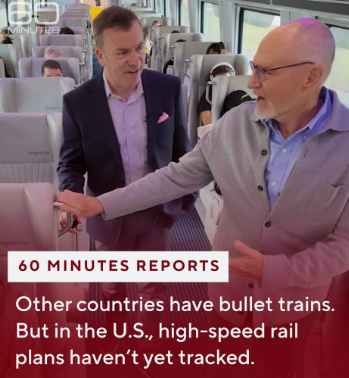 The lead story on the long-running CBS show “60 Minutes” tonight proposed to answer how is possible that the rest of the developed world, as well as communist dictatorships like China, offer their citizens and visitors the opportunity to travel around the land speeds of hundreds of miles per hour, where such projects in the U.S. have never gotten close even the feeblest level of success.
They imply that the answer lies mainly in government mismanagement, outrageous over-promises for political purposes, and various forms of malfeasance.
In the process of creating 2GreenEnergy, I coincidentally tripped across a story that explains this far more convincingly.
I happened to interview a very bright and dedicated young man in the Texas state legislature about 20 years ago, who told me that he and his team had done a great deal of research and legal work surrounding connecting Dallas, Austin, Houston, and San Antonio with highspeed rail, and had offered their plans to the public for comment.
One of the first comments came in the form of a phone call he received from Herb Kelleher, then-CEO of Southwest Airlines, which operated out of airports in those four cities. He said, “Normally, tickets between any of these cities are priced at $80 each. If you drive your first spike, I’ll reduce that price to $8. Perhaps with free parking. Let’s see how that works out for you.”
What I inferred from the interview I conducted with the young, perhaps naive Texan who was bold enough to propose low-carbon mass transportation to the Lone Star state, was this: money and power talk here, and nothing else matters.
Yet that’s not true elsewhere around the globe.
Had Kelleher publicly taken this position in China and pushed after it, he would have likely been executed by firing squad. While no one wants to see the threat of violence as public policy, we all must admit that the Chinese are quite effective in carrying out their plans, regardless of what those plans might be.
In Europe and the rest of the OECD nations, the situation is, fortunately, far more nuanced and less savage. People are highly educated, and they understand the need for decarbonizing their electric grid and transportation sectors. Having some billionaire jackass strong-arm their culture would not have enjoyed any success there either.
Many things in these parts of the world of the world get done simply because they are right, as mystifying as that seems to us in the U.S.
 Today, I met a professional driver for the film-making industry whose principal focus is stunt-work.
Somehow, we got to talking about the many movie stars for whom he’s worked over the years, and how pleasant most of them are to be around.
He started by mentioning Kevin Costner.
“I really like him,” I said. Please tell me he’s not an asshole.”
“Oh no; he’s a prince,” my new friend replied. “I also do the driving for Jay Leno’s show about his massive garage full of vintage cars. He’s even kinder. When we’re having lunch between shootings, he’ll often come up our table and ask if we need another Coke or two. Maybe desserts?”
We eventually got around to the stars who are, in fact, assholes.
“I drive in Lethal Weapon 4,” he began.
“Let me make a stab. Mel Gibson?”
Yes. One of the most hateful, most miserable people you could meet in 100 lifetimes.”
“That’s the rumor everyone’s heard,” I responded. “It’s weird how people who have more money that God feel the need to be such terrible people.”
“Well, my theory is that money doesn’t change people; it only amplifies them.”
I remind him of Henry Ford’s observation above.
Great conversation.



-
Climate Change1 year ago
Guest post: Why China is still building new coal – and when it might stop
-
Greenhouse Gases1 year ago
Guest post: Why China is still building new coal – and when it might stop
-

 Greenhouse Gases2 years ago
嘉宾来稿:满足中国增长的用电需求 光伏加储能“比新建煤电更实惠”
-

 Climate Change2 years ago
嘉宾来稿:满足中国增长的用电需求 光伏加储能“比新建煤电更实惠”
-
Climate Change2 years ago
Bill Discounting Climate Change in Florida’s Energy Policy Awaits DeSantis’ Approval
-

 Renewable Energy10 months ago
Sending Progressive Philanthropist George Soros to Prison?
-
Greenhouse Gases1 year ago
嘉宾来稿:探究火山喷发如何影响气候预测
-

 Carbon Footprint2 years ago
US SEC’s Climate Disclosure Rules Spur Renewed Interest in Carbon Credits