

Within the ocean’s vast expanse lie immense reservoirs of carbon – surpassing those found in either the atmosphere or the land.
The ocean actively captures and incorporates carbon through various natural mechanisms, locking in a significant portion that would otherwise circulate within the Earth’s systems, thereby functioning as a continuous carbon sink.
This crucial role mitigates climate change by reducing the amount of carbon which ends up in the atmosphere. If the ocean remains as a net carbon sink, it can aid in offsetting ongoing emissions and slowing global warming.
Unfortunately, a longstanding misconception persists that the ocean has an infinite resilience to human exploitation and negligence – likely stemming from the fact that the consequences of our actions are obscured beneath the surface.
Unsustainable use of the ocean’s resources – such as through overfishing – coupled with warming and acidification progressively erode the ocean’s capacity to regulate carbon and heat and its ability to sustain essential resources and services.
Consequently, rates of carbon sequestration are weakening and the vast carbon reserves held within marine ecosystems are increasingly susceptible to release.
This guest post lays out the climate opportunities presented by “blue carbon” and the challenges these ecosystems face.
Blue carbon is a term that refers to carbon captured by the world’s ocean and coastal ecosystems that has potential to be conserved or enhanced. Blue carbon is stored in vegetated coastal and marine ecosystems such as seagrass, mangroves and salt marshes.
The opportunity of coastal ecosystems
Coastal ecosystems – particularly vegetated ones, such as mangroves, seagrasses and salt marshes – are among the most crucial marine systems for storing carbon. Like plants on land, marine vegetation absorbs CO2 through photosynthesis. Because their waterlogged soils are low in oxygen, the carbon stored there can be locked away for centuries.
Despite only occupying approximately 0.5% of the ocean, these ecosystems boast remarkable carbon sequestration capabilities, contributing more than 50% of total carbon buried in marine sediments.
However, these vital ecosystems also face relentless human-caused pressures, from runoff of nutrients and sediments to urban expansion. They are being destroyed at an alarming pace – an average of 2% loss per year for mangroves – and are among the most threatened ecosystems on the planet.
Nevertheless, amidst this threat lies an opportunity: by reversing the conditions that are causing their decline, we can restore lost ecosystems and harness their potential as carbon sequestration hotspots once more.
The chart below shows the annual carbon storage potential of coastal ecosystems around the world, with yellow and light green indicating low storage potential and darker blues indicating high storage potential. The US, Mexico, Australia, Indonesia and Mexico stand out as countries with particularly high storage potential.

Managing coastal vegetated ecosystems to enhance carbon sequestration, often referred to as “blue carbon”, represents a valuable nature-based strategy for mitigating climate change.
While the amount of carbon that is offset through these methods is estimated to be at least an order of magnitude below other mitigation approaches – such as ocean alkalinisation and direct carbon capture and storage – they have additional benefits.
These ecosystems also enhance adaptation by stabilising coastlines, safeguarding against erosion and storms, enhancing water quality and nurturing marine life – thus promoting biodiversity through the provision of shelter, food and nursery grounds.
Climate and biodiversity
Blue carbon is a prime example of how climate change and the alarming decline in global biodiversity are connected.
Initiatives focused on blue carbon restoration – such as the “Mangroves for Coastal Resilience” project in Indonesia, the largest such initiative in the world – not only enhance carbon sequestration, but also reverse habitat loss and bolster biodiversity. Safeguarding marine biodiversity can also help secure the long-term well-being and prosperity of people whose lives and livelihoods are tightly linked to the oceans.
For example, declines in marine biodiversity undermine ecosystem resilience, heightening vulnerability to environmental disturbances and impacting economies reliant on marine resources. Loss of species degrades the food webs underpinning fisheries, jeopardising food security and livelihoods.
Furthermore, biodiversity loss directly compromises human health by fostering the emergence of zoonotic diseases that pass from animals to humans, diminishing water quality and impeding the exploration of new pharmaceuticals and treatments.
Protecting communities
Coastal restoration projects are already being carried out around the world, from small, local projects to larger initiatives.
They also encompass a range of activities, from planting new mangrove trees to managing tidal flows.
There are several crucial factors that demand careful consideration before implementing such a project.
Among these is the need to prioritise the protection of intact ecosystems. By safeguarding these areas, we can prevent the loss of carbon they have already sequestered and sidestep the time lag associated with re-establishing vital ecosystem services following habitat restoration.
Additionally, it is imperative to address the underlying pressures contributing to ecosystem loss, such as sewage discharge and agricultural runoff.

Restoration efforts must also be designed to withstand potential future challenges, such as changing land-use patterns and the projected impacts of climate change. Proactive measures to safeguard and restore coastal ecosystems should account for these complex and dynamic factors to ensure their long-term success and resilience in the face of ongoing environmental changes.
Local engagement and support for blue carbon initiatives are also needed because coastal communities often directly interact with these ecosystems for livelihoods, fishing, tourism and protection from natural disasters. Engaging these communities ensures that conservation efforts are sustainable. Additionally, tapping into the knowledge and expertise of local communities about coastal ecosystems is essential for informed decision-making.
Integrating carbon sequestration goals with other conservation and management objectives, such as sustainable fisheries and coastal resilience, is possible by empowering local communities to lead blue carbon initiatives. This can help ensure social equity, address economic opportunities and reduce conflicts over resource use.
Ultimately, garnering people’s buy-in for blue carbon solutions is essential for their effectiveness, sustainability and equitable distribution of benefits.
Considering marine sediment
Blue carbon “solutions” can be regarded as any intervention which aims to enhance the ocean’s natural capacity to store and sequester carbon.
As such, one might consider the management of commercial species and natural populations to increase the biomass of, and thereby carbon contained in, marine organisms. Managing interactions with the seabed can also be an important blue carbon solution.
Recent estimates suggest marine sediments are the largest store of organic carbon on the planet. Therefore, activities which disrupt them, such as bottom trawling or deep-sea mining, may be stirring up this sediment and leading to carbon being released back to the atmosphere.
Although the full picture has yet to emerge, examining the impacts of where and how trawling is conducted allows us to make choices informed by all of the potential impacts. And before deep-sea mining activities are further scaled up, a more comprehensive understanding of their impacts is vital.


The post Guest post: The role of ‘blue carbon’ in addressing climate change appeared first on Carbon Brief.
Guest post: The role of ‘blue carbon’ in addressing climate change

Climate Change
As science comes under attack at UN talks, climate movement splits over how to respond
With June’s UN climate talks inching towards gridlock, a group of diplomats calling themselves “Friends of Science” issued a stark warning: climate science was under attack in Bonn.
The coalition, spanning the world’s richest to its most vulnerable nations, pointed the finger primarily at those who think “science threatens their economic prospects” – a thinly-veiled reference to fossil fuel-dependent states accused of casting doubt on long-held scientific tenets in the UN climate process.
Fiji’s lead negotiator, Sivendra Michael, went still further. He denounced what he called “a very polluted narrative” taking hold outside the negotiating rooms and singled out ECO, a daily newsletter on the talks produced by Climate Action Network (CAN) International, for overlooking the issue.
“They are representing developing countries, but they are not representing us,” Michael said. His words hinted at how a rift between governments over the science of global warming has created tensions inside the climate movement.
Watchers of the UN climate talks have told Climate Home News there is growing unease over where the world’s most influential coalition of climate NGOs stands in an increasingly heated debate about how scientific messages produced by the Intergovernmental Panel on Climate Change (IPCC) are crafted and turned into global climate policy.
UN sets out narrow path back to 1.5C warming after inevitable overshoot
CAN’s international leadership has publicly backed a line of argument, championed by some big emerging economies including India, that questions how fair and equitable the models underpinning the work of the IPCC – the UN’s climate science body – are because they are dominated by research from the Global North.
But some climate activists, including from nations on the frontline of the climate crisis in the Pacific, are increasingly disappointed by CAN’s silence in a connected row over whether the IPCC’s forthcoming assessment report should be finished in time to inform the next UN scorecard of global climate action.
Over the last two years, India, Saudi Arabia, China, Russia and Kenya have pushed back against attempts by a large coalition of nations to align the IPCC’s AR7 report timeline with the second stocktake of national climate plans under the UN climate process. They claim this would put a burden on developing countries with limited resources and restrict their ability to provide scientific input into the process.
India flags bias in IPCC assumptions
CAN International Executive Director Tasneem Essop spoke at an online event last month in which panelists challenged the “Friends of Science” campaign launched at the Bonn talks.
During the webinar, an Indian scientist and government negotiator set out her view that the IPCC’s way of working and scientific assumptions perpetuate inequity between developed and developing countries – and yet its reports have come to be treated as “scripture” that cannot be questioned.
In her intervention, Essop did not comment directly on the Bonn science campaign nor on the IPCC timeline issue. But the participation of CAN’s leadership in an event where such criticism of the IPCC was aired has sparked concern in some parts of the NGO community.
“The way in which CAN International is playing into what could be the destruction of the IPCC inputs into the climate process is very concerning,” said Bill Hare, who was involved in CAN’s establishment nearly four decades ago and now runs think-tank Climate Analytics.
Science ‘under attack’ from fossil fuel interests at UN climate talks
He added that it was a mistake for CAN International to align itself with arguments made by India and Saudi Arabia, when those countries are blocking the conclusion of the IPCC’s next key report on cutting emissions in time for it to feed into the next global stocktake, which is due to conclude in 2028.
Like other insiders Climate Home News spoke to, the veteran Australian climate scientist fears these tensions could hamper CAN’s widely recognised power to influence the talks.
“The CAN International voice has been very, very important in the process. That voice doesn’t need to be diluted at this moment in history – that would be a really bad move,” Hare said.
Dialogue to reconcile differing views
Over the last decade, CAN has been working to transform itself into an organisation that is more representative of, and responsive to, voices and needs in the Global South. In 2019, it appointed Essop – a South African expert on climate, energy, poverty and social justice – as executive director, shifting further away from its European and North American roots.
CAN International, which functions as the broader network’s secretariat, says it is discussing how to reconcile varying views on the IPCC and the science and equity question among its hundreds of member groups spread across 130 countries.
“We acknowledge that there are different perspectives within a global network of over 2,000 members on these issues,” CAN International’s Essop said in response to questions from Climate Home News. “Given this diversity, we have democratic processes to build internal agreements.”
“Science and equity are both fundamental principles for effective climate action and are firmly embedded in CAN’s work,” she added in a written statement. “Putting these principles into practice in a painfully unjust world is not always straightforward, which is why we need continued dialogue across the network.”
Calls for “fair share” approach
The webinar in late August – which aimed to untangle what organisers described as “a growing narrative” that “treats science and equity as opposing priorities” – opened with a presentation by Tejal Kanitkar, a prominent Indian climate scientist who also serves on her government’s delegations at the IPCC and UN climate talks.
Outlining the findings of a paper she co-authored, Kanitkar argued that the IPCC had used scenarios for future emission reduction trajectories based primarily on assumptions put forward by Global North researchers that are skewed against the world’s poorest nations. These, she noted, were then incorporated into the first UN review of global climate action in 2023 and turned into widely cited emissions-cutting targets for limiting warming to 1.5C – a goal the UN has now conceded will be breached, at least temporarily.
Kanitkar said the “Friends of Science” group included “some of the people who have over-consumed the carbon budget and now use science as a slogan”. When Climate Home News raised the participation of diplomats from vulnerable countries, she said they should be asked why they “accept outcomes that burden the poorest the most”.
Commenting on Kanitkar’s presentation, CAN’s Essop said everyone knows that “imbalances of power dictate who sits at the table, who designs the models and who determines the assumptions underlying them”.
Her wider intervention focused more generally on the need to ensure that emissions-reduction pathways follow an equitable approach and account for the “fair share” of action countries need to take based on their historical responsibilities for climate change.
IPCC working to update models
Hare later acknowledged that most of the IPCC models used for 1.5C scenarios fail to account for the higher cost of capital and transition financing faced by developing countries. But as this is a “well-known” limitation, the IPCC gives a nuanced reading of the scenarios, and the next generation of models it uses is expected to include more consideration of equity, he added.
Echoing this, a climate scientist from a developing country currently involved in the IPCC process, who did not want to be identified, told Climate Home News that economic models inevitably contain biases and IPCC authors are already working to identify and correct them.
-
UN sets out narrow path back to 1.5C warming after inevitable overshoot
Leading scientists say warming must peak at 1.8C to be able to reverse course this century, but current government climate policies are way off track -
Keeping to 1.5C of warming is no longer possible – but we must still limit the overshoot
We need a strategy for navigating the huge risks to ecosystems and societies
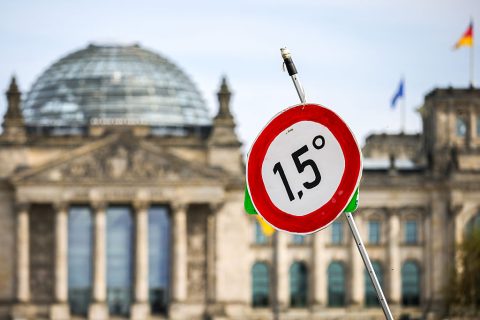

Despite criticisms of how IPCC scientific reports have been produced, all governments must sign off on every line of a key “summary for policy-makers” at a dedicated meeting. In 2023, the approved summary included the emissions reduction figures in question that informed the UN’s first global stocktake.
Irrespective of this wider debate, Hare said the “Friends of Science” campaign, which he supports, is focused on the timing of the IPCC’s next assessment cycle rather than the equity of its models.
Unresolved row over IPCC report timeline
A political battle over that time-frame has dragged on for more than two years at successive meetings of the science panel, with governments repeatedly failing to find a solution.
A large majority of nations have been pushing for a timeline that would ensure the next round of AR7 reports can feed into the UN’s global stocktake. But a group of countries, including Saudi Arabia, India, China, Russia and Kenya, have said at previous IPCC meetings that this would put a burden on developing countries with limited resources and have lobbied for a longer process.
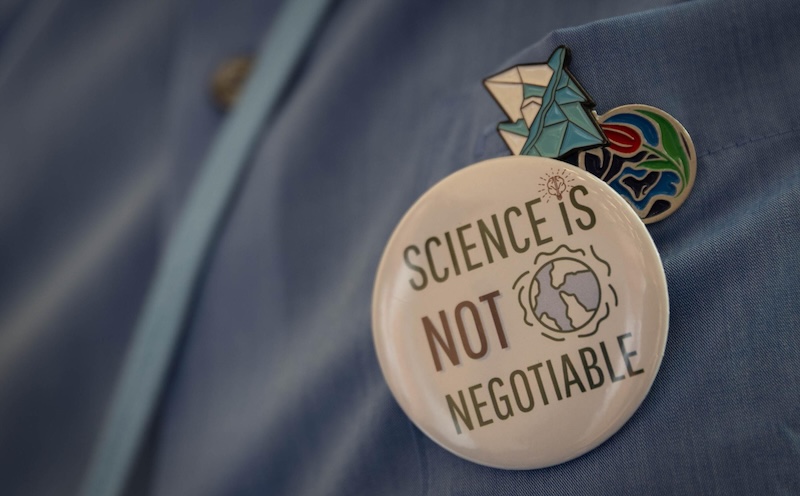
In Bonn this summer, the coalition that wants to align AR7 with the 2028 stocktake – which includes diplomats from Fiji, Nepal, the European Union, Switzerland, Sierra Leone and Panama – vowed to ensure that decision-making in the UN climate process remains based on the “best available science”, including the IPCC assessment reports.
They pointed the finger at “the usual suspects” but stopped short of singling out any countries at the public press conference. Discussions in the previous week had seen Saudi Arabia and India play down the centrality of IPCC reports in the UN stocktake and oppose calls in draft texts to encourage scientific work on scenarios to limit an overshoot of the 1.5C warming goal.
Bonn upset fuels further tension
A campaigner with knowledge of internal discussions told Climate Home News that many civil society groups from some of the world’s most vulnerable nations, including the Pacific islands, had expected CAN International to back calls in Bonn defending the centrality of the IPCC in UN climate policy-making.
Despite this, a day before the “Friends of Science” press conference, CAN published an ECO newsletter that did not mention the issue. Instead, it voiced surprise over the claims of an attack on science happening in the negotiations and accused some of the IPCC’s loudest-defending governments of hypocrisy for continuing to expand fossil fuels and not delivering “fair shares” of emissions cuts and finance to the developing world.
“We were really shocked we could not find a common position and then this jarring narrative was being pushed,” the campaigner added.
After divisions hardened in Bonn, Hare said his organisation was approached by “very upset” CAN members from various regions about the stance taken by the network’s international leadership on the issue.
Industry and NGOs lobby to weaken UN carbon credit rules in “coordinated” push
While Climate Home News understands that internal discussions have continued during the summer, including at a CAN leadership meeting in Nairobi in recent days, the campaigner said that CAN International’s endorsement of the recent webinar that directly challenged the “Friends of Science” coalition did not send a reassuring signal.
Some observers said they feared it would inflame tensions over how climate science is defined and utilised for policy purposes, with consequences reaching well beyond Bonn.
In a statement to Climate Home News, Essop said that “at a time when communities are experiencing the most horrific impacts of climate chaos, our collective energy must turn to solutions such as filling the Loss and Damage Fund, the phasing out of fossil fuels led by the Global North, and justice for people who are least responsible for this climate emergency”.
The post As science comes under attack at UN talks, climate movement splits over how to respond appeared first on Climate Home News.
As science comes under attack at UN talks, climate movement splits over how to respond
Climate Change
Q&A: What can – and cannot – be said about global warming’s role in the 2026 Himalayan floods
On the morning of 26 August, flash floods surged through a Himalayan border region of Nepal and the Chinese region of Tibet, killing more than 1,300 people, with thousands still missing.
In the days since the floods, scientists have examined satellite imagery, drone footage and seismic data in order to understand and explain the forces behind the event.
While initial theories pinned the flood on a glacial collapse, scientists now understand the event as a “multi-hazard cascade”, which began with a bedrock collapse.
Some climate sceptics have tried to use this to falsely claim that human-caused climate change had no impact on the event.
Yet, scientists have noted that, while no formal attribution study has been carried out thus far, warming is making such ice-rock avalanches in the region more likely.
Researchers have highlighted how rapid warming is dramatically reshaping Asia’s high-mountain region – and identified rising temperatures, glacier retreat and permafrost thaw as factors that may have all contributed to the disaster.
Balendra Shah, Nepal’s prime minister, has called the floods a “serious signal that…the risks we must bear in the Himalayan region are increasing” due to climate change.
Here, Carbon Brief unpacks what scientists currently know about the causes of the catastrophic event and what they can – and cannot – say about the role of climate change.
What happened?
A report published on 28 August by the HiRisk scientific consortium of high mountain experts detailed the events that led to the flash floods.
It said that events were set in motion on 26 August when a mass of bedrock, as well as the glacier ice on top of it, broke off a slope of Langtang-Lirung mountain in the Nepalese Himalaya, plunging from approximately 5,200 metres above sea level to the valley floor at 3,000 metres.
The landslide shook the ground hard enough that, at 8:37am Nepal local time, the US Geological Survey (USGS) initially reported a magnitude 4.4 earthquake. Later that day, it clarified the shaking was caused by glacier collapse and debris flow, equivalent to a magnitude 5.2 earthquake.
On the valley floor, the melting ice, water and debris slammed into the Lhende Khola river, a high-altitude river that runs along Nepal’s border with China.
Known downstream as the Bhote Koshi river in Nepal and the Poiqu or Poqu in China, the Lhende Khole feeds a network of rivers across Nepal and the Chinese region of Tibet, including the Trishuli river. (In China, the Lhende Khola is known as the Donglin Tsangpo.)
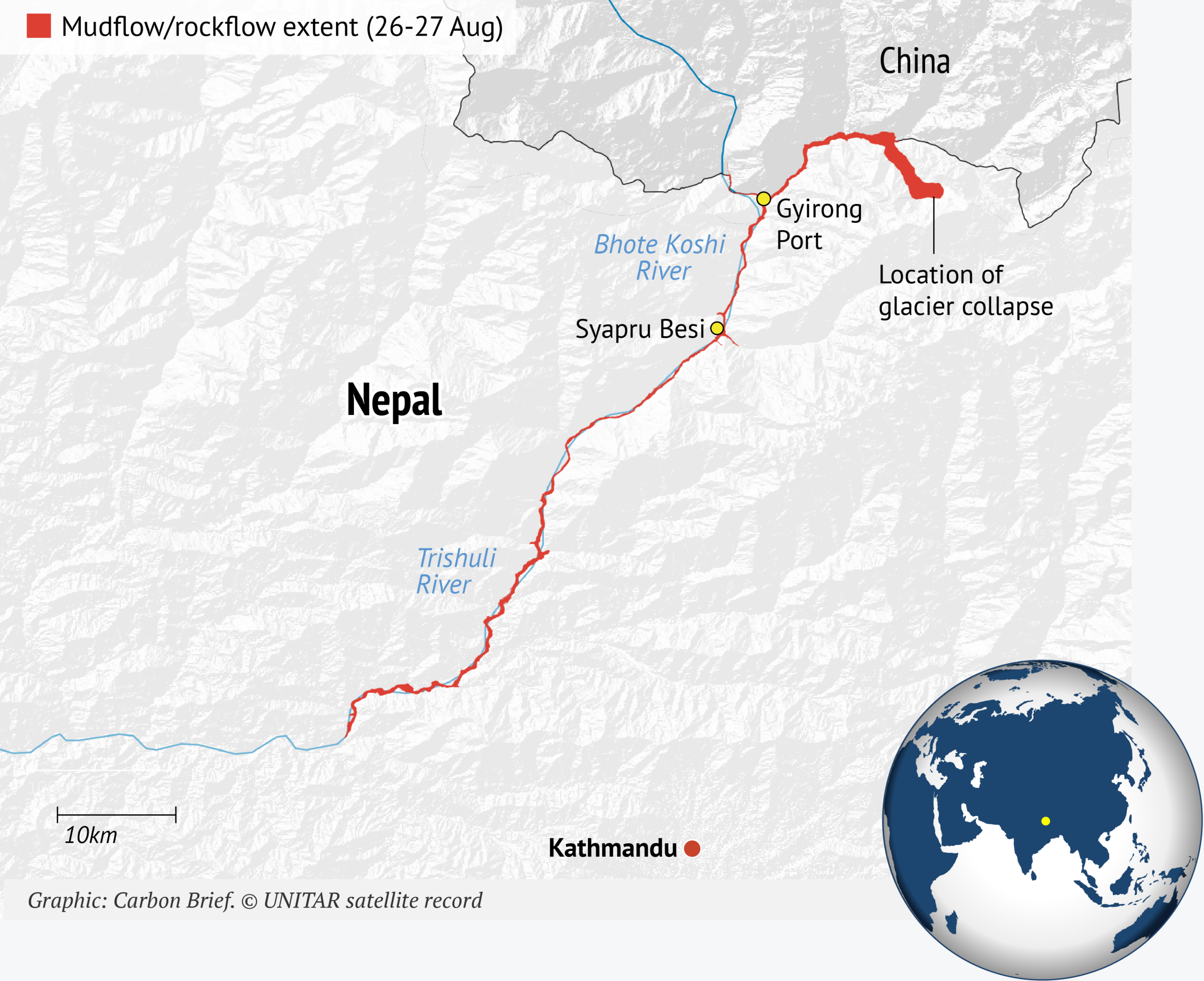
A large “debris” lake was briefly formed on the valley floor. When this lake burst, a wall of water and rock travelled downstream, killing more than a thousand people and destroying settlements, roads, bridges, hydropower plants and border posts across Nepal and Tibet.
HiRisk said that the floodwave travelled down rivers as fast as 30km an hour (around 19 miles per hour) and reached Mugling – a Nepalese town more than 130km downstream – at around 1pm local time.
A separate report from the Center for Land Surface Hazards in the US noted that the flood moved “exceptionally fast, was sediment-laden and extreme in scale”. For example, in the Nepalese municipality of Galchhi, the Trishuli river rose by nine metres in 30 minutes, it said.
Writing in the Conversation, Dr Umesh Haritashya, a glaciologist at the University of Dayton in Ohio, explained that the disaster “wasn’t finished when the first wall of water passed [on 26 August]”.
He continued that a new “barrier lake” – estimated to hold a few million cubic metres of water – had developed in a location where two rivers meet in Tibet before crossing into Nepal. This lake burst on 28 August and the river rose again, he said.
On 4 September, the chief of Nepal’s National Disaster Risk Reduction and Management Authority, told Reuters that property and infrastructure worth “at least” $2.5bn (£1.9bn) had been lost. Dharma Raj Upreti estimated the cost to build roads and temporary shelters, provide drinking water and restore power would be around $53m (£39m).
How did bedrock collapse trigger the flash floods?
In the immediate aftermath of the floods, initial reports suggested that the trigger was a collapsing glacier or earthquake in the high mountains of Nepal.
After confirming that a seismic tremor was as a result of falling rock and ice, the USGS said the trigger was likely a “glacial collapse and debris flow”. This was widely picked up by the media.
Subsequently, satellite imagery revealed that an “enormous chunk of the mountainous bedrock” beneath the glacier had also given way, reported the New York Times.
Dr Kristen Cook, a geomorphologist at the Université Grenoble Alpes in France, told the newspaper:
“The rock that the glacier was sitting on collapsed…It was a much larger collapse than we were initially able to see in the satellite imagery.”
The result was a “deluge of rock and ice, which pulverized into mud and water as it surged down the mountainside”, the newspaper said.
Dr Jakob Steiner a geoscientist at the University of Graz in Austria, tells Carbon Brief:
“It was not a glacier that collapsed. It was the mountain below the glacier that collapsed and the glacier had no other chance but to go with it because it was sitting on top of it.
“The trigger for that is something that we are not 100% certain about, but, in the end, it very much looks like simply a mechanical failure of the rock material because of stressors that have built up over a long period of time.”
Failures of “bedrock” – the hard, solid rock that sits below looser rocks and soil – are an “increasingly common occurrence”, says Prof Bethan Davies, a professor of glaciology at Newcastle University. She tells Carbon Brief:
“These massive landslides occur in mountain regions, commonly following rapid deglacierisation [the melting away of a glacier]. Similar events happened in the Chamoli event in 2021 [in the Indian Himalaya] and in the Blatten landslide last year in Switzerland. They’ve also occurred recently in Alaska.”
With a shift in focus from the failure of a glacier to the bedrock underneath, some climate sceptics seized on the development to falsely claim that climate change had not played any role in the disaster.
These include Dr Matthew Wielicki, recently appointed by the Trump administration to lead the US Global Change Research Program, on Twitter, as well as former Conservative peer and climate-sceptic commentator Matt Ridley in the Spectator.
However, scientists have highlighted the likely contribution of rapid warming in the region. These factors include the thawing of permafrost and glacier retreat. (For more, see sections below).
Fundamentally, “this would have been a much less significant tragedy if it had been just a rock-slope failure”, notes Davies.
The initial landslide took a mixture of rock and ice into a valley that “contains buried ice” as well, she says, providing the water that “resulted in the hyperconcentrated flow, which took so many lives”.
How have temperatures risen in the affected region?
Global temperatures have risen by roughly 1.4C since the pre-industrial period. However, this increase is not uniform across the planet, with some regions warming faster than others.
A study published in Global and Planetary Change in June 2026 investigated changes in the Langtang catchment – a river basin in central Nepal, in which the Langtang-Lirung mountain is located, which eventually drains into the Ganges. Around one-quarter of the area is made up of glaciers.
The paper found that glacial areas of the catchment – found at 4,000 metres above sea level – warmed at 0.31C per decade over 1960-2023. This was “more than three times” the rate observed at a lower elevation weather station, the authors said.
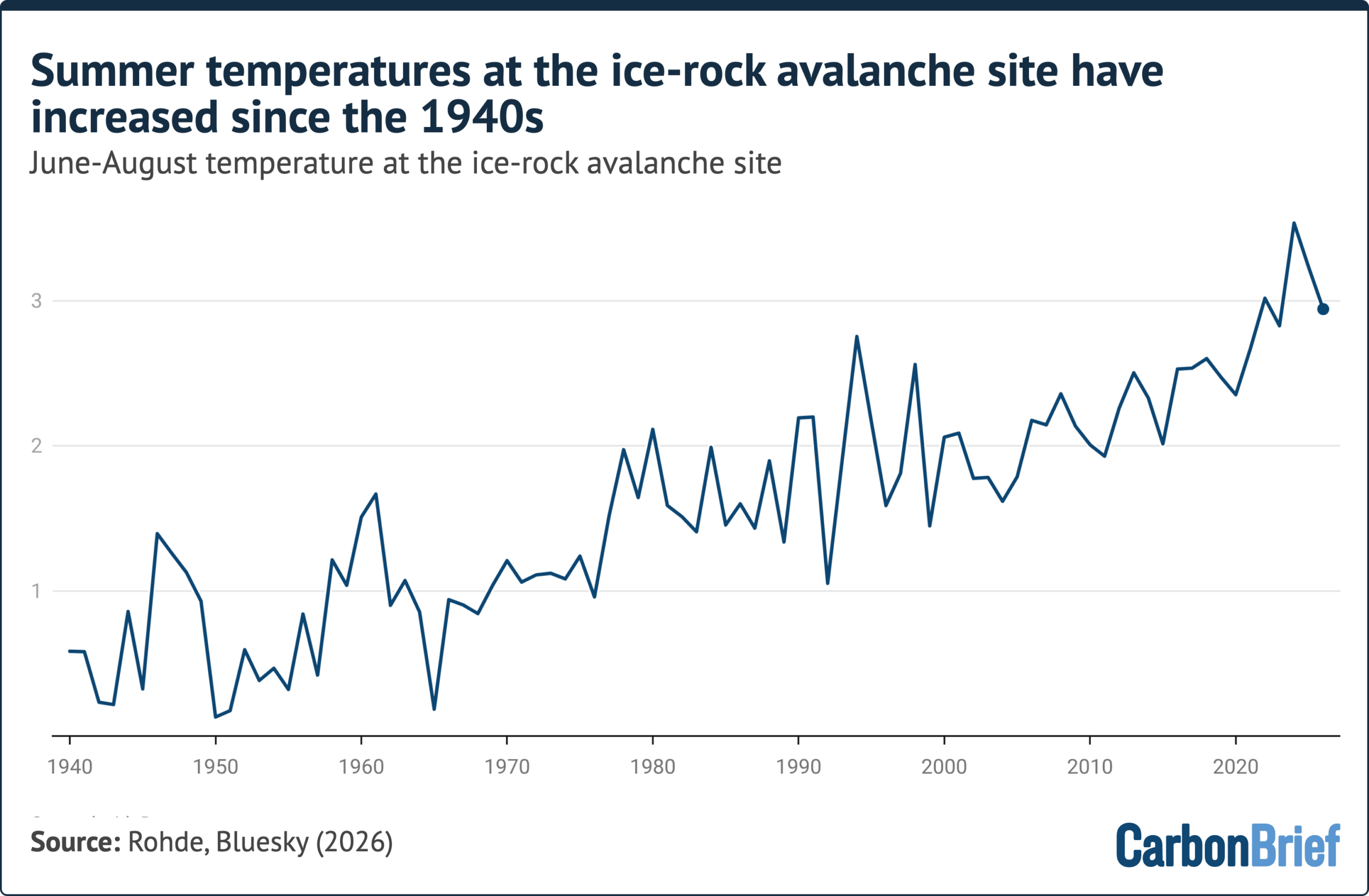
Looking in more detail at the site of the glacial collapse, Dr Robert Rohde, chief scientist for Berkeley Earth, used ERA5 reanalysis data to show how temperature has changed at the 5,200-metre elevation site where the mass of ice and rock broke loose.
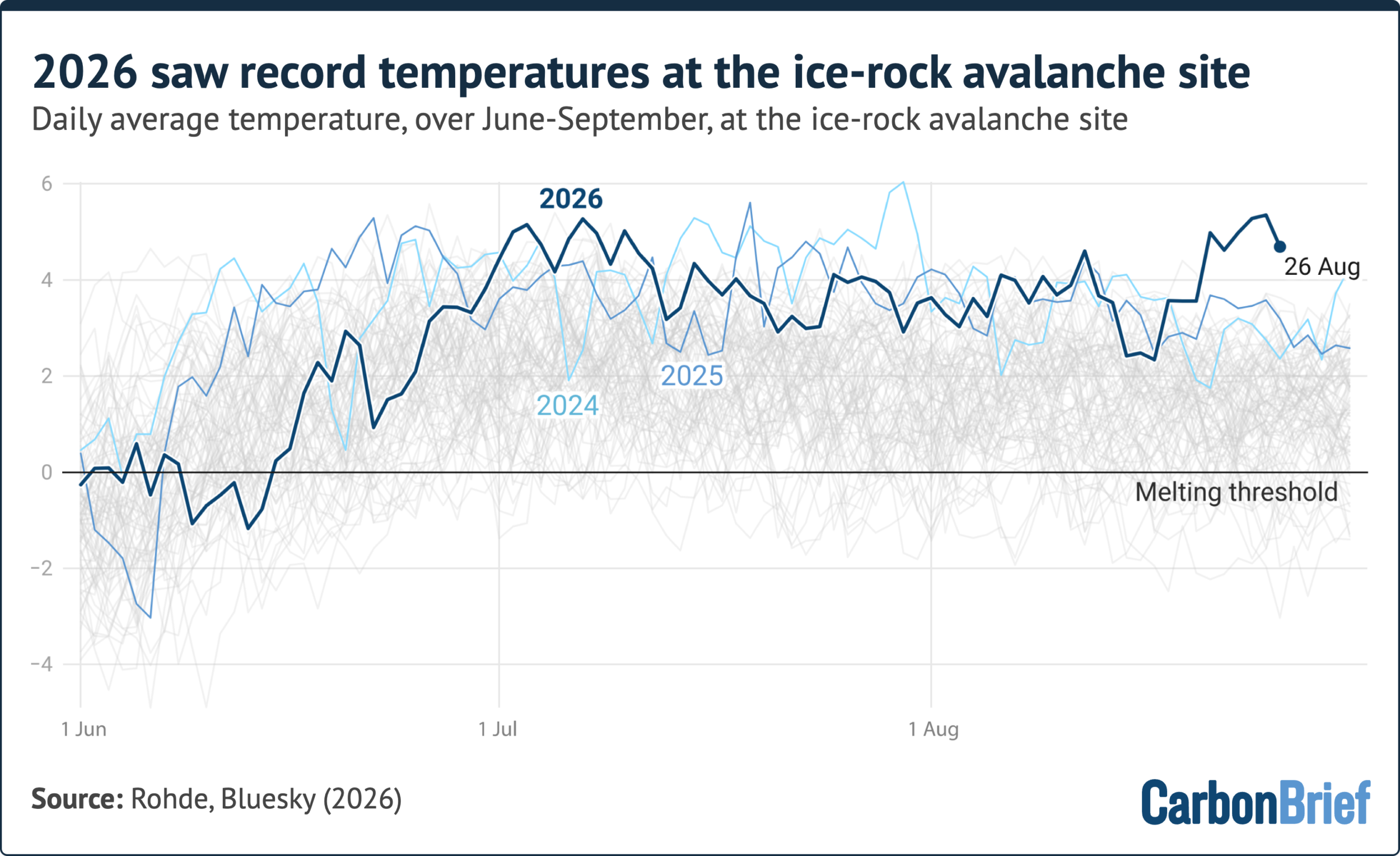
Rohde’s analysis found that June-to-August temperatures have been rising at the site of the glacier collapse since the year 1940, with 2026’s summer the fourth warmest on record, behind 2024, 2025 and 2022. This is shown in the graph below.
Rohde also found that the days leading up to the disaster recorded the hottest August temperatures ever experienced at the site. This is shown in the graph below.
On social media, Rohde stated:
“Given the warming trend, this Nepali glacier had probably been thinning and weakening for years, or even decades. But it ultimately failed during the warmest week in one of its warmest years on record. It would be a hell of a coincidence if global warming wasn’t at least partially to blame.”
How have rising temperatures affected mountain stability?
Many experts have linked warming temperatures in the region to thawing permafrost – ground that has been frozen for at least two consecutive years, whose thickness ranges from less than one metre to more than a kilometre.
Steiner is part of a research team that has been using sensors to monitor permafrost in the region since 2014. He tells Carbon Brief that it is “pretty clear” the permafrost has been thawing “very actively” at elevations as high as 5,200 metres above sea level “for many years”. He adds:
“This means that the ground has, over the last decades, moved from being in a solid state into – at least, periodically during the warm season – patchy ground where some is frozen and some isn’t…
“If you have frozen ground next to non-frozen ground, you have dynamics happening between that because there are different densities and there’s movement happening, which is conducive to interventional failure – and that we know from many other cases.”
Davies also points to the “degradation” of perennially frozen ground as a factor in the disaster:
“This permafrost acts as a glue to hold together the rocks and, as it melts, the rock can become weakened.”
Permafrost thaw can also result in saturated ground, says Davies, which adds “pressure in the joints” of rock and can “facilitate” failure. She continues:
“Sources of the water include melting permafrost and meltwater from the overlying glacier. We know that this event happened during a period of warmth, but in the absence of heavy precipitation, pointing to ice melt as the source of water.”
A 2025 study of rock and ice avalanches in High Mountain Asia found that more than two-thirds started in areas “where permafrost is probable”.
How have glaciers retreated in the affected region?
Glaciers – frozen rivers of ice holding three-quarters of the global freshwater supply – are extremely vulnerable to climate change.
In the Himalaya, the rate of glacier retreat has doubled since the late 20th century, according to a 2019 study in Science Advances.
The Global and Planetary Change study found that glacier area loss rates in the Langtang catchment increased more than fourfold from 1964 to 2023 – with melting accelerating after 2000.
It added that glaciers in the region also experienced “fragmentation” and “widespread thinning” over this period.
The study noted that this loss “coincided with elevation dependent warming”.
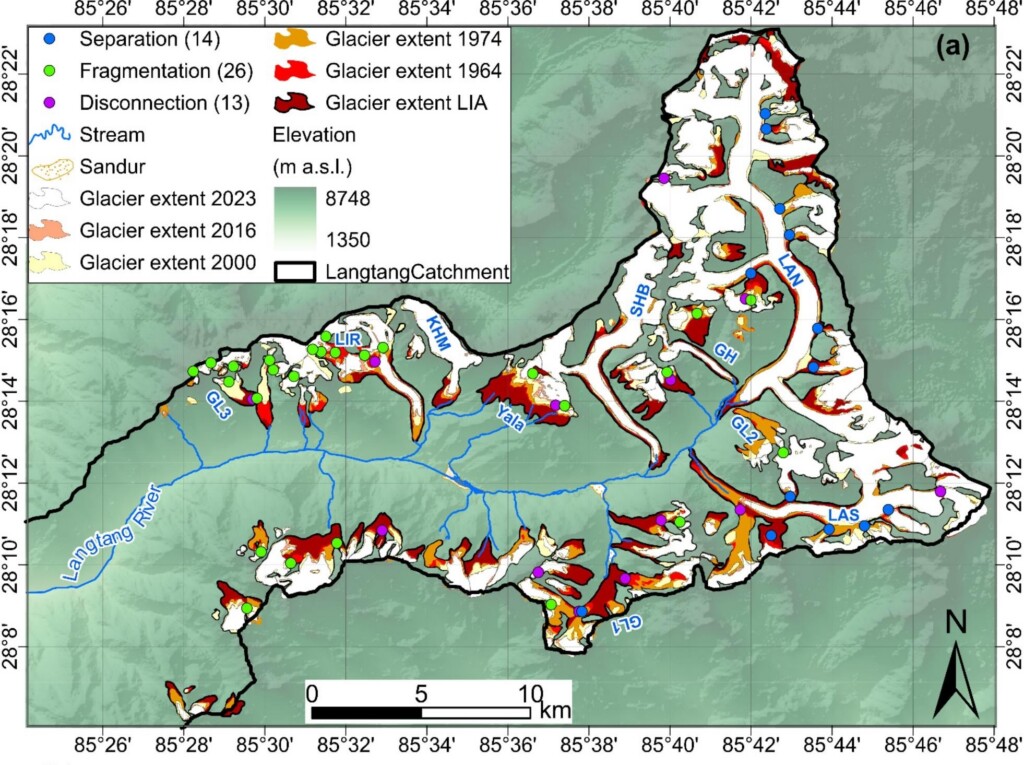
The figure below provides an overview of glacier loss in the Langtang catchment over 1964-2023, with orange, red and dark red indicating areas of retreat.
In addition, green dots note points of glacier fragmentation, while blue dots show separation and pink show disconnection.
In comments released by the University of Reading, Prof Maria Shahgedanova, a climate scientist researching climate impacts on mountain glaciers, said that the glacier involved in the floods had “retreated by approximately 450 metres between 1990 and 2020”.
She adds that this “potentially reduce[d] the mechanical support provided by the glacier to the underlying rock slope”.
Speaking to Carbon Brief, Davies reiterates that the retreat of the glacier is “potentially a contributing factor” to the bedrock collapse and subsequent disaster.
This is because the removal of the glacier from the lower slopes leaves the “upper rock slopes less stable”, she says.
The most recent assessment by the International Centre for Integrated Mountain Development said that glaciers in the Hindu Kush Himalaya region are “rapidly shrinking” as a result of climate change. (This region extends 3,500km over Afghanistan, Bangladesh, Bhutan, China, India, Myanmar, Nepal and Pakistan.)
It said this loss is threatening the safety of the nearly two billion people, including by increasing the risk of “glacial lake outburst floods” (GLOFs). A GLOF is a sudden and catastrophic release of meltwater from a glacial lake.
Although this disaster was not caused by a GLOF, it is known that climate change is making such events more likely.
Can the event be attributed to climate change?
In the wake of the flash floods, climate campaigners, media outlets and Nepalese politicians have linked them to human-caused climate change.
However, many climate scientists have cautioned that it is too early to say precisely how climate change impacted the disaster.
Davies tells Carbon Brief:
“These events happen so quickly that the exact causes and drivers can take a little time to uncover, especially if the event was a surprise and there had been no monitoring system in place.”
When trying to determine the role human-caused climate change played in the intensity or likelihood of extreme weather, scientists turn to the field of “attribution science”.
To date, no formal rapid attribution study has been produced that attempts to quantify whether – and how – climate change contributed to the event.
Scientists have noted that climate attribution of ice-rock avalanches – which are typically driven by a variety of factors – remains limited, in part because of the lack of a long-term observational record of previous collapses in high mountain areas.
Meanwhile, the studies that do exist stop short of directly linking such disasters to climate change. For example, the authors of a 2021 study into the Chamoli ice-rock avalanche concluded that “we cannot attribute this individual disaster specifically to climate change”.
However, they added, the “possibly increasing frequency of high-mountain slope instabilities can likely be related to observed atmospheric warming and corresponding long-term changes in cryospheric conditions (glaciers and permafrost)”.
In the aftermath of the disaster, many researchers have similarly highlighted that climate change could not be singled out as the cause of the disaster, even if warming likely increased the probability of its occurrence.
On the Climate Brink substack, Carbon Brief’s climate science contributor Dr Zeke Hausfather noted that a “definitive single-event attribution” of the more recent disaster “may never be possible” due to the “messy causality of rock-ice avalanches”.
However, he added that both the existing scientific literature and “essentially every scientist working on these hazards point in the same direction” – namely, that warming is making such events more likely in the Himalaya.
Steiner tells Carbon Brief it might be possible to attribute different factors that played a role in the disasters to climate change – for instance, the recession of the glacier – but it would be more difficult to do so for the event as a whole.
Part of the reason for this, he says, is that rock failures in this region of the Himalaya have occurred for millennia, well before humans started altering the climate.
However, he continues:
“The physics of it is not something that has been made possible by climate change. This could have happened without it. But the chance of it happening – and the likelihood of it happening five years after a previous, similar event [in Chamoli] – we, as the scientific community, can be pretty confident about that [being increased because of a changing climate].
“This is because so many of the changes that we know are related to climate change can potentially drive the build-up to eventual failure.”
Ultimately, says Davies, a “careful attribution study is needed, but it is hard to argue that the rapidly warming climate is not having an effect in these regions”. She adds:
“A single event may have multiple drivers, but we are seeing an increase in these events and are likely to see more as the permafrost and glacier melt continues.”
Related
Explainer: The CMIP7 emissions scenarios – and how they explore future climate change

Climate change exposes 580 million children to 20 extra ‘heat-stress days’ every year
Explainer: How the ‘super El Niño’ will reshape the world’s weather
Analysis: The two largest reservoirs in the US have hit record-low levels
The post Q&A: What can – and cannot – be said about global warming’s role in the 2026 Himalayan floods appeared first on Carbon Brief.
Q&A: What can – and cannot – be said about global warming’s role in the 2026 Himalayan floods
Chinese industry is beginning to shift from fossil fuels to clean electricity, with wind, solar and batteries progressively displacing coal, oil and gas across the industrial sectors that made the country the world’s factory and largest carbon emitter, a new analysis shows.
Clean electricity met all of China’s demand growth in 2025 and coal generation fell for the first time in a decade, even as electricity demand rose by 5%, the report found.
Despite a rebound in coal power generation in the first half of 2026, the analysis by global energy think-tank Ember found the growth in clean electricity illustrates a longer-term shift: a massive build-out of wind, solar energy and battery storage and deepening electrification of the economy are starting to make a dent in the fossil-fuel energy system supporting China’s industrial base.
China keeps Indonesia’s battery dream afloat but future less certain
The research identifies early signs that a structural transformation of China’s industrial economy from coal, oil and gas to clean electricity is underway, even if changes on the ground are not yet reflected in national data.
“The energy foundation of the Chinese industrial economy is shifting,” Muyi Yang, a senior energy analyst at Ember and the report’s lead author, told Climate Home News.
“Fossil fuels are progressively being replaced in the many functions they have historically assumed. Because of that, fossil fuel peaking is increasingly coming into view,” he said.
Electrifying industry
Coal generation has stopped growing in 17 of the 26 provinces and regions analysed by Ember between 2021 and 2025. This includes industrial centres such as Hunan in southern China and Shandong – home to energy-intensive industries like cement production. Together, these regions are home to more than half of China’s thermal power capacity.
A greater share of the Chinese economy is now running on electricity than in other major economies, accounting for 29% of final energy consumption in 2024, compared with about 23% in Europe and 21% in the US. Less than half of China’s electricity was generated from coal in the first half of the year.
-
China’s coal power rebounds as record clean energy goes to waste
Long-term contracts guarantee coal plants buyers regardless of demand, crowding out renewables, report finds -
China’s coal-chemicals boom risks repeating the mistakes of the past
By reviving the problematic industry in the name of energy security, China runs the risk of higher emissions, stranded assets and setting back its ambitions as a clean energy leader -
China’s carbon emissions rise again as more clean power is wasted
The economic powerhouse burned more coal and gas in the first quarter of 2026, despite record wind and solar build-out


Meanwhile, fossil fuel use has fallen in eight of 11 tracked industrial sectors, declining between 26% and 71% from peak consumption levels across fossil fuel extraction, manufacturing industries such as textiles, machinery and food and beverages, transport equipment and chemical materials.
Earlier this year, German company BASF, the world’s largest chemical producer, opened a new facility in southern China, which is fully supplied by renewable energy. The company said emissions from the site could be 50% lower than conventional petrochemical facilities.

In easier-to-electrify sectors such as machinery, electronics and textiles, electricity now supplies about three-quarters of final energy consumption, Ember found.
Fossil fuel use is also showing signs of flattening in the metals smelting and processing sector – one of the most fossil-intensive parts of the economy – offering “encouraging signs” that the transformation is starting to take hold in harder-to-abate sectors, said Yang.
“If that is happening in more and more provinces, and more and more economic sectors that means that fossil fuels are progressively being squeezed out of the energy system,” he said.
“Growing by greening”
China’s vast cleantech manufacturing power has become an engine for growth in its own right, spurring investment, creating jobs and generating export revenues.
Yang described this “growing-by-greening” dynamic as “turning each step of the transition into a source of strength for the next”.
China and Brazil join pledge to triple global nuclear energy capacity
For Li Shuo, director of China Climate Hub at the Asia Society Policy Institute, this is part of what makes China’s lead in manufacturing clean energy equipment “irreversible”, comparing its growth with that of a rainforest, where different parts of the ecosystem thrive by reinforcing one another.
The early success of deploying wind and solar helped drive down electricity costs, which created favourable conditions for the rapid adoption of electric vehicles (EVs) and in turn boosted demand for batteries that are now critical to balance the grid.

An oversupply of renewable energy incentivised industrial players to benefit from cheap and readily available clean power generation, encouraging innovative solutions to electrify other parts of the economy. In the transport sector, for example, electrification is moving from passenger vehicles to harder-to-electrify trucks.
This abundance of cheap green energy is also making China competitive in what has long been seen as the anchor of Western competitiveness, Li said.
Stalling fossil fuel use
At the same time, China’s huge legacy fossil fuel generation capacity is still expanding, even as coal power plants are being used less intensively.
China brought 30 GW of new coal power capacity into operation in the first six months of the year and coal-fired generation rose 3% over the same period after local governments fast-tracked coal projects to prevent a repeat of severe power shortages in 2021.
Solar surge kept fossil electricity flat in 2025 as China and India made ‘historic’ shift
A further 274 GW of coal capacity is either under construction or has permits to be built while vast amounts of solar and wind power that could not be absorbed by the grid have gone to waste in the first half of the year.
“This doesn’t mean that the transition is losing steam,” said Yang, arguing that China is now grappling with some of the more complex aspects of the transition.
A recent analysis by the Centre for Research on Energy and Clean Air (CREA) for Carbon Brief found that China’s CO2 emissions from fossil fuels and cement have plateaued for more than two years following a peak in March 2024. Ember found that on a 12-month moving average, coal generation has been stalling since then, following years of continuous expansion.
-
EU, UK lead push for electrification as “powerful weapon” against fossil fuels
A group of dozens of countries seeks to build momentum for a COP31 pledge to electrify 35% of global energy use by 2035 as an alternative to fossil fuels -
COP31 leaders unveil global targets, with spotlight on electrification
Co-hosts Türkiye and Australia want countries to sign on to global targets in three of their priority areas for this year’s COP climate negotiations -
Africa can lead the Age of Electrification
The electrification agenda presents both an extraordinary opportunity for Africa and an immense challenge for the continent



In the second quarter of the year, CO2 emissions fell by 1% after China’s oil consumption plummeted 9% as the US-Iran war prevented the transport of oil cargoes from the Gulf through the Strait of Hormuz.
The electrification of the transport sector, particularly electric trucks, was the biggest driver in displacing oil demand as the conflict in the Middle East accelerated the transition.
A lesson in sequencing
China’s bumpy transition offers a useful lesson for other countries at an earlier stage of their transition, said Xunpeng Shi, president of the Sydney-based International Society of Energy Transition Studies (ISETS), a global network of professionals that shares research and fosters collaborations.
“Build quickly enough so that clean electricity can start taking over and prepare for the pressure on the fossil system before it arrives, because that is the part nobody has done easily,” he said.
For countries that are heavily reliant on revenue from fossil fuel exports, a peak in Chinese fossil fuel use weakens the assumption of rising demand on which investments have long been made.
“For them, the time to plan for that is now, while the revenues are still there,” he said.
The post China’s industrial engine starts to break its fossil fuel habit appeared first on Climate Home News.
China’s industrial engine starts to break its fossil fuel habit



-
Climate Change1 year ago
Guest post: Why China is still building new coal – and when it might stop
-

 Greenhouse Gases2 years ago
嘉宾来稿:满足中国增长的用电需求 光伏加储能“比新建煤电更实惠”
-
Greenhouse Gases1 year ago
Guest post: Why China is still building new coal – and when it might stop
-

 Climate Change2 years ago
嘉宾来稿:满足中国增长的用电需求 光伏加储能“比新建煤电更实惠”
-

 Renewable Energy11 months ago
Sending Progressive Philanthropist George Soros to Prison?
-
Climate Change2 years ago
Bill Discounting Climate Change in Florida’s Energy Policy Awaits DeSantis’ Approval
-
Greenhouse Gases1 year ago
嘉宾来稿:探究火山喷发如何影响气候预测
-

 Carbon Footprint2 years ago
US SEC’s Climate Disclosure Rules Spur Renewed Interest in Carbon Credits