

As governments and institutions pledged billions for offshore wind, cleaner shipping and marine protection at last month’s Our Ocean Conference in Mombasa, countries are increasingly turning to the ocean as a source of jobs and climate action.
But civil society groups warn that the push to expand the “blue economy” may reproduce familiar inequalities unless coastal communities have a greater say in how projects are designed, financed and governed.
Neville van Rooy from The Green Connection in South Africa, which works with coastal communities who rely directly on the ocean for their livelihoods, said local people were frequently unaware of proposed developments until civil society groups alerted them.
“Communities need to be taken seriously,” van Rooy told delegates at the Mombasa conference held on the shores of the Indian Ocean.
“Just because they are often struggling does not mean they do not have a vision of development. Inclusivity needs to be at the centre and development pathways must build on communities’ own experience, including indigenous knowledge systems rooted in harmony with nature.”
-
Mombasa ocean summit drives progress on marine protection, but threats persist
At the 11th Our Ocean conference in Kenya, its founder John Kerry says the ocean must become central to climate solutions and needs to be looked after -
Ocean summit stays silent on new wave of offshore oil and gas expansion
At this month’s Our Ocean Conference in Mombasa, campaigners warned that ocean protection requires governments to halt new offshore fossil fuel projects -
West African nations target Eastern Atlantic for early high seas protection
At the 11th Our Ocean Conference, African governments launched a bid to have the zone classified as one of the first high-seas protected areas


Ocean investment flowing in
The value of the blue economy—the sustainable use and protection of marine resources—doubled from $1.3 trillion in 1995 to $2.6 trillion in 2020 and is projected to quadruple by 2050, according to the Organisation for Economic Co-operation and Development (OECD).
The scale of ambition in Mombasa was clear, with governments, institutions, companies and civil society groups announcing 320 commitments worth $6.4 billion.
The largest share went to sustainable blue economy projects, with 86 commitments worth $2.86 billion, followed by sustainable fisheries with $1.75 billion and ocean-climate action with $1.18 billion.
The pledges included support for ocean startups in Africa, coastal ecosystem restoration across the Indian Ocean, marine research and policy, recycling discarded fishing nets, sustainable livelihoods in Timor-Leste and planning tools for offshore wind.
Cynthia Barzuna, global deputy director of the Ocean Program at the World Resources Institute, said there are signs that blue finance and ocean planning are moving closer to coastal communities, particularly through the development of sustainable ocean plans.
In 2020, a group of 14 countries – co-led by Australia and Chile – pledged to manage their oceans sustainably, by jointly drawing up plans with coastal communities to shape how marine resources are managed and where investments should go.
“Once communities are involved in the planning, bring in their knowledge, and participate in designing, developing and implementing a sustainable ocean plan, it puts us on the right path,” Barzuna told Climate Home News on the sidelines of the conference.
Yet some of those countries – including Kenya, Australia and Mexico – have embarked on a new wave of offshore oil and gas projects, threatening key biodiversity hotspots, according to a recent report by a group of environmental NGOs.
When projects go wrong
Civil society groups say lessons need to be learnt from failed blue economy projects too.
In Kenya, a proposed coal-fired power plant at Lamu Port – a fragile coastal ecosystem and a UNESCO World Heritage site – was challenged by residents and campaigners who cited little consultation and threats to fishing, tourism, culture and public health.
In 2019, Kenya’s National Environment Tribunal revoked its environmental licence, citing inadequate public participation and flaws in the environmental assessment – a decision later upheld by the courts.
“It is not enough to say that whatever you are doing is in the name of the communities, their livelihoods and whatever else you want to improve”, but that they should be directly involved in projects from the start, said Omar Elmawi, a Kenyan climate activist and Convenor of the Africa Movement of Movements.
He said another lesson learnt was that environmental impact assessments must not only be completed, but “must be done rigorously” and that the process has to be transparent so that people feel involved and that their views are being counted.
Blue transition
Blue carbon schemes can also attract finance, but campaigners said communities that have long protected mangroves, seagrasses and salt marshes must be treated as rights-holders, not just beneficiaries. In some past projects, they said, communities were asked to provide labour, attend consultations or receive small payments, while outside developers retained control over carbon revenues and decisions over how ecosystems were managed.
Similarly, offshore wind and marine protected areas can bring climate and conservation gains, but if poorly planned, they can disrupt fishing grounds, marine species and small-scale fishers’ access to the sea, added campaigners.
Farida Aliwa, executive director of Natural Justice, said the answer was not to halt ocean-based development, but to put in place stronger safeguards before projects are approved, financed and expanded.
Aliwa said legal frameworks across Africa were evolving, with strategic litigation increasingly being used to hold governments accountable for environmental, climate and human rights impacts related to new projects.
But she warned that communities and coastal defenders still face shrinking civic space, and said any shift to renewable energy must be designed responsibly.
“As we work on alternatives, we need to ensure that renewable projects benefit communities,” she said.
The post As blue economy gathers pace, communities must benefit from ocean boom, activists say appeared first on Climate Home News.
As blue economy gathers pace, communities must benefit from ocean boom, activists say

Three countries have been named by the Paris Agreement’s compliance committee for failing to submit a nationally determined contribution (NDC) and repeatedly snubbing offers of help with their climate plans.
After months of internal debate over whether to identify serial non-responders, the Paris Agreement’s Implementation and Compliance Committee (PAICC) named the three countries which have failed to engage with it over their NDCs on Friday.
It named Democratic Republic of Congo, Senegal and North Korea in a footnote of its annual report, adding that it decided to name them “with a view to facilitating engagement”, adding that representatives of the three nations had been invited to its meeting in early 2027 “with the purpose of identifying any challenges and constraints”.
“The Committee noted the importance of Parties engaging with the Committee in a timely manner, while noting that some delays may be due to the national capabilities and circumstances of the Parties”, the report said.
-
Under US pressure, World Bank says it will back gas “where appropriate”
The US wants the World Bank to expand its gas support while climate campaigners are pushing for it to end – its head spoke this week of limited backing for the fossil fuel -
IPCC scientists vow to press on with climate reports despite political deadlock
After governments again failed to agree a timeline, nearly 120 IPCC authors pledged to complete their assessment on time and with full scientific rigour -
Paris Agreement committee snubbed over missing NDC climate plans
Many governments have still not submitted a nationally determined contribution to the UN, breaching a key requirement of the Paris Agreement

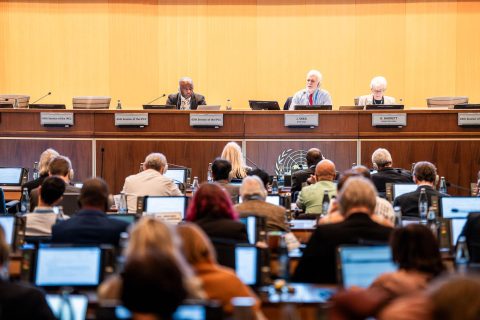

In July, PAICC said 12 countries had ignored its repeated attempts to discuss why they had not published an NDC as required every five years under the 2015 Paris accord.
Members of the committee had been divided over whether to name them, but at a September meeting decided to do so in their annual report to the annual climate COP summit.
By the time the report was published on Friday, only Congo, Senegal and North Korea “had not communicated an NDC or submitted a [Biennial Transparency Report] and had not yet responded to any of the Committee’s notifications, despite several reminders issued by the Committee in this regard”.
Rainforest and renewable energy ambitions
The silence from Congo and Senegal is notable because the former is home to much of the Congo Basin rainforest while the latter has sought billions of dollars in climate finance to support its renewable energy ambitions.
After Brazil, Congo has more rainforest than any country in the world. This forest, and the country’s peatlands, absorb huge amounts of greenhouse gas but are fast being lost to expanding farmland, charcoal production, logging and mining.
Senegal signed a Just Energy Transition Partnership with Canada and wealthy European nations in 2023, to help it meet its renewable energy targets under the-then government of Macky Sall. It was chair of the Least Developed Countries group between January 2022 and December 2023.

Tejas Rao, who is researching the PAICC as part of a doctoral thesis at Cambridge University, said the governments of the three countries should engage with the committee.
“Engagement costs these governments very little and the committee has shown it will listen,” he said.
“Silence leaves the committee with no basis to help, and it leaves the [governments] exposed to the narrative that they are simply disengaged,” he told Climate Home News.
Paris Agreement requirement
The 2015 Paris Agreement requires all parties to publish an NDC every five years outlining their emissions reduction targets, with each plan meant to be more ambitious than the country’s last NDC.
The latest set – the third round of plans, with new targets for 2035 – was due in February 2025. While most countries missed this deadline, all but around 30 – mostly small emitters but including Egypt, Vietnam and Argentina – have now submitted them.
Over the year, the PAICC – which is made up of government climate officials from developed and developing countries – has been communicating with governments that have not submitted NDCs and trying to overcome barriers to them doing so.
Some nations have cited exceptional circumstances as the reason for not submitting an NDC, a process that requires a significant amount of work in tracking emissions and consulting on how to curb them across the economy. For example, a letter from a Sudanese official to the PAICC, seen by Climate Home News, said that the country’s civil war had led to the suspension of its NDC preparation.
-
IPCC scientists vow to press on with climate reports despite political deadlock
After governments again failed to agree a timeline, nearly 120 IPCC authors pledged to complete their assessment on time and with full scientific rigour -
Under US pressure, World Bank says it will back gas “where appropriate”
The US wants the World Bank to expand its gas support while climate campaigners are pushing for it to end – its head spoke this week of limited backing for the fossil fuel -
Who shapes climate science? The equity question facing the IPCC
Early completion of the next global climate science assessment reports risks excluding research from the Global South, which is key to ensuring the findings are fair
The US and Iran are not signed up to the Paris Agreement and so do not have active NDCs, nor does Taiwan, which is not a UN member state.
Rao said that because the PAICC is “facilitative and non-punitive”, naming the countries “is meant to open a door, not close one – the invited consultation is the point”.
“In recent months, governments that explained their constraints, whether capacity, finance or domestic process, have been met with follow-up and support rather than sanction, and the number of silent governments has fallen sharply,” Rao said.
The post Paris Agreement committee names three countries snubbing it over NDCs appeared first on Climate Home News.
Paris Agreement committee names three countries snubbing it over NDCs