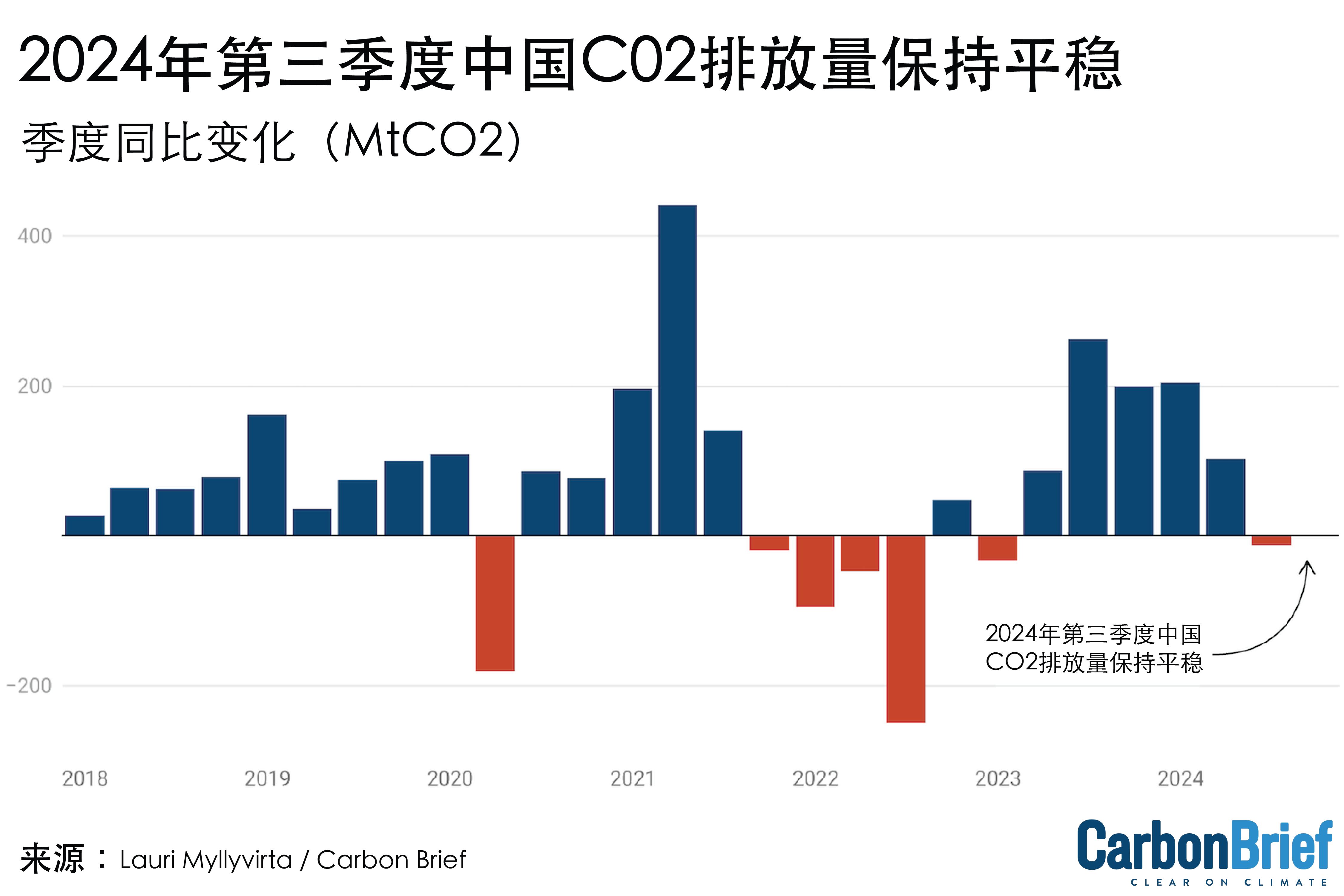
继中国的二氧化碳(CO2)排放量在2024年第二季度出现下降后,第三季度碳排放量与去年同期持平或略低。
Carbon Brief基于官方和商业数据进行的最新分析显示,三季度的数字意味着今年中国全年碳排放量仍有可能下降。

然而,最近创纪录的高温导致九月份的排放量上升,加之新的经济刺激措施出台,使得中国的排放轨迹现在面临更大的不确定性。
在今年八月和九月的大部分时间里,肆虐的热浪导致空调用电需求大幅上升,再加上水电出力不足,导致第三季度燃煤发电量增长2%,燃气发电量增长13%,尽管风电和太阳能发电量的增长继续打破纪录。
电力部门的排放量增加被钢铁、水泥和石油使用产生的排放量减少、以及电力部门以外的天然气需求停滞所抵消。因此,中国第三季度的碳排放量较去年同期基本持平或略有下降。
该分析的其他关键调研结果包括:
- 第三季度太阳能发电量同比增长44%,风电增长24%,两者的新增装机容量继续创纪录。
- 与去年受干旱影响的数据相比,水力发电量增长了11%,但仍未达到预期水平。核电增长了4%。
- 由于建筑活动减少、电动汽车和天然气卡车的增加以及消费疲软,石油需求下降了约2%。
- 第三季度,钢铁和水泥行业的排放量分别下降了3%和12%,这两个行业都继续受到建筑活动下降的影响。
- 煤化工行业获得了新的政策支持,导致该行业的煤炭消费量年初至今增长近五分之一。
若要使中国2024年总排放量低于2023年水平,第四季度三个月的碳排放量需至少下降2%。工业用电需求增长放缓以及空调季的结束将助力实现这一目标。
然而,北京在九月底宣布的新经济刺激计划并未明显强调碳排放问题,这给排放量下降的前景增加了不确定性。
无论如何,中国仍将偏离其2025年“碳强度”目标,该目标要求该国在2020至2023年碳排放快速增长之后,在2024年和2025年排放量都需减少至少2%。
就未来而言,决策者最近透露了中国在碳达峰和减排方面的新计划,表明该国将采取渐进而谨慎的方式,这与实现《巴黎协定》目标所需要的水平有差距。
但是,如果中国清洁能源的快速增长能够持续,它有可能更快地实现减排。
清洁能源扩张满足夏季全部电力需求增长
尽管此前有预测显示中国的电力需求增速将放缓,但2024年第三季度实际电力需求同比增长了7.2%,高于第二季度的6.9%。
然而,电力需求增长的构成有所变化,大约60%的需求增长来自住宅和服务行业,其中家庭需求猛增了15%。
工业电力需求增长继续放缓,七月至九月增长了4.6%,低于第二季度的5.9%。
与此同时,太阳能发电量同比增长44%,风电增长了24%。尽管水电利用率不足,但仍同比增长了11%。核电的增长仅为4%,主要是由于新建核电机组较少。
电力需求的迅速增长超过了低碳能源供应的增长。为填补供需之间的缺口,燃煤发电量增长了2%、燃气发电量增长了13%,如下图所示。
这导致该季度电力部门的碳排放量增加了3%。

然而,纵观整个夏季,无论是从五月到九月,还是从六月到八月,清洁能源的扩张都足以覆盖电力需求的全部增长。
今年八月和九月比去年更热,导致空调用电需求迅速增长。相比之下,去年六月和七月气温更高。
尽管住宅用电需求快速上升,但夏季燃煤和燃气发电量总体上有所减少,六月下降了7%,七月下降了5%,八月上升了4%,九月上升了9%。单月的增长率受极端高温出现时间的影响显著。
就新增发电装机容量而言,太阳能持续打破去年纪录,2024年初至九月新增装机容量达163GW,相当于德国、西班牙、意大利和法国四个拥有最多太阳能装机容量的欧盟国家的总和。第三季度中国太阳能装机同比增长22%。
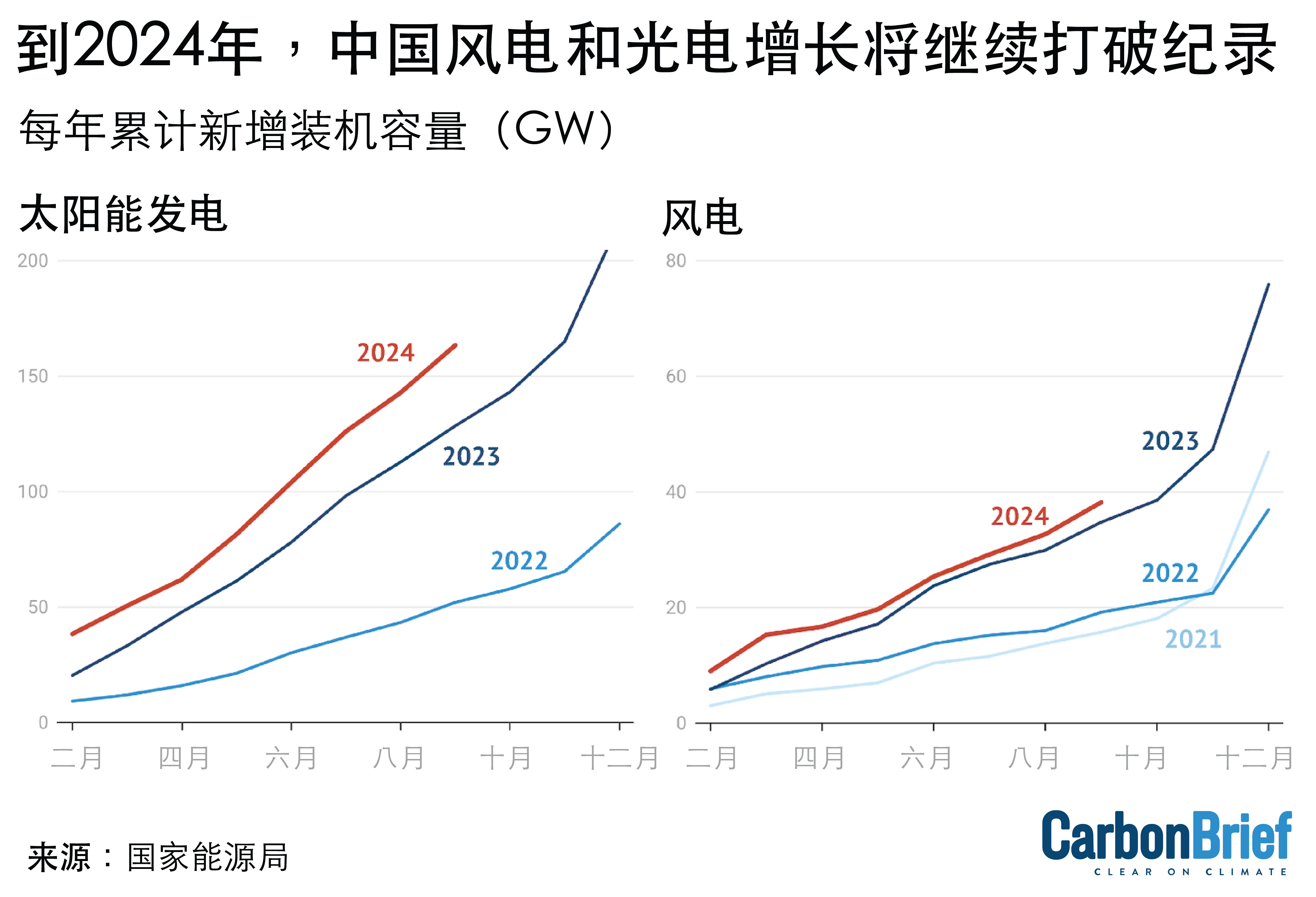
根据今年前九个月的增速,仅今年中国太阳能发电量的增长就可能相当于澳大利亚或越南在2023年的总发电量。
风电装机也加速增长,截至九月新增了38GW,同比增长10%,超过英国的总风电装机容量(30GW)。
今年八月,国务院一次性核准了11台新核电机组,获批项目的总发电装机容量约13GW。继2022年和2023年各核准10台核电机组后,2024年迄今批准的11台机组标志着中国下一批核电产能正在启动,将助力清洁能源增长。
在第三季度,水电装机仅同比增长2%,意味着11%的发电量增长主要源自利用率的恢复。由于严重干旱,水电利用率在2022年跌至十年来最低,2023年仅部分恢复,今年的反弹已接近预期平均水平。
2024年上半年,中国新核准的煤电项目骤降了80%,仅批准9GW,相比去年同期的52GW大幅下降。然而,根据能源资讯提供商Polaris Network的数据,第三季度有八个大型煤电项目获批,显示核准量可能在下半年有所增加。
建筑和石油需求放缓继续拉低总排放
虽然电力行业的碳排放在2024年第三季度出现了小幅增长,但工程量的持续萎缩拉低了总排放量。
因此,第三季度中国的碳排放量保持平稳,与去年同期水平持平或略低,如下图所示。
如果剖析建筑业导致的除电力行业以外的排放下降会发现,第三季度钢铁产量下降9%,水泥产量下降12%,房地产投资萎缩10%,与上半年持平。
这导致与2023年同期相比,水泥相关碳排放量减少了11%(24MtCO2),如下图所示。
尽管钢铁产量下降了9%,但钢铁相关排放量仅下降了3%(13MtCO2),原因在于需求下降的冲击主要由电弧炉炼钢厂承担,而不是排放强度高得多的燃煤高炉炼钢厂。
中国钢铁行业缺乏优先发展电弧炉的激励机制。电弧炉使用回收废钢,排放量较低。理论上,将钢铁纳入中国的碳排放权交易市场可能会促进转型。
然而,如果对该行业采取与电力行业相同的方式,对燃煤高炉炼钢和电炉炼钢设定不同的基准,则难以激励电力转型。
为推动钢铁行业结构性变革,中国工信部颁布政策,暂停所有新增钢铁产能的核准,将年初以来的实际停止审批变成正式禁令。直至去年,该行业仍在大规模投资煤基炼钢产能。

另一个排放下降的主要领域是石油消费,第三季度石油相关碳排放下降了2%(13MtCO2),如上图所示。该数据来自国家统计局。
石油需求和相关二氧化碳排放量的减少可能更多。石油产品供应量(以炼油厂扣除进出口后的产量计算)降幅更大。该指标显示,第三季度燃烧石油产生的碳排放下降了10%(63MtCO2),表明中国的二氧化碳总排放量或下降2%。
统计局报告的降幅要温和得多,这可能反映了中国统计数据趋于平缓化的特点。另一种可能的解释是,炼油厂以前的产量超出了消费需求,现在不得不削减产量以减少库存。
无论石油消费量下降的幅度如何,其下降原因已显而易见。工程量减少是重要因素,因为很大一部分柴油用于建筑工地和运输建筑材料。
电动车份额的增加也侵蚀了汽油需求量。家庭消费支出疲软也推动了需求减少,直到十月政府刺激政策出台后才出现回升迹象。
使用液化天然气的卡车的普及也对柴油需求形成抑制。2024年初至九月,液化天然气卡车销量占卡车总销量的20%,但天然气整体需求增长缓慢,表明这一影响有限。
天然气消费量增速从今年上半年的10%放缓至第三季度的3%。增量集中在电力行业,其他行业需求停滞,可能是由于工业需求疲软。
在经历了一二月排放量上升、三月至八月下降、九月再次增加后,年末三个月排放量需要至少下降2%,方能使中国的年度总排放量低于2023年水平。
由于工业电力需求增长的持续放缓和空调季的结束,这种情况很有可能发生。但即便如此,中国仍将偏离2025年的碳强度目标。该目标要求,在2020年至2023年中国排放量快速增长之后,在2024年和2025年都需至少下降2%。
排放量没有更快下降——甚至可能在第三季度根本没有下降——的根本原因是:今年能源消费量增速继续远超历史趋势。
第三季度,能源消费总量(包括但不限于电力消费量)增长了5.0%,快于GDP增长4.6%。
在疫情前,中国的能源需求增长一直低于GDP增速,这意味着经济的能源强度在下降。
然而,疫情后以制造业为重点的经济政策似乎扭转了这一趋势。
煤化工行业获得新的政策支持
中国碳排放前景中新增的一个变数是煤化工行业。该行业将国内煤炭转化为进口石油和天然气的替代品,尽管碳足迹要高得多。
国家发改委最近出台的政策要求“加快”煤化工行业的发展,包括“加快煤制油气战略基地建设”。
政策发布后数周,山西一个大型煤制油项目和陕西一个煤化工园区已开工建设,新疆也有类似项目获得核准。
据咨询公司中信建投期货称,2024年,煤化工行业的煤炭消费量预计将占中国煤炭总消费量的7%以上。
万得金融终端(Wind Financial Terminal)的数据表明,2024年前八个月煤化工行业的煤炭消费量增长了18%,2023年增长了9%。在今年一至八月期间,煤化工行业煤炭消费量增长所带来的排放占化石燃料碳排放总量增长的三分之二(总增幅为0.9%)。
然而,该行业的煤炭消费量增速在七月至八月放缓至5%,九月化工产品产量也继续放缓。上图(“化工”)显示了这个对碳排放量增长的较小推动因素。
近期油气价格上涨、加上中国增加国内煤炭产量和压低国内煤炭价格的努力,共同提振了对油价和煤价敏感的煤化工行业。
煤化工行业体现了中国是将能源安全,还是减排置于优先事项的直接矛盾。
经济刺激计划为排放前景增添不确定性
今年夏季的经济数据显示中国经济持续放缓、GDP增长未达目标,因此市场对当局出台刺激计划的预期随之增强。
政府在九月下旬宣布了一系列刺激措施,其主要针对金融市场,但也承诺要“稳定”房地产市场。
尽管该刺激计划的规模对于中国而言并不算大,进一步的细节也让那些希望政策出现更激烈转向的人感到失望,但该方案显然是经过深思熟虑后协调进行的,让外界得以一窥中国最高决策者正计划如何应对经济下行。
近年来广受关注的直接向家庭转移政府资金的措施,如今也将开始尝试。
这些措施旨在提振家庭消费,而非此前刺激政策重点的高能耗制造业和建筑业,若得以实施将让中国在更低能耗、低碳排的方式下实现增长。
然而,与整个一揽子计划的规模相比,直接转移资金的规模较小,且大部分资金用于汽车和家电补贴。这些补贴释放了家庭现金流,但同时也引导了家庭支出向最高耗能的领域集中。
大部分刺激资金仍通过地方政府借贷和银行贷款等传统渠道进行,这些资金通常用于工业和基础设施项目。
该刺激计划并没有明确着墨于气候。尽管相当一部分资金可能会流向与清洁能源相关的领域,但这只是因为这些投资最近在中国的投资流中占据主导地位,但该计划并未有额外政策推动此类投资。
决策者不认为碳排放会“提前”达峰
尽管清洁能源的快速增长似乎表明中国可能很快实现碳达峰,但决策者仍然预期碳排放量将在2030年之前继续增长,然后趋于平稳或逐渐下降。
今年八月,国家能源局在回应记者就有分析显示中国可能已实现碳达峰的问题时,淡化了这一可能性。
国家能源局相关部门负责人在回答这一问题时强调,国家领导层已确定“2030年前”为实现碳达峰的时间点,暗示该机构并无授权改变这一目标。
中共中央也在一份《意见》中重申,该国的目标是到2035年前让碳排放进入“下降趋势”。
国务院此前的一项计划表明,中国将在碳达峰后重点控制二氧化碳排放总量,而非排放强度,并表示这不会在2026至2030年期间发生。
根据中国目前在《巴黎协定》中的承诺,其允许采取一种非常渐进的方法来实现碳达峰并在达峰后减少排放,将更大幅度的减排留到未来几十年。
然而,这种路径将消耗全球1.5°C温控目标下90%的碳预算。若要限制全球气温上升至比工业化前高1.5°C以内,中国的排放量需在2035年之前至少比2023年水平下降30%。
国际能源署(IEA)最新分析指出,到2035年,中国等新兴市场需要将排放量减少到比2022年水平低35至65%的水平,以实现在COP28气候大会上做出的全球承诺或国家净零目标。
与中国决策者所传递的谨慎态度相反,若中国能保持当前的清洁能源扩展速度并推进电气化,到2035年,化石燃料的二氧化碳排放量将在2023年的水平上减少30%。
同样,国际能源署最新发布的《世界能源展望》(World Energy Outlook)发现,根据目前的政策方案,清洁能源的增长将有助于到2035年将中国的二氧化碳排放量减少到比2023年水平低24%。国际能源署表示,如果中国实现其宣布的雄心和目标,到2035年,碳排放量的削减将增加到45%。
根据《巴黎协定》,中国将于2025年2月前向联合国提交国家自主贡献(NDC)承诺,预计其将更清楚地说明决策者正在追求的减排途径。
关于数据
分析数据汇编自中国国家统计局、国家能源局、中国电力企业联合会和中国海关的官方数据发布,以及行业数据提供商万得资讯(WIND Information)的数据。
风能和太阳能发电量,以及按燃料划分的火电发电量系通过将每月末的发电装机乘月利用率计算得出,数据来自万得金融终端提供的中电联报告数据。
火电总发电量以及水电、核电发电量来自国家统计局月度发布数据。
由于没有生物质的月利用率数据,因此采用了2023年52%的年平均值。电力部门的煤炭消费量估算基于燃煤发电量和每月燃煤电厂的平均热耗率,以避免有争议的官方煤炭消费数据对近期其他产量数据的影响。
当数据来自多个来源时,本文对不同来源的数据交叉引用,并尽可能使用官方来源,调整总消费量以匹配国家统计局报告的第一季度、上半年和前三季度的消费增长和能源结构变化。数据调整对所有能源的影响不到1%。未经调整的数据显示,第三季度的排放量减少了1%。
二氧化碳排放量的估算基于国家统计局的默认燃料热值和中国最新的2018年国家温室气体排放清单中的排放因子。水泥的二氧化碳排放因子基于截至2023年的年度估算。
对于石油消费,表观消费量是根据炼油加工量计算的,并减去石油产品的净出口量。
The post 分析:尽管煤电反弹,但中国2024年三季度碳排放未增长 appeared first on Carbon Brief.
Greenhouse Gases
DeBriefed 12 December: EU under ‘pressure’; ‘Unusual warmth’ explained; Rise of climate boardgames
Welcome to Carbon Brief’s DeBriefed.
An essential guide to the week’s key developments relating to climate change.
This week
EU sets 2040 goal
CUT CRUNCHED: The EU agreed on a legally binding target to reduce greenhouse gas emissions by 90% from 1990 levels by 2040, reported the EU Observer. The publication said that this agreement is “weaker” than the European Commission’s original proposal as it allows for up to five percentage points of a country’s cuts to be achieved by the use of foreign carbon credits. Even in its weakened form, the goal is “more ambitious than most other major economies’ pledges”, according to Reuters.
PETROL CAR U-TURN: Commission president Ursula von der Leyen has agreed to “roll back an imminent ban on the sale of new internal combustion-engined cars and vans after late-night negotiations with the leader of the conservative European People’s Party,” reported Euractiv. Car makers will be able to continue selling models with internal combustion engines as long as they reduce emissions on average by 90% by 2035, down from a previously mandated 100% cut. Bloomberg reported that the EU is “weighing a five-year reprieve” to “allow an extension of the use of the combustion engine until 2040 in plug-in hybrids and electric vehicles that include a fuel-powered range extender”.
CORPORATE PRESSURE: Reuters reported that EU countries and the European parliament struck a deal to “cut corporate sustainability laws, after months of pressure from companies and governments”. It noted that the changes exempt businesses with fewer than 1,000 employees from reporting their environmental and social impact under the corporate sustainability reporting directive. The Guardian wrote that the commission is also considering a rollback of environment rules that could see datacentres, artificial intelligence (AI) gigafactories and affordable housing become exempt from mandatory environmental impact assessments.
Around the world
- EXXON BACKPEDALS: The Financial Times reported on ExxonMobil’s plans to “slash low-carbon spending by a third”, amounting to a reduction of $10bn over the next 5 years.
- VERY HOT: 2025 is “virtually certain” to be the second or third-hottest year on record, according to data from the EU’s Copernicus Climate Change Service, covered by the Guardian. It reported that global temperatures from January-November were, on average, 1.48C hotter than preindustrial levels.
- WEBSITE WIPE: Grist reported that the US Environmental Protection Agency has erased references to the human causes of climate change from its website, focusing instead on “natural processes”, such as variations in the Earth’s orbit. On BlueSky, Carbon Brief contributing editor Dr Zack Labe described the removal as “absolutely awful”.
- UN REPORT: The latest global environment outlook, a largest-of-its-kind UN environment report, “calls for a new approach to jointly tackle the most pressing environmental issues including climate change and biodiversity loss”, according to the Associated Press. However, report co-chair Sir Robert Watson told BBC News that a “small number of countries…hijacked the process”, diluting its potential impact.
$80bn
The amount that Chinese firms have committed to clean technology investments overseas in the past year, according to Reuters.
Latest climate research
- Increases in heavy rainfall and flooding driven by fossil-fuelled climate change worsened recent floods in Asia | World Weather Attribution
- Human-caused climate change played a “substantial role” in driving wildfires and subsequent smoke concentrations in the western US between 1992-2020 | Proceedings of the National Academy of Sciences
- Thousands of land vertebrate species over the coming decades will face extreme heat and “unsuitable habitats” throughout “most, or even all” of their current ranges | Global Change Biology
(For more, see Carbon Brief’s in-depth daily summaries of the top climate news stories on Monday, Tuesday, Wednesday, Thursday and Friday.)
Captured

The years 2023 and 2024 were the warmest on record – and 2025 looks set to join them in the top three. The causes of this apparent acceleration in global warming have been subject to a lot of attention in both the media and the scientific community. The charts above, drawn from a new Carbon Brief analysis, show how the natural weather phenomenon El Niño, sulphur dioxide (SO2) emissions from shipping, Chinese SO2, an eruption from the Hunga Tonga-Hunga Ha’apai volcano and solar cycle changes account for most of the “unusual warmth” of recent years. Dark blue bars represent the contribution of individual factors and their uncertainties (hatched areas), the light blue bar shows the combined effects and combination of uncertainties and the red bar shows the actual warming, compared with expectations.
Spotlight
Climate change boardgames
This week, Carbon Brief reports on the rise of climate boardgames.
Boardgames have always made political arguments. Perhaps the most notorious example is the Landlord’s Game published by US game designer and writer Lizzie Magie in 1906, which was designed to persuade people of the need for a land tax.
This game was later “adapted” by US salesman Charles Darrow into the game Monopoly, which articulates a very different set of values.
In this century, game designers have turned to the challenge of climate change.
Best-selling boardgame franchise Catan has spawned a New Energies edition, where players may choose to “invest in clean energy resources or opt for cheaper fossil fuels, potentially causing disastrous effects for the island”.
But perhaps the most notable recent release is 2024’s Daybreak, which won the prestigious Kennerspiel des Jahre award (the boardgaming world’s equivalent of the Oscars).
Rolling the dice
Designed by gamemakers Matteo Menapace and Matt Leacock, Daybreak sees four players take on the role of global powers: China, the US, Europe and “the majority world”, each with their own strengths and weaknesses.
Through playing cards representing policy decisions and technologies, players attempt to reach “drawdown”, a state where they are collectively producing less CO2 than they are removing from the atmosphere.
“Games are good at modelling systems and the climate crisis is a systemic crisis,” Daybreak co-designer Menapace told Carbon Brief.
In his view, boardgames can be a powerful tool for getting people to think about climate change. He said:
“In a video game, the rules are often hidden or opaque and strictly enforced by the machine’s code. In contrast, a boardgame requires players to collectively learn, understand and constantly negotiate the rules. The players are the ‘game engine’. While videogames tend to operate on a subconscious level through immersion, boardgames maintain a conscious distance between players and the material objects they manipulate.
“Whereas videogames often involve atomised or heavily mediated social interactions, boardgames are inherently social experiences. This suggests that playing boardgames may be more conducive to the exploration of conscious, collective, systemic action in response to the climate crisis.”
Daybreak to Dawn
Menapace added that he is currently developing “Dawn”, a successor to Daybreak, building on lessons he learned from developing the first game, telling Carbon Brief:
“I want the next game to be more accessible, especially for schools. We learned that there’s a lot of interest in using Daybreak in an educational context, but it’s often difficult to bring it to a classroom because it takes quite some time to set up and to learn and to play.
“Something that can be set up quickly and that can be played in half the time, 30 to 45 minutes rather than an hour [to] an hour and a half, is what I’m currently aiming for.”
Dawn might also introduce a new twist that explores whether countries are truly willing to cooperate on solving climate change – and whether “rogue” actors are capable of derailing progress, he continued:
“Daybreak makes this big assumption that the world powers are cooperating, or at least they’re not competing, when it comes to climate action. [And] that there are no other forces that get in the way. So, with Dawn, I’m trying to explore that a bit more.
“Once the core game is working, I’d like to build on top of that some tensions, maybe not perfect cooperation, [with] some rogue players.”
Watch, read, listen
WELL WATCHERS: Mother Jones reported on TikTok creators helping to hold oil companies to account for cleaning up abandoned oil wells in Texas.
RUNNING SHORT: Wired chronicled the failure of carbon removal startup Running Tide, which was backed by Microsoft and other tech giants.
PARIS IS 10: To mark the 10th anniversary of the Paris Agreement, climate scientist Prof Piers Forster explained in Climate Home News “why it worked” and “what it needs to do to survive”.
Coming up
- 15-19 December: American Geophysical Union (AGU) annual meeting, New Orleans
- 15-19 December: 70th Meeting of the Global Environment Facility (Gef) Council, online
- 16 December: International Energy Agency: Future of electricity in the Middle East and North Africa webinar, online
Pick of the jobs
- Natural Resources Wales, senior strategic environmental policy specialist | Salary: Unknown. Location: Wales (hybrid)
- The Nature Conservancy, director of conservation – Mata Atlântica | Salary: Unknown. Location: São Paulo, Belo Horizonte, Rio de Janeiro and nearby cities, Brazil
- Barcelona Supercomputing Centre, postdoctoral researcher – downscaling for climate services | Salary: Unknown. Location: Barcelona, Spain
DeBriefed is edited by Daisy Dunne. Please send any tips or feedback to debriefed@carbonbrief.org.
This is an online version of Carbon Brief’s weekly DeBriefed email newsletter. Subscribe for free here.
The post DeBriefed 12 December: EU under ‘pressure’; ‘Unusual warmth’ explained; Rise of climate boardgames appeared first on Carbon Brief.
DeBriefed 12 December: EU under ‘pressure’; ‘Unusual warmth’ explained; Rise of climate boardgames
Greenhouse Gases
‘Cali Fund’ aiming to raise billions for nature receives first donation – of just $1,000
A major biodiversity fund – which could, in theory, generate billions of dollars annually for conservation – received its first donation of just $1,000 in November.
The Cali Fund was created under the UN Convention on Biological Diversity (CBD) at the COP16 nature negotiations in Cali, Colombia, last year.
On 19 November, nine months after the fund officially launched, UK start-up TierraViva AI put forward the first contribution.
The $1,000 payment is an “ice-breaker”, the company’s chief executive tells Carbon Brief, aimed at encouraging others “who may be hesitating” to pay in.
The fund is designed to be a way for companies that rely on nature’s genetic resources to share some of their earnings with the developing, biodiverse countries where many of the original resources are found.
Companies use genetic data from these materials to develop products, such as vaccines and skin cream.
One expert describes the $1,000 as a good “first step”, but says it is “time for larger actors to step forward”. Another says it “squarely points the finger to the profit-making enterprises that are not contributing”.
The CBD is “pleased” about the first payment, a spokesperson tells Carbon Brief, adding that “many discussions” are ongoing about future donations.
Funding biodiversity action
Companies all around the world use genetic materials from plants, animals, bacteria and fungi often found in biodiversity-rich, global south countries to develop their products.
There are existing rules in place to secure consent and ensure compensation if companies or researchers travel to a country to physically gather these materials.
Today, however, much of this information is available in online databases – with few rules in place around access. This genetic data is known as digital sequence information (DSI).
The Cali Fund is part of an effort to close this loophole.
The COP16 agreement on the creation of the fund outlined that large companies in several sectors, including pharmaceutical, cosmetic, biotechnology, agribusiness and technology, “should” contribute a cut of the money they earn from the use of these materials. (See: Carbon Brief’s infographic on DSI.)
The money is intended to fund biodiversity action, with 50% of resources going to Indigenous peoples and local communities who protect vast swathes of the world’s nature and biodiversity.
These contributions, however, are voluntary.
The fund officially launched at the resumed COP16 negotiations in Rome in February 2025, where a spokesperson for the CBD said that first contributions could be announced in spring.
However, Carbon Brief reported in August that the fund was still empty.
On 19 November, the first contribution was announced during the COP30 UN climate summit. At $1,000, the amount was significantly lower than the potential millions that larger companies could pay in.
A UK government press release described it as a “major milestone” that will “pav[e] the way for others to do the same and mobilise private sector finance for nature at scale”.

The payment was an “expression of our commitment to the objectives of the Cali Fund”, TierraViva AI chief executive Dr Paul Oldham wrote in a letter to the executive secretary of the CBD, Astrid Schomaker.
The $1,000 is an “initial contribution”, Oldham said, and the company plans to give more “as our business grows”. Based in the UK with a team of programmers in Nairobi, TierraViva AI was set up in 2023 and uses AI to support conservation.
An anthropologist who worked on Indigenous peoples’ rights in the Amazon, Oldham’s research helped inform the list of sectors most likely to “directly or indirectly benefit from the use of DSI”, including “generative biology” and AI companies.
Oldham noted in a speech at the sidelines of COP30 that although the company’s earnings are not large enough to meet the contribution thresholds set out in the Cali Fund agreement, its contribution showed that companies “of any size” can pay in.

He tells Carbon Brief that while “some” companies “are not serious about contributing and are seeking to delay” paying into the fund, others have different concerns, including the “need for a level playing field” and positive incentives to contribute:
“This will be hard-earned company money, so it’s reasonable enough to imagine that one of the first questions companies will want an answer to is: ‘well, what is this actually going to be spent on?’ And: ‘what is the benefit of this to us’, which is likely to vary by sector.
“In my view, the best way forward would be for companies that can to make contributions. That would give everybody, including governments, confidence that there might be constructive ways to address difficult topics.”
Future contributions
A spokesperson for the CBD tells Carbon Brief:
“We are pleased that the Cali Fund is not only ‘open for business’, but that this first contribution also demonstrates it is fully operational. We thank and congratulate TierraViva AI for being the first company to step up.”
“Many discussions” are ongoing around future donations to the fund, the spokesperson says, and the CBD is “hopeful that further announcements can be made soon”, ahead of the next UN biodiversity summit, COP17, in October 2026.
Asked whether the CBD was expecting more contributions at this stage, the spokesperson says the fund was set up in “very short order” and that the first payment shows that companies are “able to contribute”.
US biotechnology company Ginkgo Bioworks was the first to pledge to contribute to the fund earlier this year, but has so far not put forward any money. The company did not respond to Carbon Brief’s request for comment.
Carbon Brief reported earlier this year that at least two companies were contacted by a UK department with opportunities to be involved in the Cali Fund before its launch in February, but no company took up on the offer.

The first contribution coming from a “startup that has just begun operations squarely points the finger to the profit-making enterprises that are not contributing”, Dr Siva Thambisetty, associate professor of law at the London School of Economics, tells Carbon Brief. Thambisetty adds:
“Strident cries of lack of legal certainty, unfairness or stacking obligations [combining responsibilities from different agreements and laws] would be more credible if industry organisations encouraged large firms that use DSI to begin contributing, instead of denying the last 20 years of multilateral [negotiations] that have led to this point.”
Dr June Rubis – Indigenous peoples and local communities (IPLC) lead from Asia on the Cali Fund’s steering committee – welcomes TierraViva AI’s “first step”, but tells Carbon Brief that the “real test lies ahead” and that it is “now time for larger actors to step forward”.
She says the Cali Fund offers “clarity” on how the private sector can directly increase support to UN-backed funds at a time when “states are retreating” from their climate and biodiversity finance obligations:
“It’s not a voluntary offsetting scheme or a…risky or fringe fund; it’s a multilateral mechanism designed to meet the highest fiduciary and equity standards. We invite companies to see this not as philanthropy, but as participation in a globally endorsed system where trust is institutionalised, benefits are traceable and equity is operationalised.
“Contributing to the Cali Fund isn’t just ethical, it’s strategic. [But] It’s about more than funding: it’s about trust, power-sharing and making sure IPLCs are part of the decisions, not just the outcomes.”
The post ‘Cali Fund’ aiming to raise billions for nature receives first donation – of just $1,000 appeared first on Carbon Brief.
‘Cali Fund’ aiming to raise billions for nature receives first donation – of just $1,000
Greenhouse Gases
Net-zero scenario is ‘cheapest option’ for UK, says energy system operator
A scenario that meets the “net-zero by 2050” goal would be the “cheapest” option for the UK, according to modelling by the National Energy System Operator (NESO).
In a new report, the organisation that manages the UK’s energy infrastructure says its “holistic transition” scenario would have the lowest cost over the next 25 years, saving £36bn a year – some 1% of GDP – compared to an alternative scenario that slows climate action.
These savings are from lower fuel costs and reduced climate damages, relative to a scenario where the UK fails to meet its climate goals, known as “falling behind”.
The UK will need to make significant investments to reach net-zero, NESO says, but this would cut fossil-fuel imports, support jobs and boost health, as well as contributing to a safer climate.
Slowing down these efforts would reduce the scale of investments needed, but overall costs would be higher unless the damages from worsening climate change are “ignored”, the report says.
In an illusory world where climate damages do not exist, slowing the UK’s efforts to cut emissions would generate “savings” of £14bn per year on average – some 0.4% of GDP.
NESO says that much of this £14bn could be avoided by reaching net-zero more cheaply and that it includes costs unrelated to climate action, such as a faster rollout of data centres.
Notably, the report appears to include efforts to avoid the widespread misreporting of a previous edition, including in the election manifesto of the hard-right, climate-sceptic Reform UK party.
Overall, NESO warns that, as well as ignoring climate damages, the £14bn figure “does not represent the cost of achieving net-zero” and cannot be compared with comprehensive estimates of this, such as the 0.2% of GDP total from the UK’s Climate Change Committee (CCC).
Net-zero is the ‘cheapest option’
Every year, NESO publishes its “future energy scenarios”, a set of four pathways designed to explore how the nation’s energy system might change over the coming decades.
(Technically the scenarios apply to the island of Great Britain, rather than the whole UK, as Northern Ireland’s electricity system is part of a separate network covering the island of Ireland.)
Published in July, the scenarios test a series of questions, such as what it would mean for the UK to meet its climate goals, whether it is possible to do so while relying heavily on hydrogen and what would happen if the nation was to slow down its efforts to cut emissions.
The scenarios have a broad focus and do not only consider the UK’s climate goals. In addition, they also explore the implications of a rapid growth in electricity demand from data centres, the potential for autonomous driving and many other issues.
With so many questions to explore, the scenarios are not designed to keep costs to a minimum. In fact, NESO does not publish related cost estimates in most years.
This year, however, NESO has published an “economics annex” to the future energy scenarios. It last published a similar exercise in 2020, with the results being widely misreported.
In the new annex, NESO says that the UK currently spends around 10% of GDP on its energy system. This includes investments in new infrastructure and equipment – such as cars, boilers or power plants – as well as fuel, running and maintenance costs.
This figure is expected to decline to around 5% of GDP by 2050 under all four scenarios, NESO says, whether they meet the UK’s net-zero target or not.
For each scenario, the annex adds up the total of all investments and ongoing costs in every year out to 2050. It then adds an estimate of the economic damages from the greenhouse gas emissions that primarily come from burning fossil fuels, using the Treasury’s “green book”.
When all of these costs are taken into account, NESO says that the “cheapest” option is a pathway that meets the UK’s climate goals, including all of the targets on the way to net-zero by 2050.
It says this pathway, known as “holistic transition”, would bring average savings of £36bn per year out to 2050, relative to a pathway where the UK slows its efforts on climate change.
The overall savings, illustrated by the dashed line in the figure below, stem primarily from lower fuel costs (orange bars) and reduced climate damages (white bars).

Note that the carbon pricing that is already applied to power plants and other heavy industry under the UK’s emissions trading system (ETS) is excluded from running costs in the annex, appearing instead within the wider “carbon costs” category.
This makes the running costs of fossil-fuel energy sources seem cheaper than they really are, when including the ETS price.
Net-zero requires significant investment
While NESO says that its net-zero compliant “holistic transition” pathway is the cheapest option for the UK, it does require significant upfront investments.
The scale of the additional investments needed to stay on track for the UK’s climate goals, beyond a pathway where those targets are not met, is illustrated in the figure below.
This shows that the largest extra investments would need to be made in the power sector, such as by building new windfarms (shown by the dark yellow bars). This is followed by investment needs for homes, such as to install electric heat pumps instead of gas boilers (dark red bars).
These additional investments would amount to around £30bn per year out to 2050, but with a peak of as much as £60bn over the next decade.
These investments would be offset by lower fuel bills, including reduced gas use in homes (pale red) and lower oil use in transport (mid green).
Notably, NESO says it expects EVs to be cheaper to buy than petrol cars from 2027, meaning there are also significant savings in transport capital expenditure (“CapEx”, dark green).

Again, the biggest savings in “holistic transition” relative to “falling behind” would come from avoided climate damages – described by NESO as “carbon costs”.
Net-zero cuts fossil-fuel imports
In addition to avoided climate damages, NESO says that reaching the UK’s net-zero target would bring wider benefits to the economy, including lower fuel imports.
Specifically, it says that climate efforts would “materially reduce” the UK’s dependency on overseas gas, with imports falling to 78% below current levels by 2050 in “holistic transition”. Under the “falling behind” scenario, imports rise by 35%”, despite higher domestic production.
This finding, shown in the figure below, is the opposite of what has been argued by many of those that oppose the UK’s net-zero target.

NESO goes on to argue that the shift to net-zero would have wider economic benefits. These include a shift from buying imported fossil fuels to investing money domestically instead, which “could bring local economic benefits and support future employment”.
The operator says that there is the “potential for more jobs to be created than lost in the transition to net-zero” and that there would be risks to UK trade if it fails to cut emissions, given exports to the EU – the UK’s main trading partner – would be subject to the bloc’s new carbon border tax.
Beyond the economy, NESO points to studies finding that the transition to net-zero would have other benefits, including for human health and the environment.
It does not attempt to quantify these benefits, but points to analysis from the CCC finding that health benefits alone could be worth £2.4-8.2bn per year by 2050.
Investment is higher for net-zero than for ‘not-zero’
It is clear from the NESO annex that its net-zero compliant “holistic transition” pathway would entail significantly more upfront investment than if climate action is slowed under “falling behind”.
This idea, in effect, is the launchpad for politicians arguing that the UK should walk away from its climate commitments and stop building new low-carbon infrastructure.
As already noted, the NESO analysis shows that this would increase costs to the UK overall.
Still, NESO’s new report adds that “falling behind” would “save” £14bn a year – relative to meeting the UK’s net-zero target – as long as carbon costs are “ignored”.
Specifically, it says that ignoring carbon costs, “holistic transition” would cost an average of £14bn a year more out to 2050 than “falling behind”, which misses the net-zero target. This is equivalent to 0.4% of the UK’s GDP and is illustrated by the solid pink line in the figure below.

Some politicians are indeed now willing to ignore the problem of climate change and the damages caused by ongoing greenhouse gas emissions. These politicians may therefore be tempted to argue that the UK could “save” £14bn a year by scrapping net-zero.
However, NESO’s report cautions against this, stating explicitly that the “costs discussed here do not represent the cost of achieving net-zero emissions”. It says:
“Our pathways cannot provide firm conclusions over the relative costs attached to the choices between pathways…We reiterate that the costs discussed here do not represent the cost of achieving net-zero emissions.”
It says that the scenarios have not been designed to minimise costs and that it would be possible to reach net-zero more cheaply, for example by focusing more heavily on EVs and renewables instead of hydrogen and nuclear.
Moreover, it says that some of the difference in costs between “holistic transitions” and “falling behind” is unrelated to climate action. Specifically, it says that electricity demand from data centres is around twice as high in “holistic transitions”, adding some £5bn a year in costs in 2050.
In addition, NESO says that most of the “saving” in “falling behind” would be wiped out if fossil fuel prices are higher than expected – falling from £14bn per year to just £5bn a year – even before considering climate damages and wider benefits, such as for health.
Finally, NESO says that failing to make the transition to net-zero would leave the UK more exposed to fossil-fuel price shocks, such as the global energy crisis that added 1.8% to the nation’s energy costs in 2022. It says a similar shock would only cost 0.3% of GDP in 2050 if the country has reached net-zero – as in “holistic transition” – whereas costs would remain high in “falling behind”.
The post Net-zero scenario is ‘cheapest option’ for UK, says energy system operator appeared first on Carbon Brief.
Net-zero scenario is ‘cheapest option’ for UK, says energy system operator
-
Climate Change4 months ago
Guest post: Why China is still building new coal – and when it might stop
-
Greenhouse Gases4 months ago
Guest post: Why China is still building new coal – and when it might stop
-
Climate Change2 years ago
Spanish-language misinformation on renewable energy spreads online, report shows
-
Greenhouse Gases2 years ago嘉宾来稿:满足中国增长的用电需求 光伏加储能“比新建煤电更实惠”
-
Climate Change Videos2 years ago
The toxic gas flares fuelling Nigeria’s climate change – BBC News
-
Climate Change2 years ago嘉宾来稿:满足中国增长的用电需求 光伏加储能“比新建煤电更实惠”
-
Carbon Footprint2 years agoUS SEC’s Climate Disclosure Rules Spur Renewed Interest in Carbon Credits
-
Climate Change2 years ago
Why airlines are perfect targets for anti-greenwashing legal action