

中国的气候和能源政策呈现出一种悖论:在以惊人的速度发展清洁能源的同时,也未停下新建燃煤电厂的步伐。
仅在2023年,中国就新建了70吉瓦(GW)的煤电装机容量,比2019年增长了四倍,占当年全球新增煤电装机容量的95%。
煤电产能的激增引发了人们对中国二氧化碳(CO2)排放和气候目标能否实现,以及对未来出现搁浅资产风险的担忧。
由于光伏和风能发电量不稳定,中国政府将煤炭作为保障能源安全和满足快速增长的用电高峰的手段。
与此同时,中国的电力行业在成本、需求模式、监管和市场运作方面正在发生重大变化。我们的新研究表明,用于证明新煤炭产能合理性的传统经济计算方式可能已经过时。
我们使用一个简单的分析指标来评估能满足用电高峰需求的最经济方式是什么。结果表明,光伏加电池储能的组合可能是比新建煤电更具成本效益的选择。
中国电力格局发生了怎样的变化?
在过去十年里,可再生能源和电池储能的成本大幅下降,高峰时段的住宅和商业用电需求激增,电力交易市场获得了更大的吸引力。
与此同时,中国还宣布了“双碳”目标,即在2030年前实现碳达峰、2060年前实现碳中和。鉴于这些转型,建设更多未减排的煤电厂与中国的长期气候承诺相冲突,而且对满足用电需求对增长来说,可能不再是最具成本效益的选择。它还占用了清洁能源系统转型急需的资金。
替代指标如何评估成本?
我们的研究引入了一种替代指标,用于计算在满足不断增长的高峰用电需求的情况下,所需的最优成本投资。

这一指标,即“净容量成本”(net capacity cost),是满足用电高峰需求所需的基础设施投资的年化固定成本,减去该设施带给电力市场的收入,或其“系统价值”(system value)。 在该指标中,负数意味着这些投资将带来利润,而非支出。
为了探索在中国使用的情境,我们使用了一个简单的例子:在一个假定省份,高峰用电需求增加了1500兆瓦(MW)、全年需求增加了6570吉瓦时(GWh)。
然后,我们概述了满足高峰和全年能源需求的五种策略(情况),其涵盖了从严重依赖煤电到光伏和电池储能相结合的方式。
在不同的案例中,资源衡量的规模基于它们能够可靠地满足高峰供应需求和年度能源需求的程度。
- 情况1:新的煤炭发电能力可满足高峰和年度能源需求的所有增长。
- 情况2:光伏可满足70%的年度能源需求增长,煤炭可满足30%的年度能源需求增长;光伏可满足525兆瓦的高峰供应需求(由于光伏发电可能不在高峰期间,因此基于“容量可信度”进行折减),而煤电可提供剩余的975兆瓦。
- 情况3:光伏可满足所有年度能源需求增长;光伏和煤炭均可满足750兆瓦的高峰供应需求,同样通过容量可信度对光伏发电量进行折减。
- 情况4:光伏满足所有年度能源需求增长;光伏和电池均为高峰供电需求提供750兆瓦;电池提供调频储备(用于管理精确至分钟的供需差异的备用电源)。
- 情况5:光伏满足所有年度能源需求增长;广泛和电池均为高峰供电需求提供750兆瓦;电池提供能源套利(在价格或成本较低时充电,在价格或成本较高时放电)。
如下图所示,我们针对每种情况都计算了单个资源(煤、电池或光伏),以及整个系统每年获得1千瓦(kW)发电容量的年净成本,单位为人民币元。
表上半部分的资源净容量成本是指该资源的净成本(即年化固定成本减去该资源从提供能源和辅助服务,如调频,所获得的年收入)。正数表示电网运营商在增加或获取该资源时的净成本。
表下半部分的系统总净容量成本,是在每种情况下利用资源组合满足高峰需求增长的净成本。
我们用于计算系统净成本的权重是基于装机容量与高峰需求增长的比率。
不同能源组合满足用电需求的成本
| 情况 1 | 情况 2 | 情况 3 | 情况 4 | 情况 5 | |
|---|---|---|---|---|---|
| 资源净容量成本 (元/千瓦/年, 每千瓦装机容量) | |||||
| 煤炭 | 424 | 424 | 512 | ||
| 电池 | 248 | 781 | |||
| 光伏 | -128 | -128 | -128 | -128 | |
| 系统净容量成本 (元/千瓦/年, 每千瓦满足高峰用电需求且折减容量可信度后) | |||||
| 煤炭 | 471 | 306 | 236 | ||
| 电池 | 138 | 434 | |||
| 光伏 | -223 | -319 | -319 | -319 | |
| 总计 | 471 | 83 | -83 | -181 | 115 |
为了对这一简单分析进行压力测试,我们研究了不同来源的各种价格的敏感性。
由于中国的光伏价格已经很低,我们的敏感性分析主要集中在煤炭、电池和其他分析所需投入的价格上。
满足高峰用电需求最经济的方法是什么?
我们的结果表明,当电池储能提供调频储备时(情况4),光伏和储能的组合是满足高峰用电需求增长最具成本效益的选择。
在这种组合下,每获得1千瓦发电装机容量,电网运营商的成本为-181元(约-25美元或-20英镑)。
相比之下,新建煤电产能以满足高峰用电需求增长(情况1)是最昂贵的方案,每获得1千瓦装机容量的净容量成本为471元(约合65美元或52英镑)。
情况3,即大型煤电厂仅用作备用电源(几乎不发电),在中国可能出于政治原因而至少在短期内不可行。
另外两种情况(情况2和情况5)更具可比性,但鉴于自本分析报告发布以来,电池价格下降了30%以上,约为每瓦时(Wh)1元人民币(约合0.14美元或0.11英镑),因此情况5中的电池可能比情况2中的煤炭更具经济吸引力。
我们的解决方案如何助力中国实现气候目标?
我们的分析表明,为了应对不断变化的形势,在满足中国日益增长的能源需求的同时,实现其气候目标的近期战略是将电池储能纳入电力市场。
目前,中国政府允许包括电池在内的“新型储能”参与电力市场。然而,详细规定尚不明确,电池的参与可以更简单。
例如,电池储能不被允许提供“运转储备”,即为应对意外的供需误差所预留的发电量。如果允许电池储能提供运转储备,将增强其商业价值。
允许电池储能更多地参与市场将促进电池储能系统的持续创新和降低成本,同时为系统运营商提供宝贵的运营经验。
这种策略将与市场效益相符,并反映美国和欧洲近期的电力市场经验。
这也将有助于解决近期的产能和能源需求,因为电池和光伏发电通常比燃煤电厂的建设速度更快。
此外,它还有助于缓解未来新增燃煤发电与可再生能源之间的冲突。主要作为可再生能源发电备用电源的新建燃煤电厂要么很少运营,要么侵占了其他现有煤炭发电厂的运营时间和净收入,从而产生新搁浅资产的风险。
通过继续进行电力市场改革,也将促进对可再生能源发电和电力储存进行更有效的投资。
允许市场制定批发市场电价、允许可再生能源发电和电力储存参与批发市场,这可以提高其收入和利润。
此外,改革还将鼓励高效利用储能,这是我们的关键发现。储能可以为电力系统提供多种功能;批发电价有助于引导储能运营以最低的成本实现具有最高价值的功能。
中国国家能源局最近发出指令,要求将新型储能设施(非抽水蓄能)纳入电网调度运行,这是向我们概述的改革迈出的一步。
可能需要进一步确定适当的补偿机制,例如在某些省份对此类储能设施提供的所有服务进行容量补偿,以促进这些储能设施的可持续发展和并网。
最后,仅靠增加供应不太可能成为满足中国电力需求增长的最低成本方式。提高终端使用效率和“需求响应”也有助于降低供电的总体成本。
随着中国电力市场改革的不断深入,连接多个省份的区域市场设计,以及鼓励省份间资源共享的区域资源充裕性规划,也有助于以最具成本效益和最低碳的方式满足中国不断增长的用电量和高峰需求。


The post 嘉宾来稿:满足中国增长的用电需求 光伏加储能“比新建煤电更实惠” appeared first on Carbon Brief.

Climate Change
FOIs show fossil fuel “rust bucket” Northern Endeavour shipped 17,000 kms from Australia with toxic, corrosive substances
SYDNEY, WEDNESDAY 24 JUNE 2026 — Freedom of Information documents obtained by Greenpeace Nordic reveal Australian oil processing vessel Northern Endeavour was carrying toxic waste when it was shipped across the world to Denmark, and its export by the Australian Government may have breached the Basel Convention.
The Northern Endeavour, a floating production storage and offloading (FPSO) vessel, which arrived at a Danish port in March, was found through FOIs to be carrying flammable liquids, poisonous substances, corrosive substances, toxins and ecotoxins, and its documentation was not signed by Australia’s Basel Competent Authority despite the shipment originating from an Australian offshore decommissioning project.
This week, Greenpeace Nordic protested the arrival of the Northern Endeavour to Frederikshavn Harbour in Denmark, displaying a two meter-long banner reading, “Australia, deal with your own toxic waste.”
Lauren Bowey, Campaign Leader at Greenpeace Nordic, said: “This issue is urgent –- Australia has 5.7 million tonnes of offshore oil and gas infrastructure to recycle — the steel equivalent of 110 Sydney Harbour Bridges and 11 more FPSOs like the Northern Endeavour. It cannot become a precedent that Australia puts the world’s oceans at risk by towing old, toxic oil and gas industry waste halfway across the world to Denmark.
“Of course these offshore structures should be decommissioned; leaving rusting industrial equipment to rot at sea poses serious and long-lasting environmental threats. But there is a safer solution than towing a 274 metre toxic rust bucket 17,000 kilometres across vulnerable international waters to Denmark. Australia must build its own recycling centre.”
Greenpeace Australia Pacific is renewing its calls for a decommissioning hub in Western Australia.
Geoff Bice, WA Lead at Greenpeace Australia Pacific, said: “The Northern Endeavour is a prime example of why oil and gas companies can not be trusted with our oceans, and why the Australian Government needs to establish a local decommissioning industry.
“In this case, gas corporation Woodside shirked its responsibilities and sold the Northern Endeavour to a company that could not afford to properly decommission it. The government then chose to ship the vessel, including the toxic waste onboard, halfway across the planet for decommissioning rather than deal with it at home.
“Australia must stop outsourcing the decommissioning of fossil fuel infrastructure and commit to a local industry. Maritime workers and local businesses would benefit from the sustainable jobs going their way, and Australia would seize a major untapped source of scrap steel — 5.7 million tonnes worth.
“Strong regulation and investment in local decommissioning would reduce risks to marine environments, prevent operators from delaying or avoiding the responsibility of decommissioning their infrastructure, and ensure industrial waste is not left to corrode in the ocean.”
-ENDS-
Images of Greenpeace Nordic’s protest can be found here
Media contact
Emma Sangalli on 0431 513 465 or emma.sangalli@greenpeace.org
Faster electrification is the best way to secure lower energy bills and stronger energy security, according to the Climate Change Committee (CCC).
The government’s official climate advisers have stressed the importance of electrification, noting that electric cars and heat pumps can “put money back into people’s pockets”.
Moreover, the UK’s net-zero targets face “significant risks” unless there is faster progress in electrifying cars, heating and industry, according to the CCC’s latest progress report
The report notes that the government has closed some of the gaps to its upcoming targets and introduced more “credible” plans.
However, challenges remain in the UK’s climate strategy, including accelerating the expansion of heat pumps, cutting emissions from farms and supplying planes with “sustainable” fuels.
The CCC notes that 17% of the emissions cuts required to achieve the UK’s 2030 Paris Agreement climate target are currently not addressed by any government plans at all.
Amid political and industry pressure, the committee also says the government should “stand firm” on its climate goals, including its strategy for encouraging electric-vehicle (EV) sales.
Carbon Brief has covered the CCC’s annual progress reports in 2025, 2024, 2023, 2022, 2021 and 2020.
- Overall progress
- The electrification ‘prize’
- Policy gaps
- Road transport
- Buildings
- Industry
- Fossil fuels
- Electricity
- Agriculture and land
- Aviation and shipping
- Other sectors
Overall progress
Today’s progress report is the third since Labour swept to power in 2024.
It arrives amid a “red extreme heat warning”, on the day that parliament will vote on the seventh “carbon budget”, a legally binding limit on UK emissions in 2040.
The report comes at a febrile moment in UK politics, with prime minister Keir Starmer having just resigned and with newly re-elected MP Andy Burnham widely tipped to take his place.
The opposition Conservatives and Reform are lobbying to scrap UK climate goals – and senior Labour figures want to row back on EVs and North Sea oil and gas drilling.
Against that backdrop, the CCC insists that it is the UK’s reliance on fossil fuels – and the second fossil-fuel price shock in four years – that has caused a “cost of living crisis”.
Speaking to journalists ahead of the launch, CCC chair Nigel Topping warned against any moves to weaken UK climate policies. He said:
“U-turns are really damaging to inward investment confidence…[We should] hold the course and focus on electrification…which will unlock very significant savings.”
Whereas the CCC said last year it had become “more optimistic” that UK climate goals could be met under the new government, its latest progress report strikes a more cautious tone.
It says that the UK’s emissions fell by 1.8% in 2025 and that there has been “some positive progress” in terms of delivery over the past year, but that this has been “too slow”.
There was actually an increase in emissions from transport and electricity supplies in 2025, as shown below, despite the expansion of clean power and EVs.
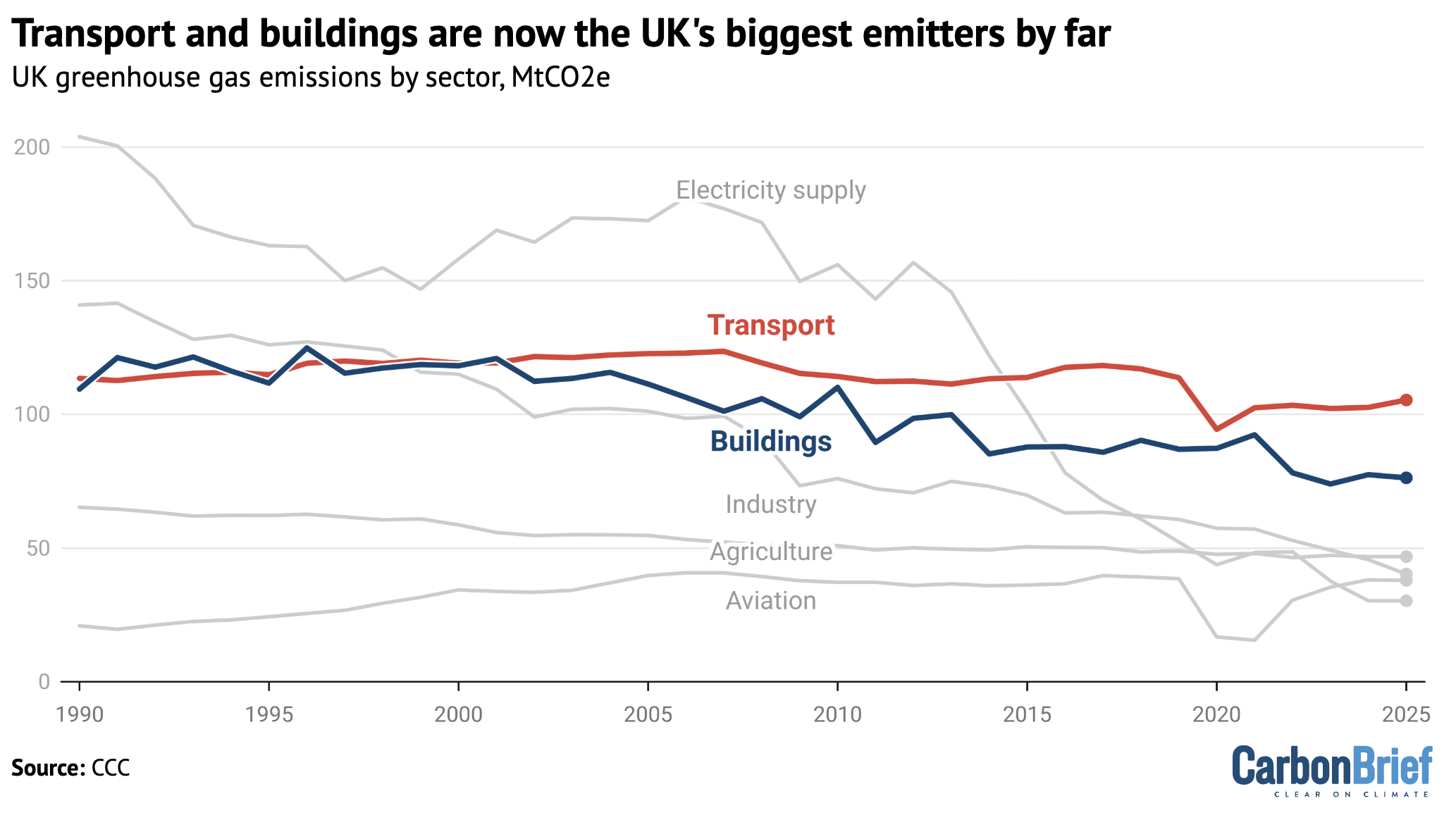
The UK’s greenhouse gas emissions are now roughly 50% below 1990 levels, the CCC notes, with the lion’s share of this having come from cleaning up the power sector.
In contrast, there has been far less progress in transport, which is now the UK’s largest emitter, as well as in buildings, the second largest.
The CCC stresses that future emissions cuts will need to come from using clean power to decarbonise other sectors – particularly buildings, transport and industry.
It puts a major emphasis on the need to electrify these sectors by more rapidly rolling out EVs, heat pumps and electric heating for industrial sites.
The CCC adds that government plans for meeting future targets, published last year, leave a “significant gap” to the UK’s international climate pledge for 2030. (See: Policy gaps.)
The electrification ‘prize’
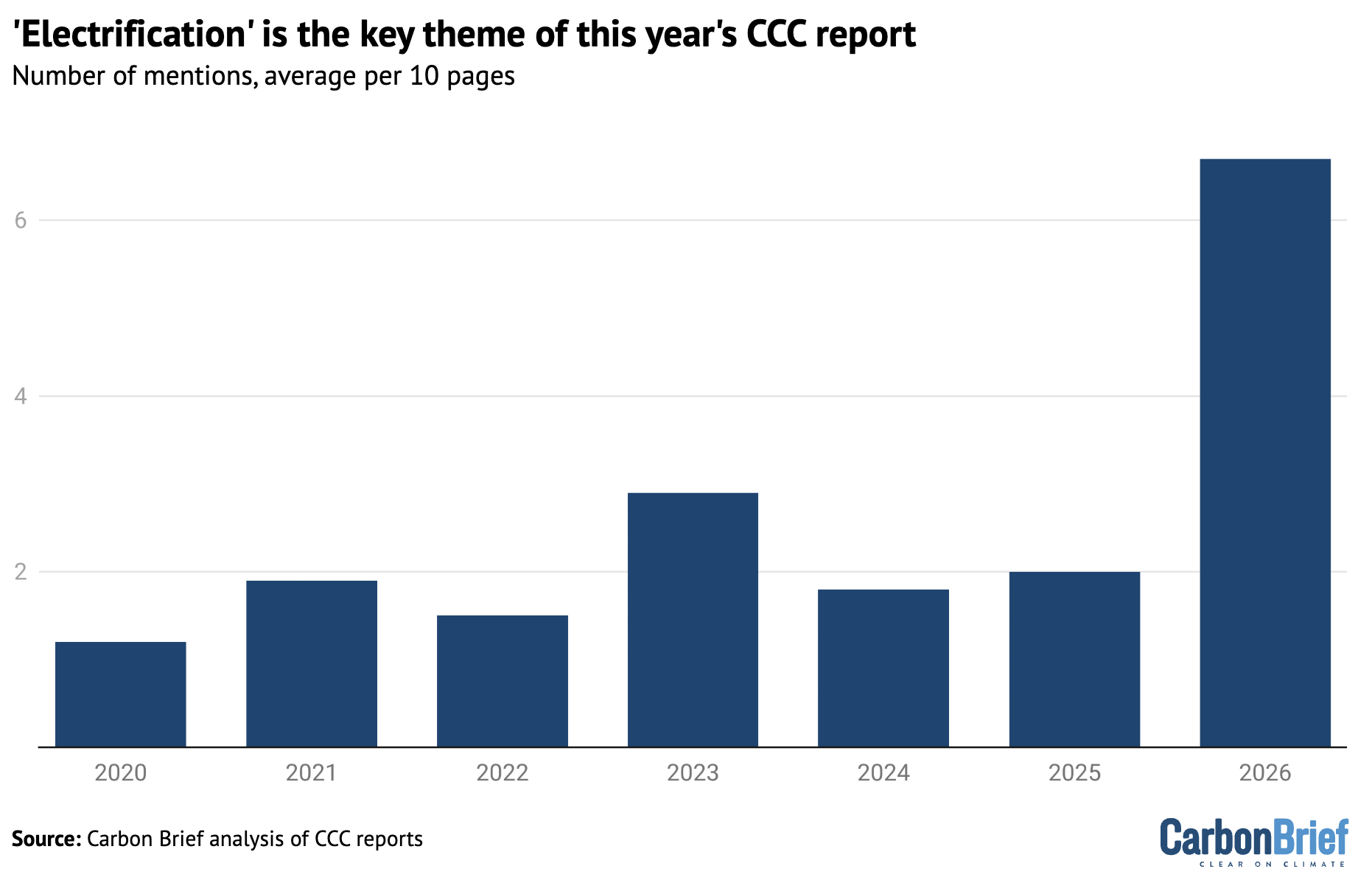
The most striking aspect of this year’s report is the way it centres on electrification, which the CCC says has been given “insufficient focus” to date.
Electrification has shot up the agenda in recent months, with the COP31 presidency calling for countries to back a global goal for 35% of “final” energy to come from electricity by 2035.
The text of the CCC’s latest report uses the word “electrification” far more often than previous editions, as shown in the figure below.
Early last year, in advice on the seventh carbon budget, the committee singled out electrification as key to cutting UK emissions. It said electrification had won out over alternative options, thanks to rapid cost reductions for technologies such as EVs.
Now, the CCC says that electrification is also the best way to secure lower energy bills, stronger energy security and a host of other benefits.
Topping said these benefits include “putting money back into people’s pockets”, but also cleaner air, stronger energy security and protection from fossil-fuel shocks:
“The prize is really significant here. By 2030 alone, the UK could save up to 80m barrels of oil and 1.5bn therms of gas each year. That would cost almost £8bn at current oil and gas prices.”
The emphasis on the topic is also clear in the CCC press release for its report, which is titled: “Faster electrification would cut UK household bills, say climate advisers.”
The report fleshes this out in a dedicated chapter that explores the financial benefits of electrifying household energy use, including heat and transport.
Topping said that the “home of the future” will be equipped with an EV, a flexible “time-of-use tariff” for its electricity supplies and a heat pump for keeping warm.
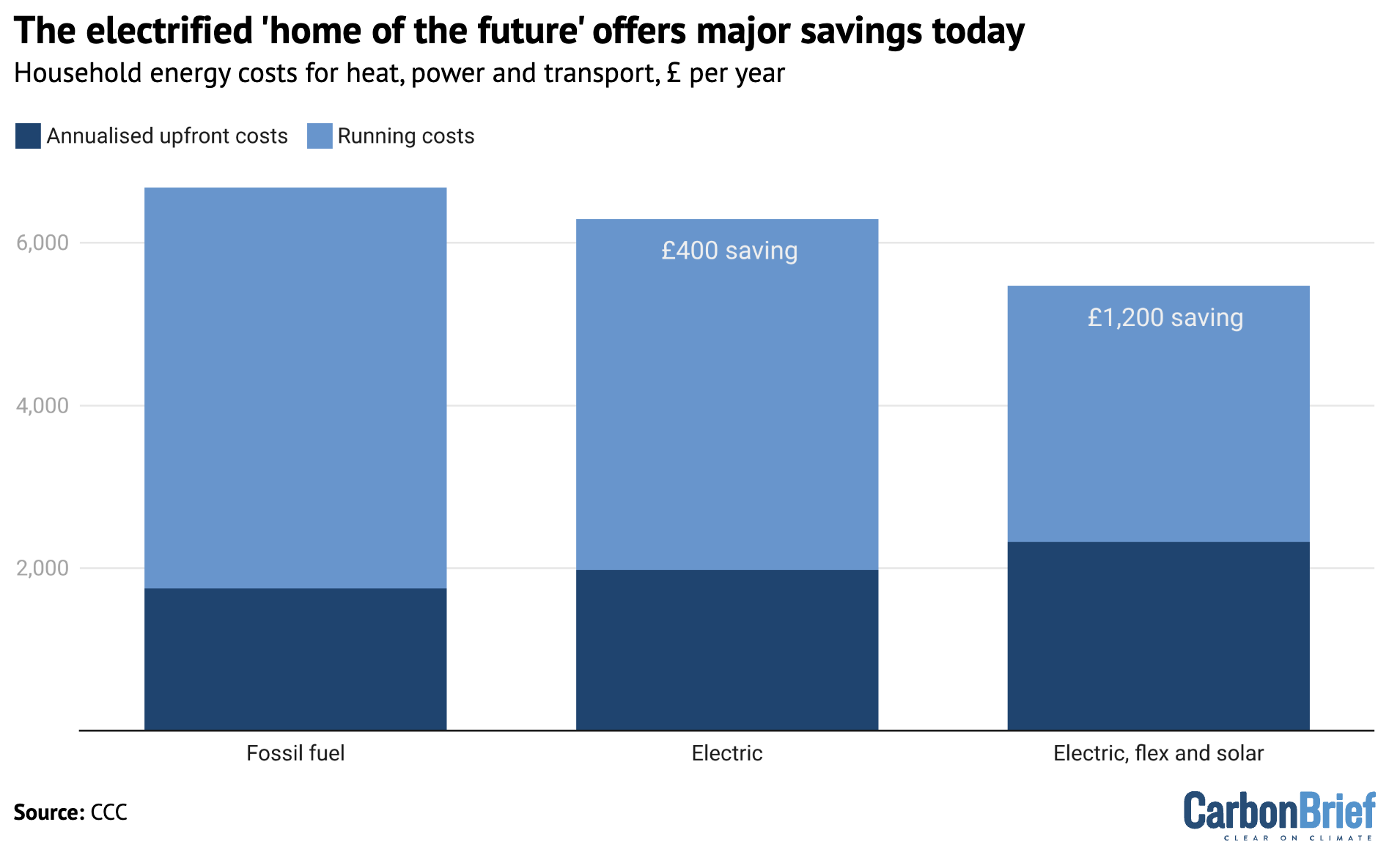
Moreover, the report shows that even today, this type of household would cut its annual energy bills by around £1,200, relative to using a petrol car and a gas boiler.
Crucially, this saving, shown in the figure below, includes the high upfront costs of installing an electric heat pump and solar panels. The analysis shows that electrified homes have far lower annual running costs, which easily outweigh this initial outlay.
(Due to “modelling limitations”, the CCC analysis does not consider home batteries, which can help unlock even larger savings.)
The CCC says that while not everyone is currently in a position to enjoy the financial benefits of electrification, its analysis points to savings both before and after the Iran crisis, as well as for high- and low-income households, with the latter eligible for grants to cover upfront costs.
Even more homes would be able to unlock these benefits if the government acts to resolve barriers, such as high public charging costs, says the CCC.
However, the report says that the government’s current plan to electrify the economy “lacks ambition” and that there are “worrying signs” in some areas, such as heat pumps and electric vans. (See: Road transport and Buildings.)
Ultimately, says the CCC, the best way to encourage faster and wider electrification is to make electricity cheaper. This has been its top recommendation for several years.
Policy gaps
Since the last CCC progress report, the government has published a new “carbon budget and growth delivery plan” (CBGD), explaining how it will cut emissions in the 2030s.
The CBGD “projects slower emissions reductions for surface transport and buildings compared to the previous government’s plan”, according to the CCC.
This reflects both the slow rollout of some technologies – such as heat pumps – and “areas of reduced policy ambition”, including less support for low-income homes to install insulation.
The CCC says that without “sufficient progress on electrification” this year, the UK’s 2030 emissions target “may become out of reach” and future goals would face “significant risks”.
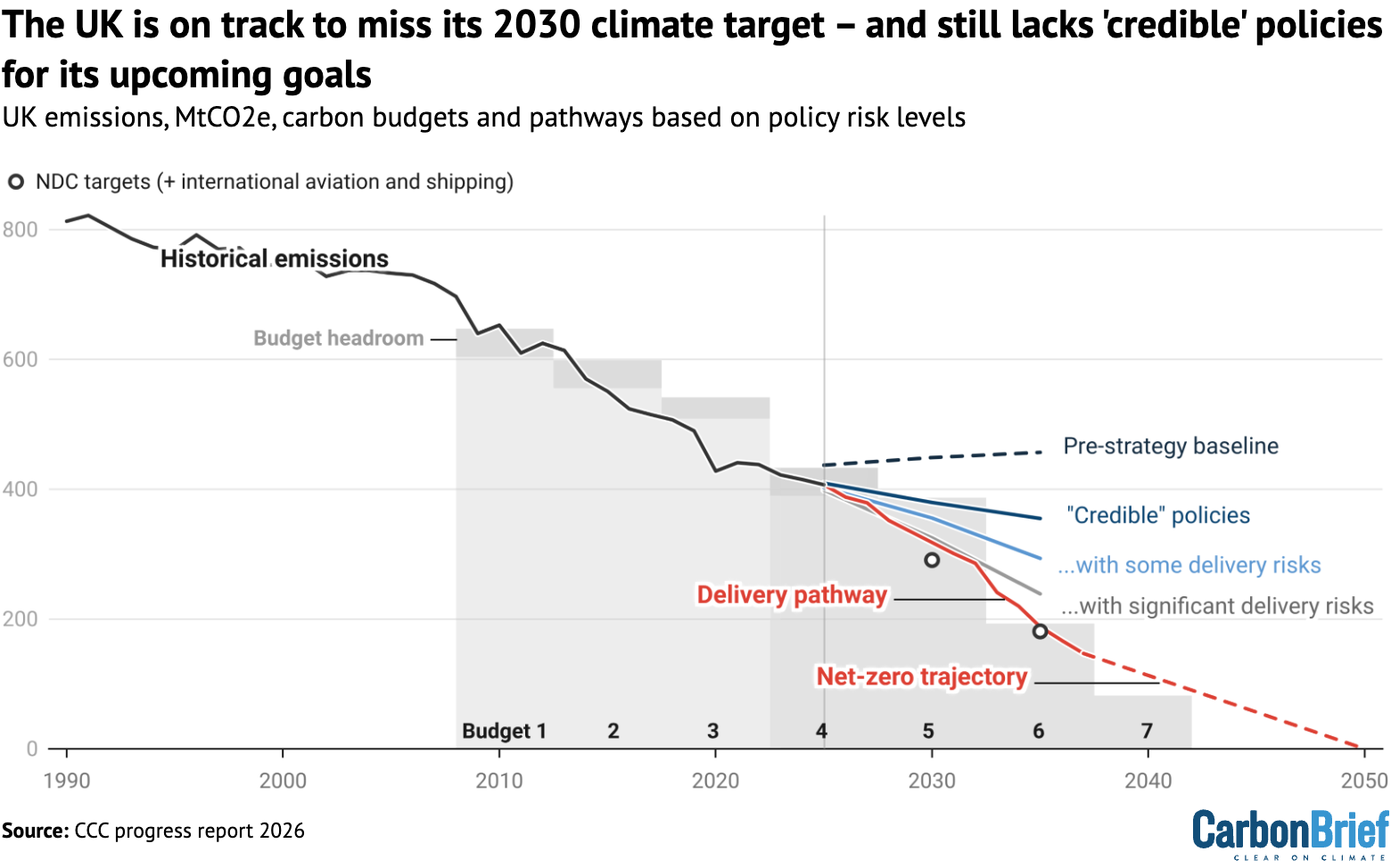
The chart below demonstrates the CCC’s view that the UK is “well on track” to meet its fourth carbon budget, between 2023 and 2027, and that there are “credible policies in place” to meet the fifth carbon budget out to 2032.
However, it also shows the “significant gap” that the CCC says still exists between projected emissions cuts (blue lines) and the UK’s international climate target for 2030, its nationally determined contribution (NDC) to the Paris Agreement (black circle).
(This is particularly notable as the NDC was the first official UK climate goal that was aligned with its 2050 net-zero target. The fourth and fifth carbon budgets were set before the net-zero goal and therefore need to be overachieved.)
Plans that are “credible” or only come with “some risks” are on track to cut emissions to 356m tonnes of carbon dioxide equivalent (MtCO2e) by 2030. This is 11MtCO2e lower than last year, but still a shortfall of 64MtCO2e.
Overall, the CCC says there are “credible” plans in place for 44% of emissions reductions by 2030, including those linked to renewable energy, EV sales growth and electrification of steel production at Port Talbot in Wales. Another 15% of reductions come with “some risks”.
The report concludes that there are “significant risks” attached to 19% of emissions cuts, including the expansion of heat pumps, future “sustainable aviation fuel” (SAF) supply and agricultural policies.
There are also 4% of required emissions cuts for which the UK has “insufficient plans”, including much of the electrification of the UK’s heavy industry.
The chart below shows how this assessment compares to previous CCC analysis of government plans, with the share of “credible” government plans increasing.
(As the latest report is based on the new CBGD rather than the previous 2023 plan, the assessments have different levels of baseline emissions and are not directly comparable. However, this chart shows the rough direction of travel.)
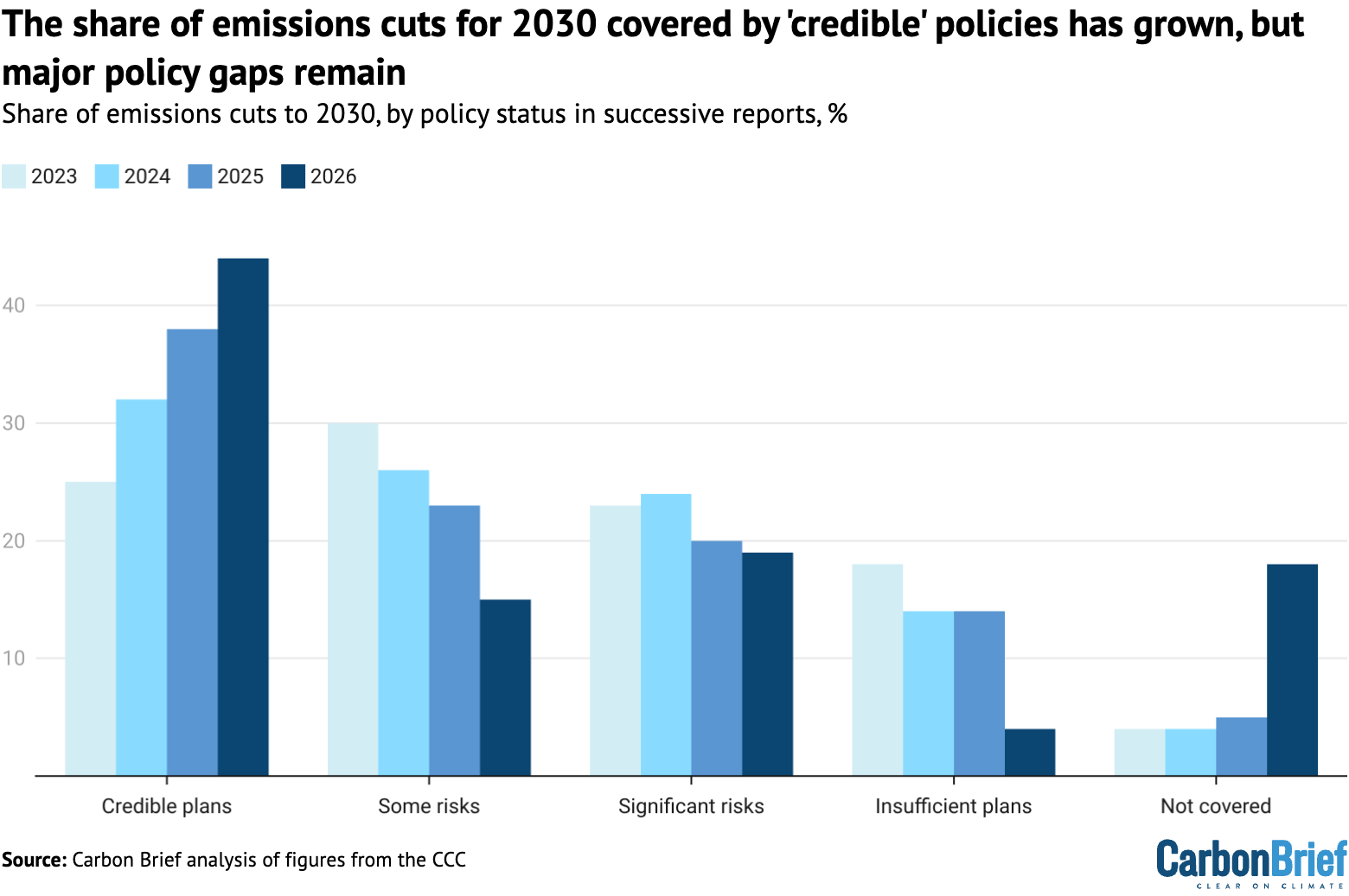
As the chart shows, a substantial chunk of the required emissions cuts need to meet the 2030 pledge – 17% of the total – are not covered by the CBGD.
This reflects the fact that the new plan simply does not achieve the 2030 target, according to the CCC, despite the government’s stated commitment to its NDC goal.
(The government’s plan had also acknowledged that it fell short of meeting the 2030 NDC.)
The CCC emphasises that “the government will need to bring forward additional policies and plans to make up this gap”.
The new report suggests several areas – including faster EV growth, more heat-pump installations and more ambitious recycling rates – that would close 17MtCO2e of the 26MtCO2e gap to the 2030 goal.
Unlike the 2030 NDC, the government’s plan does achieve the sixth carbon budget, between 2033 and 2037. However, the committee says “this is largely achieved through additional measures where we have assessed there to be significant risks or insufficient plans”.
Only around three-fifths of the required emissions cuts for the sixth carbon budget are covered by “credible” plans or plans with “some risks”.
According to the CCC, the government is relying on a rapid scale-up of engineered removals beyond 2030, but has provided little detail about how it will achieve this. (See: Other sectors)
“This approach carries substantial risks,” according to the committee.
Road transport
Road transport remains the UK’s highest emitting sector and its emissions increased by nearly 3% last year, according to provisional data in the CCC report.
Electric-car sales have continued increasing, reaching nearly a quarter of new sales last year. The number of electric cars on the road surpassed 2m in May 2025.
However, the emissions benefit of this rollout of electric vehicles (EVs) “is likely to have been offset by other factors”, such as driving rates returning nearly to pre-Covid levels, according to the CCC.
The report notes that EV costs “continue to fall” and have met price parity in some parts of the market, with grants providing an extra boost to sales.
The committee’s pathway to net-zero assumes faster emissions cuts from road transport than the government’s pathway. This is largely because it assumes an imminent “tipping point” will be reached, when EVs reach upfront price parity with petrol cars.
Nevertheless, the report says that sales will still “need to accelerate fast” over the next few years and that this will require consistent government support.
The CCC stresses the “key role” of the zero-emission vehicle (ZEV) mandate, which requires manufacturers to sell a rising share of EVs.
There have been reports that the government is planning a “U-turn” after a review of the ZEV mandate. The CCC says it is “essential” that the review “does not lead to further concessions”:
“Doing so would severely undermine prospects of achieving the UK’s 2030 NDC, exacerbate the UK’s dependence on imported oil, and leave more households paying the higher costs of petrol or diesel cars.”
As well as “stand[ing] firm” on the ZEV mandate, the committee says it is important that the government “remove[s] barriers to EV adoption”.
One key policy highlighted by the report is increased access to cheap EV charging, so the one-third of UK homes without off-street parking access can “benefit from lower running costs”.
(CCC analysis suggests that while the average home would save at least £660 a year by switching from a petrol car to an EV, their running costs could actually increase if they have to rely on public charging infrastructure.)
The report also stresses the use of EV “time-of-use tariffs”, which it says can help people save even more money. It notes that “measures to support consumer awareness” of this “could drive further uptake”.
Also, with a new 3p per mile EV tax due to start from April 2028, the committee says it is “essential that this new tax is implemented in a straightforward manner” to minimise the “hassle factor” that could disrupt the EV transition.
While electric-car sales have so far remained slightly ahead of the level needed to hit the ZEV mandate, the CCC notes that both electric van sales and prices are “significantly off track”. Unlike cars, electric vans still cost considerably more than their combustion-engine equivalents.
The committee says government support, including improved access to fast charging and “regulatory reforms”, is also “key”. As an example of the latter, it notes that certain licensing and testing requirements are based on vehicle weight, which puts heavier battery-powered vehicles at a disadvantage.
Finally, the CCC criticises recent policy decisions that incentivise sales of plug-in hybrids (PHEVs) “based on emissions factors which underestimate real-world emissions”. It notes:
“Providing incentives for emissions savings that PHEVs do not deliver distorts the market and risks eating into the demand for EVs.”
Buildings
The CCC says that the rate of growth in heat-pump installations in homes slowed last year, rising just 7%, compared to the 56% jump seen in 2024.
Around 52,000 heat pumps were installed in 2025, according to the report. Of these, 31,200 were installed with the support of grants from the “boiler upgrade scheme”.
This was not enough to meaningfully reduce emissions, says the CCC, only delivering around 0.1MtCO2e of extra savings in 2025.
(To eliminate emissions from homes by 2050, heat pump installations in existing homes need to reach 1.4m per year by 2035, according to the CCC.)
Overall, emissions from the buildings sector fell by 1.2MtCO2e in 2025, amounting to a reduction of 1.3% for non-residential and 1.6% for residential buildings compared to 2024.
This was despite the winter months being colder in 2025 than the previous year, generally meaning greater heating demand. This suggests factors other than weather are driving the reduction, it says, such as higher energy prices leading to lower heating use.
The CCC notes that while emissions did drop, this “does not indicate progress on decarbonising home heating”. It adds:
“Without further actions to decarbonise buildings, it is likely that emissions will rebound if energy prices fall or weather conditions revert to average.”
The slowdown in the rate of heat pump installations was largely due to the closure of the ECO scheme, which delivered around one-third of heat pump installations in existing homes over the last three years.
In terms of government policy, the CCC notes that there has been some “positive progress” for buildings, due to the new “warm homes plan” and the “future homes standard”.
The former provides support to help people install electric heat pumps, rooftop solar panels and insulation. In total, 5m homes are expected to benefit from £15bn of grants and loans earmarked by the government for these upgrades by 2030.
While installation rates in the UK in 2025 were significantly below this level, the CCC report says that growth rates in other European markets – and indeed, in the UK between 2023 and 2024 – suggest that higher rates could be achievable.
The CCC notes that while there is £1bn a year earmarked for supporting upgrades of low-income households under the warm homes plan, this is still a “significant decrease in investment” from that provided by ECO.
The future homes standard, meanwhile, is an update to existing regulations in England. From March 2028, new-build homes in England will be required to have on-site renewable energy generation and a low-carbon heating system.
From then on, newly built homes will produce 75% less greenhouse gas emissions than under previous regulations.
The CCC report notes that the installation of heat pumps in new homes, specifically, is currently on track to achieve targets, with 25% of new homes built with a heat pump in 2025. However, it says retrofit installations of existing homes are significantly below where they need to be and “urgently need to accelerate”.
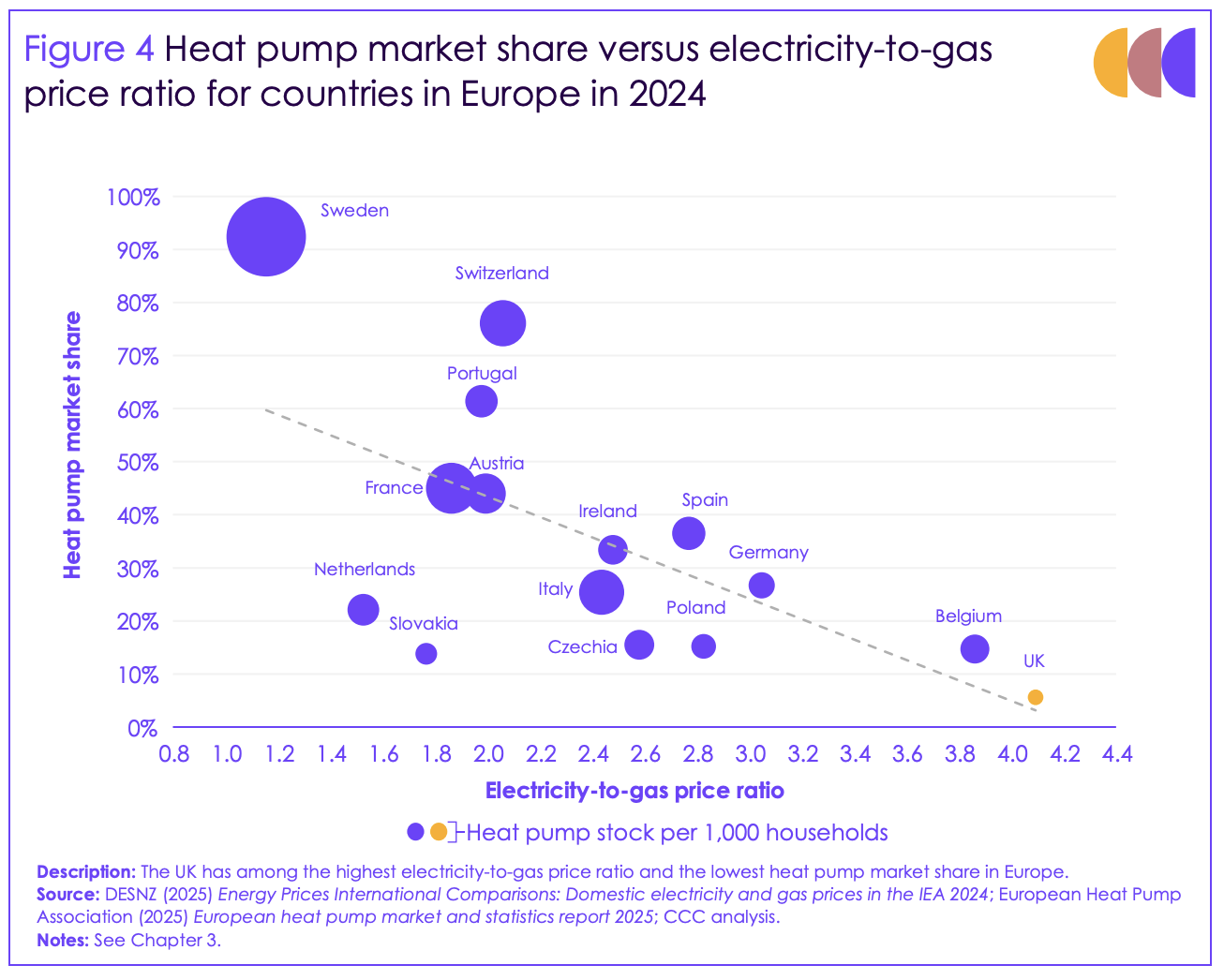
The CCC notes that while there has been some progress in removing policy costs from household electricity bills, the ratio of electricity to gas prices remains a major barrier to heat pump take-up. (See: The electrification ‘prize’.)
It also notes that there has been no action to address this barrier for non-residential buildings.
Fewer than 2% of homes have a heat pump in the UK, it says, placing the nation among the lowest rates of installation in Europe, as seen in the chart below.
Industry
Industry accounted for the largest share of emissions reduction in the UK in 2025, according to the CCC, with a 5.4MtCO2e (12%) drop from 2024.
As such, sectoral emissions for industry are now 56% lower than they were in 2008.
This was largely due to the closure of blast furnaces at the Port Talbot steelworks towards the end of 2024, ahead of reopening with new electric arc furnaces. Emissions from iron and steel production therefore fell by 3.2MtCO2e year-on-year in 2025, according to the CCC report.
The rest of the reduction was due to a fall in the output of energy-intensive, which the CCC says is in line with the longer-term trend in UK manufacturing seen since the 1990s.
However, the CCC notes that while some specific progress has been made to decarbonise industry, barriers to further progress remain.
It urges the government to set a clear plan for how electrification can become the economically rational choice for a wide range of industries.
As for buildings, the CCC points to the high electricity prices, relative to gas, as a major barrier to the decarbonisation of UK industry.
Carbon capture and storage (CCS) has taken some “positive steps”, according to the report. This includes the government allocating £9.4bn of funding to support its development.
There has also been a final investment decision for the first CO2 storage facility at a UK manufacturing site and the construction of transport and storage infrastructure for the nation’s first CCS industrial “clusters”.
Fossil fuels
The CCC’s report states that “many countries are responding” to the current global energy crisis triggered by the Iran war by “rapidly reducing dependency on fossil fuels”.
It continues that emissions from the UK’s fossil-fuel supply sector fell by 1.5MtCO2e in 2025, in line with the “significant historical decline seen over the last three decades”.
Emissions in the sector are now 45% lower than 2008 levels, it adds.
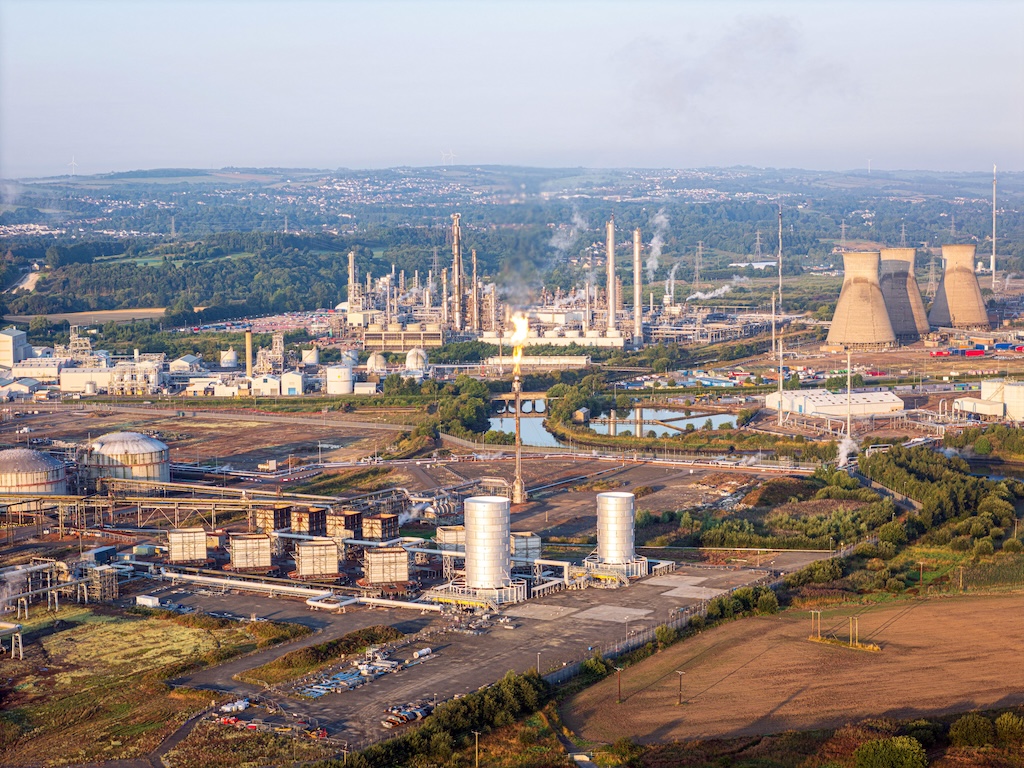
Key drivers of emissions decline from 2024-5 were a fall in emissions from oil refining of 0.9MtCO2e, mostly due to the closure of Grangemouth and Prax Lindsey refineries in 2025, according to the CCC.
Declines in production emissions associated with oil and gas were due to the closure of North Sea fields “as they reach the end of life”, says the report.
It adds that this is a “continuation” in a longer-term trend. Production emissions from oil and gas have fallen by 58% since 2008 and by 75% since their peak in 2000. The CCC continues:
“The decline in oil and gas production is expected to continue as oil and gas reserves in the mature North Sea basin are increasingly depleted – the NSTA [North Sea Transition Authority] projects a further decline in combined oil and gas production of 93% by 2050.”
The report does not directly address the Labour government’s policies on oil and gas production in the North Sea.
Labour has ruled out new oil and gas licences – a manifesto commitment that has been subject to intense lobbying from the oil and gas industry and right-wing media. (See Carbon Brief’s factcheck on nine false or misleading myths about the North Sea.)
However, the government has indicated it might approve new projects that already have a licence, if they can pass an environmental impact assessment that will consider the emissions from burning the oil and gas produced.
Speaking at a briefing for journalists, CCC chair Nigel Topping noted that oil and gas production is projected to continue to plummet in the coming decades, regardless of whether the government issues new drilling licences, adding:
“The real road to energy security is not through some marginal drilling decisions, but through electrifying the economy.”
Electricity
Emissions from electricity supply rose in 2025, following a 5% increase in unabated gas generation year-on-year.
According to the CCC, this offset the reduction in emissions from coal, with the closure of the UK’s last coal-fired power plant in 2024.
This is in line with Carbon Brief’s analysis from January, which similarly found that there was a small increase in emissions per unit of generation in 2025.
This bucks the trend seen in the UK since 2008, over which period emissions from electricity supply have fallen by 82%.
The CCC says the rise in gas generation was likely due to a combination of factors, including a 12% drop in nuclear generation, an 11% decrease in net imports, underutilisation of wind capacity due to grid constraints and lower-than-average wind capacity additions.
Last year, offshore wind capacity increased by 0.7 gigawatts (GW), bringing the UK’s total to 16.6GW, according to the CCC.
This is expected to more than double to around 37GW by 2032, once the existing pipeline of new projects is built – including those that secured subsidies in the most recent auction for “contracts for difference” (CfDs).
The CCC notes, however, that further additions will be needed to reach the government’s “stretching goals” for offshore wind.
An additional 0.3GW of onshore wind capacity was added in 2025, bringing the national total to 16.4GW. It says between 2.1GW and 2.5GW will need to be added annually up to the end of the decade to meet government targets.
The UK installed more solar capacity in 2025 than in any year since 2015, adding 2.8GW to bring the national total capacity to 21.7GW.
To reach government targets, the CCC says installation of solar power still needs to increase, with around another 5GW required by the end of this decade.
The CCC highlights that faster progress is needed on expanding and modernising electricity networks, as well as deploying storage.
For example, in 2025, some 9.4 terawatt hours (TWh) of wind generation was “curtailed” – when windfarms are paid to turn off – up 77% on 2024.
Agriculture and land
The CCC’s report says “emissions in agriculture and land use have not fallen significantly in recent years” and that progress addressing this has been “too slow”.
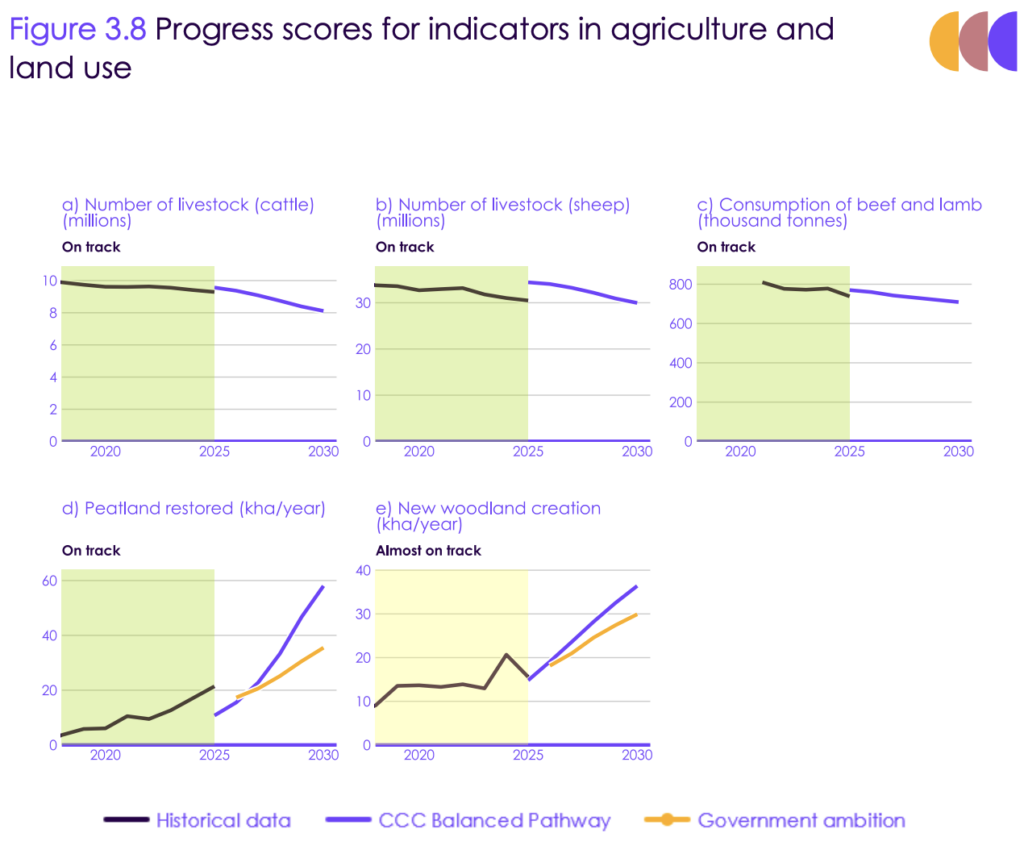
Cattle and sheep numbers fell by 1% and 2% respectively in 2025, continuing a longer-term trend, with livestock numbers at their lowest since 1990, says the report.
This has led to a reduction in methane emissions from 2022-24, but this was offset by an increase in CO2 emissions in these sectors. It continues:
“This was in part driven by a smaller forestry sink due to an ageing woodland profile and removal of trees for habitat restoration priorities.”
The report adds that household beef and lamb purchases fell by 5% in the last year and have dropped by 9% since 2021, likely “driven by high beef and lamb prices and cost-of-living pressures”.
It continues that one area of “positive progress” is an increase in peatland restoration rates.
Some 21,400 hectares of peatlands were restored in 2025 – a 26% increase on the previous year and around three times the level in 2020, according to the CCC.
It adds that there is grant funding in place for peatland restoration across the country “until at least 2027”.
Tree-planting has seen “more mixed” progress, says the report. Planting rates fell by 25% from 2024-5, following a large boost to forest creation the year before.
The reduction was “driven by funding cuts in Scotland, which continues to lead in the establishment of new woodlands for the UK, planting more than half of the total in 2024-25”, says the report.
It adds that planting rates increased in England and the Department for Environment, Food and Rural Affairs (DEFRA) is expected to launch a woodland creation strategy this year.
Despite this mixed progress, the chart below shows how the UK government is “on track” on most key agriculture and land use indicators, when compared to the CCC’s central pathway to net-zero and the government’s own ambitions.
The report says that another area of “positive progress” is the publishing of England’s long-awaited land-use framework in March of this year.
The framework used “high-resolution modelling” and found that there is enough land in England to meet climate and nature goals, while also producing more food and building new homes.
To increase progress, the report says that the government should “put policies and incentives in place to ramp up tree-planting and peatland restoration”.
One key upcoming policy development will be the “25-year farming roadmap”, the government’s long-term direction for farming in England. This is due to be published later this year, according to the CCC.
Aviation and shipping
Emissions from flights fell by 0.5% in 2025, despite a 3% increase in overall distance flown by UK passengers.
The CCC says this is likely due to fuel-efficiency improvements within the nation’s aircraft fleet and “a small contribution” from the use of “sustainable aviation fuel” (SAF).
The report concludes that fuel-efficiency improvements are “almost on track” compared to the CCC’s net-zero pathway. The share of jet fuel provided by SAF reached 2.5% in 2025, which is above the level set by the government’s SAF mandate.
While people flew more last year, the overall distance travelled via planes is still below the projected levels in the CCC’s pathway for 2025.
The committee says emissions growth from aviation has “slowed down”, but notes that “it is too early to say whether aviation emissions will grow, plateau or decrease in the future”.
Overall, the CCC says there has been “mixed progress” in the aviation sector. This year’s SAF Act included a mechanism designed to drive domestic production of SAFs, but the report stresses that “significant challenges remain around scaling up supply”.
Meanwhile, for the first time, the government plans to use international carbon credits under CORSIA – the UN’s aviation emissions scheme – to deliver its sixth carbon budget. According to the CCC:
“This introduces significant risk, including uncertainty over the availability and quality of high-integrity credits.”
As for shipping, the CCC says this has seen “limited progress”. It welcomes the inclusion of domestic shipping in the UK emissions trading scheme (ETS) as “an important step”, but points out that this is only a small fraction of the sector.
Most emissions come from international shipping. The committee says delays to the International Maritime Organization’s (IMO) net-zero framework – following opposition from the US and big fossil-fuel producers – has “significantly increased” the risk of hitting emissions targets for this sector.
Other sectors
The CCC report highlights “significant risks” with the use of engineered removals in the coming years.
The government’s plan for achieving emissions targets over 2033-37 relies on a “rapid ramp-up” of technologies that suck CO2 out of the atmosphere, the report says, but there is still a lack of detail on how this will be achieved.
During this period, the amount of CO2 removed through these technologies is expected to reach an average of 17.4MtCO2e per year.
But the CCC says that 94% of removals planned for 2033-37 have “significant risks or insufficient plans”.
There is greater confidence in achieving planned removals over 2028-32, the report says, but this is due to scaled-back plans and policy progress.
The CCC says it is “essential” for the government to develop a strategy for delivering and monitoring engineered removals, along with “sufficient contingency plans…for any shortfall”.
The report also looks at emissions from waste, which are expected to reduce by an average of 1.1MtCO2e per year between 2024 and 2037.
The CCC has greater confidence in the government’s ability to meet waste goals compared to last year’s assessment.
But the report notes that there has been “little improvement” in recycling rates in UK homes. It says that further policies will be needed to meet plans to reduce waste, boost recycling and prevent waste going to landfill.
Looking at hydrogen, the CCC says there has been “good progress” in developing low-carbon hydrogen, but risks remain due to tight timelines and delays in funding.
The report mentions missed or upcoming deadlines to award contracts for some hydrogen projects and to update the UK hydrogen strategy. It notes that progress on hydrogen “must continue on the ground” in the meantime.
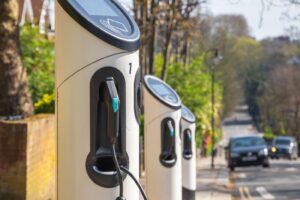



The post CCC: Faster electrification of UK will ‘put money back into people’s pockets’ appeared first on Carbon Brief.
CCC: Faster electrification of UK will ‘put money back into people’s pockets’
The head of the United Nations has launched an initiative aimed at holding artificial intelligence companies accountable for their exploding environmental impacts, including their carbon emissions, the amount of water and land used for data centres, and the energy they consume.
During a speech at London Climate Action Week on Tuesday, António Guterres noted that AI can accelerate climate solutions, among other key challenges, and said its potential must be harnessed.
“But AI is also hungry for land, water and power,” he emphasised, adding that the data centres needed to run AI models already consume more electricity than most countries.
The UN Secretary-General repeated a call he first made in July 2025 for all big AI companies to commit to power every data centre with renewable energy by 2030.
Some tech firms have announced they are sourcing or building out clean energy to run their hubs, but growing power demand is also contributing to gas-fired generation in the US, according to data from Global Energy Monitor.
The International Energy Agency (IEA) estimates that data centres are set to more than double the emissions from the electricity they use between 2024 and 2030 in a high-growth scenario. But AI’s use could lead to far larger reductions in the energy sector through efficiency gains if adopted widely.
-
UN chief says fossil fuel industry must cut methane for warming “relief”
The UN Secretary-General urges drastic reductions in methane emissions, starting with the energy sector, to limit an expected overshoot of global warming beyond 1.5C -
China’s coal-chemicals boom risks repeating the mistakes of the past
By reviving the problematic industry in the name of energy security, China runs the risk of higher emissions, stranded assets and setting back its ambitions as a clean energy leader -
Mombasa ocean summit drives progress on marine protection, but threats persist
At the 11th Our Ocean conference in Kenya, its founder John Kerry says the ocean must become central to climate solutions and needs to be looked after


‘No more hidden costs’
Proposing the new “AI Environmental Transparency Initiative” on Tuesday, Guterres also urged big AI firms companies to measure and publicly disclose the full environmental impact of their systems, including their carbon, water, and land footprints.
“No more hidden costs. No more shifting the burden onto those least able to bear it. It is time to come clean,” he said in a major speech on responding to the world’s twin climate and energy crises. “If AI is to help build a better future, it must be honest about what it costs us now.”
A report issued earlier this month by the UN University Institute for Water, Environment and Health noted that most current assessments of AI’s environmental cost focus on carbon emissions from training models. But, it added, this misses a substantial part of the picture.
Every kilowatt-hour of electricity for AI also carries a water footprint, from cooling and generation, and a land footprint, from infrastructure and supply chains, it said.
Explainer: Will AI data centres make or break the energy transition?
The report estimated that AI data centres globally could consume 945 terawatt-hours of electricity annually by 2030 – more power than all but five countries and roughly twice France’s 2025 consumption.
Offsetting this carbon footprint by 2030 would require growing some 6.7 billion trees over 10 years, it calculated. Producing power for the data centres would consume water equal to the basic needs of 1.3 billion people in sub-Saharan Africa for a year and take up land of more than 14,500 square kilometers, roughly twice the Jakarta metropolitan area.
The European Union said earlier this month it will develop minimum energy-efficiency standards for both new and existing data centres, with a “needs assessment” due by 2027, Reuters reported. It’s also planning a sustainability label for data centres, covering criteria including water use and clean energy supply – but that has been delayed.
US community push-back
Asked after his speech what the response had been, the UN chief said “we’ll see”, without giving more details.
But, he argued that, in his view, the push for transparency “is perfectly reasonable and even positive for the AI industry, because eventually some people will say that they consume much more than they really do”. “I think the truth is essential,” he added.
Concerns about the environmental impacts of AI and the infrastructure needed to run the technology have led to growing opposition in some communities, especially in the US.
This month, Monterey Park in Los Angeles County was the first city in the United States to enact a citywide prohibition on data centres through a voter-approved ballot measure. The developers behind a proposed centre in the area had already pulled the project in April amid an increasingly hostile local environment and regulatory uncertainty.
The vote that stopped a data center: US communities query resource-hungry AI
According to nonprofit Data Center Watch, around $64 billion-worth of data centre projects nationwide were delayed or blocked between May 2024 and March 2025 as communities pushed back against them.
Industry lobby groups argue that data centres can provide economic benefits in their host communities. According to the US-based Data Center Coalition, which represents big operators and developers, data centres generate tax revenue, support construction and technical jobs, and provide infrastructure needed for cloud computing, scientific research and AI development.
The industry has also challenged claims that data centers necessarily raise electricity costs for households.
Force for good?
The UN chief said benefits can be few in the places that are home to the data centre, while “communities are often left in the dark about the environmental impact of the infrastructure rising around them”.
Guterres said companies have an “obligation” to be clear and open about the services they are offering but also the level of resources they require.
“Transparency is essential for the decisions that communities must make – and transparency is essential even for the future of artificial intelligence, and to make sure that artificial intelligence is essentially a force for good,” he told an audience of climate professionals in London
A senior UN official told journalists ahead of Tuesday’s announcement that the AI industry has started to talk about and disclose some of their impacts, but those efforts are not yet comprehensive enough.
The hope is that the new initiative will “encourage the industry to come together and take further action on it”, the official said.
The post UN asks AI companies to reveal full environmental impacts appeared first on Climate Home News.


Do Oil Wells Dropped by Big Oil Represent an Investment Opportunity?

The Haves and the Have-Nots
FOIs show fossil fuel “rust bucket” Northern Endeavour shipped 17,000 kms from Australia with toxic, corrosive substances
-
Greenhouse Gases11 months ago
Guest post: Why China is still building new coal – and when it might stop
-
Climate Change11 months ago
Guest post: Why China is still building new coal – and when it might stop
-

 Greenhouse Gases2 years ago
嘉宾来稿:满足中国增长的用电需求 光伏加储能“比新建煤电更实惠”
-
Climate Change2 years ago
Bill Discounting Climate Change in Florida’s Energy Policy Awaits DeSantis’ Approval
-

 Renewable Energy8 months ago
Sending Progressive Philanthropist George Soros to Prison?
-

 Carbon Footprint2 years ago
US SEC’s Climate Disclosure Rules Spur Renewed Interest in Carbon Credits
-
Greenhouse Gases11 months ago
嘉宾来稿:探究火山喷发如何影响气候预测
-

 Climate Change11 months ago
嘉宾来稿:探究火山喷发如何影响气候预测