

Irene Vélez Torres is Colombia’s Minister of Environment and Sustainable Development, and Mark Watts is Executive Director of C40 Cities.
The science is unequivocal. The world must transition away from fossil fuels. What remains uncertain is whether our institutions, economies and political systems are prepared to deliver the transformation required at the necessary speed and scale.
For too long, this transition has been framed as a technological substitution challenge. Replace fossil fuels with renewables and the problem is solved. But this view overlooks a deeper reality. Fossil fuels are embedded in economic systems shaped by extraction, inequality, and dependence. Moving beyond them requires structural transformation, not only of energy systems, but of the way economies are organised and governed.
This is both a global and a territorial challenge. And it is precisely at the intersection of national leadership and urban action where the transition becomes real.
Today, the energy system accounts for more than three-quarters of global greenhouse gas emissions, while fossil fuel expansion continues despite clear scientific warnings. This contradiction reflects entrenched financial and institutional incentives that continue to favour short-term extraction over long-term stability.
Recent global crises have exposed the consequences. Volatility in fossil fuel markets has translated into rising energy costs, fiscal pressure and growing inequality. A system that depends on geopolitical instability cannot guarantee reliable or affordable energy for people. Nor can it sustain resilient economies.
-
Sixty countries head to Santa Marta to cement coalition for fossil fuel transition
After last year’s COP30 disappointment, governments will seek a renewed push to phase out fossil fuels at the first global summit on the theme in Colombia -
Fossil fuel crisis offers chance to speed up energy transition, ministers say
As climate diplomacy resumes in Berlin, ministers say the Iran war-driven fuel crisis is exposing the risks of fossil dependence


This is why Colombia has argued consistently in international spaces that the transition away from fossil fuels is not only an environmental necessity, but a matter of justice. It requires moving beyond an extractive model toward economies that protect life, redistribute opportunity and recognise the value of territories and communities.
In Colombia, the challenge is immediate. Fossil fuels represent a significant share of exports and public revenues, and entire regions depend on these industries. Addressing this reality demands deliberate strategies to overcome economic dependence, manage fiscal constraints, and enable productive re-conversion without reproducing new forms of extractivism.
But this transformation will not be delivered by national governments alone. Cities are not just implementers of policy. They are strategic actors in reshaping demand, accelerating innovation, and demonstrating that a different model is already possible.
Cities turn climate goals into real-life improvements
Urban areas account for the majority of global energy use and emissions. Yet they are also where the benefits of the transition are most immediate and visible. From expanding clean public transport to reducing air pollution, from improving energy efficiency in buildings to scaling decentralised renewable systems, cities are turning long-term climate goals into tangible improvements in people’s lives.
Across the C40 network, cities are already reducing emissions while strengthening economic resilience. These experiences show that transitioning away from fossil fuels lowers costs, improves public health and creates jobs. They also demonstrate something equally important: that climate action, when designed around people, can rebuild trust in public institutions.
Solar surge kept fossil electricity flat in 2025 as China and India made ‘historic’ shift
The Mayor of London has delivered the world’s largest clean air zone. Melbourne has enabled new wind farms that now supply 100% of municipal operations. In Curitiba, solar investments are cutting public energy bills by 30% while creating inclusive jobs.
Johannesburg’s US$140-million green bond, oversubscribed by 150%, has mobilised strong investment into clean energy and efficiency projects. And in Colombia, Bogotá established a low-emission zone (ZUMA) in a vulnerable neighborhood, improving air quality and public health for nearly 40,000 people.

These actions are part of a shared global effort to halve fossil fuel use in C40 cities by 2030, a goal that is not only achievable but already in motion. Crucially, it also contributes to the global target of tripling renewable energy capacity by the end of the decade, set by nearly 195 countries at COP28.
This is what makes cities indispensable to a just transition. They operate closest to citizens, where energy systems intersect with daily life. They are uniquely positioned to ensure that the transition is not only fast, but fair.
Structural barriers to national and urban action
At the same time, cities cannot act in isolation. Their ability to lead depends on national frameworks that align policy, regulation and investment, as well as on an international system that enables rather than constrains transformation.
And this is where the global dimension becomes critical. Many countries in the Global South face structural barriers, including high borrowing costs, debt burdens and legal frameworks that limit policy space. Reforming the international financial architecture, expanding access to affordable finance, and addressing constraints are essential to unlocking both national and urban climate action.
Recognising this, Colombia and the Netherlands are convening the First Conference on Transitioning Away from Fossil Fuels in Santa Marta. This is not a space for abstract commitments. It is a platform for implementation, designed to bring together those ready to move from ambition to action.
To phase out fossil fuels, developing countries need exit route from “debt trap”
Crucially, the conference places cities and subnational governments at the heart of this effort. Alongside national governments, civil society, workers, Indigenous peoples and the private sector, cities will help identify concrete enabling pathways to advance a just, orderly and equitable transition.
These pathways are not theoretical. They focus on three interconnected priorities: transforming energy supply and demand, overcoming economic dependence, and strengthening international cooperation. What cities bring to this agenda is the capacity to operationalise these priorities, translating them into policies that reshape infrastructure, mobility, housing and local economies.
Energy transition means redefining development
The objective is clear. To build a coalition of countries and cities willing to move forward, not by negotiating new principles, but by implementing them. A coalition that reflects a shared understanding that the transition must be grounded in equity, democratic participation and real delivery.
What is at stake goes beyond energy. It is about redefining development in a way that is compatible with climate stability and social justice.
The costs of delay are already evident. Continued investment in fossil fuel expansion deepens climate risk, economic vulnerability and inequality. By contrast, accelerating the transition opens pathways for more resilient, inclusive and sustainable economies.
Cities are already showing what this future looks like. National governments can scale it. International cooperation can enable it.
From Santa Marta, the message is clear. The end of the fossil fuel era is not only necessary. It is already underway. The task now is to ensure that it is just, that it is coordinated, and that it is irreversible.
The post Why the transition beyond fossil fuels depends on cities and collective action appeared first on Climate Home News.
Why the transition beyond fossil fuels depends on cities and collective action

For the first time, new-energy vehicles (NEVs) made up 67% of new car sales in China in September, according to the latest data from the China Passenger Car Association (CPCA).
The figures show that NEVs, which include battery electric cars and plug-in hybrids, captured a record share of sales, even though fewer were sold than last year.
This is because sales of combustion-engine cars are falling steeply, a trend that the CPCA has attributed to rising petrol prices following the start of the Hormuz crisis.
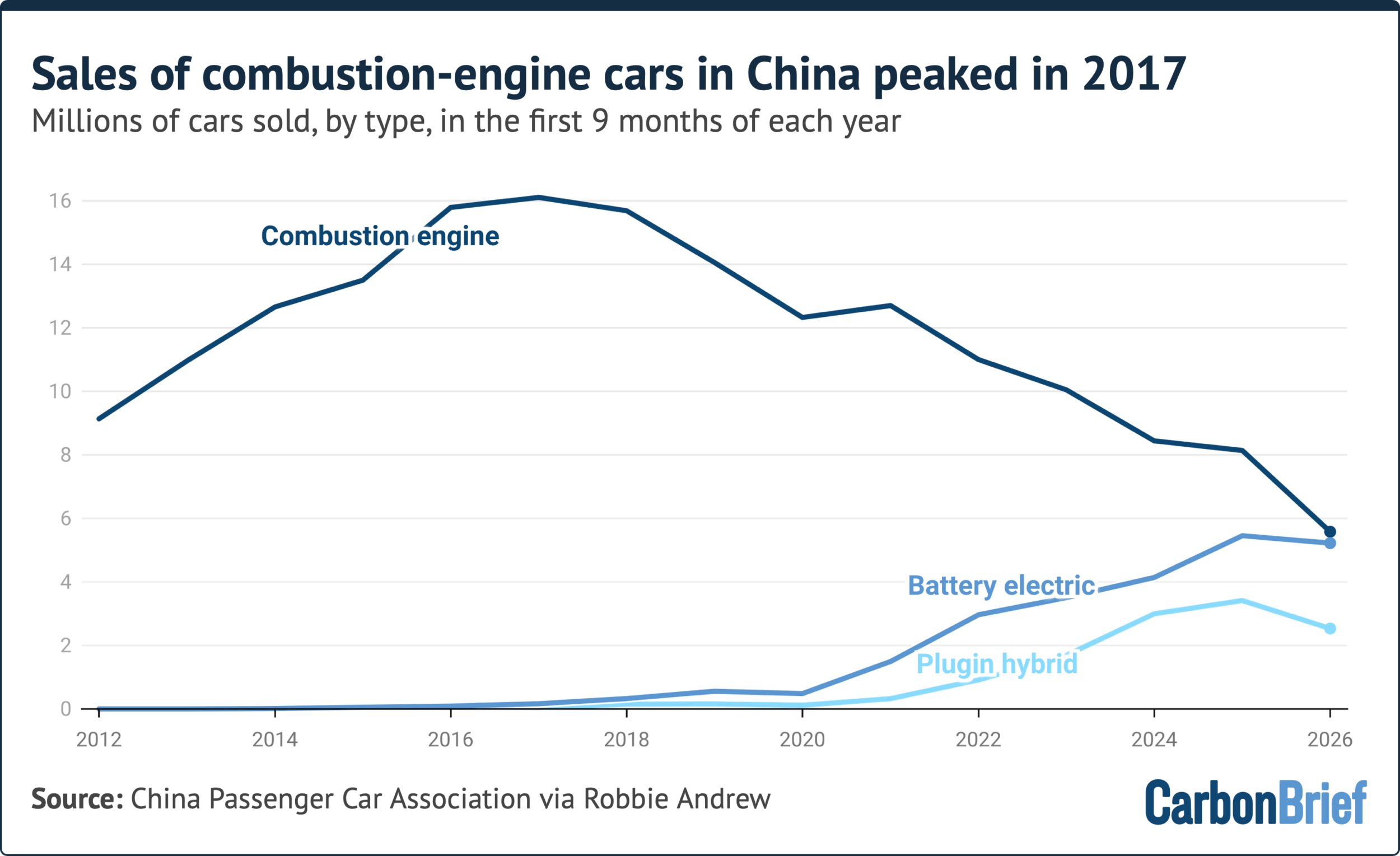
Indeed, sales of fuel-only cars were down 31% year-on-year in the first nine months of 2026, with plug-in hybrid sales down 26% – whereas battery EV sales were only down 4%.
One analyst tells Carbon Brief that China’s rapidly growing EV fleet has offset demand for 143m barrels of oil since the start of the Hormuz crisis.
Another says that the crisis is “reinforcing China’s electrification of road transport”.
Meanwhile, amid slowing domestic sales, Chinese carmakers’ exports of NEVs more than doubled [in 2026 to date / in September] from a year earlier.
NEV record
A record two out of every three cars sold in September in China were NEVs, according to CPCA data, as shown in the figure below.
(NEVs predominantly include battery electric vehicles – BEVs – and plug-in hybrids – PHEVs. BEVs only run on electricity, whereas PHEVs also have a combustion engine.)
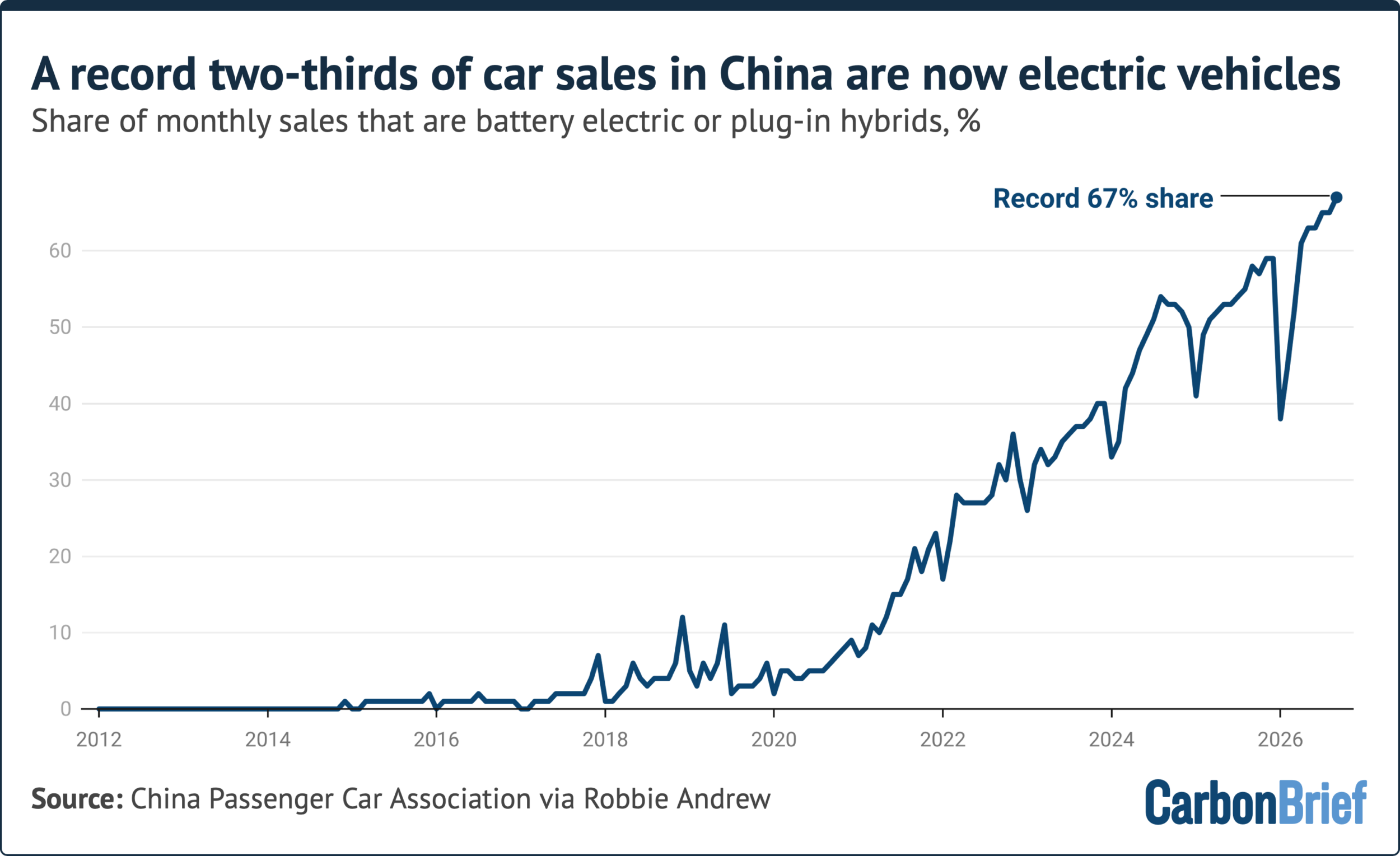
This marks a rapid rise for NEVs from just 6% of new car sales in 2020 up to 58% in 2026 to date – and a record 67% in the month of September.
This year, NEVs’ share of sales has also bounced back from a low of 39% in January, after the full purchase tax exemption that had been in place for more than a decade came to an end in December 2025.
The gain in NEV share in 2026 has come amid a slowdown across the wider domestic passenger-car market, which has hit sales of combustion-engine vehicles particularly hard.
This September, passenger-car retail sales across all categories declined, with overall sales volumes falling 28% year-on-year.
The contraction was led by combustion-engine vehicles, which saw sales fall 43% year-on-year in September and 31% in 2026 to date.
However, sales of PHEVs also fell by 36% year-on-year in September and by 26% in 2026 to date. By comparison, BEVs performed better, although sales still declined 8.5% from a year earlier in September and 4% in 2026 to date.
As a result, NEV sales overall fell by 17% in September and 13% in 2026 to date.
While the market changes in 2026 to date were particularly dramatic, they reflect a broad continuation of trends seen over the past decade.
Indeed, sales of combustion-engine cars in China peaked in 2017 and they have been declining ever since, shown in the figure below.
Impact of Hormuz
Part of the reason for the advance of NEVs in 2026, said Chinese technology news outlet OFweek, was petrol cars “giving up market share” as they were outperformed by electric alternatives.
Cui Dongshu, secretary-general of the CPCA, cited higher petrol prices as an explanation for September’s weak combustion-car sales, in comments to financial news outlet National Business Daily.
Imports of oil into China in January-September have fallen 15% compared to 2025, equivalent to 470m barrels, as ongoing conflict tightened supply and drove up prices.
China’s passenger-car NEV fleet has displaced 143m barrels of oil so far during the strait of Hormuz crisis, Euan Graham, senior energy analyst at thinktank Ember, tells Carbon Brief.
EVs “accounted for 12% of the decrease in China’s oil use post-Hormuz”, according to an estimate provided to thinktank the Brookings Institute by an unnamed analyst.