

The world should question its skyrocketing demand for energy-transition minerals and the roll-out of ineffective climate measures that damage people and the planet, the UN’s special rapporteur on climate change and human rights has warned.
“The need for critical minerals in terms of climate action is an assumption that we need to challenge,” Elisa Morgera told an online event hosted by the International Institute for Environment and Development (IIED) on Wednesday.
This should include asking “how do we take into account over-consumption by the super-rich, which we know are contributing to climate change in ways that are non-comparable to the vast majority of the world’s population,” she said.
Morgera called for “a step back… to ensure that any decisions around critical minerals are taken with a full understanding of the potential impacts on the environment and on everyone’s human rights”. That should also entail “prior, comprehensive and independent assessments of the need for critical minerals and whether there are alternatives to extraction”, she added.
The acceleration of clean energy technology deployment has spurred a global race for the metals and minerals that are needed to manufacture solar panels, wind turbines, batteries and electric vehicles. Many of them – from copper to lithium and nickel – are sourced from the Global South using extractive models that have harmed the environment and local communities.
The International Energy Agency (IEA) has projected that demand for these minerals could triple by 2030 and quadruple by 2040 as the green transition accelerates, which would require vast investments in new mining developments.
Indian start-ups mine e-waste for battery minerals but growing industry has a dark side
But mining comes with unavoidable environmental and social trade-offs, which need to be fully understood, Morgera told the panel of critical mineral experts.
She argued for moving away from the “inaccurate idea” that there is “conflict” between urgently addressing climate change and protecting the human rights of Indigenous peoples on whose territories critical minerals are often extracted. This is about “everyone’s human right to a healthy environment,” she added.
Those working on the issue should “ask critical questions at the outset about who’s going to benefit from a proposed development and what assumptions are framing that understanding of benefits”, she said.
Morgera, an Italian professor of global environmental law at the University of Strathclyde in Scotland, previously worked on the links between human rights and healthy oceans. She took on the role of UN special rapporteur last year.
Land-grabbing on the rise
Across the world, communities in mineral-producing countries – from Indonesia, to Chile and the Democratic Republic of Congo – have reported environmental destruction and human rights abuses linked to the mining of transition minerals.
Ketakandriana Rafitoson, director of Publish What You Pay, an NGO that advocates for financial transparency in the extractive industry, told the event that besides the environmental, food and water impacts faced by some communities in mineral-producing countries, land grabbing is becoming a bigger issue.
“Territorial rights violations is something which is growing, and it is often linked to the fact that Indigenous peoples and local communities voices, including the right to say no to mining, are not always taken into account or heard,” she said.
Last year, the UN Secretary-General’s Panel on Critical Minerals outlined seven principles for developing critical mineral supply chains with justice, equity and human rights at their core.
The panel called for “balancing consumption with sustainable supply, especially in high-income countries” to reduce environmental impacts. It cited innovation and product design, such as reducing the size of electric vehicle batteries, material efficiency gains and building circular supply chains, as ways to reduce demand.
Recycling and fairer use
Recycling minerals could reduce the need for new mining projects and help mitigate the environmental and social impacts of mining. But the use of recycled materials has so far failed to keep pace with rising material consumption, according to the IEA.
Meanwhile, global resource extraction is accelerating. Resource use is projected to grow 60% by 2060, which the UN says could derail efforts to achieve global climate, biodiversity and pollution targets, as well as human well-being and economic prosperity.
High-income countries use six times more materials and are responsible for ten times more climate impacts per capita than low-income ones, according to the UN’s Global Resource Outlook report. It called for reducing the resource intensity of the wealthiest economies to allow poorer nations to use more resources, where they are most needed.
Q&A: What you need to know about clean energy and critical minerals supply chains
The UN, meanwhile, is digging deeper into the issues surrounding critical minerals.
Special rapporteur Morgera is seeking inputs on the positive and negative human rights impacts of the full life-cycle of renewable energy, including the extraction and re-use of critical minerals, and will present a report at the UN in October.
This is “a really important opportunity for us to fully explore and understand the trade-offs and where we have foreseeable negative impacts on the environment and human rights that we can and must prevent,” she said.
(Reporting by Chloé Farand; editing by Megan Rowling)
The post We must challenge rising demand for transition minerals, says UN rapporteur appeared first on Climate Home News.
We must challenge rising demand for transition minerals, says UN rapporteur

Fifty-six years after the first one rallied 20 million people across America, “we need to do things that make us feel more powerful.”
From our collaborating partner Living on Earth, public radio’s environmental news magazine, an interview by host Steve Curwood with environmental historian Adam Rome.
It was the second defeat for the Trump administration’s unusual litigation to stop states from acting on climate change.
In a setback to the Trump administration’s extraordinary legal campaign against state climate action, a federal judge threw out the Justice Department’s lawsuit seeking to prevent the state of Hawaii from suing oil companies for damages.
Judge Dismisses Trump Administration’s Bid to Block Hawaii Climate Lawsuit
Climate Change
DeBriefed 17 April 2026: Fossil-fuel power slumps | ‘Super’ El Niño warning | Afghanistan’s climate struggle
Welcome to Carbon Brief’s DeBriefed.
An essential guide to the week’s key developments relating to climate change.
This week
Oil prices rebound
OIL UP AGAIN: Oil prices surged by more than 7% and back above $100 a barrel on Monday after US-Iran peace talks faltered and US president Donald Trump ordered the blockading of Iranian ports, reported BBC News. The jump came after prices fell last week in the wake of the announcement of a conditional two-week ceasefire, it said.
RESCUE PLANS: European countries unveiled plans to protect citizens and businesses from rising energy prices. Ireland announced a support package worth €505m, reported BBC News, while Germany agreed on measures worth €1.6bn, said Bloomberg. Meanwhile, Reuters reported on a draft EU proposal due to be unveiled next week that would see the bloc reduce electricity prices and roll out clean energy more quickly in response to the crisis.
UNSOLICITED ADVICE: Trump renewed his criticism of UK energy policy and called on the government to “drill, baby drill”, reported the Independent. Via social media, the president said: “Europe is desperate for energy, and yet the United Kingdom refuses to open North Sea oil, one of the greatest fields in the world. Tragic!!!” (See Carbon Brief’s recent factcheck of various false claims about the North Sea.)
Around the world
- C-WORD: Faced with pressure from the US, countries attending spring meetings of the International Monetary Fund and World Bank were urged to “not mention the climate”, reported the Guardian. It added that plans to agree a new “climate change action plan” for the World Bank “may be shelved, along with substantive discussion of the climate crisis”.
- NEW DIRECTION: Péter Magyar’s landslide victory over Victor Orbán in Hungary’s elections “presents new opportunities for the country to reduce emissions and invest in clean energy”, reported Time. Carbon Brief explored what it means for European climate action.
- ‘FURNACE’ SUMMER: There was widespread coverage – including in the Boston Globe, ABC News, CNN, Euro Weekly News, Guardian and New Scientist – of warnings from meteorologists of the development of a “super” El Niño phenomenon that could ramp up temperatures and drive extreme weather.
- ANTALYA COP: The Turkish government unveiled the dates and venues for the “leaders’ summit” segment of November’s COP31 conference, according to Climate Home News.
- PACIFIC PRE-COP: Meanwhile, the Guardian reported that Tuvalu will host a special meeting of world leaders before the climate summit in Antalya.
€10bn a year
The amount of state support that French prime minister Sébastien Lecornu has pledged for electrification through to 2030 in a bid to reduce the country’s dependence on fossil fuels. In a speech late on Friday 10 April, Lecornu noted the figure amounted to a “doubling” of existing support.
Latest climate research
- Over a four-month period of 2023, more than 70% of editorials discussing net-zero in four right-leaning UK newspapers included “at least one misleading statement” | Climate Policy
- Air pollution from global transport currently has a net cooling effect that offsets 80% of the warming impact of the sector’s CO2 emissions | npj Climate and Atmospheric Science
- The incorporation of “observational constraints” into climate-model projections suggests that the Atlantic Meridional Overturning Circulation could weaken by 50% by 2100 in a medium-emissions scenario | Science Advances
(For more, see Carbon Brief’s in-depth daily summaries of the top climate news stories on Monday, Tuesday, Wednesday, Thursday and Friday.)
Captured
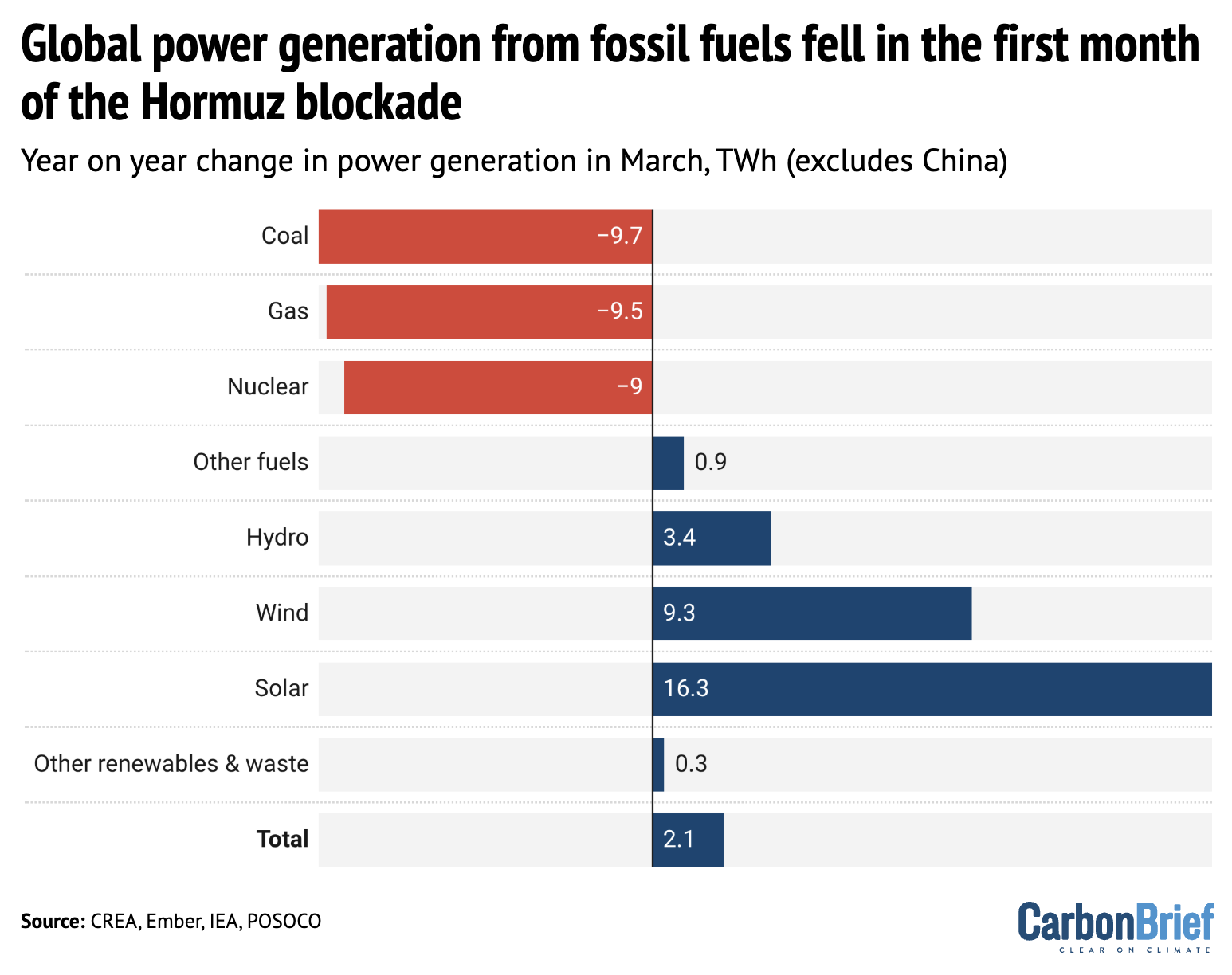
Analysis by the Centre for Research on Energy and Clean Air (CREA) found that global electricity generation from fossil fuels fell in the first month of the closure of the Strait of Hormuz. Across all countries with real-time electricity data outside of China, coal-fired power generation fell 3.5% and gas-fired power generation fell 4.0%, according to CREA. This was offset by a rise in solar power and wind generation, which increased by 14% and 8%, respectively. Hydropower generation also saw a small increase, the analysis showed, but this was “more than offset” by a drop in nuclear power generation.
Spotlight
How climate change affects Afghan lives
This week, Carbon Brief reports on the impact of climate change in Afghanistan, following deadly floods this year.
Earlier this month, heavy rains, flash floods and landslides struck large parts of Afghanistan, damaging thousands of homes, destroying crops, bridges and roads and taking nearly 100 lives.
The flooding – reported to have affected 74,000 people in 31 of 34 provinces – is the latest weather-related catastrophe to afflict the nation, whose communities have suffered the brunt of repeated flash floods, droughts and landslides in recent years.
Hameed Hakimi, non-resident senior fellow at the Atlantic Council’s South Asia Center, told Carbon Brief the recent floods would hurt livelihoods and food security, noting reports of destroyed wheat and rice crops in the most affected eastern parts of the country. He said:
“This is common. For at least a decade now, [we have seen] these flash floodings and the damage that happens to rural life, farming, the disruption to crops…Flash flooding physically eats up the land. So, it not only damages where people live, but also people’s livelihoods, based on what they grow.”
The damage to crops will be felt acutely, he explained, given that food security in the landlocked nation is already strained by the blockage of its main transit trade artery through Pakistan and international sanctions that have frozen long-term development aid.
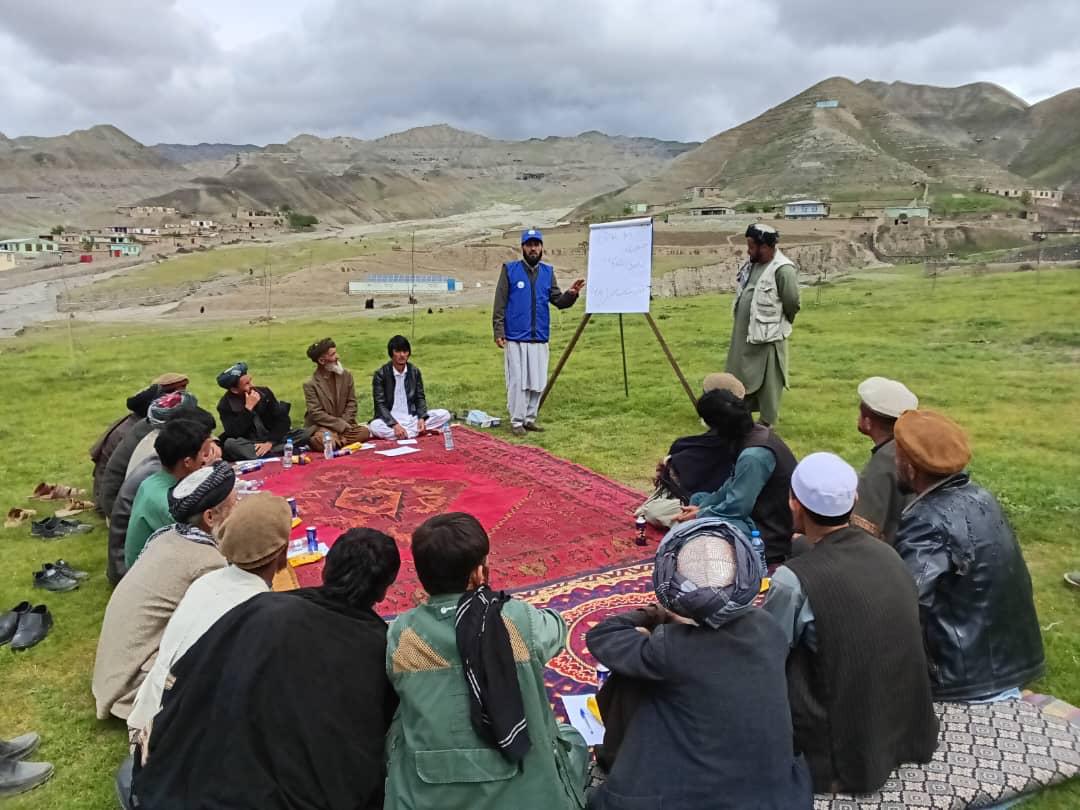
Speaking to Carbon Brief, Abdulhadi Achakzai, founding CEO of the Environmental Protection Trainings and Development Organization (EPTDO), an Afghan NGO, described flooding in Afghanistan as a “chronic situation”.
Achakzai, whose organisation runs projects that help urban and rural communities adapt to climate impacts, says climate change hurts the country in four key ways: extreme drought; extreme temperature; “natural hazards”, including landslides and dust storms; and, finally, flash flooding. He said:
“Climate change is a serious matter in Afghanistan. Every nation and every corner within this country is severely affected.”
Ranked 176 of 187 on the University of Notre Dame “global adaptation index”, Afghanistan is among the countries most vulnerable to climate change.
Average temperature across the country has increased from 12.2C in 1960 to 14.2C in 2024, according to the World Bank’s climate change knowledge portal. Drought is widespread, severe and persistent – harming food and water security in a nation of subsistence farmers.
Meanwhile, extreme weather events are the leading driver of internal displacement in the country. More than three-quarters of the 710,000 people who relocated within Afghanistan in 2024 did so driven by “environmental hazards”, such as drought and flood, according to a recent climate vulnerability assessment from the International Organization for Migration.
Finance struggles
Despite feeling the impacts of extreme weather, Afghanistan has been barred from UN climate negotiations and had limited access to climate finance since 2021. (The government attended COP29 in Baku as guests of the Azerbaijan hosts, but did not take part in formal negotiations.)
This is because the international community does not recognise the Taliban government, which resumed power in 2021, due to its record on human rights and its repression of women and girls in particular.
Almost all financing from key climate funds has been suspended, with the exception of a few projects where UN agencies and NGOs act simultaneously as a “requesting” and “implementation” partner.
Aid from UN climate funds fell from $5.9m annually over 2014-20 to $3.9m annually over 2021-24, according to recent analysis by the Berghof Foundation. Multilateral development banks provided a further $337m of funds badged as “climate finance” over 2021-23, it said.
By comparison, Afghanistan’s national climate plan, submitted to the UN Framework Convention on Climate Change (UNFCCC) in 2016, requested $17.4bn in climate finance over 2020-30. An updated national climate plan seen by Carbon Brief – completed in 2021 and later endorsed by the Taliban government, but not accepted by member governments of the UNFCCC – called for $20.6bn through to 2030.
Achakzai, whose organisation attends the COP climate summit each year in an observer capacity, has in the past been the sole delegate from Afghanistan to the conference.
He is calling on the UNFCCC to accept the country’s latest climate plan – and to find an “alternative solution” that would give the people of the country a voice in negotiations. He said:
“Every year we are losing hundreds, thousands of people because of climate change-related matters. Every year we are losing hundreds, thousands of hectares of crops. We are affected by [the decisions of] other countries. Why are we not part of this process?”
Watch, read, listen
BLOSSOM WATCHER: The Guardian reported on the successful search to find a researcher to continue Japan’s 1,200-year cherry blossom record.
COP OUT: Deutsche Welle spoke to experts to understand why India walked away from its bid to host COP33 in 2028.
‘BOMBS AND PORN’: The New Republic looked at who is set to benefit from the rapid build-out of energy-intensive AI datacentres.
Coming up
- 20-24 April: Intergovernmental Panel on Climate Change (IPCC) working group one report author meeting, Santiago, Chile
- 22 April: Earth day
- 22 April: Launch of third edition of the Lancet Countdown’s Europe report
- 24-29 April: First conference on transitioning away from fossil fuels, Santa Marta, Colombia
Pick of the jobs
- International Organization for Migration, senior thematic associate (climate action) | Salary: UN G-6 salary grade | Location: Dakar, Senegal
- Climate Action Network UK, several board member roles | Salary: Unknown. Location: Unknown
- UK Department for Energy, Food and Rural Affairs, G7 science lead | Salary: £56,375. Location: Bristol, London, Newcastle-upon-Tyne or York, UK
- Save the Children UK, senior climate change advisor | Salary: £62,000-£65,000. Location: London
DeBriefed is edited by Daisy Dunne. Please send any tips or feedback to debriefed@carbonbrief.org.
This is an online version of Carbon Brief’s weekly DeBriefed email newsletter. Subscribe for free here.


The post DeBriefed 17 April 2026: Fossil-fuel power slumps | ‘Super’ El Niño warning | Afghanistan’s climate struggle appeared first on Carbon Brief.


-
Climate Change8 months ago
Guest post: Why China is still building new coal – and when it might stop
-
Greenhouse Gases8 months ago
Guest post: Why China is still building new coal – and when it might stop
-

 Greenhouse Gases2 years ago
嘉宾来稿:满足中国增长的用电需求 光伏加储能“比新建煤电更实惠”
-
Climate Change2 years ago
Bill Discounting Climate Change in Florida’s Energy Policy Awaits DeSantis’ Approval
-

 Climate Change2 years ago
嘉宾来稿:满足中国增长的用电需求 光伏加储能“比新建煤电更实惠”
-
Climate Change Videos2 years ago
The toxic gas flares fuelling Nigeria’s climate change – BBC News
-

 Renewable Energy6 months ago
Sending Progressive Philanthropist George Soros to Prison?
-

 Carbon Footprint2 years ago
US SEC’s Climate Disclosure Rules Spur Renewed Interest in Carbon Credits