

Lucie Pinson is the founder and executive director of Paris-based NGO Reclaim Finance.
The abrupt exit of the six biggest US banks from the UN’s Net Zero Banking Alliance (NZBA) is a disturbing sign of the shallowness of these institutions’ professed commitment to acting on climate. It is also a sign of their willingness to preemptively show subservience to the incoming Trump administration.
The question now is whether other banks will follow the example of their US counterparts – especially given the rise of right-wing politicians in Europe and Canada who seek to halt action on climate – or if the remaining banks in the NZBA will now push for more ambition from the alliance, and strengthen their own climate commitments.
Some European bank officials have privately complained in the past that they would like the NZBA guidelines to be stronger but that US members were blocking progress. The European and other banks in the NZBA can now show that they were not just hiding behind the US banks’ obstructionist skirts, and act to increase the NZBA’s ambition.
The recent exodus of the Wall Street banks is hardly a surprise. At least some of them reportedly threatened to leave the NZBA two years ago when red-state officials threatened them with antitrust lawsuits. The banks stayed in then because the NZBA and the Glasgow Financial Alliance for Net Zero (GFANZ), an associated alliance for all types of financial institutions, both clarified that none of their recommendations were compulsory.
What Trump’s second term means for climate action in the US and beyond
The suspension of activities by another net-zero alliance representing big money managers is one more sign of financial firms’ fear of retribution from the Trump administration and emboldened right-wing politicians at the state level.
The Net Zero Asset Manager (NZAM) initiative’s requirements of its members were so weak as to be to mainly symbolic – and it shows how much fossil fuel companies are concerned about their continued access to capital that the politicians they fund will attack even the most milquetoast climate initiative from the finance sector.
Action with or without voluntary body
Regardless of their NZBA membership, the big US banks have never exhibited any real interest in restricting fossil fuel finance. JPMorgan Chase provided US$41 billion in finance for oil and gas and coal companies in 2023, billions more than any other bank. Citi, Bank of America and Wells Fargo were all in the top five global bankers of fossil fuels between 2016 and 2023.
In contrast, some of the largest European banks have shown that another path is possible.
While still falling short of the action required by science to stop fuelling climate change, particularly on LNG (liquefied natural gas), French giants BNP Paribas and Crédit Agricole have both committed to end the facilitation of bond issuances for oil and gas companies. Société Générale has a target to cut its credit exposure to oil and gas producers by 80% by 2030. These three banks have each more than halved their volumes of fossil fuel finance between 2020 and 2023. Additionally, Dutch bank ING will stop funding LNG projects after next year.
LA fires show human cost of climate-driven ‘whiplash’ between wet and dry extremes
Yet none of these robust measures and targets were due to the banks’ membership of the NZBA.
The NZBA does not require its members to restrict financing for oil, gas or coal – not even for those companies that are doing the most to expand fossil fuel production. Members are required to set targets for high-emitting sectors, but although the targets are recommended to be 1.5°C-aligned, the NZBA does nothing to ensure this.
No clear target-setting requirements
A lack of clear requirements on target-setting from the NZBA means that its members have a bewildering array of target types, many of which are deeply flawed and unlikely to lead to real-world emission reductions. The most problematic targets are those based on “financed emissions”.
This methodology attributes the emissions from corporations to their banks using a formula that divides lending exposure by corporate value. The resulting number changes as the market value of the companies in a bank’s sectoral portfolio rises, so the bank’s financed emissions for that sector will fall even if real emissions stay the same.
French bank BPCE, like most other major European banks such as HSBC, Deutsche Bank or UBS, has set only a financed emissions target for the oil and gas sector - in sharp contrast to the banks mentioned above that have set targets to reduce their lending to oil and gas companies.
Provided oil and gas company share prices rise sufficiently, BPCE could meet its target without reducing its finance to these companies, and without these companies cutting their emissions – as Barclays did in 2023, seven years ahead of the target year.
European banks must push NZBA for more ambition
Given their mixed track record so far, it is also possible that European banks could use the US exodus as an excuse to backtrack on their climate commitments, and even for pushing back on recently adopted related regulations. BPCE’s “Vision 2030”, published in June last year, is one example of an important European bank moving backwards on climate.
Some EU business groups have successfully lobbied to reopen key Green Deal legislation. And while we do not yet know how far the changes will go, some banks may join their push to go beyond mere clarifications and simplifications, and dismantle new reporting and due diligence obligations.
To reform climate COPs, we should start with the voting rules
The last of the US banks to announce they were quitting the NZBA was JPMorgan Chase. Their announcement was made on January 7 — the very same day that the catastrophic fires broke out in Los Angeles.
Wall Street may escape the wrath of Trump by appearing not to care about climate change, but financial institutions will not escape the wrath of climate change unless they show the courage to stop financing the expansion of fossil fuels.
The post Wall Street’s faltering on climate action opens up opportunity for European banks appeared first on Climate Home News.
Wall Street’s faltering on climate action opens up opportunity for European banks

With the U.S. bombing Iran and the Strait of Hormuz closed, energy experts say countries transitioning to renewables will be more resilient in the “face of the shock.”
The United States’ war on Iran could fundamentally alter how countries consume and generate energy and hamper international progress in combating climate change, a panel of energy experts said today.
The Global Energy Supply in a Decade ‘Is Not a World We’re Going to Recognize’
One month into the US and Israel’s war on Iran, at least 60 countries have taken emergency measures in response to the subsequent global energy crisis, according to analysis by Carbon Brief.
So far, these countries have announced nearly 200 policies to save fuel, support consumers and boost domestic energy supplies.
Carbon Brief has drawn on tracking by the International Energy Agency (IEA) and other sources to assess the global policy response, just as a temporary ceasefire is declared.
Since the start of the war in late February, both sides have bombed vital energy infrastructure across the region as Iran has blocked the Strait of Hormuz – a key waterway through which around a fifth of global oil and liquified natural gas (LNG) trade passes.
This has made it impossible to export the usual volumes of fossil fuels from the region and, as a result, sent prices soaring.
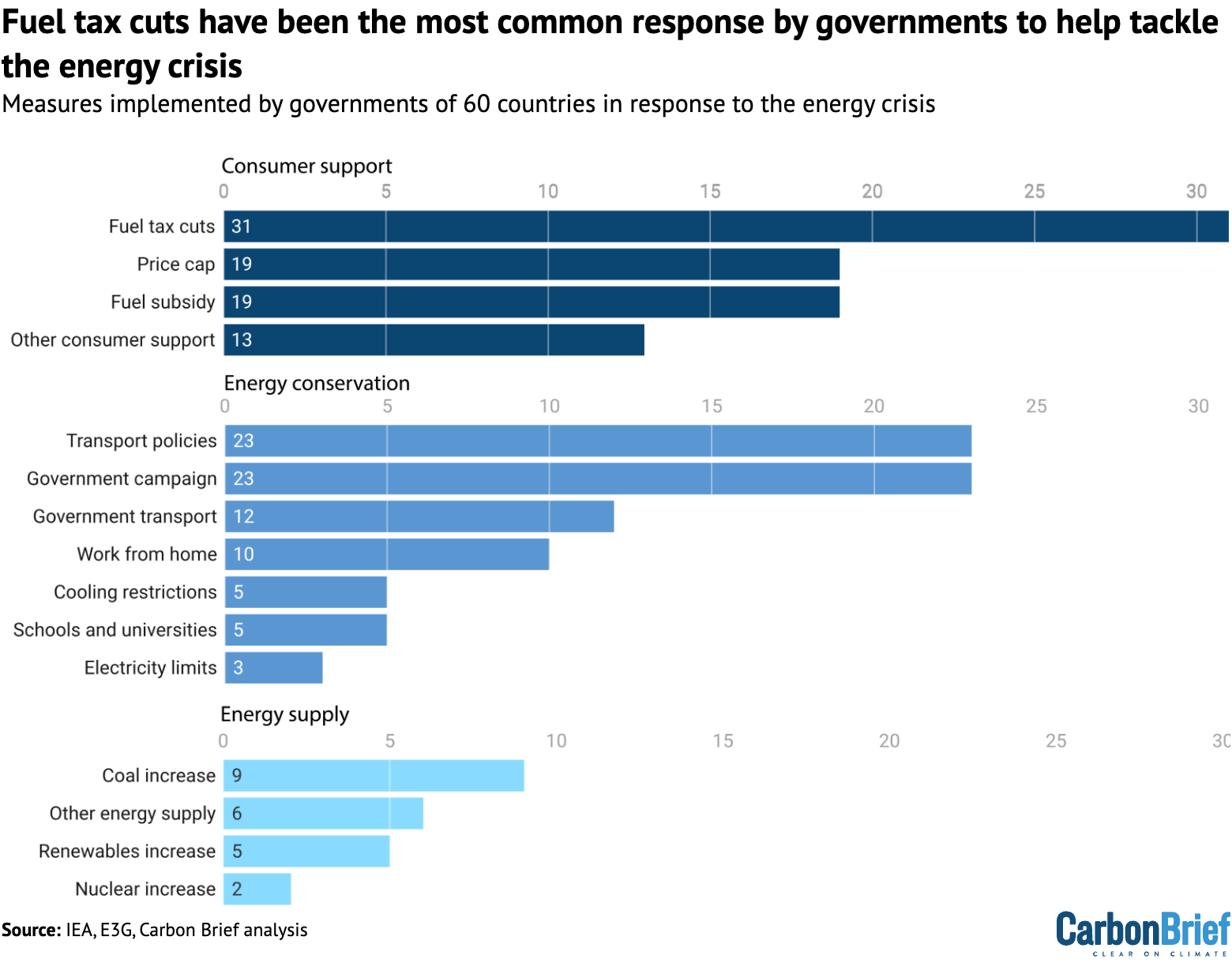
Around 30 nations, from Norway to Zambia, have cut fuel taxes to help people struggling with rising costs, making this by far the most common domestic policy response to the crisis.
Some countries have stressed the need to boost domestic renewable-energy construction, while others – including Japan, Italy and South Korea – have opted to lean more on coal, at least in the short term.
The most wide-ranging responses have been in Asia, where countries that rely heavily on fossil fuels from the Middle East have implemented driving bans, fuel rationing and school closures in order to reduce demand.
‘Largest disruption’
On 28 February, the US and Israel launched a surprise attack on Iran, triggering conflict across the Middle East and sending shockwaves around the world.
There have been numerous assaults on energy infrastructure, including an Iranian attack on the world’s largest LNG facility in Qatar and an Israeli bombing of Iran’s gas sites.
Iran’s blockade of the Strait of Hormuz, a chokepoint in the Persian Gulf, is causing what the IEA has called the “largest supply disruption in the history of the global oil market”.
A fifth of the world’s oil and LNG is normally shipped through this region, with 90% of those supplies going to destinations in Asia. Without these supplies, fuel prices have surged.
Governments around the world have taken emergency actions in response to this new energy crisis, shielding their citizens from price spikes, conserving energy where possible and considering longer-term energy policies.
Even with a two-week ceasefire announced, the energy crisis is expected to continue, given the extensive damage to infrastructure and continuing uncertainties.
Asian crunch
Carbon Brief has used tracking by the IEA, news reports, government announcements and internal monitoring by the thinktank E3G to assess the range of national responses to the energy crisis roughly one month into the Iran war.
In total, Carbon Brief has identified 185 relevant policies, announcements and campaigns from 60 national governments.
As the map below shows, these measures are concentrated in east and south Asia. These regions are facing the most extreme disruption, largely due to their reliance on oil and gas supplies from the Middle East.
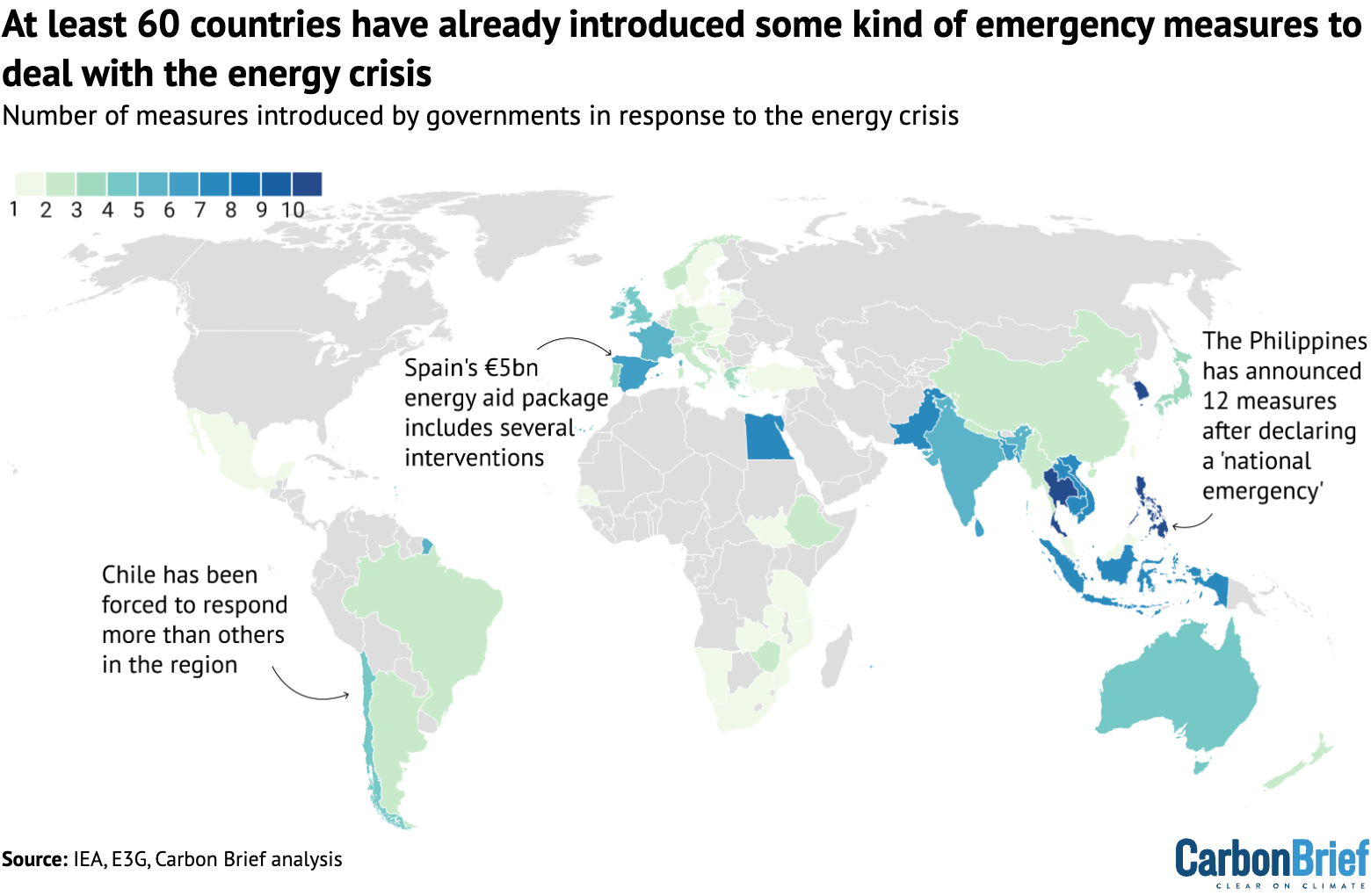
Nations including Indonesia, Japan, South Korea and India are already spending billions of dollars on fuel subsidies to protect people from rising costs.
At least 16 Asian countries are also taking drastic measures to reduce fuel consumption. For example, the Philippines has declared a “state of national emergency”, which includes limiting air conditioning in public buildings and subsidising public transport.
Other examples from the region include the government in Bangladesh asking the public and businesses to avoid unnecessary lighting, Pakistan reducing the speed limit on highways and Laos encouraging people to work from home.
Europe – which was hit hard by the 2022 energy crisis due to its reliance on Russian gas – is less immediately exposed to the current crisis than Asia. However, many nations are still heavily reliant on gas, including supplies from Qatar.
The continent is already feeling the effects of higher global energy prices as countries compete for more limited resources.
At least 18 European nations have introduced measures to help people with rising costs. Spain, which is relatively insulated from the crisis due to the high share of renewables in its electricity supply, nevertheless announced a €5bn aid package, with at least six measures to support consumers.
Many African countries, while also less reliant on direct fossil-fuel supplies via the Strait of Hormuz than Asia, are still facing the strain of higher import bills. Some, including Ethiopia, Kenya and Zambia, are also facing severe fuel shortages.
There have been fewer new policies across the Americas, which have been comparatively insulated from the energy crisis so far. One outlier is Chile, which is among the region’s biggest fuel importers and is, therefore, more exposed to global price increases.
Tax cuts
The most common types of policy response to the energy crisis so far have been efforts to protect people and businesses from the surge in fuel prices.
At least 28 nations, including Italy, Brazil and Australia, have introduced a total of 31 measures to cut taxes – and, therefore, prices – on fuel.
Even across Africa, where state revenues are already stretched, some nations – including Namibia and South Africa – are cutting fuel levies in a bid to stabilise prices.
Another 17 countries, including Mexico and Poland, have directly capped the price of fuel. Others, such as France and the UK, have opted for more targeted fuel subsidies, designed to support specific vulnerable groups and industries.
These measures are all shown in the dark blue “consumer support” bars in the chart below.
Such measures can directly help consumers, but some leaders, NGOs and financial experts have noted that there is also the risk of them driving inflation and reinforcing reliance on the existing fossil fuel-based system.
Christine Lagarde, president of the European Central Bank, spoke in favour of short-term measures to “smooth the shock”, but noted that “broad-based and open-ended measures may add excessively to demand”.
Measures to conserve energy, of the type that many developing countries in Asia have implemented extensively, have been described by the IEA as “more effective and fiscally sustainable than broad-based subsidies”.
So far, there have been at least 23 such measures introduced to limit the use of transport, particularly private cars.
These include Lithuania cutting train fares, two Australian states making public transport free and Myanmar and South Korea asking people to only drive their cars on certain days.
Clean vs coal
At least eight countries have announced plans to either increase their use of coal or review existing plans to transition away from coal, according to Carbon Brief’s analysis. These include Japan, South Korea, Bangladesh, the Philippines, Thailand, Pakistan, Germany and Italy.
These measures broadly involve delaying coal-plant closure, as in Italy, or allowing older sites to operate at higher rates, as in Japan – rather than building more coal plants.
There has been extensive coverage of how the energy crisis is “driving Asia back to coal”. However, as Bloomberg columnist David Fickling has noted, this shift is relatively small and likely to be offset by a move to cheap solar power in the longer term.
Indeed, some countries have begun to consider changes to the way they use energy going forward, amid a crisis driven by the spiralling costs of fossil-fuel imports.
Leaders in India, Barbados and the UK have explicitly stressed the importance of a structural shift to using clean power. Governments in France and the Philippines are among those linking new renewable-energy announcements with the unfolding crisis.
New renewable-energy capacity will take time to come online, albeit substantially less time than developing new fossil-fuel generation. In the meantime, some nations are also taking short-term measures to make their road transport less reliant on fossil fuels.
For example, the Chilean government has enabled taxi drivers to access preferential credit for purchasing electric vehicles (EVs). Cambodia has cut import taxes on EVs and Laos has lowered excise taxes on them.
Finally, there have been some signs that countries are reconsidering their future exposure to imported fossil fuels, given the current economics of oil and gas.
The New Zealand government has indicated that a plan to build a new LNG terminal by 2027 now faces uncertainty. Reuters reported that Vietnamese conglomerate Vingroup has told the government it wanted to abandon a plan to build a new LNG-fired power plant in Vietnam, in favour of renewables.



The post Iran war analysis: How 60 nations have responded to the global energy crisis appeared first on Carbon Brief.
Iran war analysis: How 60 nations have responded to the global energy crisis
Seven Senate Democrats launched the probe over controversial tax credits to the country’s largest exporter of liquefied natural gas.
Seven Democratic U.S. senators have launched a probe into a $370 million “alternative fuel” payout to Cheniere Energy, made earlier this year by the IRS, that critics say the liquefied natural gas export company never should have received.
US Senators Investigate $370 Million IRS Payout to Cheniere Energy



-
Climate Change8 months ago
Guest post: Why China is still building new coal – and when it might stop
-
Greenhouse Gases8 months ago
Guest post: Why China is still building new coal – and when it might stop
-

 Greenhouse Gases2 years ago
嘉宾来稿:满足中国增长的用电需求 光伏加储能“比新建煤电更实惠”
-
Climate Change2 years ago
Bill Discounting Climate Change in Florida’s Energy Policy Awaits DeSantis’ Approval
-

 Climate Change2 years ago
嘉宾来稿:满足中国增长的用电需求 光伏加储能“比新建煤电更实惠”
-
Climate Change Videos2 years ago
The toxic gas flares fuelling Nigeria’s climate change – BBC News
-

 Renewable Energy6 months ago
Sending Progressive Philanthropist George Soros to Prison?
-

 Carbon Footprint2 years ago
US SEC’s Climate Disclosure Rules Spur Renewed Interest in Carbon Credits