

The US, Saudi Arabia, Russia and their allies have spearheaded a push to alter the approval process for a hard-fought green shipping deal, which experts say could jeopardise the landmark pact at the International Maritime Organisation (IMO) talks in London this week.
If approved, the procedural changes would make it harder for the IMO’s Net-Zero Framework (NZF) to come into effect, as it would require support from countries representing half of the world’s shipping fleet.
After years of discussions, governments provisionally agreed the NZF in April, in which they pledged to penalise polluting ships and uses the money to fund the transition to cleaner fuel. The policy is the world’s first global emissions pricing on any sector. At talks in London this week, countries are meeting to discuss how to carry the NZF forward.
Procedural roadblock to shipping deal
The US and its allies want to shift away from a system of tacit approval where, after the NZF is approved at the IMO talks, its rules automatically come into force unless a certain number of countries object. They prefer explicit approval instead, meaning it would not come into force unless enough governments – representing a certain percentage of the world’s shipping fleet – actively indicate support for it.
Emma Fenton, senior director of climate diplomacy at nonprofit policy group Opportunity Green, told Climate Home News that the US’s proposed change “risks undermining the NZF’s ambitions, delays the maritime transition and does not meet the scale or the pace of action that the climate crisis demands”.
Bryan Comer, maritime director at the International Council on Clean Transportation called it “an unnecessary procedural roadblock”.
The US has been pressuring governments not to support the NZF, which they provisionally agreed at the last set of talks in April. Last week, the US threatened supportive government officials and their shipowners with sanctions, visa restrictions, tariffs and port fees.
These measures that would hit small nations with big shipping registries, particularly those whose ships sail frequently to the USA or who have office offices there, the hardest. Two such governments, Bahamas and Liberia – have reversed their support for the NZF and have been actively opposing it this week.

Green shipping deal at risk
While in April some climate campaigners said the NZF lacked ambition and Pacific Island nations abstained from supporting it, others celebrated it a “groundbreaking moment which should signal a turning of the tide on greenhouse gases from global shipping”.
The deal was set to be officially approved by governments at talks at the International Maritime Organisation (IMO) this week, with discussions limited to minor changes to the text. The head of the IMO – Panamanian Arsenio Dominguez – told governments on Tuesday that the text was “balanced” and that not agreeing to it would cause uncertainty and lead to a patchwork of regional and national green shipping regulations which would “increase the costs of this transition in the long run”.
Despite the US threats, government statements at an opening plenary on Tuesday suggested that support for the measure had grown since April – with Pacific and other nations who had previously abstained backing the proposal.
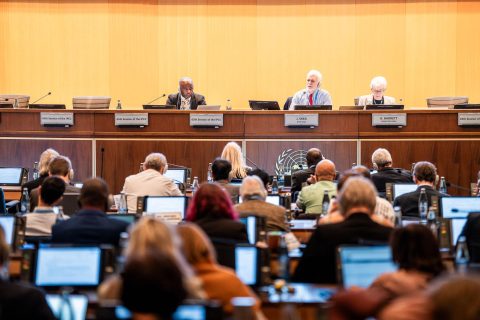
A US, Saudi and Russia-led attempt to oppose the adoption of the agenda failed and the talks’ chair – Liberian Harry Conway – introduced a three-minute time limit and urged governments to stop repetitive interventions in an attempt to prevent delays, joking that offenders would have to donate money to the IMO if they kept repeating themselves.
How high-risk biofuels could sink a flagship climate law for global shipping
Tacit or explicit approval
But on Wednesday morning, the US proposed not to use the tacit approval, a system which stipulates that, after agreements, amendments have a ten-month cooling off period.
During this period, the deal can be cancelled if a third of the nations signed up to the relevant IMO treaty – in this case the countries signed up to the Marpol Annex 6 treaty – object. It can also be cancelled if nations whose ship registries make up half of the world’s fleet by weight actively oppose it.
The US negotiator – who IMO rules say cannot be named – proposed explicit acceptance, which puts the onus on the governments supporting the NZF. Under this system, it would come into force until six months after two-thirds of nations, representing more than half the world’s shipping fleet, actively “communicated” to the IMO that they accept the deal.
“The usual tacit acceptance method is not appropriate for the potential entry into force of such significant measures”, the US negotiator said. They were supported by just over 20 governments, mainly from oil-reliant states like Saudi Arabia, Russia, Iran and Nigeria as well as Turkiye, Morocco, Argentina and Paraguay.
Their proposal was opposed by a larger group of nations, including Western and Pacific countries, South Africa, Brazil, Indonesia, Namibia and Kenya. The Danish negotiator protested that switching to the “time consuming and inefficient” explicit acceptance procedure would throw off the NZF’s timeline and reopening the text would mean “starting all over again”.
“The regulatory framework is ready. It is mature. The decision to move forward was already made in April with the approval of the amendments and, in reality, accepting an explicit acceptance procedure would, in reality, mean no to realising the NZF”, she said.
-
How high-risk biofuels could sink a flagship climate law for global shipping
New rules on shipping fuel emissions must account for their indirect impacts on forests and food production, otherwise owners may rush to use soy and palm oil to power their vessels -
Oil states accused of using scare tactics in bid to sink green shipping deal
Saudi Arabia, Iran and other oil-reliant countries are campaigning to stop the adoption of the IMO’s Net-zero Framework in October -
Governments agree green shipping targets and fees for missing them
Ship owners who fail to reduce emissions intensity 30% by 2035 will have to pay into a “net zero fund” to clean up shipping through green fuels


The Brazilian negotiator said tacit approval has been the default since 1973 because explicit acceptance “simply does not work”. The internal procedures for national governments to ratify amendments are “complicated”, he said, and “may take longer than action requires”, particularly as the shipping industry needs “predictability” on what the rules will be.
The negotiator from the Pacific island nation of Tuvalu said he was “surprised” that the US had not made its proposal before the talks. “We are of the view that the requested change at this stage is not conducive of a transparent and predictable process”, he said.
Talks’ chair U-turns under pressure
After nearly two hours of government statements, Conway said that from what he had heard it was “the will of the committee to proceed with the tacit approval”.
But that conclusion drew further complaints from the US and allies, who repeated their arguments. The US accused Conway and the IMO secretariat of not being “neutral” – which they later firmly denied. Russia’s negotiator accepted that “perhaps those who spoke in the majority were indeed for tacit acceptance” but argued that because the NZF is so “significant” it needs explicit approval.
Countries like Spain and Denmark spoke in defence of Conway’s ruling that the room was for tacit approval. Conway repeated that “there’s a clear majority that have decided to maintain the tacit acceptance procedure” and said he did not want to hear arguments repeated.

But after 30 more minutes of statements from the US, Saudi Arabia and allies, he changed his mind. In the interest of consensus and compromise, he said that the US proposal should be discussed by technical negotiators in a working group. “This will be my final ruling on the matter, he said.
The other side then complained. The Cook Islands negotiator suggested Conway had folded under the “pressure of events” and his decision risked “driving a VLCC [a type of big ship] through the processes and procedures that have stood the test of time”.
But they relented and Wednesday morning’s plenary meeting ended with negotiators being given a mandate to discuss tacit and explicit acceptance procedures in behind closed door sessions, which continued until nearly 11pm that night.
The full plenary met again on Thursday afternoon, but Conway proposed that discussions continue on Friday morning. The US called for time to consult and gathered with its Saudi Arabian and other allies. As negotiations continued behind closed doors, Conway urged governments to come back in the morning – the last day of talks – with solutions “so we will have a smooth discussion and a happy ending”.
Governments are also likely to vote tomorrow on the NZF itself. To pass, the deal need two-thirds of the MARPOL VI signatory countries which are present and voting to vote in favour of the deal – a threshold that was achieved easily in April.
The post US, Saudi-led alliance plunges green shipping deal into doubt appeared first on Climate Home News.
US, Saudi-led alliance plunges green shipping deal into doubt

Three countries have been named by the Paris Agreement’s compliance committee for failing to submit a nationally determined contribution (NDC) and repeatedly snubbing offers of help with their climate plans.
After months of internal debate over whether to identify serial non-responders, the Paris Agreement’s Implementation and Compliance Committee (PAICC) named the three countries which have failed to engage with it over their NDCs on Friday.
It named Democratic Republic of Congo, Senegal and North Korea in a footnote of its annual report, adding that it decided to name them “with a view to facilitating engagement”, adding that representatives of the three nations had been invited to its meeting in early 2027 “with the purpose of identifying any challenges and constraints”.
“The Committee noted the importance of Parties engaging with the Committee in a timely manner, while noting that some delays may be due to the national capabilities and circumstances of the Parties”, the report said.
-
Under US pressure, World Bank says it will back gas “where appropriate”
The US wants the World Bank to expand its gas support while climate campaigners are pushing for it to end – its head spoke this week of limited backing for the fossil fuel -
IPCC scientists vow to press on with climate reports despite political deadlock
After governments again failed to agree a timeline, nearly 120 IPCC authors pledged to complete their assessment on time and with full scientific rigour -
Paris Agreement committee snubbed over missing NDC climate plans
Many governments have still not submitted a nationally determined contribution to the UN, breaching a key requirement of the Paris Agreement


In July, PAICC said 12 countries had ignored its repeated attempts to discuss why they had not published an NDC as required every five years under the 2015 Paris accord.
Members of the committee had been divided over whether to name them, but at a September meeting decided to do so in their annual report to the annual climate COP summit.
By the time the report was published on Friday, only Congo, Senegal and North Korea “had not communicated an NDC or submitted a [Biennial Transparency Report] and had not yet responded to any of the Committee’s notifications, despite several reminders issued by the Committee in this regard”.
Rainforest and renewable energy ambitions
The silence from Congo and Senegal is notable because the former is home to much of the Congo Basin rainforest while the latter has sought billions of dollars in climate finance to support its renewable energy ambitions.
After Brazil, Congo has more rainforest than any country in the world. This forest, and the country’s peatlands, absorb huge amounts of greenhouse gas but are fast being lost to expanding farmland, charcoal production, logging and mining.
Senegal signed a Just Energy Transition Partnership with Canada and wealthy European nations in 2023, to help it meet its renewable energy targets under the-then government of Macky Sall. It was chair of the Least Developed Countries group between January 2022 and December 2023.

Tejas Rao, who is researching the PAICC as part of a doctoral thesis at Cambridge University, said the governments of the three countries should engage with the committee.
“Engagement costs these governments very little and the committee has shown it will listen,” he said.
“Silence leaves the committee with no basis to help, and it leaves the [governments] exposed to the narrative that they are simply disengaged,” he told Climate Home News.
Paris Agreement requirement
The 2015 Paris Agreement requires all parties to publish an NDC every five years outlining their emissions reduction targets, with each plan meant to be more ambitious than the country’s last NDC.
The latest set – the third round of plans, with new targets for 2035 – was due in February 2025. While most countries missed this deadline, all but around 30 – mostly small emitters but including Egypt, Vietnam and Argentina – have now submitted them.
Over the year, the PAICC – which is made up of government climate officials from developed and developing countries – has been communicating with governments that have not submitted NDCs and trying to overcome barriers to them doing so.
Some nations have cited exceptional circumstances as the reason for not submitting an NDC, a process that requires a significant amount of work in tracking emissions and consulting on how to curb them across the economy. For example, a letter from a Sudanese official to the PAICC, seen by Climate Home News, said that the country’s civil war had led to the suspension of its NDC preparation.
-
IPCC scientists vow to press on with climate reports despite political deadlock
After governments again failed to agree a timeline, nearly 120 IPCC authors pledged to complete their assessment on time and with full scientific rigour -
Under US pressure, World Bank says it will back gas “where appropriate”
The US wants the World Bank to expand its gas support while climate campaigners are pushing for it to end – its head spoke this week of limited backing for the fossil fuel -
Who shapes climate science? The equity question facing the IPCC
Early completion of the next global climate science assessment reports risks excluding research from the Global South, which is key to ensuring the findings are fair
The US and Iran are not signed up to the Paris Agreement and so do not have active NDCs, nor does Taiwan, which is not a UN member state.
Rao said that because the PAICC is “facilitative and non-punitive”, naming the countries “is meant to open a door, not close one – the invited consultation is the point”.
“In recent months, governments that explained their constraints, whether capacity, finance or domestic process, have been met with follow-up and support rather than sanction, and the number of silent governments has fallen sharply,” Rao said.
The post Paris Agreement committee names three countries snubbing it over NDCs appeared first on Climate Home News.
Paris Agreement committee names three countries snubbing it over NDCs