

There is very little authorities in Nepal could have done to prevent the deaths and devastation caused by the flash flood on its border with Tibet in late August, scientists with the World Weather Attribution (WWA) group have said.
Launching a study that highlighted the role of climate change in causing the glacial rock and ice collapse that triggered the Himalayan flood, WWA co-founder Friederike Otto told reporters that “no amount of local adaptation can fully shield vulnerable people downstream from this scale of destruction”.
The findings released on Thursday are likely to strengthen Nepal’s case for emergency support from the UN’s Fund for Responding to Loss and Damage. Its board members met informally on Wednesday to discuss whether to grant the country a maximum of $20 million towards its estimated $4.8 billion cost of recovery and reconstruction, but no decision has yet been taken.
Nepal’s foreign minister Shisir Khanal told Climate Home News last week that the destructive flood was “exactly the kind of climate-driven catastrophe the Fund was created to address”.
Hard to predict
The WWA study found that rock-ice avalanches are very hard to predict and that moving people out of areas vulnerable to such floods is difficult as their livelihoods revolve around the rivers along which the floods travel.
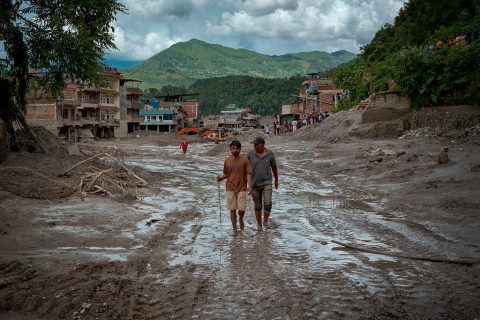
The recent disaster began on the morning of August 26, when an avalanche started falling beneath a glacier. This caused huge amounts of rocks and glacier ice to fall over a kilometre to a valley floor, where they then picked up more rock and ice and became a flood of debris heading downhill and downstream along the border of Nepal and Tibet.
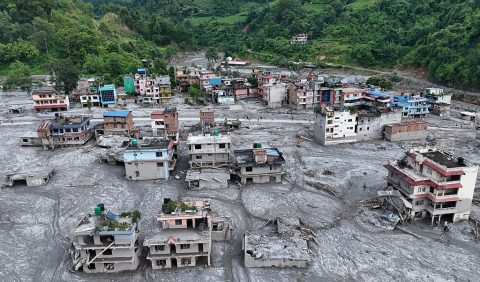
The torrent entered the narrow Lhende Khola gorge and crashed through the busy Gyirong port border crossing at 170 kilometres an hour. It continued many kilometres downstream before eventually turning from rock and ice to water and slowing down.
The flood swept through villages, roads, bridges and hydropower stations, killing over 1,300 people in Nepal with more than 5,000 still missing. The flood also killed at least 40 people in Chinese-run Tibet.
Those on higher ground away from the river mainly survived but the flood’s speed meant that many people received no warning to seek higher ground or shelter.
While Nepal has early warning systems for flooding caused by rain and glacial lake outbursts, the WWA study noted that rock-ice avalanches are complex and understudied, with methods to monitor them still being explored.
Co-author Walter Immerzeel, mountain hydrology professor at Utrecht University, told journalists that with current methods, the disaster could not have been predicted.
But, he said, in the future it may be possible to use remote sensing techniques to analyse glaciers and rocks to generate a warning before a collapse occurs.
A technique called radar interferometry can detect hotspots which should be monitored with field-based sensors and drones, he said, adding that early warning systems could be installed in these areas using seismometers, water-level measurements and CCTV.
Because doing this for thousands of glaciers across the Himalayas would be difficult, authorities could monitor only the rock and ice faces that are a danger to the river valleys with the most people and infrastructure in them, he added. But this would still require lots of investment together with international collaboration and coordination, he warned.
The study found that another potential adaptation strategy – restricting development in flood-prone river valleys – is socially, economically and politically difficult.
The scientists said habitable land is scarce in these steep river valleys and economic activities like transport and hydropower generation are dependent on the river itself.
Madhab Uprety, a Nepali scientist from the Red Cross Red Crescent Climate Centre, said that, while new development should assess the risks of floods, many existing communities and buildings are already at risk.
Loss and damage
Otto said the flood should be discussed in the context of loss and damage as “there is no doubt that climate change is one of the drivers” and “it’s also one of the types of events that are absolutely outside of the limits we can possibly adapt to”.
As well as the deaths, a Nepali government’s assessment has found that a large amount of infrastructure was damaged, including more than 7,500 homes, 105 bridges, 48 public buildings, 47 cultural heritage assets, 18 schools, 13 hydropower facilities, seven health facilities, and numerous shops, hotels, restaurants, irrigation systems and farms. Over 30,000 people were affected.
Developing countries have called for the loss and damage fund’s board to hold an emergency meeting to discuss how to respond to Nepal’s request for funding. Instead of a full board meeting though, board members met only informally and online on Wednesday, Climate Home News understands. A source with knowledge of discussions said the informal nature of the meeting meant they were not able to take decisions or agree on next steps, which have been left up to the board’s co-chairs.
-
Foreign minister: Nepal needs “meaningful” international support to face climate threats
Following its recent Himalayan flooding disaster, the South Asian nation is seeking urgent help from a new UN climate fund, appealing for “stronger global solidarity” -
Loss and damage fund urged to hold crisis meeting on Nepal
The new fund is coming under pressure from developing nations to respond quickly to climate disasters rather than just financing longer-term projects -
Nepal’s EV revolution pays off as oil crisis causes pain at the pumps
Import subsidies, abundant hydropower and charging investments have spurred EV adoption, with electric vehicles now making up about three-quarters of new car sales

Speaking before that meeting started, Nepali climate negotiator Manjeet Dhakal said he had “heard of an extremely positive response” to Nepal’s request from board members. “Hopefully there will be something – a decision that the fund will do for exactly the reason that the fund was established,” he said.
Ajay Mathur, former Indian climate negotiator and now head of The Energy and Resources Institute in New Delhi, told a separate press briefing on Wednesday that the Nepal flood disaster would push loss and damage higher up the agenda of international climate talks, particularly if the United Nations Secretary-General decides to champion the cause at the UN General Assembly in New York next week.
Murat Kurum, Turkish environment minister and president-designate of COP31, told Climate Home News last week that he would be “pleased” if the fund could support Nepal and that he will keep calling in every speech for countries to give money to the loss and damage fund.
Jennifer Morgan, former German climate envoy and now a senior fellow at the Fletcher School of Law and Diplomacy, called for the loss and damage fund – which currently has around $630 million in contributions – to be topped up with new pledges from governments as well as solidarity levies on things like luxury air travel, super-rich individuals and fossil fuel firms’ windfall profits.
The post Nepal flood destruction shows “limits to adaptation”, scientists say appeared first on Climate Home News.
Nepal flood destruction shows “limits to adaptation”, scientists say

Next week, diplomats from around the world will descend on Yerevan, Armenia, to negotiate a series of decisions under the UN Convention on Biological Diversity (CBD).
Between 19 and 30 October, 196 parties will gather to hammer out the precise wording of the dozens of legal texts that make up the decisions under the Conference of the Parties (COP) to the CBD.
This year’s summit is particularly significant, as it marks the halfway point between the agreement of the Kunming-Montreal Global Biodiversity Framework and the deadline for achieving its targets.
The CBD has found that countries are currently not on track to meet 22 out of the framework’s 23 targets.
During the fortnight, delegates will also be negotiating decisions relating to the two supplemental protocols to the CBD: the Cartagena Protocol, which covers biosafety; and the Nagoya Protocol, which covers access and benefit-sharing for the use of genetic resources.
(The Cartagena and Nagoya Protocols, which are each governed by a “meeting of the parties”, or “MOP”, have fewer parties than the CBD as a whole, with 173 and 141, respectively.)
Carbon Brief is tracking the progress of countries towards consensus on dozens of negotiating texts using the interactive table below.
The tracker includes texts from the COP, as well as the MOPs for the Cartagena and Nagoya protocols. It also includes draft decisions from the most recent subsidiary body meetings, as these form the starting point for the negotiations in Yerevan.
The CBD has three subsidiary bodies: the subsidiary body on scientific, technical and technological advice (SBSTTA), the subsidiary body on implementation (SBI) and the subsidiary body on article 8(j) and other provisions (SB8J).
SB8J focuses on issues related to the Indigenous peoples and local communities. It was established at COP16 in Cali, Colombia, in 2024.
The first two columns of the interactive tracker list the topic of each agenda item and the relevant body, with subsequent columns including dates, page counts and links to the original documents.
The table is searchable and can be sorted using the arrows in the header.
Areas of disagreement in UN draft texts are denoted by square brackets. Counting the brackets in a particular iteration of a text therefore gives a sense of how far parties are from reaching consensus.
The bracket column is colour-coded, with dark green indicating a low number of brackets and red indicating a high number of brackets remaining.
Texts can also present parties with choices using “options” or alternatives (“alt”), which are counted together in the sixth column of the table.
The key discussions in Yerevan will centre around two agenda items in particular. The first is the global review, which will assess progress towards the GBF and make recommendations for accelerating action.
The second is finance, which can be separated into two parts: resource mobilisation and the financial mechanism. On resource mobilisation, biodiverse global south countries are likely to push for an increased amount of international finance for conservation.
Disagreement over the creation of the financial mechanism led to the suspension of COP16 in Cali in October 2024, as parties failed to find agreement on the mobilisation of finance before the end of the summit.
Global south countries want the establishment of a separate financial mechanism under the control of the CBD; global north countries largely prefer to maintain the existing mechanism, which sits under the Global Environment Facility.
At the resumed session of COP16 in Rome in early 2025, countries agreed on a roadmap that would lead to the establishment of a permanent mechanism.
related

Analysis: Lula presidency saved at least 20,000km2 of Brazilian Amazon since 2022

Why land-use emissions have fallen by a third this century – in six charts

Analysis: 84% of nations miss deadline to identify ‘nature-harming’ subsidies by 2025

UK withdraws millions in funding from world’s second-largest rainforest in Congo
The post Interactive: Tracking negotiating texts at the COP17 biodiversity summit appeared first on Carbon Brief.
Interactive: Tracking negotiating texts at the COP17 biodiversity summit
A beacon of love
On an outer island of Fiji, two thousand nautical miles from Sydney, is a shining light of hope and resilience for our troubled world.
The island of Kioa is home to a Tuvaluan community who migrated from their atoll of Vaitupu in the late 1940s. It is a land of warm hearts, big smiles, and deep cultural roots; a place where the sound of a conch still summons the island together, where islanders paddle out to fish in carved outrigger canoes, and healthy happy children walk barefoot to school.
Here, culture is life. Kioans live sustainably through their traditional knowledge and practices. The island is alive with song, dance and the rhythms of a life tied to the tides, the winds, and the seasons.

Facing the future
Greenpeace has been lucky to have a relationship with Kioa for a number of years now, and we are continually learning from this remarkable community.
Last week, as part of our Voyaging Oceania project, we returned to the island. Our purpose was twofold —- to carry messages from the island to leaders gathering in Nadi this week for the Pacific Pre-COP, and to support the Kioa community in their efforts to improve water security for the island.
Unlike Tuvalu itself, with its eight atolls, Kioa is a mountainous, forested and richly fertile island. It will remain habitable far into the future. Kioans did not initially migrate from Vaitupu due to climate change, but the move was prophetic. They now have a lifeboat.
However, even Kioa faces challenges on our rapidly warming planet, in particular when it comes to water. Climate change is shifting once reliable rainfall patterns. On top of this, the island is already feeling the effect of this year’s intensifying El Niño event, which for Fiji means reduced rainfall and prolonged dry spells.
Right now, fresh water has to be carefully rationed, and is only available for a few hours a day. During last week’s visit aboard our campaigning ship Oceania, Greenpeace was privileged to work with the Kioa community on a new solar-powered water distribution project for the island.
Designed and led by the island, the project involves using a solar pump to move water from a reliable source to a storage tank and then using gravity to distribute the water around the village.
It was a lesson in how local knowledge and ingenuity can be the backbone of today’s climate solutions. To build a dam around the source, the local community knew the exact spot where they could gather gravel at low tide to mix with the cement. They took only what was needed, knowing that all resources must be carefully conserved. Kioa has no roads and no machinery, and it was an all-of-island effort to carry the materials up to the project site, including many heavy bags of sand and rock.
Such projects truly bring to life the vision of a resilient, locally-led, fossil fuel free Pacific.