

Weather Guard Lightning Tech
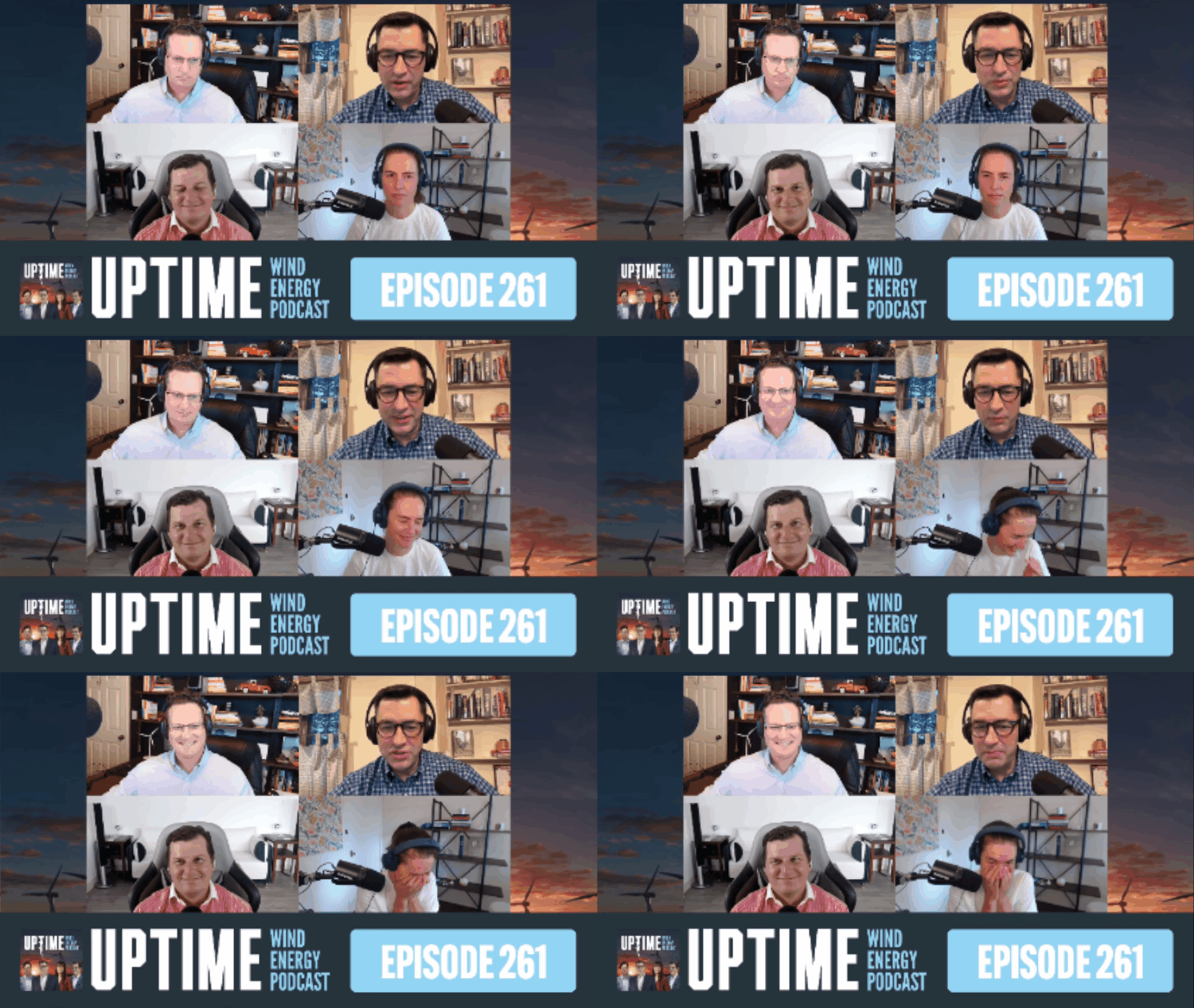
Uptime 5th Anniversary, Carbon Negative Materials
The Uptime Podcast team celebrates their fifth anniversary, reflecting on their journey and contributions from team members. They also discuss Siemens Gamesa’s India operations acquisition by TPG and future renewable energy investments. Additionally, the episode covers innovations in carbon-negative building materials.
Sign up now for Uptime Tech News, our weekly email update on all things wind technology. This episode is sponsored by Weather Guard Lightning Tech. Learn more about Weather Guard’s StrikeTape Wind Turbine LPS retrofit. Follow the show on Facebook, YouTube, Twitter, Linkedin and visit Weather Guard on the web. And subscribe to Rosemary Barnes’ YouTube channel here. Have a question we can answer on the show? Email us!
Allen Hall: We just celebrated our fifth year of podcasting, everybody. So the uptime podcast is of officially five years old. I can’t believe we’ve made it this far. That’s we were trying to do the math on it the other day at five times 50. Roughly. It’s 250 odd episodes. That’s a lot of episodes,
Rosemary Barnes: but that’s only the weekly episodes.
What about all the others? You’re not only putting out one a week these days.
Allen Hall: No, it’s two or three or four, right? It’s somewhere in there. But I just wanted to say congratulations to each of you on behalf of the Uptime podcast and all the work that happens behind the scenes. Everybody listens to the finished product, and I know it sounds great and the comments are great, and the ideas are great, but there’s.
A ton of work that goes into this every week to give you this content, and everybody that’s been on the podcast as a guest, it was just trying to remember all the faces and names that are. Big and wind that have been on the podcast. It’s amazing the people we’ve touched, the people we’ve met that are friends that have come from the podcast.
It’s a nice little family, weirdly enough. And it’s one of those it feels like a pair of comfortable shoes that hey, when you go to a conference, you just know everybody and you, and they know us. You feel like we’ve known them forever because we just spend every week together talking about what’s happening in wind.
It’s a great little experience.
Phil Totaro: Can we add that, a big thank you to everyone who listens because we wouldn’t keep doing it if you weren’t also showing up. Thank you to everyone that listens. Again, your feedback is fantastic. Good and bad. It it keeps us entertained.
So we thank you all.
Joel Saxum: I would say from my seat as well, Alan, thank you for having all of us and organizing the things that you do. And the unsung hero that you guys don’t hear from or usually see unless you’re a guest on the podcast is Claire Hall in the background. Who’s our producer who puts all of these episodes together and is juggling work life.
School, a million different things to make sure this thing goes out every week. So thank you Claire as well. And of course, Rosemary.
Rosemary Barnes: Yeah I was gonna say that, Alan has abnormal persistence. I think it took it like now it’s obvious why, the value and why we would all keep going and why we come back every week.
But yeah, Alan’s efforts, especially in the early years was like, just. Just kept on doing it week after week. And, when I started, all I had to do was show up and try and read the material beforehand. I definitely would not have been doing a weekly podcast for, I think I’ve been on it for four years or so.
I wouldn’t have been doing that on my own, that’s for sure. I think yeah, 90% of the success comes from Alan’s abnormal persistence. So Thanks Alan.
Allen Hall: Yeah. I appreciate everybody coming every week. I know we’ve all been through ups and downs over the last several years, rosemary, you’ve grown a family.
And Joel is. Been in and out and I’ve been in and out and Phil too, right? So between the four of us, we can actually make a decent podcast, which is what I like listening to. And I, we actually reduce the there’s a lot of back and forth. We don’t put on the air because. We disagree quite a bit, but that’s what makes it fun for, at least for me.
I know Rosemary and I sometimes sound like we, we don’t get along, but actually we quite do. I like Rosemary. I think she’s fantastic and I think she brings a ton to the podcast, but there are times it doesn’t seem like we, we get along. I’m fine with it honestly. And Phil, brings in all the investor and the analysis and the data stream and all that which just.
Puts depth to this and puts the numbers together so it makes sense and Joel’s experience in oil and gas and in wind and working for a company in Denmark and all those pieces that you can’t. Find anywhere, make this podcast work. It’s just what it is. It was just great. So I’m just thrilled we met, made it five years and thanks to everybody that’s listened and we’re gonna cross a million subscribers on YouTube in the next couple of weeks.
Thanks to everybody who has. Has joined us on this journey, and yeah, let’s look forward to the next five years to see if we make it that long.
You’re listening to the Uptime Wind Energy Podcast, brought to you by build turbines.com. Learn, train, and be a part of the Clean Energy Revolution. Visit build turbines.com today.
Now here’s your hosts, Alan Hall, Joel Saxon, Phil Ro and Rosemary Barnes.
Allen Hall: A consortium led by TPG. Is set to acquire Siemens Gomesa renewable powers, India operations. Now that deal, Phil is valued at 500 to 550 million, and it comes as Siemen energy works to streamline its operation. Following some significant challenges over the last year or two.
Phil, do you know all the groups that are involved along with TPG and what’s the approach inside of India once they close this deal with Siemens cesa?
Phil Totaro: That’s a really good question, and I don’t know if we know all the answers yet, but it looks like Siemens energy is slated to retain a little bit less than 10% share in, in the company.
TPG Capital is working with the consortium of local companies. Have prior experience in the renewable energy sector. So that’s a good sign. They’ve got nine gigawatts of installed capacity in India at this point with, legacy kind of Ga, Mesa technology.
So the question is they bought the whole thing, including the manufacturing facilities of which they have, I think three. It’s. Interesting that it’s a, an investor TPG capital, basically, that’s taking majority ownership of this and not somebody that’s, again, they’ve brought in these couple of guys that, that run these other two investment partners that are I.
Experienced in the Indian renewable space, but I don’t know if that’s enough to keep everybody going. The capital infusion is certainly enough to keep the manufacturing operations going if they want to, but are they really getting orders? I’m assuming this means they’ve got the license to keep manufacturing these, two to three megawatt Siemens ESA designs.
So where do they go from there?
Joel Saxum: Phil, when Alan and I are doing, we do quite a bit of communication work and lightning stuff in the Indian market and we run into a lot of G one fourteens. A ton of them actually. So in my mind I’m thinking, okay, we know that when this thing was up on the block to be sold, they were people that were looking at it, were wanting mostly from what I saw, was the services revenue.
They wanted to take over that service organization ’cause they wanted the revenue. From that, in my mind, I’m thinking. Who’s on the hook for the risk of warranty? Because if they’re built, if there’s stuff that has been deployed, are they take, are they buying the warranty risk or does that still go back to Siemens Ag?
Of course, we probably won’t. The details of this won’t be public, but at this point in time, I don’t know because that seems risky as hell to me.
Phil Totaro: Yeah. And for those that aren’t familiar, legacy ESA technology, of which the G one 14 was a derivative of, the technology that they originally licensed from Vestas and made the G 80 series and the G 90 series that was lightning prone is all get out.
And, those things have suffered immeasurably, throughout the world. The G eighties, g and g one 14 of are. Just absolute lightning magnets. I’m sure there’s someone that’s gonna be accepting whatever risk there is.
Joel Saxum: If you own G eighties, G nineties, or G one fourteens, call us.
We can help.
Allen Hall: Private equity firms are capitalizing on depressed, renewable energy stock prices to acquire clean energy assets at attractive valuations. Now despite the challenging market conditions for wind and solar companies, investors see strong long-term fundamentals in the sector, particularly as oil majors retreat from the renewable energy commitments.
Now Phil, we’ve seen a lot of this activity over the last year. Brookfield is a big player in acquisitions at the moment. Masar is making a lot of moves. There is ripe fruit. Out there that is valued right to grab now, and I think you’re gonna see a lot more of these acquisitions happening because the more recent acquisitions have not been in the hundreds of millions of dollars.
They’ve been in the billions of dollars and a lot of billions. I don’t see this changing anytime soon.
Phil Totaro: Yeah. And particularly as the oil and gas companies pull back some of these companies you mentioned Brookfield and Masar Master also just announced they were contemplating an IPO. So that’s gonna give them even more resources to, to plow into that if they go that route.
But the reality of it is too, that these are also companies that have made the long-term commitment. To renewables and a renewables portfolio. They’re not just getting in to flip an asset. They’re getting in to build out their portfolio of what they can own, what they can operate, what they can repower.
This is what happens at the beginning where we are right now, which is almost the beginning of a recession. Everybody starts smelling blood and water and starts mobilizing their capital, but it’s the companies that are already active and talking to everybody.
Like your Brookfields, like your KKRs, like your BlackRocks of the world. They already know where to go and what to do. But the funny thing is if you don’t. Give us a call because I got news for you. We’ve got a huge catalog of every project, particularly in the US where, we can tell like who’s making money, who’s not, who’s ready to repower, and, how much is it gonna cost.
There’s definitely ways of, if you haven’t already figured that out and you want to get in on this, don’t waste time, mobilize your capital the right way.
Joel Saxum: I think something to be that’s important to notice or to note here as well is if you watch the press releases from these big oil companies that are retreating.
They’re not saying we’re done with renewables, they’re just saying, for now we’re gonna reallocate our capital and our efforts elsewhere. So I’ve, I would fully see like in the next, maybe not in the next four years, but in the next few, 20 30, 20 35, like as things continue to evolve, you’re going to see those players come back.
And maybe at that point in time that those, some of those markets will be more mature. You may have the technology for floating wind may be like ready to roll. ’cause right now we’re still in those early stages. Very early stages. You see some of these permitting things happening and a little bit more of a it’ll be a more mature market when I think they come back and there will be SOVs available, there’ll be key side facilities available.
Those kind of things will be in place. It’ll de-risk the. The investment, I believe. So I don’t think you’ll see this as a complete departure of big oil, but. Of course this private equity wave is back filling that gap that they, that, that vacuum that they left, they’ll be back. I fully believe
Allen Hall: that, Phil, can we stick on oil and gas just for another moment?
The oil prices have been dropping steadily for the last year-ish. Getting back into oil and gas is not a big money maker at the moment. It isn’t like oil prices are a hundred dollars a barrel. They’re down in the sixties right at the moment, so there’s not a huge revenue stream. And if everybody’s getting back at the same time, it’s gonna really lower the price.
It’s supply demand. So is this the right time to get back in oil and gas, or is it just because they’re just trying to get back to what they know rather than be on the periphery of something that they just don’t maybe really understand?
Phil Totaro: It’s also getting back to what. They know and, but more importantly, maybe what’s made them money already and what’s more in vogue, if you actually wanna look more at fundamental economics renewables are cheaper and can be deployed faster.
And the reality of it is if you’re gonna. If you only look at the power generation sector if it’s based on, petroleum or natural gas generation, there’s a finite amount of order book available. All the manufacturers and the global supply chain, it, it’s. Booked up for through the end of the decade already.
So good luck getting anything deployed. Wind and solar are cheap and deployable right now. If you’re Shell or your BP or whomever and you do oil and gas for a living, like pivoting back to that, not gonna be a problem. But again, if you’re trying to get into a market and you have a decision to make about where to park, capital renewables are actually the better option even longer term because, fixed price contracts and things like that, that you don’t have to be susceptible to, all these press fluctuations and all this other stuff that you gotta put up with compliance related in the oil and gas industry.
That’s what I’d be doing if I had, billions to invest.
Joel Saxum: Oil and gas is is not, oh. Okay. So when we talk about oil and gas being cyclical in nature, if you’re outside of the industry, when you look, when you hear oil and gas is cyclical in nature, you look at price per barrel, what does it cost you with the gas pump, that kind of thing.
However, there is a lot more cycles within gas, oil and gas, and a lot of those cycles have to do with when are you developing capital facilities and when are you doing exploration? So exploration has been happening for a while as capital was high exploration. You grab the war chest, you go out and you look for some resources.
You do some unconventional stuff. You look around, you build plans to get into the play. Right now you have this drill, baby drill thing now as well. If you look at the rig counts global and. In the, in North America, they’re down about 5% right now than they were today, last year. And that’s unconventional knowledge when people are like, why?
Why is that happening? Because they’re pumping. They don’t need to be drilling right now. They have resources that were ready to roll that they’re just flip that capital Twitter at switchback on let’s go. And that’s why you’re seeing prices come down. So we, there’s a lot of odd cyclical, there’s a lot of sign waves in the cycle of oil and gas that are being played on right now.
And, but if you look at the, like the Shell’s recent announcement that they talked about, what they talked about was we’re, you know what, we’re gonna pull it into the chest. We’re gonna get dividends back up for our shareholders. And to me that’s Hey, we’re gonna get, we’re gonna de-risk our operation.
We’re gonna build up the war chest a little bit more, and then. You never know what we could deploy capital on, but we don’t need to do it right now. We’re making money and I think that’s where there, the volatility index in the stock markets is through the roof. It’s easier to pull it back in and drive some shareholder value without taking risks right now.
Allen Hall: Don’t let blade damage catch you off guard. OGs. Ping sensors detect issues before they become expensive, time consuming problems from ice buildup and lightning strikes to pitch misalignment and internal blade cracks. OGs Ping has you covered The cutting edge sensors are easy to install, giving you the power to stop damage before it’s too late.
Visit eLog ping.com and take control of your turbine’s health today. Phil, I think you sent me an article talking about. How natural gas, which six months ago was gonna be the energy supply for AI and all these data centers that are gonna plan to be built in the United States, mostly around Texas.
And now that that was the pathway. Everybody’s realizing that they can’t build gas turbines that quickly. So the oil and gas demand, the natural gas demand may not be there because they can’t have no way of burning it and turning into electricity. So the net is that renewables are gonna fill that space.
Phil Totaro: Theoretically, in Texas in particular though, they just passed a Senate bill, which seems like it’s gonna get signed by the governor to basically offset every megawatt of renewable generation. So basically if you’re a renewable asset owner in Texas you’re no longer allowed to deploy batteries to back up your renewables.
You actually have to deploy gas. To back up your renewables. And so I don’t know how that’s actually gonna work if they, if the governor actually does sign this ridiculous nonsense. But the reality as well is, you have the ability to deploy renewables, to be able to, power data centers and things like that.
A as we talked about a lot faster, and b in a more consistent fashion than. What you would be able to get with with gas anyway. Because if, especially if you’re talking about putting something like behind a meter for example, like renewables are probably the way to go again, because even though it’s variable generation, you’re still doing it on a relatively fixed price contract.
So I’m not sure why that’s not a viable option again, when it can be deployed cheaper and faster than whatever else. Could be leveraged, whatever other technologies could
Allen Hall: be leveraged, and data centers are mobile. You would just pick it up, put it in the back of a truck and take it to Iowa, which is what you should be doing to start off with, because the electricity prices in Iowa are really aggressive.
There’s a ton of renewables there, a lot of wind, a good bit of solar. If you want to go someplace where electricity is readily available. I’m still a little confused to why Texas would be that place. Obviously if you’re doing gas turbines yes, true. But if you’re looking to do renewables, there’s a lot of land in Iowa.
As Joel knows, there’s a lot of cornfields in Iowa you can make into data centers. It wouldn’t take much Iowa’s a fixed price market. Some of it is,
Phil Totaro: not all of it but you’re also now running into all of these local restrictions, at the county and township level on wind and solar project development and that’s coming back to bite everybody in the butt.
At this point because, you’re, you’ve restricted renewables, which could be deployed fast, but you’re allowing natural gas and fracking and whatever else, but you, it’s gonna take you forever to get the power. But you’ve got companies that wanna deploy these data centers if you have put all these blockades in place from being able to, allow this data center to be built. They’re just gonna, like Helen just said they’re mobile. Like they’re gonna move it someplace else. They’re gonna take it down to Texas, they’re gonna take it to, heck they could take it anywhere and buy revenue from, the data center and the power generation.
Joel Saxum: So this is, but this is part of our, this is a cultural or a societal problem that we have, and it’s a global problem. It’s worse in Europe. Is this need or like the delay in permitting and we used to be able to get done things so fast, like the Empire State Building was built in a little over 400 days from like start to finish, right?
There’s no way we would do that now. Because they, oh, we have to this, we gotta slow down because of this or this ant might not, like whatever it may be. We can’t get anything done quickly anymore.
Allen Hall: How soon before they put data centers on barges and how soon before they put data centers in Australia where there’s plenty of resources and electricity is cheap?
Why would you not do that? Because the, it’s just a data line. It could be anywhere. It could literally be anywhere.
Joel Saxum: The best data center model for me is yeah, sinking one in the ocean and putting a tal turbine on it. Cooling, no cooling problems. Gonna say that. Yeah.
Rosemary Barnes: But they are being located places where cooling is easy, like scandinavia’s getting a lot because the, yeah, the water that is nearby is cool.
And then sometimes they can also use the heat for district heating. It’s a easy kind of way to integrate all that. And I visited a project in in. Denmark, I think it was in where they have their yeah, a Facebook data center that was using cool Danish water to cool it, and then it was providing heat to the district heating, and there was no money changed hands because it’s like.
Facebook were getting rid of some heat for no cost and the district heating system was getting some heating energy for no cost. So it was a win-win. And I know that there are a few other projects around like that. It’s definitely not all data centers can be located just wherever you want.
Some of them need to be near the cities that they’re serving, sometimes it needs to be just really fast. Yeah. But I know that they are thinking about things like that, about the climate of the place that they’re putting it in many cases because. Cooling is a huge part of their their energy cost.
It’s very significant
Allen Hall: in Norway, Iceland, natural resources to generate electricity with, right? And it’s cold most of the year, so you solve two problems right there. The third one, it gets solved by SpaceX because Elon’s putting up all those high speed low earth orbit satellites so you can transmit the data at crazy speeds around the world.
You don’t even need a cable anymore. W this gets very mobile and I think we’re thinking like 1980s approach here. I’m gonna connect to a pipeline. I’m gonna plant this data center in, I’m gonna put a gas turbine next to it. I’m gonna crank this thing up like I’m Henry Ford. The reality is that data centers can be placed anywhere, and I do think there’s an opportunity for a large part of Northern Europe, just like Joel was saying.
And you too, Rosemary. I agree with you. There. This thing’s gonna get moved around quick.
Rosemary Barnes: What else is interesting about the mobile nature of data centers? I was listening, I think it was a Vaults podcast I was listening to yesterday.
Allen Hall: What?
Rosemary Barnes: Yeah, I listened to other podcasts as well. And. Their guest on there, I can’t remember who it was talking about how that’s a risk for you.
’cause you know how like a lot of, data centers, there’s a lot more data centers in the US because there’s a lot more tech companies using them in the us so that makes sense. And it’s really hard to tease out what the actual, upcoming demand will be on electricity grids because they they shop around a few different locations to find the place that’s gonna give ’em the most favorable, yeah, the most favorable deal. And one of the challenges is that, the same data center might be represented in 2, 3, 4 different utilities, forward planning. And then there’s a big risk because, if the utility’s gonna build real infrastructure to serve those projects, real gas turbines, real transmission lines that sort of thing.
What happens if the data center does just pack up and leave, like those assets are still there and who’s gonna pay for it? Then once the data center’s gone, it’s gonna be, the the, the rest of the utilities customers. So it’s yeah, it’s really. Challenging to figure out like how American consumers or just regular American consumers of electricity are not gonna end up paying like a significant chunk of the bill for this data center expansion because they really are wooed by the local areas to get this business there.
But yeah, like it’s far from certain that the benefits are gonna outweigh the cost to the communities that host them.
Joel Saxum: Have you guys heard of the company wind cores? Wind cores is a German company and they’re putting mini data centers, right? ’cause they’re not huge in the foundations, in the towers of existing turbines.
Phil Totaro: Oh yeah. Okay. Yeah, I have heard of them.
Joel Saxum: So I just, I’m just looking on my other screen and I was Googling it and it says, on average 85 to 92% of the power for each of these. Many data centers is coming directly from the hosting wind turbine, so they’re taking advantage of when markets are curtailed and other things like that to power these things.
So taking that behind the meter approach, but with it, you’re doing. You’re eliminating the other infrastructure, you’re eliminating the, the need to build a building to do all these other things. ’cause it’s in the tower already. So like a solution like that. Now that one’s not infinitely scalable of course.
But that’s a cool solution that could be used. I think that one’s neat.
Phil Totaro: Joel, there’s more than 500,000 wind turbines in the world, so it’s scalable if they want it to be.
Allen Hall: As wind energy professionals, staying informed is crucial, and let’s face it difficult. That’s why the Uptime podcast recommends PES Wind Magazine.
I. PES Wind offers a diverse range of in-depth articles and expert insights that dive into the most pressing issues facing our energy future. Whether you’re an industry veteran or new to wind, PES Wind has the high quality content you need. Don’t miss out. Visit PS wind.com. Today, Northwestern University scientists have developed a new carbon negative building material that could transform the concrete and cement industries using seawater.
Now, Rosemary. Stay with me here. You’re gonna using sea water, electricity, and carbon dioxide. The researchers have created a process that not only permanently locks away CO2, but also produces valuable materials for construction. And as a bonus, hydrogen gas as a clean fuel byproduct. Now. So let’s just walk through this just for a minute.
The material can be used in concrete as a substitute for gravel or sand to manufacture cement, plaster, and paints, right? So you get this gritty substance you can mix in. And it produces hydrogen gas, which obviously can eventually burn, and it was developed to maximize the value of captured CO2 rather than just storing it underground.
So the first question is it worth it? Is it worth all that hassle and all the electricity to do this? Or should you just be bearing CO2 underground and leaving it?
Rosemary Barnes: Yeah, so there’s there’s a few. Concrete, cement based solutions that can be carbon negative. I think carbon cure is one where they bubble in CO2 into the into the concrete as it’s curing and that stores carbon.
And yeah, as I. Concrete cures over like over many years of its lifetime. It continues to absorb CO2. All just even regular concrete with regular cement does that already. And then there’s some other companies there’s an Australia one actually that Canberra based where I’m from, called Mineral Carbonation International, and they’ve got a product that can yeah, basically absorb CO2 and it makes a.
Yeah. A material, a mineral that you can use for a bunch of different things, including, you can put it in building materials, another option that does roughly the same things, will it? Work or not? I’m sure it works. The challenge is scale. The challenge is the cost as well. Does it cost more than regular concrete, then who’s gonna pay for it?
And that’s the biggest challenge with any carbon capture project is at the moment, unless the material you’re making is actually. Better or cheaper in some way than the thing it’s replacing. And I haven’t seen it. You said it came out of a lab, so I’m sure that for now it’s not at the point where it is cheaper.
Perhaps there is cost potential cement. Really, you need something besides capitalism to, to get you there.
Joel Saxum: It’s the sa it’s the same outline of the problem we have with recycling, wind turbine mine blades. You can recycle them, you can make this material out of ’em. To put, to use as in, in concrete.
But if it’s not cheaper, unless it’s substantially better, then it’s not, it’s hard to build an economic model around it.
Rosemary Barnes: You know what, even the better part is actually hard because there are a few like really cool smart cement alternatives that are you, and even some of them I chemically identical to Portland Cement, but the standards for cement around the world for using cement, they don’t say it needs to be this strong or, it doesn’t give a bunch of.
Materials, properties that it has to hit. It says it has to use this much Portland cement, like it’s specified in building standards all over the world that you have to use this ratio of Portland cement. And so that’s actually one of the hardest obstacles to overcome. Yeah, like it’s funny that one of the biggest obstacles to decarbonizing that industry is all the standards in place.
And I, I do think this is one place where governments could make a really big difference besides not actually just, putting in a carbon tax or something. But actually like helping to rewrite those standards. One and two. The biggest user of the biggest purchaser of concrete and cement in most countries is the government.
For a lot of these, like urban infrastructure projects, also defense, they, they could start specifying, we’re going to require, I don’t know, 5% needs to be, these alternative materials that are, just as good, better properties in many cases, but just haven’t been used before.
If the government would would start to use them, we could really accelerate their development and the the costs coming down. I. As they got used more. Yeah, that that’s one of my hopes. I don’t often look to the government for solutions technology solutions, but I do think that this is one area where they really could make a big difference without changing things too much.
Allen Hall: That’s gonna do it for this week’s Uptime Wind Energy podcast. Thanks for listening, and please give us a five star rating on your podcast platform and subscribe in the show notes below to uptime tech news, or next week on the Uptime Wind Energy Podcast.
https://weatherguardwind.com/uptime-anniversary-carbon-negative/

 Someone commented on the meme here: “Don’t forget your jihadi prayer group meeting.”
 One would think that Republicans could see the stark contrast between John McCain (honest, sane, decent American hero) and Donald Trump (criminal sociopath and traitor to his country).
But alas.
Tightline and Avient Remove Peel Ply From Carbon Planks
This week we’re revisiting our discussion with Andrew Davis of Tightline Composites and Brad Schmidt of Avient, who discuss a resin additive that eliminates peel ply on carbon planks.
The Uptime Wind Energy Podcast is brought to you by Weather Guard Lightning Tech, creators of the StrikeTape Ultra LPS retrofit. Subscribe to Uptime’s Substack newsletter. And check out Rosemary’s “Engineering with Rosie” Youtube channel. Have a question we can answer on the show? Email us!



