


UnitedHealth Group shares surged after Warren Buffett’s Berkshire Hathaway revealed a major investment stake. The move signals investor confidence in UnitedHealth’s market strength, diversified operations, and growth potential in the U.S. healthcare sector.
UnitedHealth operates through two primary businesses:
-
UnitedHealthcare, the insurance arm, and
-
Optum, which provides pharmacy, data, and healthcare delivery services.
Together, they serve millions of customers in the U.S. and internationally, making UnitedHealth one of the largest players in the industry.
Berkshire’s Billion-Dollar Prescription for UnitedHealth
Shares climbed over 12% after it became public that Berkshire Hathaway invested about $1.57 billion in UnitedHealth. The stake represents roughly 5 million shares.
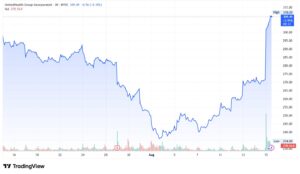
The company faced a tough year. It saw a 46% drop in stock value, rising healthcare costs, a DOJ investigation, and leadership changes. But Berkshire’s move reassures investors. Many see it as validation of UnitedHealth’s long-term value and resilience.
While rising on financial news, attention is shifting to UnitedHealth’s environmental efforts—especially its net-zero plans and renewable energy projects.
The Healthcare Sector’s Race Toward Net Zero
The healthcare sector is increasingly committing to net-zero goals. It recognizes its responsibility as it accounts for an estimated 4–5% of global greenhouse gas emissions.
In the U.S., over 60 major hospitals and health systems aim to cut their emissions by half by 2030. More than 140 organizations have also signed the Health Sector Climate Pledge. Their goal is to achieve a 50% reduction by 2030 and reach net-zero by 2050.
Globally, over 3,000 healthcare institutions from various countries have joined the UN’s Race to Zero campaign. AstraZeneca is leading the way with its “Ambition Zero Carbon” program. So far, it has cut emissions by 68%. The goal is to reach 98% by 2026.
The UK’s National Health Service plans to achieve net-zero by 2045. They will focus on electrification, sustainable procurement, and improving energy efficiency.
In the UAE, PureHealth plans to reach net-zero by 2040 using advanced monitoring systems. These commitments show a stronger, united push to link healthcare with climate and sustainability goals.
Inside UnitedHealth’s Climate Cure Plan
UnitedHealth Group aims for net-zero emissions across the value chain by 2050. This target covers its direct operations (Scope 1 and 2) and seeks major cuts in indirect value chain emissions (Scope 3).
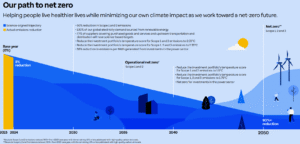
This ambition is part of the health giant’s larger ESG framework. It connects environmental responsibility with long-term healthcare results and business strength.
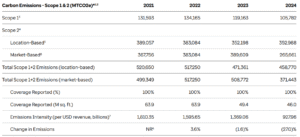
In 2024, UnitedHealth reported about 1.1 million metric tons of CO₂e emissions. This is a 12% drop from its 2020 baseline in Scope 1 and Scope 2. The company has set clear climate goals:
-
Cut its direct emissions (Scope 1 and 2) by 60% by 2030.
-
Power 100% of operations with renewable energy by 2030.
-
Reach net-zero operations by 2035.
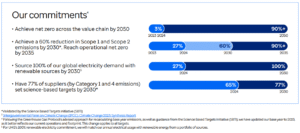
The company’s major decarbonization approach includes the following levers:
Reducing Operational Emissions
UnitedHealth is moving its facilities to use renewable electricity. They aim to source 100% renewable energy for all global operations by 2030. In 2024, the company reported that over 70% of its electricity use was already renewable, up from about 60% in 2022.
Energy Efficiency Measures
UnitedHealth is implementing energy management systems across its offices, data centers, and clinics. Upgrades such as LED lighting, better HVAC systems, and smart controls have cut energy use by around 15% since 2020.
Fleet and Transportation Decarbonization
The company is testing electric and hybrid vehicles in its delivery fleets. And it plans to switch to all low-emission vehicles by 2030.
Scope 3 Emissions Engagement
UnitedHealth knows that a large part of its emissions comes from its supply chain. So, it has begun working with suppliers to set science-based emissions targets. Top-tier suppliers must share their carbon footprints. They will also report progress on sustainability platforms.
Powering the Future: Renewable Energy Milestones
In 2024, UnitedHealth signed a 15-year virtual power purchase agreement (VPPA) with Ørsted’s Mockingbird Solar Center in Texas. This supplies 250 megawatts (MW)—enough power for about 54,000 U.S. homes each year through 2039.
The company invested $81 million in Texas’s Tres Bahias solar project. This secures clean energy and renewable energy credits (RECs). It will cover 70 megawatt-hours (MWh) each year for seven years, powering about 40,000 homes.
Together, these projects supply:
-
89% of UnitedHealth’s U.S. electricity needs
-
58% of its global electricity needs (based on a 2021 baseline)
Tackling the Supply Chain Emissions Puzzle
The company also links climate goals to its broader mission of improving health outcomes. UnitedHealth aims to reduce its environmental impact by cutting emissions from healthcare delivery. This includes energy-intensive medical equipment and facility operations. They want to keep care quality high while making these changes.
Scope 3 emissions remain the largest challenge, representing more than 90% of the company’s carbon footprint.
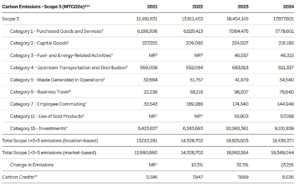
UnitedHealth also invests in carbon removal and offset projects to address hard-to-abate emissions. These include RECs and verified carbon credits. These projects help improve air quality and community health, matching our healthcare mission.
While offsets are a small part of the strategy, UnitedHealth sees them as a short-term tool while transitioning to low-carbon operations. In 2024, UnitedHealth used 8,636 MTCO2e of carbon credits to negate its Scope 3 emissions.
UnitedHealth’s climate plan emphasizes:
-
Sustainable procurement
-
More telehealth use, cutting down travel for patients and staff
-
Partnerships with providers who embrace greener practices
UnitedHealth wants to lead in healthcare and be a good corporate citizen. By focusing on environmental performance, it aims to tackle climate-related risks.
Other ESG and Sustainability Initiatives
UnitedHealth’s ESG strategy goes beyond emissions. It focuses on expanding access to care, promoting health equity, and supporting community health programs.
The United Health Foundation has pledged over $100 million each year. This funding aims to address social factors that affect health, like food insecurity, stable housing, and access to preventive care.
UnitedHealth is also committed to environmental stewardship. They work with industry partners to promote sustainable healthcare. This includes cutting down on single-use plastics in medical settings. They also look for lower-carbon options for medical supplies.
Healthy Returns—For Investors and the Planet
UnitedHealth appeals to institutional investors like Warren Buffett’s Berkshire Hathaway. Its strong financial performance, growing Optum segment, and active ESG commitments all contribute to this attractiveness.
Analysts say that adding sustainability to healthcare can boost efficiency, cut costs, and meet rising regulatory and customer demands.
As the sector faces increasing scrutiny over its environmental impact, UnitedHealth’s net-zero goals and progress tracking place it ahead of many industry peers. If the company meets its 2035 goals and stays profitable, it could lead in ESG for healthcare.
Overall, UnitedHealth’s stock rally, sparked by Berkshire Hathaway’s stake, comes alongside deepening ESG commitments—especially in clean energy and net-zero transition. Its renewable energy projects, emission cuts, and sustainability leadership position the company to thrive financially and environmentally.
The post UnitedHealth Group (UNH) Stock Soars After Berkshire’s $1.57B Stake: But Can It Win the Net-Zero Race? appeared first on Carbon Credits.

EU carbon credit claims changed on 27 September 2026, the day the Directive (EU) 2024/825 began to apply across the European Union. The change is narrow. It changes how a company can talk about the credits it buys. A product can no longer be called neutral on the strength of compensation alone; however, every specific, evidenced statement about what a company measured, reduced, and funded stays fully available.

The post Promoting Improved Cooking Practices in Nigeria appeared first on Terrapass.



-
Climate Change1 year ago
Guest post: Why China is still building new coal – and when it might stop
-

 Greenhouse Gases2 years ago
嘉宾来稿:满足中国增长的用电需求 光伏加储能“比新建煤电更实惠”
-
Greenhouse Gases1 year ago
Guest post: Why China is still building new coal – and when it might stop
-

 Climate Change2 years ago
嘉宾来稿:满足中国增长的用电需求 光伏加储能“比新建煤电更实惠”
-

 Renewable Energy12 months ago
Sending Progressive Philanthropist George Soros to Prison?
-
Climate Change2 years ago
Bill Discounting Climate Change in Florida’s Energy Policy Awaits DeSantis’ Approval
-
Greenhouse Gases1 year ago
嘉宾来稿:探究火山喷发如何影响气候预测
-

 Climate Change2 years ago
Analysis: China’s CO2 falls 1% in Q2 2024 in first quarterly drop since Covid-19