

The latest round of country climate plans ‘barely move the needle’ on future warming, the head of the UN Environment Programme (UNEP) has warned.
Executive director Inger Anderson made the comments as UNEP published its 16th annual assessment of the global “emissions gap”.
The report sets out the gap between where global emissions are headed – based on announced national policies and pledges – and what is needed to meet international temperature targets.
It finds that the latest round of national climate plans – which were due to the UN this year under Paris Agreement rules – will have a “limited effect” on narrowing this emissions gap.
Currently, the world is on track for 2.3-2.5C of warming this century if all national emissions-cutting plans out to 2035 are implemented in full, according to the report.
In a statement, UNEP executive director Inger Anderson said: “While national climate plans have delivered some progress, it is nowhere near fast enough.”
A decade on from the Paris Agreement, the UN agency credits the climate treaty for its “pivotal” role in lowering global temperature projections and driving a rise of renewable energy technologies, policies and targets.
Nevertheless, it warns that countries’ failure to cut emissions quickly enough means the world is “very likely” to breach the Paris Agreement’s aspirational 1.5C temperature limit “this decade”.
It urges countries to make any “overshoot” of the 1.5C warming target “temporary and minimal”, so as to reduce damages to people and ecosystems, as well as future reliance on “risky and costly” carbon removal methods.
Among the other key findings of the report are that China’s emissions could peak in 2025, while the impact of recent climate policy reversals in the US are likely to be outweighed by lower emissions in other countries in the coming years.
(See Carbon Brief’s detailed coverage of previous reports in 2014, 2015, 2016, 2017, 2018, 2019, 2020, 2021, 2022, 2023 and 2024.)
Greenhouse gas emissions continue to grow
The UNEP report finds that global emissions of greenhouse gases – carbon dioxide (CO2), methane, nitrous oxide and fluorinated gases (F-gases) – reached a record 57.7bn tonnes of CO2 equivalent (GtCO2e) in 2024. This marks a 2.3% increase compared to 2023 emissions.

This increase is “high” compared to the rise of 1.6% recorded between 2022 and 2023, the report says.
This rate of increase is more than four times higher than the average annual emissions growth rate throughout the 2010s, the report notes, and is comparable with the 2.2%-per-year rate seen in the 2000s.
The chart below shows total greenhouse gas emissions between 1990 and 2024.
It illustrates that “fossil CO2” (black), driven by the combustion of coal, oil and gas, is the largest contributor to annual emissions and the main driver of the increase in recent decades, accounting for around 69% of current emissions.
Methane (grey) plays the second largest role. Meanwhile, emissions from nitrous oxide (blue) fluoride gases (orange) and land use, land-use change and forestry (LULUCF, in green) make up 24% of total greenhouse gas emissions.
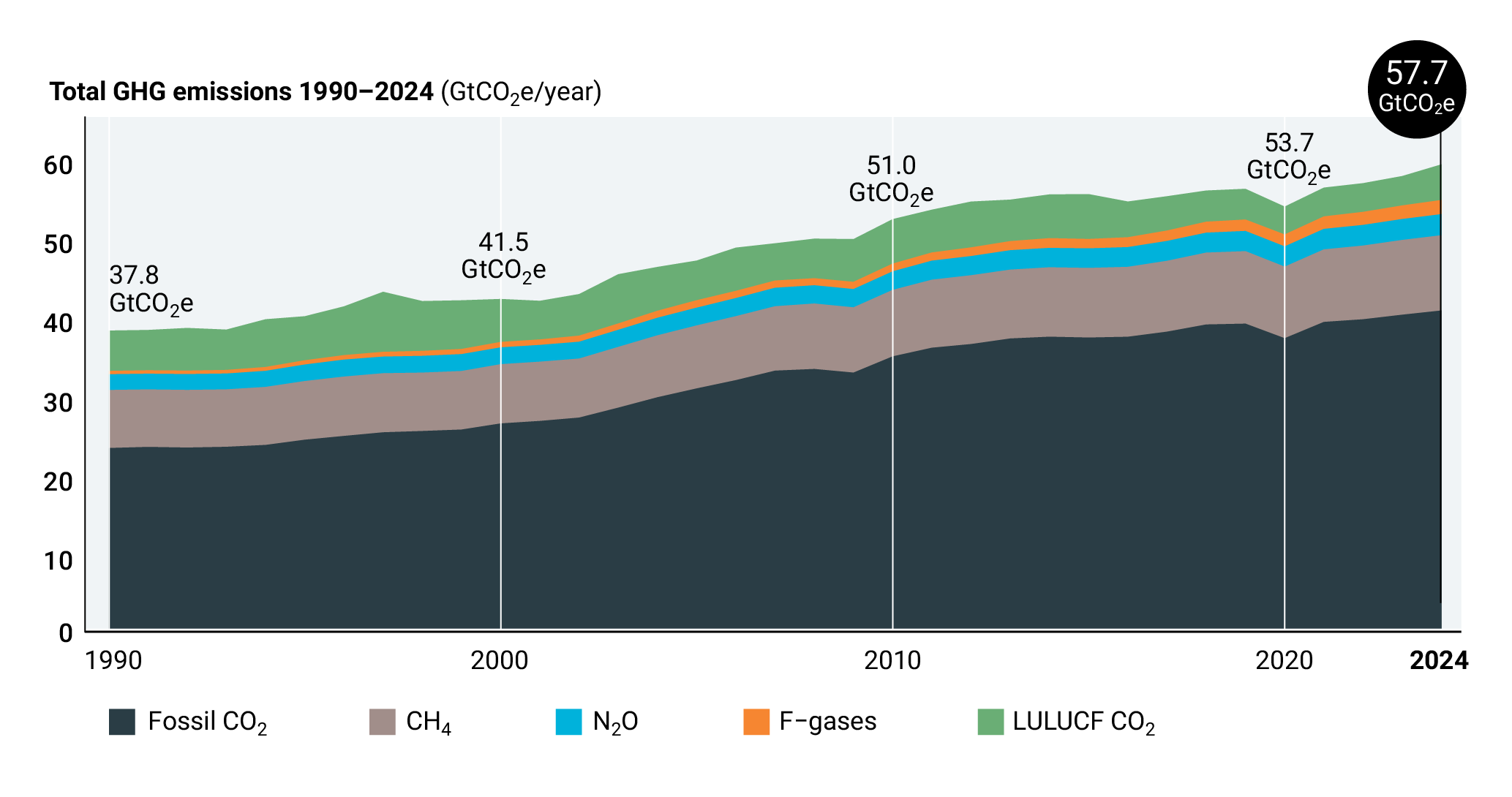
The report notes that all “all major sectors and categories” of greenhouse gas emissions saw an increase in 2024. For example, fossil CO2 emissions increased by 1.1% between 2023 and 2024.
However, it highlights that deforestation and land-use emissions played a “decisive” role in the overall increase last year. According to the report, net LULUCF CO2 emissions rose by a fifth – some 21% – between 2023 and 2024.
This spike is in contrast to the past decade, the report notes, where emissions from land-use change have “trended downwards”.
It says one of the reasons for the increase in LULUCF emissions over 2023-24 is the rise in emissions from tropical deforestation and degradation in South America, which were among the highest recorded since 1997.
The authors also break down changes in greenhouse gases by country or country group. They note that the six largest emitters in the world are China, the US, India, the EU, Russia and Indonesia.
The report finds that, when emissions from land use are excluded, emissions from the G20 countries accounted for 77% of the overall increase in emissions over 2023-24. Meanwhile, the “least developed countries” group contributed only 3% of the increase.
The graph below shows contributions to the change in greenhouse gas emissions between 2023 and 2024 for the five highest-emitting countries and groups, as well as for the rest of the G20 countries (purple), the rest of the world (grey), LULUCF globally (green) and international transport (dark blue).
The bottom horizontal black line shows the 56.2GtCO2e emitted in 2023. The size of each bar indicates the change in emissions between 2023 and 2024. The top horizontal black line shows the 57.7GtCO2e emitted in 2024.
The chart illustrates how India and China are the countries that recorded the largest individual increase in emissions between 2023 and 2024, while the EU is the only grouping where emissions decreased.
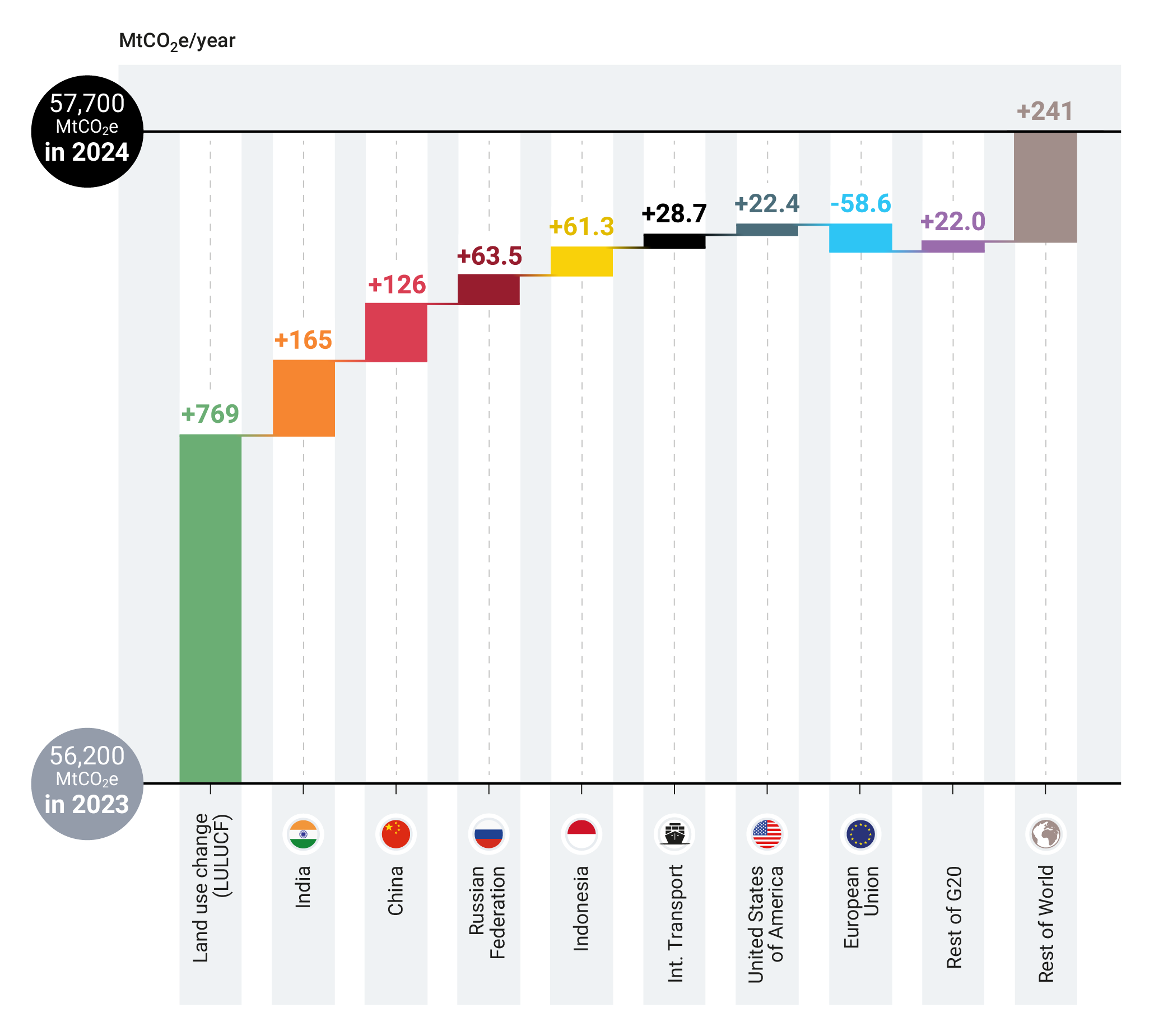
India and China recorded the largest absolute increase in emissions beyond the land sector. However, Indonesia saw the highest percentage increase of 4.6% (compared to 3.6% for India and 0.5% for China). In contrast, emissions from the EU decreased by 2.1%.
New national climate plans fall short
Under the terms of the Paris Agreement, countries are required to submit national climate plans, known as “nationally determined contributions” (NDCs), to the UN every five years. These documents describe each country’s plans to cut emissions and adapt to climate change.
The deadline for countries to submit NDCs for 2035 was February 2025.
(Carbon Brief reported earlier this year that 95% of countries had missed the February deadline and, more recently, that just one-third of new plans submitted by the end of September expressed support for “transitioning away” from fossil fuels.)
By September 2025, 64 parties had submitted or announced their new NDCs. UNEP says that 60 of these countries accounted for 63% of global emissions. Meanwhile, only 13 countries, accounting for less than 1% of global emissions, had updated their emissions reduction targets for 2030.
Writing in the foreword to the report, UNEP’s Inger Andersen says that “many hoped [the pledges] would demonstrate a step change in ambition and action to lower greenhouse gas emissions and avoid an intensification of the climate crisis that is hammering people and economies”. However, she adds that “this ambition and action did not materialise”.
The report emphasises that “immediate and stringent emissions reductions” are the “fundamental ingredient” for meeting the Paris temperature goal of keeping warming this century to well-below 2C and making efforts to keep it to 1.5C.
However, it adds that the new NDCs and “current geopolitical situation” do not provide “promising signs” that these emissions cuts will happen.
The report presents a “deep dive” into the emissions reduction targets of G20 countries – the world’s largest economies, which are collectively responsible for more than three-quarters of global emissions.
The analysis investigates NDCs and policy updates as of November 2024.
None of the G20 countries have strengthened their targets for 2030, according to the report. However, it finds that seven G20 countries have submitted NDCs with emissions reduction targets for 2035. The EU, China and Turkey have announced targets, but had not yet submitted 2035 climate plans to the UN by the time the report was finalised.
According to the report, the new NDCs and policy updates of G20 countries lead to a reduction in projected emissions by 2035. However, these reductions are “relatively small and surrounded by significant uncertainty”, it cautions.
Nevertheless, UNEP says there are a number of G20 countries whose emissions projections have seen “significant changes” in this year’s report, including the US and China.
For the first time, the projections in the gap report suggest that China will see its emissions peak in 2025, followed by a reduction in emissions of 0.3-1.4GtCO2e by 2030. According to the report, this is due to the growth of renewable electricity generation in the country “outpacing” overall power demand growth.
In contrast, the authors warn that projections for US emissions in 2030 have increased by 1GtCO2e compared to last year’s assessment, mainly due to “policy reversals”.
(Since taking office in January 2025, Donald Trump has triggered the process of withdrawing the US from the Paris Agreement for the second time and dismantled US climate policies implemented under Joe Biden. The UNEP report does not specifically mention Trump or his administration.)
However, it finds that lower greenhouse gas projections for China and several other countries outweigh the higher projections in the US by 2030.
Overall, the report projects that, under current climate policies, annual emissions from G20 countries will drop to 35GtCO2 by 2030 and 33Gt by 2035.
China is the largest contributor to this projected reduction, followed by the EU then the US, according to the report. (Emissions from the US are still projected to decline, albeit much more slowly than previously expected.)
It adds that other G20 members are on “clear downward emission trends”, noting that “several more” might see emissions “peak or plateau between 2030 and 2035” under current policies.
The graph below shows the historical emissions (light blue) and projected emissions (dark blue) of the G20 members, along with their NDCs for 2030 and 2035 (shown by the diamonds) and net-zero targets (circles).
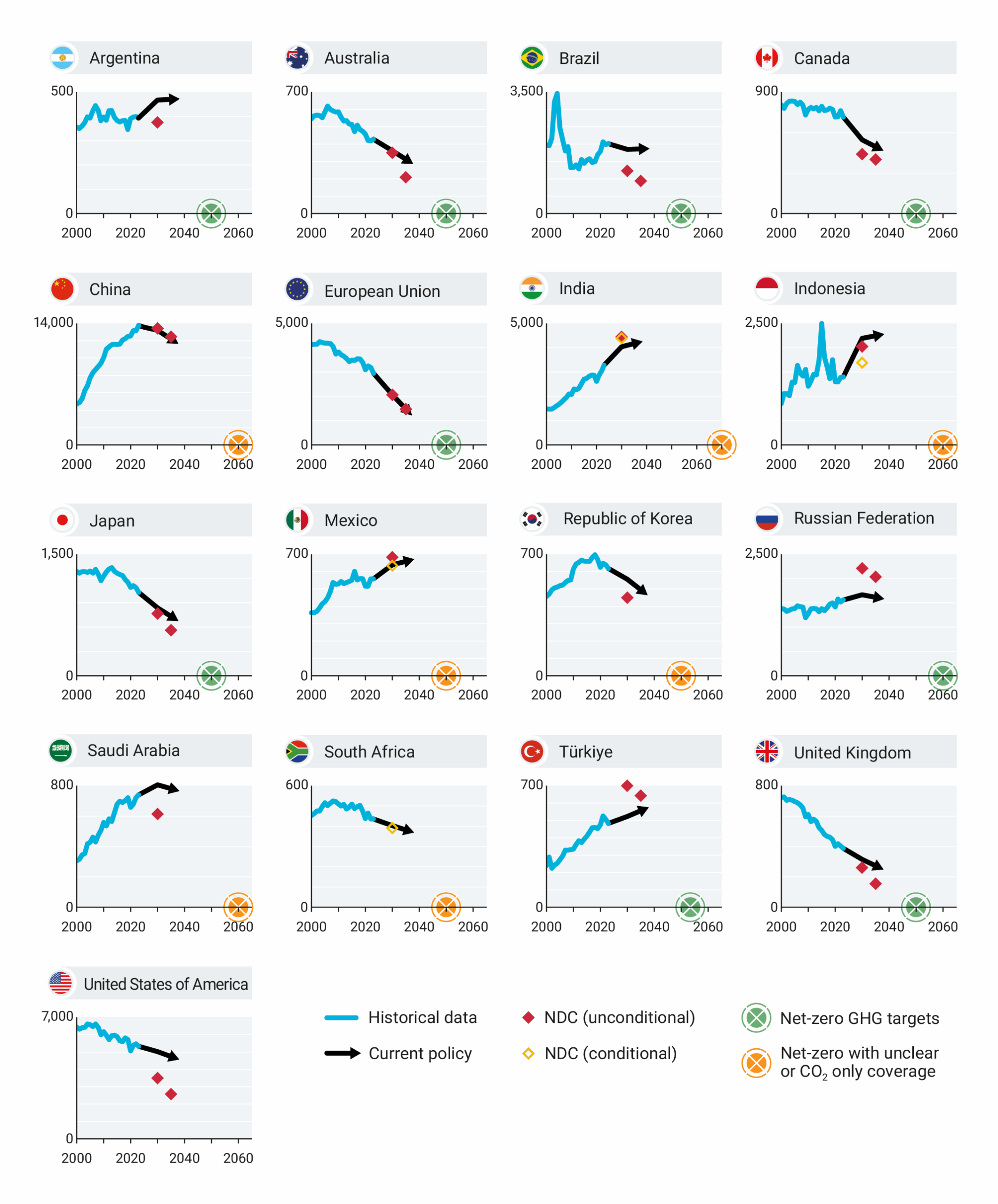
The graph shows that some countries, such as Turkey and Russia, are projected to cut emissions more rapidly than they have pledged under their NDCs. In contrast, other nations, such as the UK and Canada, are anticipated to fall short of the emissions-reduction goals set out in their national climate plans.
New NDCs and policy updates lower expected emissions in 2035
The report conducts an “emissions gap” analysis that compares the emissions that would be released if countries follow their climate policies or pledges, with the levels that would be needed in order to hold warming below 2C, 1.8C and 1.5C with limited or no overshoot.
The “gap” between these two values shows how much further emissions would need to be reduced in order to limit warming below global temperature thresholds.
To explore potential rises in global temperature over the coming years and decades, the report authors use a simple climate model, or “emulator”, called FaIR. They assess a range of potential futures:
- A “current policy” scenario, which assumes that countries follow policies adopted as of November 2024. This scenario also assumes the full implementation of announced policy rollbacks in the US as of September 2025.
- An “unconditional NDCs” scenario, which assumes the implementation of NDCs that do not depend on external support. This scenario includes the US NDC, as withdrawal from the Paris Agreement will not be complete until January 2026.
- A “conditional NDCs” scenario that further assumes the implementation of NDCs that depend on external support, such as climate finance from wealthier countries.
The report also analyses two “scenario extensions”, which explore the post-2035 implications of current policies, NDCs and net-zero pledges:
- A “current policies continuing” scenario, which “follows current policies to 2035 and assumes a continuation of similar efforts thereafter”.
- A “conditional NDCs plus all net-zero pledges” scenario, which is “the most optimistic scenario included”. This scenario assumes the “conditional NDC” scenario is achieved until 2035 and then all net-zero or other long-term low emissions developments strategies are followed thereafter, excluding that of the US.
The authors note that emissions projections for 2030 under the “current policy” scenario in this year’s report are slightly larger than they were in last year’s assessment. The authors say this is “mainly” due to policy rollbacks in the US.
In contrast, this report projects slightly lower emissions for 2035 than last year’s report, as policy changes in the US are offset by “improved 2035 policy estimates” in other countries.
The authors find that the new NDCs have “no effect” on the 2030 gap when compared to last year’s assessment.
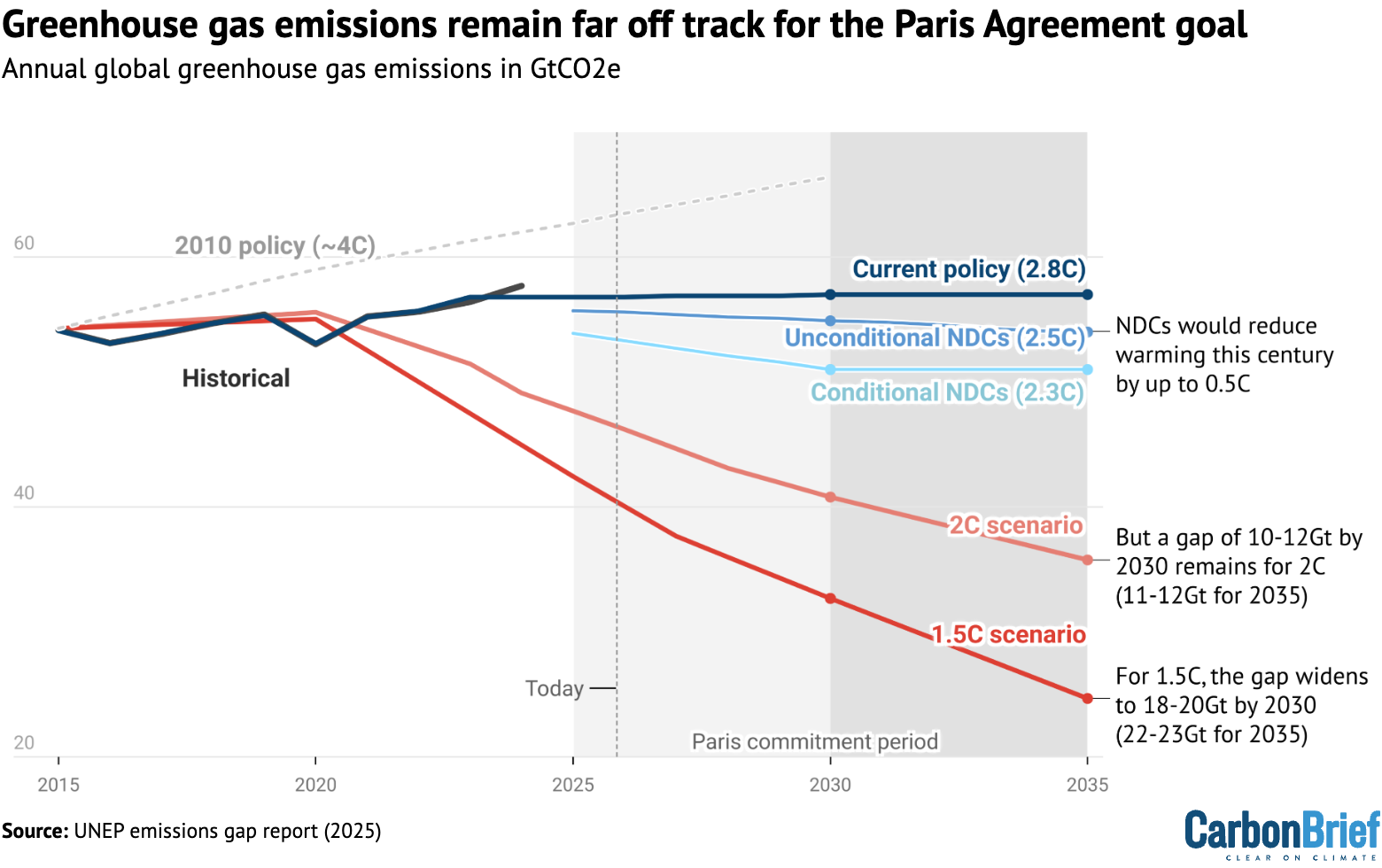
According to the report, implementing unconditional NDCs would result in emissions in 2030 being 12GtCO2e above the level required to limit warming to 2C. This number rises to 20GtCO2e for a 1.5C scenario.
Also implementing conditional NDCs would shrink these gaps by around 2GtCO2e, the report says.
(The authors note that these numbers are slightly smaller than in last year’s report, but say this is not a reflection of “strengthening of 2030 NDC targets”, but instead from “updated emission trends by modelling groups and methodological updates”.)
The report adds that the formal withdrawal of the US from the Paris Agreement for a second time will mean that emissions laid out in the US NDC are not counted. This will increase the emissions gap by 2GtCO2e, the report says.
According to the report, the new NDCs do narrow the 2035 emissions gap compared to last year’s assessment. The report says:
“The unconditional and conditional NDC gaps with respect to 2C and 1.5C pathways are 6bn and 4bn tonnes of CO2e lower than last year, respectively.”
This means that the “emissions gap” between a world that follows conditional NDCs and one that limits warming to 2C above pre-industrial temperatures is 6GtCO2e smaller in this year’s report than last year’s. Similarly, the gap between the “conditional NDCs” scenario and the 1.5C scenario is now 4GtCO2e smaller.
Despite the improvement, the report warns that the emissions gap “remains large”.
The graph below shows historical and projected global emissions over 2015-35 under the current policy (dark blue), unconditional NDCs (mid blue), conditional NDCs (light blue), 2C (pink) and 1.5C (red) scenarios.
The report also warns that there is an “implementation gap”, as countries are currently not on track to achieve their NDC targets.
The authors say the implementation gap is currently 5GtCO2e for unconditional NDCs by 2030 and 7GtCO2e for conditional NDCs, or around 2GtCO2e lower once the US withdrawal from the Paris Agreement is complete next year.
‘Limited’ progress on reducing future warming
UNEP calculates that the full implementation of both conditional and unconditional NDCs would reduce emissions in 2035 by 12% and 15%, respectively, on 2019 levels. However, these percentages shrink to 9% and 11% if the US NDC is discounted.
The projections suggest there will be a “peak and decline” in global emissions. However, the report says the large range of estimates that remain around global emissions reductions means there is “continued uncertainty” around when peaking could happen.
Projected emissions cuts by 2035 are “far smaller” than the 35% reduction required to align with a 2C pathway and the even steeper cut of 55% required for a 1.5C pathway, the report says.
The authors say that temperature projections set out in this year’s report are only “slightly lower” – at 0.3C – than last year’s assessment.
It notes that new policy projections and NDC targets announced since the last assessment have lowered warming projections by 0.2C. “Methodological updates” are responsible for the remaining 0.1C.
Furthermore, the forthcoming withdrawal of the US from the Paris Agreement would reverse 0.1C of this “limited progress”, the report notes.
Responding to these figures in the report’s foreword, UNEP’s Anderson says the new pledges have “barely moved the needle” on temperature projections.
The chart below shows the different warming projections under four of the scenarios explored in the report.
It shows how, under the current policies pathway, there is a 66% chance of warming being limited to 2.8C. In a scenario where efforts are made to meet conditional NDCs in full, there is the same probability that warming could be capped at 2.3C.
In the most optimistic scenario – where all NDCs and net-zero targets are implemented – there is a 66% chance that warming could be constrained to 1.9C. (This projection remains unchanged since last year’s report.)
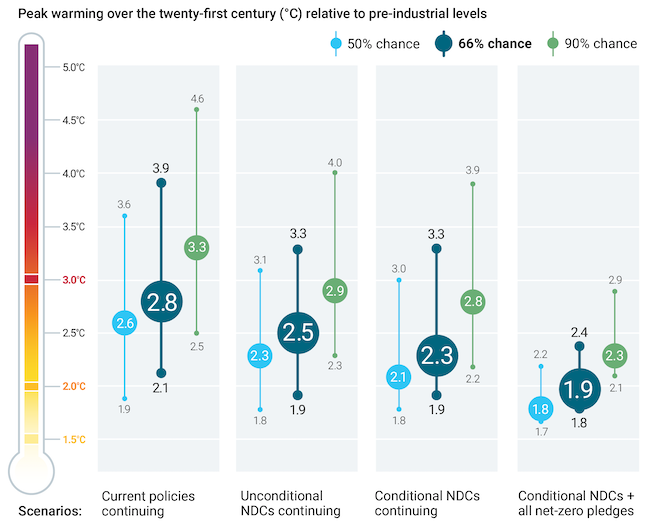
The report warns that, across all scenarios, the central warming projections would see global warming surpass 1.5C “by several tenths of a degree” by mid-century. And it calculates there is a 21-33% likelihood that warming could exceed 2C by 2050.
Nevertheless, it stresses that the Paris Agreement has been “pivotal” in reducing temperature projections. Policies at the time of the treaty’s adoption would have put the world on track for warming “just below 4C”.
1.5C limit could be exceeded within a decade
UNEP notes that its updated temperature projections underscore an “uncomfortable truth” that surpassing the Paris Agreement’s 1.5C warming limit is “increasingly near”.
The limit – which refers to long-term warming over a pre-industrial baseline and not average warming in any particular year – could be exceeded “within the next decade”, it says. However, the report emphasises that it remains “technically possible” to return to 1.5C by 2100.
Global inaction on emissions in the 2020s means that 1.5C pathways explored in previous emission gap reports and Intergovernmental Panel on Climate Change’s sixth assessment cycle are “no longer fully achievable”, according to UNEP.
Moreover, a lack of “stringent emissions cuts” in recent years means climate pathways with “limited” overshoot of 1.5C are also “slipping out of reach”, the authors say.
A future of “higher and potentially longer” overshoot of 1.5C is “increasingly likely”, they warn.
Climate “overshoot” pathways are those where temperatures exceed 1.5C temporarily, before being brought back below the threshold using techniques that remove carbon from the atmosphere.
(For more on climate overshoot, read Carbon Brief’s detailed write-up of a recent conference dedicated to the concept.)
Elsewhere, the report notes the remaining “carbon budget” for limiting warming to 1.5C without any overshoot of the goal will “likely be exhausted” before 2030.
(The carbon budget is the total amount of CO2 that scientists estimate can be emitted if warming is to be kept below a particular temperature threshold. Earlier this year, the Indicators of Global Climate Change report estimated the remaining carbon budget had declined by three-quarters between the start of 2020 and the start of 2025.)
The graphic below illustrates the percentage likelihood of limiting warming under 1.5C, 2C and 3C under the four scenarios set out in the report.
It shows how the chances of limiting warming to below 1.5C throughout the 21st century is close to zero in all but the most optimistic scenario. In the scenario where conditional NDCs and net-zero pledges are met, the chances of limiting temperatures below the goal is just 21%.
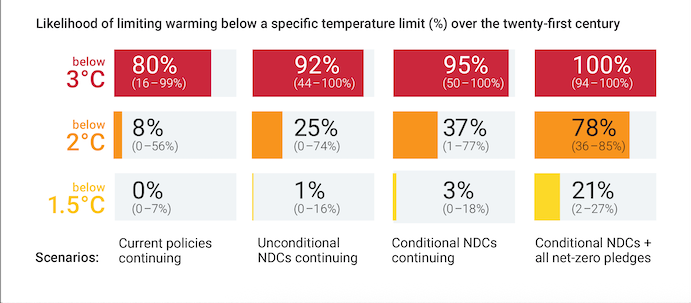
The report stresses that it is critical to limit “magnitude and duration” of overshoot to avoid “greater losses for people and ecosystems”, higher adaptation costs and a heavier reliance on “costly and uncertain carbon dioxide removal”.
Roughly 220GtCO2 of carbon removals will be required to reverse every 0.1C of overshoot, according to the report. This is equivalent to five years of global annual CO2 emissions.
The report also warns that it is “highly unlikely” that all risks and hazards will “reverse proportionately” after a period of temperature overshoot.
UNEP states that pursuing the 1.5C temperature goal is nevertheless a “legal, moral and political obligation” for governments regardless of whether warming exceeds the target.
The UN agency emphasises that the 2015 Paris Agreement establishes “no target date or expiration” for its temperature goal – and points to the International Court of Justice’s recent advisory opinion that 1.5C remains the “primary target” of the climate treaty.



The post UNEP: New country climate plans ‘barely move needle’ on expected warming appeared first on Carbon Brief.
UNEP: New country climate plans ‘barely move needle’ on expected warming

Drought and heatwaves occurring together – known as “compound” events – have “surged” across the world since the early 2000s, a new study shows.
Compound drought and heat events (CDHEs) can have devastating effects, creating the ideal conditions for intense wildfires, such as Australia’s “Black Summer” of 2019-20 where bushfires burned 24m hectares and killed 33 people.
The research, published in Science Advances, finds that the increase in CDHEs is predominantly being driven by events that start with a heatwave.
The global area affected by such “heatwave-led” compound events has more than doubled between 1980-2001 and 2002-23, the study says.
The rapid increase in these events over the last 23 years cannot be explained solely by global warming, the authors note.
Since the late 1990s, feedbacks between the land and the atmosphere have become stronger, making heatwaves more likely to trigger drought conditions, they explain.
One of the study authors tells Carbon Brief that societies must pay greater attention to compound events, which can “cause severe impacts on ecosystems, agriculture and society”.
Compound events
CDHEs are extreme weather events where drought and heatwave conditions occur simultaneously – or shortly after each other – in the same region.
These events are often triggered by large-scale weather patterns, such as “blocking” highs, which can produce “prolonged” hot and dry conditions, according to the study.
Prof Sang-Wook Yeh is one of the study authors and a professor at the Ewha Womans University in South Korea. He tells Carbon Brief:
“When heatwaves and droughts occur together, the two hazards reinforce each other through land-atmosphere interactions. This amplifies surface heating and soil moisture deficits, making compound events more intense and damaging than single hazards.”
CDHEs can begin with either a heatwave or a drought.
The sequence of these extremes is important, the study says, as they have different drivers and impacts.
For example, in a CDHE where the heatwave was the precursor, increased direct sunshine causes more moisture loss from soils and plants, leading to a drought.
Conversely, in an event where the drought was the precursor, the lack of soil moisture means that less of the sun’s energy goes into evaporation and more goes into warming the Earth’s surface. This produces favourable conditions for heatwaves.
The study shows that the majority of CDHEs globally start out as a drought.
In recent years, there has been increasing focus on these events due to the devastating impact they have on agriculture, ecosystems and public health.
In Russia in the summer of 2010, a compound drought-heatwave event – and the associated wildfires – caused the death of nearly 55,000 people, the study notes.

The record-breaking Pacific north-west “heat dome” in 2021 triggered extreme drought conditions that caused “significant declines” in wheat yields, as well as in barley, canola and fruit production in British Columbia and Alberta, Canada, says the study.
Increasing events
To assess how CDHEs are changing, the researchers use daily reanalysis data to identify droughts and heatwaves events. (Reanalysis data combines past observations with climate models to create a historical climate record.) Then, using an algorithm, they analyse how these events overlap in both time and space.
The study covers the period from 1980 to 2023 and the world’s land surface, excluding polar regions where CDHEs are rare.
The research finds that the area of land affected by CDHEs has “increased substantially” since the early 2000s.
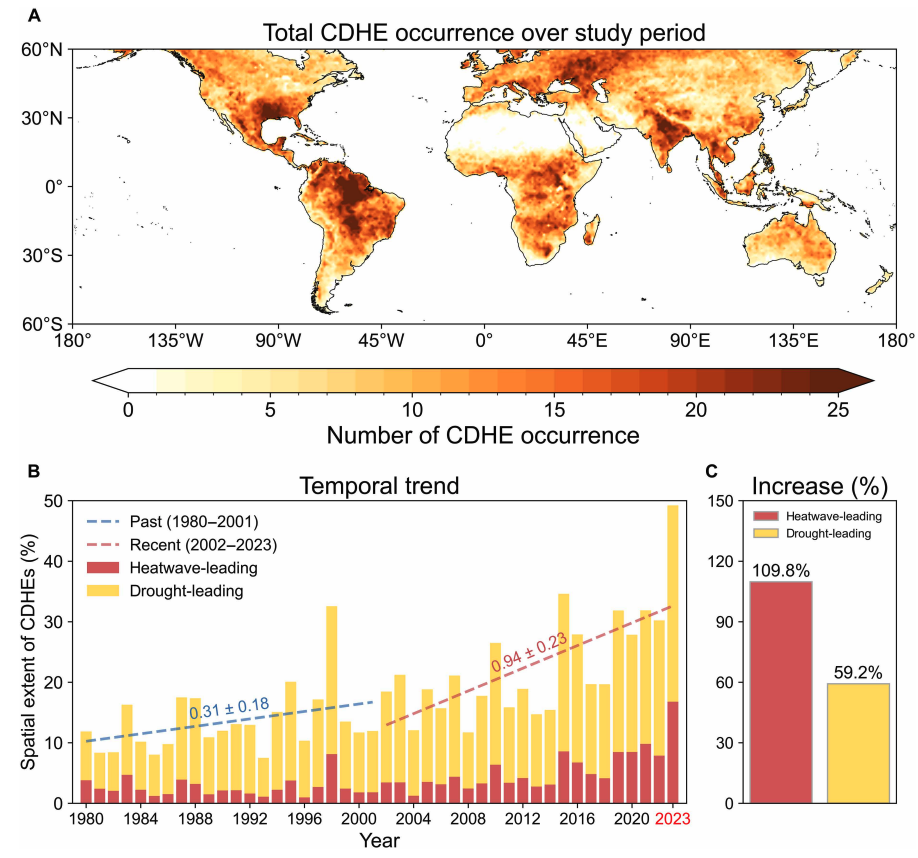
Heatwave-led events have been the main contributor to this increase, the study says, with their spatial extent rising 110% between 1980-2001 and 2002-23, compared to a 59% increase for drought-led events.
The map below shows the global distribution of CDHEs over 1980-2023. The charts show the percentage of the land surface affected by a heatwave-led CDHE (red) or a drought-led CDHE (yellow) in a given year (left) and relative increase in each CDHE type (right).
The study finds that CDHEs have occurred most frequently in northern South America, the southern US, eastern Europe, central Africa and south Asia.
Threshold passed
The authors explain that the increase in heatwave-led CDHEs is related to rising global temperatures, but that this does not tell the whole story.
In the earlier 22-year period of 1980-2001, the study finds that the spatial extent of heatwave-led CDHEs rises by 1.6% per 1C of global temperature rise. For the more-recent period of 2022-23, this increases “nearly eightfold” to 13.1%.
The change suggests that the rapid increase in the heatwave-led CDHEs occurred after the global average temperature “surpasse[d] a certain temperature threshold”, the paper says.
This threshold is an absolute global average temperature of 14.3C, the authors estimate (based on an 11-year average), which the world passed around the year 2000.
Investigating the recent surge in heatwave-leading CDHEs further, the researchers find a “regime shift” in land-atmosphere dynamics “toward a persistently intensified state after the late 1990s”.
In other words, the way that drier soils drive higher surface temperatures, and vice versa, is becoming stronger, resulting in more heatwave-led compound events.
Daily data
The research has some advantages over other previous studies, Yeh says. For instance, the new work uses daily estimations of CDHEs, compared to monthly data used in past research. This is “important for capturing the detailed occurrence” of these events, says Yeh.
He adds that another advantage of their study is that it distinguishes the sequence of droughts and heatwaves, which allows them to “better understand the differences” in the characteristics of CDHEs.
Dr Meryem Tanarhte is a climate scientist at the University Hassan II in Morocco, and Dr Ruth Cerezo Mota is a climatologist and a researcher at the National Autonomous University of Mexico. Both scientists, who were not involved in the study, agree that the daily estimations give a clearer picture of how CDHEs are changing.
Cerezo-Mota adds that another major contribution of the study is its global focus. She tells Carbon Brief that in some regions, such as Mexico and Africa, there is a lack of studies on CDHEs:
“Not because the events do not occur, but perhaps because [these regions] do not have all the data or the expertise to do so.”
However, she notes that the reanalysis data used by the study does have limitations with how it represents rainfall in some parts of the world.
Compound impacts
The study notes that if CDHEs continue to intensify – particularly events where heatwaves are the precursors – they could drive declining crop productivity, increased wildfire frequency and severe public health crises.
These impacts could be “much more rapid and severe as global warming continues”, Yeh tells Carbon Brief.
Tanarhte notes that these events can be forecasted up to 10 days ahead in many regions. Furthermore, she says, the strongest impacts can be prevented “through preparedness and adaptation”, including through “water management for agriculture, heatwave mitigation measures and wildfire mitigation”.
The study recommends reassessing current risk management strategies for these compound events. It also suggests incorporating the sequences of drought and heatwaves into compound event analysis frameworks “to enhance climate risk management”.
Cerezo-Mota says that it is clear that the world needs to be prepared for the increased occurrence of these events. She tells Carbon Brief:
“These [risk assessments and strategies] need to be carried out at the local level to understand the complexities of each region.”