Connect with us

Published

on

Governments are holding “critical” talks this week on a global treaty to curb plastic pollution, as some countries and activists warn that key issues – including measures to rein in soaring plastic production – are being sidelined.

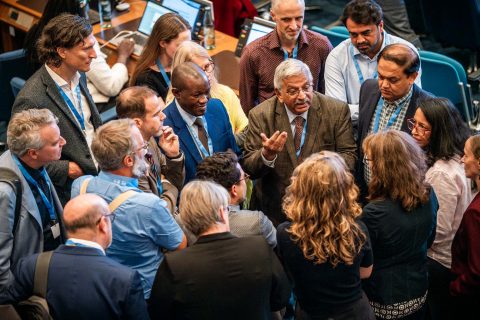
Diplomats are meeting in person in Nairobi for the first time since negotiations were suspended in chaos nearly a year ago, stymied by a long-running deadlock that pits petrostates against more ambitious nations over the reach of the UN pact.

Because nearly all plastic is made from planet-heating oil, gas and coal, the sector’s trajectory will have a major influence on global efforts to cut greenhouse gas emissions.

The four-day informal gathering, which begins on Tuesday, has been billed by the chair of the talks, Chilean ambassador Julio Cordano, as a “brainstorming” session in which countries are invited to put forward possible solutions to some of the treaty negotiations’ most divisive elements.

Cordano is expected to distill those views in a new document intended to serve as the basis for a new draft text of the future treaty, which governments would take up at the next official round of negotiations, scheduled for March 13-24, 2027.

Two earlier rounds, each billed as the final one, ended without agreement, derailed largely by a standoff over how the treaty should address plastic production, which the UN says is set to triple by 2060 without intervention.

Production curbs in the spotlight

Large fossil fuel and petrochemical producers, led by Saudi Arabia, the United States, Russia and India, have repeatedly argued that the treaty should focus only on managing plastic waste. A US State Department spokesperson told Climate Home News that Washington supports “practical, cost-effective solutions” to plastic pollution, while opposing “global plastic bans”.

A majority of countries – including most European, Latin American, African and Pacific island nations -want to limit the manufacturing of plastic to “sustainable levels”, but have not pushed for any wide-ranging ban.

    Ahead of what it described as “critical” talks in Nairobi, the French government said last week it had already shown flexibility and “significantly scaled back” its initial ambitions. But a French official told a meeting of EU environment ministers that without an explicit reference to the “unsustainable nature” of plastic production, the treaty would be “fundamentally unbalanced, ineffective and, worse still, could set us on the wrong path for decades to come”.

    In a separate written communication, the French government lamented that informal meetings held in recent months have given “disproportionate visibility to the positions of the least ambitious states”, fuelling a “risk that partial agreements may be reached only on the issues with the broadest consensus”.

    Dennis Clare, a negotiator for the Pacific island nation of Micronesia, told Climate Home News that “if we fail to address any key elements”, including overproduction, the impacts of the plastic crisis on the climate, human health and ecosystems will only grow more severe.

    Fears over “political calculations”

    Despite such concerns, plastics production is not mentioned in the wide-ranging list of topics Cordano has drafted for the meeting – an omission that has alarmed observers.

    Christina Dixon, a campaigner at the Environmental Investigation Agency (EIA), said there appeared to be an attempt to write off this crucial element of the treaty as “too complicated and politically unviable”.

    David Azoulay, environmental health programme director at the Center for International Environmental Law (CIEL), said the meeting’s proposed structure was “highly concerning”. He accused the chair of “making political calculations in favour of potential short-term wins” and aiming to deliver a treaty “based on the lowest common denominator”.

    UN asks AI companies to reveal full environmental impacts

    Speaking to journalists last week, Cordano pushed back, insisting that “no topic is off the table” and inviting countries to bring whatever proposals they judged necessary for a successful outcome.

    He added that the treaty could not be allowed to settle for just any level of ambition, and that he would not be happy with an outcome at all costs.

    “This is what makes it so difficult and complex,” said Cordano, who was elected in February after his predecessor’s resignation. Countries “are trying to be creative” in finding solutions, he explained, because “the road to the objective of our work might not be so obvious”.

    The post UN plastics pact talks restart amid fears production curbs will be left out appeared first on Climate Home News.

    UN plastics pact talks restart amid fears production curbs will be left out

    Continue Reading

    Climate Change

    Australia’s Global Ocean Conservation Opportunity

    Published

    on

    A new report from Greenpeace Australia Pacific sets out the pathway forward for Australia to be a global leader on ocean protection. With the Treaty now in force, Australia and nations around the world, have an important opportunity to drive the creation of ocean sanctuaries on the high seas, by leading with ambition, science and collaboration to ensure this landmark agreement delivers lasting protections.

    The report was launched on Tuesday 23rd June at Parliament House at an event to celebrate Australia’s recent ratification and look ahead to implementation. The event was attended by Parliamentarians, Ambassadors, Departmental leaders and civil society. Thank you to everyone for celebrating with us. To ensure the Treaty is strong, fit for purpose and delivers its role of creating ocean sanctuaries on the high seas across the global ocean – multilateralism and collaboration is essential. The event hosted by Greenpeace Australia Pacific and WWF was a strong step forwards on the implementation pathway.

    The Global Ocean Treaty is one of the most significant international nature agreements in history and the first focused on protecting biodiversity in the high seas. These waters cover 64% of the ocean, are home to extraordinary biodiversity, and until now, less than 1% have been fully or highly protected.

    Australia’s Global Ocean Conservation Opportunity

    Continue Reading

    Climate Change

    Six charts show how clean power was world’s largest source of new energy in 2025

    Published

    on

    Clean power added more to global energy supplies than any other source in 2025, according to the latest Energy Institute statistical review of world energy.

    Outside the Covid pandemic, it was also the first year ever in which wind and solar, when combined, contributed more new energy than any of the individual fossil fuels.

    The findings illustrate the “growing prominence” of electricity in the global energy system, according to the Energy Institute, a professional membership body that took over the production of the annual statistical review from oil firm BP in 2023.

    It notes that electricity demand is rising much faster, at 3% in 2025, than energy use overall at 1.7% – and that all of the new power supply came from low-carbon sources.

    While it includes data on data-centre demand for the first time, the review shows that these only make up 2% of all electricity use and 15% of the increase in 2025.

    (The review does not explore other sources of demand, but separate data shows electrification of industry, heat and transport is a far larger driver of growth than data centres.)

    At the same time, every source of energy – including coal, oil, gas, nuclear and hydro – also reached global all-time highs in 2025, the statistical review shows.

    While the 86% of “primary energy” that came from fossil fuels is a record low, their real contribution to the economy is far lower, because roughly two-thirds of their energy is lost during combustion.

    Below, Carbon Brief highlights the key findings of the review in six charts.

    Global energy supplies increase 1.7% in 2025

    The review shows that global energy supply reached a record high in 2025, climbing 10 exajoules (EJ, 1.7%) to more than 600EJ for the first time ever.

    Within this total, there were new all-time highs for every energy source: oil; coal; gas; nuclear; wind and solar; as well as hydro and other renewables. This is shown in the figure below.

    Chart showing that global energy supply rose 1.7% in 2025 – with all sources reaching record highs
    Total global energy supply by fuel, exajoules. Source: Energy Institute (2026).

    Notably, coal hit a new record of 166EJ in 2025, up 0.7% from a year earlier and 2.8% above the level reached in 2014, which had been seen as a potential peak for the fuel.

    Wind and solar saw the fastest growth, up by 18.3% year-on-year, as well as adding more to global supplies – in combination – than any single fuel source.

    Fossil fuels met a record-low 86.2% of global energy supply

    Nevertheless, on the basis of these primary energy figures, the contribution of low-carbon sources to the global energy system still looks relatively small.

    The latest data shows that fossil fuels made up 86.2% of global primary energy supplies, as shown in the figure below.

    Chart showing that fossil fuels met a record-low of 86.2% of global energy supply
    Share of total global energy supply from fossil fuels and clean-energy sources, including nuclear and renewables, %. Source: Energy Institute (2026).

    The rise of nuclear power had pushed the fossil-fuel share of global energy down to 91% as long ago as 1986, before the Chernobyl disaster pulled the plug on further growth.

    It is only in the past decade that clean-energy sources have started to gain more ground, as a result of the rapid expansion of wind and solar.

    The ‘primary energy fallacy’ ‘inflates fossil fuels’

    Crucially, however, the statistical review is based on “total energy supply” (TES), a measure of primary energy. This counts the energy stored in coal, oil, gas and nuclear fuel going into the energy system, whereas for renewables it measures the amount of electricity coming out.

    Yet, most of the energy in fossil fuels is lost as waste heat during combustion.

    In fact, some two-thirds of all primary energy is lost before it can be turned into useful energy that moves a car, warms a home or keeps the lights on.

    This gives rise to the “primary energy fallacy”, which tends to “inflate…the perceived contribution of fossil fuels” and the difficulty of replacing them with low-carbon energy sources.

    Jan Rosenow on BlueSky (@janrosenow.bsky.social): "The primary energy fallacy is the idea that all primary energy from fossil fuels must be replaced with an equivalent amount of clean energy. BUT: This is not necessary because conversion losses do not need to be replaced. More than 2/3 of all primary energy is lost as waste heat."

    For example, the figure in the post shows that 105 units of energy went into the global transport sector – almost all of it oil – but this only generated 20 units of transport “energy services”.

    In other words, less than 20% of the primary energy being used for transport actually ends up moving people or goods, while the remaining 80% was lost as waste heat.

    Until 2024, the statistical review sought to address this issue by using the “substitution method” for clean-energy sources. This listed the primary energy supplied by wind and solar, for example, as the amount of fossil fuels that would have been needed to generate the same amount of electricity.

    It stopped using this approach in 2025, explaining that this would reveal the higher efficiency of a clean-energy system that loses less energy during fossil-fuel combustion. It explained:

    “Put simply, in future we will need to supply less energy in the form of clean electricity to undertake the same amount of work as the equivalent energy supplies from fossil fuels. Primary energy demand will decrease as the energy system increasingly electrifies and renewable electricity continues to increase its share of generation..”

    Wind and solar were biggest source of new energy in 2025

    With this in mind, it is all the more notable that wind and solar, in combination, were the world’s biggest source of new energy in 2025, as shown in the figure below.

    Again, perhaps two-thirds of the new primary energy added by fossil fuels last year will never actually contribute useful work to the economy, because it will be lost as waste heat.

    In contrast, the new energy added by wind and solar is in the form of electricity and almost all of it can be used directly to power factories, homes, appliances and electric vehicles.

    Bar chart showing that wind and solar were world's largest source of new energy in 2025
    Contribution to the change in total global energy supply by fuel, %. Source: Energy Institute (2026).

    Moreover, wind and solar saw the fastest growth by far, up 18% in 2025 alone. Over the past decade, they expanded fivefold, while coal, oil and gas grew by 6%, 9% and 21%, respectively.

    Clean energy met all of global electricity growth in 2025

    The impact of renewables is clearest in the power sector, where combined with a new record for nuclear power, they met all of the growth in global electricity demand in 2025.

    This is shown in the figure below, which illustrates how fossil generation was flat last year and how wind and solar now generate more electricity than hydro or nuclear power.

    Chart showing that clean energy met all of global electricity growth in 2025
    Global electricity generation by fuel, terawatt hours. Source: Energy Institute (2026).

    The review says that wind and solar power, when combined, grew by 18% in 2025, whereas there was a small decline in coal generation balanced by a small rise for gas.

    Overall, it says that global electricity generation increased by some 940 terawatt hours (TWh, 3%), roughly three times the annual demand of the UK.

    Separate figures, included in the review for the first time, show that data centres used 788TWh of electricity in 2025, up 130TWh on a year earlier.

    This means that data centres accounted for 2% of global electricity demand.

    China generates more power than the US, EU and India combined

    The Energy Institute report says that the power sector is set to play an increasingly important role, because it is growing more quickly than other parts of the global energy system.

    There is also increasing political attention on the idea of using expanded clean-power supplies to rapidly electrify other parts of the economy, particularly heat and transport.

    The COP31 presidency has called for countries to back a global goal for 35% of “final” energy to come from electricity by 2035, against a global average today of around 22%.

    China is well ahead of the global average, with electricity making up 30% of its final energy supplies in 2025. It recently adopted a 35% by 2030 target for electrification.

    One reason it has been able to do this is the huge scale of its electricity system. Indeed, China now generates more electricity than the US, EU and India combined, as shown in the figure below.

    Chart showing that China now generates more electricity than the US, EU and India combined
    Electricity generation by country, terawatt hours. Source: Energy Institute (2026).

    While much of the rise in China’s electricity has historically come from coal-fired generation, there was enough growth of clean-power sources to push coal down last year.

    The post Six charts show how clean power was world’s largest source of new energy in 2025 appeared first on Carbon Brief.

    Six charts show how clean power was world’s largest source of new energy in 2025

    Continue Reading

    Climate Change

    We need no-go mining zones for the energy transition to be just: Here’s how it could work

    Published

    on

    Perrine Fournier is a trade, mining, and forest campaigner at Fern.

    The threat that mining critical raw materials poses to some of the planet’s most important ecosystems is beyond dispute. To prevent it, some places on Earth must be declared off-limits for mining under any circumstances. Work has already began to identify them.

    A global power struggle to secure strategic resources powering the energy transition, AI and weapons systems is driving growing demand for minerals such as copper, cobalt, lithium, nickel and manganese, which are used to make electric vehicles (EVs), batteries, wind turbines and other clean energy technologies needed to transition away from fossil fuels.

    This mining boom is compounding the threats that extraction poses to precious ecosystems – including tropical forests which are vital to address climate change – and the communities who depend on them.

    Preventing this environmental destruction and ensuring that mining is carried out within planetary boundaries is urgent. One solution that is gaining traction has long been advocated by Indigenous groups: creating mining no-go zones.

    Fern and a group of NGOs in consultations with Indigenous Peoples’ organisations have began to sketch out a methodology to map out where mining poses unacceptable social, environmental and human rights-related risks and should be prohibited.

    Off-limits: Fragile ecosystems that store carbon

    The methodology is based on six criteria to determine where mining should be off-limits.

    This includes areas protected under international conventions; areas with high conservation value from intact forests to key biodiversity hotspots; forests, peatlands and wetlands that are critical for carbon storage; significant ecosystems such as small islands, mangroves and grasslands; critical water bodies and Indigenous Peoples’ territories.

    Around half of the of the metals and minerals needed for the energy transition are located on or near Indigenous Peoples’ territories.

    A case in point is Brazil, one of the most mineral-rich countries on earth. Recent research shows that the expansion of mining threatens the conservation of about 363,000 km2 of protected land in the Brazilian Amazon, which consist mainly of forests, and is home to 195,000 traditional and Indigenous people.

    Deforestation is a major driver of climate change as it releases carbon stored in the trees into the atmosphere, weakening the forests’ role as a carbon sink. Most of the Brazilian Amazon should therefore be off-limits to mining, both to protect Indigenous Peoples’ rights and because of its crucial role for the climate and biodiversity.

    In the Democratic Republic of Congo, mining has had a devastating impact on the precious Miombo forest, one of the world’s largest dry forest ecosystems, and local peoples’ food security. This too is an area where mining should not be allowed to take place.

    Protected areas must be default no-go zones

    In Europe, efforts to secure access to minerals is also threatening fragile ecosystems. Recent reporting revealed that the European Commission disregarded expert advice when selecting “strategic” mining sites eligible for streamlined permitting procedures, with several environmentally and socially controversial projects added to the list after they initially failed to meet expert assessments.

    One project which met the expert assessment but is nevertheless attracting controversy is the Sakatti nickel mining project in Finnish Lapland.

      Part of its nickel deposit lies under a rich peat bog ecosystem, a major carbon store which developed when glacial rivers and a lake melted at the end of the late Ice Age. The site is protected under Finnish law and is as part of the Natura 2000 network intended to protect Europe’s most valuable species and habitats. These legal safeguards are on the verge of being overridden. Such protected areas should always remain off-limits to mining.

      Kicking starting a discussion

      To prevent mining from undermining human rights and global climate and biodiversity goals, we urgently need to adopt a global and precautionary approach. This should start with a shared definition of which areas on land and sea should be considered off-limits for extraction.

      The methodology we propose is intended to kick-start a broader and transparent discussion, based on scientific, legal and social criteria, in which rights-holders and Indigenous Peoples’ organisations have a seat at the table. No mining should go ahead if it doesn’t have the Free Prior and Informed Consent (FPIC) of Indigenous Peoples’ or local communities.

      Many of the restricted areas are bound to lie in forested tropical countries in the Global South, which understandably want to capitalise on their resources to spur industrial development and create jobs. But history has taught us that relying on a single resource for development runs the risk of being trapped in a resource curse. The more diversified an economy is, the more secure it is.

      Reducing mineral demand

      Our modelling shows that for minerals such as nickel, cobalt, lithium, there are sufficient resources that could be mined outside of these restrictive areas to wean the global economy away from climate-wrecking fossil fuels and shift to clean energy systems.

      However, that requires hard policy choices, such as reducing mineral demand by promoting more efficient vehicles and alternative battery technologies that are less reliant on critical minerals, as well as better public transport, active travel and car sharing opportunities.

      In addition, recycling has a major role to play. A major study recently showed that Europe could meet half of its critical mineral needs through recycling by 2050.

      Some mining to access the materials the world needs to address climate change is both inevitable and necessary. But agreeing on a framework to restrict mining in the world’s most sensitive areas will protect them from its ravages, and break the destructive patterns of the past.

      The post We need no-go mining zones for the energy transition to be just: Here’s how it could work appeared first on Climate Home News.

      We need no-go mining zones for the energy transition to be just: Here’s how it could work

      Continue Reading

      Trending

      Copyright © 2022 BreakingClimateChange.com