Climate Change
UN plastics pact talks restart amid fears production curbs will be left out
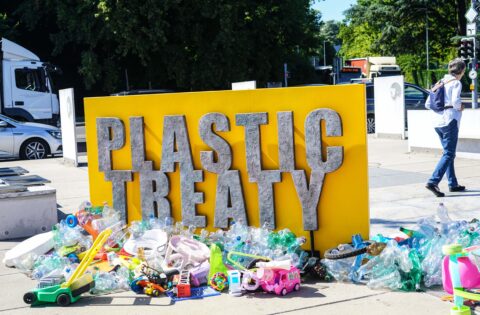
Governments are holding “critical” talks this week on a global treaty to curb plastic pollution, as some countries and activists warn that key issues – including measures to rein in soaring plastic production – are being sidelined.
Diplomats are meeting in person in Nairobi for the first time since negotiations were suspended in chaos nearly a year ago, stymied by a long-running deadlock that pits petrostates against more ambitious nations over the reach of the UN pact.
Because nearly all plastic is made from planet-heating oil, gas and coal, the sector’s trajectory will have a major influence on global efforts to cut greenhouse gas emissions.
The four-day informal gathering, which begins on Tuesday, has been billed by the chair of the talks, Chilean ambassador Julio Cordano, as a “brainstorming” session in which countries are invited to put forward possible solutions to some of the treaty negotiations’ most divisive elements.
Cordano is expected to distill those views in a new document intended to serve as the basis for a new draft text of the future treaty, which governments would take up at the next official round of negotiations, scheduled for March 13-24, 2027.
Two earlier rounds, each billed as the final one, ended without agreement, derailed largely by a standoff over how the treaty should address plastic production, which the UN says is set to triple by 2060 without intervention.
Production curbs in the spotlight
Large fossil fuel and petrochemical producers, led by Saudi Arabia, the United States, Russia and India, have repeatedly argued that the treaty should focus only on managing plastic waste. A US State Department spokesperson told Climate Home News that Washington supports “practical, cost-effective solutions” to plastic pollution, while opposing “global plastic bans”.
A majority of countries – including most European, Latin American, African and Pacific island nations -want to limit the manufacturing of plastic to “sustainable levels”, but have not pushed for any wide-ranging ban.
-
China’s coal-chemicals boom risks repeating the mistakes of the past
By reviving the problematic industry in the name of energy security, China runs the risk of higher emissions, stranded assets and setting back its ambitions as a clean energy leader -
Roadmap launched to restart deadlocked UN plastics treaty talks
The chair of the negotiations proposes informal meetings through 2026 to bridge deep divisions among countries, following the collapse of talks in Geneva last year


Ahead of what it described as “critical” talks in Nairobi, the French government said last week it had already shown flexibility and “significantly scaled back” its initial ambitions. But a French official told a meeting of EU environment ministers that without an explicit reference to the “unsustainable nature” of plastic production, the treaty would be “fundamentally unbalanced, ineffective and, worse still, could set us on the wrong path for decades to come”.
In a separate written communication, the French government lamented that informal meetings held in recent months have given “disproportionate visibility to the positions of the least ambitious states”, fuelling a “risk that partial agreements may be reached only on the issues with the broadest consensus”.
Dennis Clare, a negotiator for the Pacific island nation of Micronesia, told Climate Home News that “if we fail to address any key elements”, including overproduction, the impacts of the plastic crisis on the climate, human health and ecosystems will only grow more severe.
Fears over “political calculations”
Despite such concerns, plastics production is not mentioned in the wide-ranging list of topics Cordano has drafted for the meeting – an omission that has alarmed observers.
Christina Dixon, a campaigner at the Environmental Investigation Agency (EIA), said there appeared to be an attempt to write off this crucial element of the treaty as “too complicated and politically unviable”.
David Azoulay, environmental health programme director at the Center for International Environmental Law (CIEL), said the meeting’s proposed structure was “highly concerning”. He accused the chair of “making political calculations in favour of potential short-term wins” and aiming to deliver a treaty “based on the lowest common denominator”.
Speaking to journalists last week, Cordano pushed back, insisting that “no topic is off the table” and inviting countries to bring whatever proposals they judged necessary for a successful outcome.
He added that the treaty could not be allowed to settle for just any level of ambition, and that he would not be happy with an outcome at all costs.
“This is what makes it so difficult and complex,” said Cordano, who was elected in February after his predecessor’s resignation. Countries “are trying to be creative” in finding solutions, he explained, because “the road to the objective of our work might not be so obvious”.
The post UN plastics pact talks restart amid fears production curbs will be left out appeared first on Climate Home News.
UN plastics pact talks restart amid fears production curbs will be left out