


The lithium sector took center stage this week when Lithium Americas (NYSE: LAC) stock soared nearly 95% on reports that the Trump administration is considering taking an equity stake in the company’s Thacker Pass mine in Nevada. If it happens, this move would be one of the biggest government actions in U.S. mining in years. It shows how important lithium is to national policy now.
Behind the headlines lies a deeper story: America’s ambition to lead the clean energy transition risks colliding with a stark supply shortage. We highlight below, with the two charts, both the opportunity and the vulnerability facing the United States in this lithium quest.
A Lithium Crisis in the Making
The United States faces a lithium crisis that makes its clean energy ambitions look more like an aspiration than an execution. Current domestic production is only 2,700 metric tons a year. That’s too small compared to the 500,000 tons needed by 2030 to hit electric vehicle (EV) goals.
To put this in perspective:
- The lithium in an iPhone weighs about the same as a penny.
- A Tesla Model 3 battery pack requires around 12 kilograms.
- A Ford F-150 Lightning demands closer to 17 kilograms.
At present mining levels, the U.S. produces enough lithium for only about 158,000 Tesla Model 3s annually. That’s in a market where Americans bought 1.4 million EVs in 2024 alone, with demand expected to climb sharply in the coming years.
This gap reveals a harsh reality: America’s lithium supply chain is ill-prepared for its electrification goals.
From Marginal Producer to Top Four — If Thacker Pass Delivers
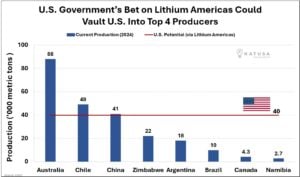
The government’s solution to this issue is projects like Lithium Americas’ Thacker Pass. It’s one of the largest lithium deposits in North America. If fully developed, it could boost U.S. production to around 40,000 tons each year. This would place the country among the top four producers, following Australia, Chile, and China.
That would mark a tenfold increase in output, but it is still far from enough. Even under the most optimistic forecasts, Thacker Pass would meet just 8% of projected U.S. demand by 2030, and a mere 3% of the 1.2 million tons expected by 2035.
Meanwhile, China has spent more than a decade locking up supply chains, securing lithium assets in Africa, South America, and Australia. It is also building refining infrastructure that now processes nearly 80% of the world’s lithium.
The comparison is striking: Zimbabwe produces eight times more lithium than the U.S. Even smaller producers, like Argentina, surpass American output. In this context, Washington’s sudden push for equity stakes is less about profits and more about survival in a high-stakes race for supply.
Reserves Rich, Supply Poor: The Untapped U.S. Advantage
The second chart points to America’s hidden strength: the U.S. ranks first globally in lithium reserves, with more than 100 million tonnes identified. Despite this geological advantage, those resources remain largely untapped.
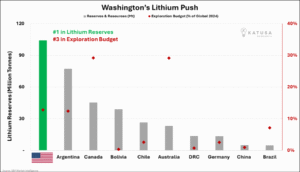
Encouragingly, the U.S. now ranks third in global exploration budgets, reflecting a deliberate policy pivot. Billions of dollars are going to exploration and project development, from Nevada to North Carolina. If even a fraction of these reserves is unlocked, the U.S. could rival today’s top producers and reduce dependence on foreign supply chains.
However, converting reserves into production requires more than exploration. Projects can hit delays with permits, face environmental lawsuits, struggle with financing, and deal with local opposition. All these issues can stretch timelines into decades. This is why federal involvement is becoming more important. This includes equity stakes, subsidies, and fast-tracking permits.
Why the LAC Surge Matters
The near-doubling of Lithium Americas’ stock was not just a speculative rally. It was a market signal that U.S. lithium policy is entering a new phase.
- Government backing reduces financing risk, making it easier to attract institutional investors.
- Aligning policies with EV makers like General Motors, which has a big stake in Thacker Pass, ensures supply security and offtake agreements.
- National security framing places lithium on the same level as oil and gas. This makes lithium a strategic commodity and allows for more state intervention.
For automakers and battery manufacturers, this could mark the start of a more stable domestic supply base. For investors, it highlights how policy can rapidly change the outlook for mining equities.
Demand, Prices, and the Rollercoaster Market
Lithium demand will rise quickly. Benchmark Mineral Intelligence (BMI) predicts that consumption of lithium carbonate equivalent (LCE) will surpass 2.4 million tonnes by 2030. That’s almost four times what we use now. By 2035, demand could climb past 5 million tonnes, fueled by electric vehicles and large-scale battery storage.
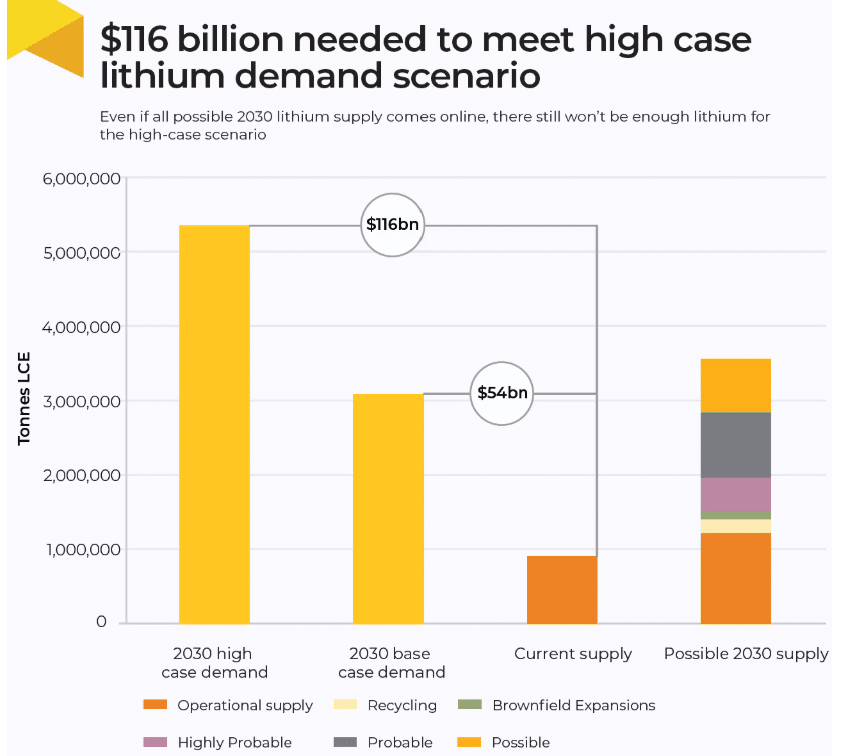
The industry needs hundreds of new projects to meet this surge. However, BMI points out that permitting delays, financing issues, and tech challenges are slowing supply growth.
Battery demand adds another layer of urgency. Analysts predict global battery capacity will reach nearly 4 terawatt-hours by 2030. This highlights lithium’s vital role in the clean energy shift.
The U.S. is still a minor player. Most refining and conversion happens in China, which holds about 80% of processing capacity. This imbalance shows why Washington supports projects like Lithium Americas. They want to secure a local supply.
Litium prices, meanwhile, have been highly volatile. After lithium carbonate reached over $80,000 per tonne in late 2022, prices dropped sharply. In 2023–2024, they fell by more than 80%, going below $10,000 earlier this year. BMI attributes the crash to oversupply from South America and weaker near-term EV sales in China, which created a temporary glut.
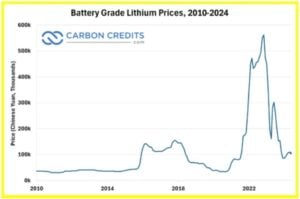
However, the consultancy stresses that volatility is cyclical, not structural. Demand is strong, and prices should bounce back. In fact, last August, prices climbed when China’s major battery player closed its major mine.
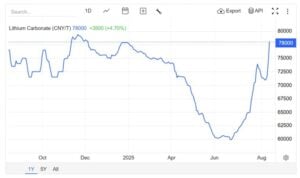
New supply can’t keep up with long-term consumption. BMI warns that without steady investment and diversification of supply, future shortages could push prices sharply higher again by the late 2020s.
For the U.S., this shows why public investment matters. It helps create a strong domestic lithium industry. This will support electrification goals and better handle global changes.
Government in the Game: Stabilizing Supply Chains
U.S. government equity in Lithium Americas offers help in these areas:
- Provide a floor for project financing — Government backing reduces the risk premium for lenders or institutional partners.
- Stabilize supply — A guaranteed domestic source reduces reliance on external shocks.
- Mitigate short-term volatility — If Thacker Pass operates under a model combining private and public capital, it could offer a more stable supply corridor insulated from market swings.
- Signal future project structures — The U.S. may increasingly demand “state-option carve-outs” or partial equity as a condition for major critical mineral projects.
In a market where excess supply can drive prices into unprofitable territory, having a strategic anchor on flagship projects becomes a competitive edge.
Lithium as a Strategic Commodity
Lithium is no longer just a commodity for battery makers — it is now a strategic asset shaping national policy. The U.S. has the reserves, capital, and political will to be a major producer. But it will take years of teamwork to turn potential into production.
The Trump administration’s willingness to consider a government equity stake in Lithium Americas suggests a broader trend: future large-scale projects may require some form of state participation to succeed.
For the U.S., the stakes could not be higher. Without a reliable domestic lithium supply, the country risks falling behind in the global EV race, remaining dependent on supply chains controlled by rivals. With it, America could not only meet its clean energy goals but also secure a critical pillar of its industrial future.
- READ MORE on Lithium:
- Lithium Market in 2025 and Beyond: Supply Deficit Looms with $116B Requirement
- Lithium’s Comeback in 2025: Will Surging EV Demand Fuel the Next Price Boom?
- Top 5 Lithium Producers Powering the Battery Market in 2025
The post U.S. Lithium Push: How Washington’s Bet on Lithium Americas Could Reshape the Global Market appeared first on Carbon Credits.


Google has taken a major step in reshaping how large energy users interact with the power grid. The company has secured 1 gigawatt (GW) of demand response capacity across its U.S. data center operations with several utility partners. This allows Google to cut or shift electricity use during high demand. It helps stabilize the grid and reduce system costs.
The scale is significant. One gigawatt is roughly enough to power about 750,000 U.S. homes for a year. Demand response helps reduce peak power needs, which can cut grid strain during extreme heat or cold. It also reduces the need for expensive “peaker” plants that run only a few hours per year.
The company noted:
“Demand response enables our data centers to be valuable assets for the power grid. Our ability to shift or reduce our energy demand can help utility companies balance supply and demand and plan for future capacity needs. These agreements create a smart solution to make the electricity systems that serve our data centers more affordable and reliable.”
Demand Response: Turning Data Centers into Flexible Grid Assets
Google’s move reflects a growing challenge. U.S. electricity demand is rising fast. Data centers, especially those running artificial intelligence (AI) and cloud computing, are among the fastest‑growing power loads.
At the same time, building new power supply and grid infrastructure can take five to ten years or more. Google’s strategy bridges this gap by making demand more flexible instead of only increasing supply.
Demand response is a system where large electricity users reduce or shift power use during peak periods. Instead of running at full capacity all the time, facilities adjust operations based on grid conditions. This helps balance supply and demand in real time.
Google applies this by managing its data center workloads. It can delay or shift energy‑intensive tasks, especially machine learning and batch computing, to times when electricity demand is lower. This reduces energy use during peak grid stress without affecting performance.
It also turns data centers into flexible energy assets rather than fixed loads. Traditionally, grids treat demand as constant. Google’s model changes that assumption.
The company has built this system through agreements with multiple U.S. utilities, including:
- Tennessee Valley Authority (TVA)
- Indiana Michigan Power
- Entergy Arkansas
- Minnesota Power
- DTE Energy
These partnerships let grid operators ask Google to cut demand during stressful times, like heat waves or winter peaks. This helps keep the system reliable without just depending on backup generation.
Why Peak Demand Matters for Costs and Reliability
The timing of this move is critical. The U.S. Department of Energy projects that electricity demand could grow 20% or more by 2030, driven by electrification and digital services.
Data centers are a major part of this growth. With AI workloads increasing rapidly, total data center energy use rose over 20% between 2020 and 2025 in the U.S., according to industry studies.

At the same time, grid expansion faces delays. Building new transmission lines or power plants can take years or even decades due to permitting, siting, and cost challenges. Demand response offers a faster solution that can be deployed now.
Google notes that flexible demand can help utilities:
- Balance supply and demand in real time,
- Avoid building rarely used “peaker” plants,
- Reduce stress on transmission systems, and
- Lower wholesale electricity prices during peaks.
Even small flexibility gains can have large system‑wide effects. Research from the Electric Power Research Institute (EPRI) suggests that demand response programs could reduce peak load by 10–20% in many regions, leading to significant savings in infrastructure costs.
This is because peak demand drives infrastructure spending. Power systems are often built to meet only a few hours of extreme demand each year. Reducing those peaks can delay or avoid costly investments in generation and transmission.
Cost Savings and Reliability Gains
Google’s demand response strategy targets two key outcomes: lower costs and improved reliability.
- First, cost reduction. Peak demand periods often coincide with the highest wholesale electricity prices. By lowering demand during those hours, both Google and utilities can save money. These savings can help stabilize electricity prices for businesses and households alike.
- Second, reliability. Power grids face increasing pressure from extreme weather, electrification of transport and buildings, and higher loads from digital infrastructure. Demand response adds flexibility that helps prevent outages when supply is tight.
Google’s system allows it to cut the load quickly when needed. This gives grid operators more tools during tight supply conditions. It also reduces the risk of blackouts and emergency calls for conservation.
Importantly, this approach does not reduce overall energy use over time. Instead, it shifts when energy is used. This makes the system more efficient without limiting long‑term growth in data center activity or other demand.
SEE MORE:
- Google Taps Earth’s Heat in 150MW Geothermal Deal with Ormat Technologies to Power Data Centers
- Google Pledges $50M to Fight Superpollutants by 2030: A Near-Term Climate Game Changer
A Shift in Energy Strategy for Big Tech
Google’s move reflects a broader shift across the technology sector. Large tech companies are no longer just energy consumers. They are becoming active participants in energy systems.
This change is driven by several trends:
- Rapid growth in AI workloads that require large computing resources;
- Rising energy costs that pressure operating margins;
- Corporate climate targets tied to investor and public expectations; and
- Pressure to secure a reliable power supply amid grid uncertainty.
Demand response is now joining renewable energy procurement as a core strategy. Google has already invested heavily in solar, wind, geothermal, and energy storage. The company regularly ranks among the top corporate buyers of renewable energy, which helps avoid emissions.

Other industries have used demand response for years, including manufacturing and heavy industry. However, its use in data centers is still new. The scale of Google’s 1 GW deployment signals that this model could expand quickly and be adopted by other large energy users.
Linking Demand Response to Google’s 24/7 Carbon-Free Goals
Google’s demand response move also supports its wider clean energy and climate strategy. The company aims to run on 24/7 carbon‑free energy by 2030 and reach net‑zero emissions across its operations and value chain by 2030.
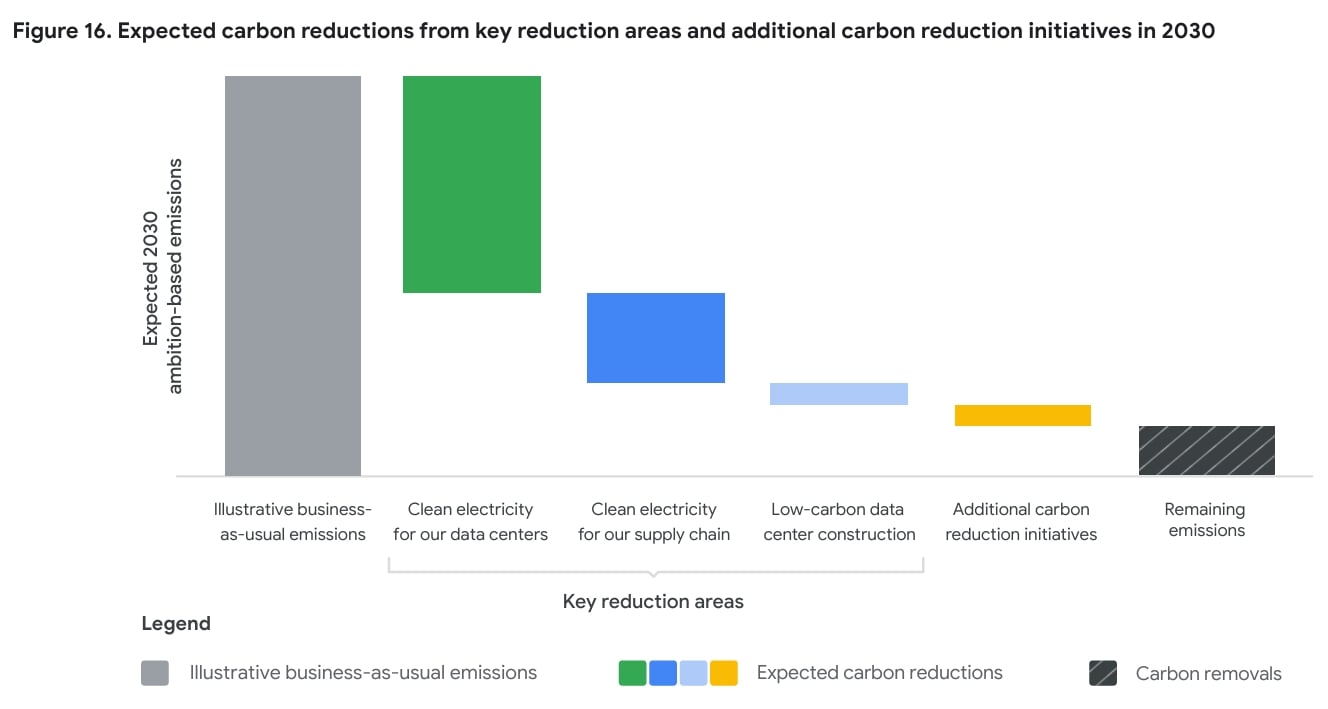
Progress is ongoing. In 2024, Google matched about 66% of its electricity use with carbon‑free energy on an hourly basis, even as power demand rose due to a 27% increase in workload from AI and cloud services.
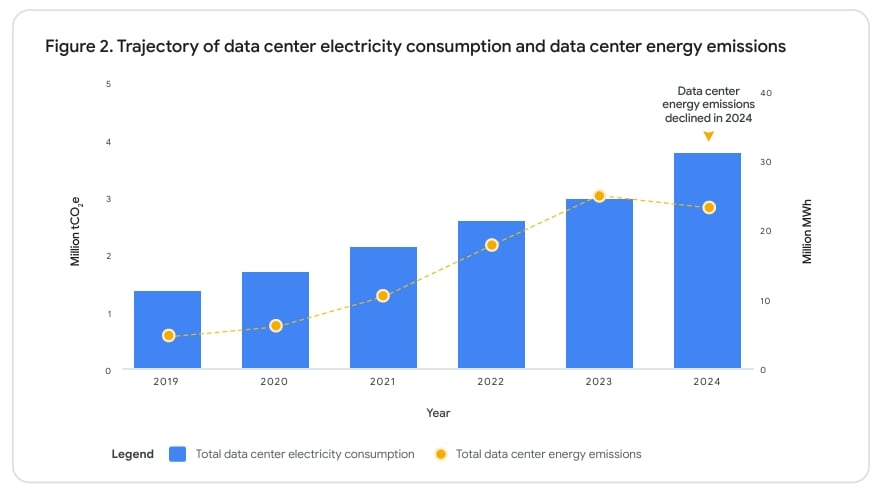
At the same time, Google added 2.5 GW of new clean energy capacity to the grids serving its operations and cut data center energy emissions by 12% compared with baseline years.
Demand response helps close the remaining gap. By shifting when electricity is used, Google can better match operations with clean energy supply. This improves its ability to run on carbon‑free power every hour of the day.
The Future of Demand Response in AI and Cloud Operations
The demand response market is expected to grow as grids become more complex. Several trends support this outlook.
- Rising demand: U.S. data center growth will drive much of the new electricity use over the next decade. Digital services continue to push the load higher.
- Renewables growth: Wind and solar are cheap but variable, making flexible demand more important for grid stability.
- Grid limits: U.S. interconnection queues include thousands of gigawatts of projects, far more than the grid can handle quickly, causing delays.
Demand response can help manage these constraints. It acts as a “virtual power plant” by reducing demand instead of increasing supply. Studies suggest that flexible demand could unlock large amounts of additional grid capacity and reduce the need for costly transmission upgrades.
This makes demand response one of the fastest and most cost‑effective tools available for grid management.
A Cost-Effective Tool for Modern Grids
As electricity demand continues to grow, this energy model may become more common. Utilities, regulators, and companies are already exploring ways to expand demand‑side flexibility.
In the coming years, the success of these programs will depend on technology, policy support, and market design. However, the direction is clear. Flexible demand is becoming a core part of modern energy systems. Google’s latest move provides a real‑world example of how this transition can work at scale.
The post Google Turns Data Centers Into Grid Assets With 1 GW Flex Power Deal appeared first on Carbon Credits.
Tesla may be getting ready for one of the biggest solar manufacturing moves in America. Reuters reports that the company is looking at buying about $2.9 billion worth of equipment from Chinese suppliers to make solar cells and solar panels in the United States.
If the plan moves forward, it could help Tesla build up to 100 gigawatts of solar manufacturing capacity on American soil by the end of 2028. That is a huge number. It also shows how serious Elon Musk may be about turning solar into a much bigger part of Tesla’s future.
But the report also reveals a bigger problem for the U.S. clean energy sector. Even when companies want to manufacture in America, they still often depend on Chinese tools, machinery, and supply chains to make it happen.
Tesla’s Solar Dream Is Getting Bigger
According to Reuters, Tesla is in talks with several Chinese companies that make solar manufacturing equipment. Suzhou Maxwell Technologies is one of the main names in the discussion. The company is known as the world’s biggest maker of screen-printing equipment used in solar cell production.
Other possible suppliers include Shenzhen S.C New Energy Technology and Laplace Renewable Energy Technology, Reuters said, citing people familiar with the matter.
Some of the equipment may need export approval from China’s commerce ministry before it can be shipped. Reuters reported that the companies were asked to deliver the machinery before autumn, and two sources said the equipment would likely head to Texas.
These details suggest Tesla’s plan is not just an idea or a long-term goal. The company seems to be preparing for a major manufacturing buildout in the U.S. However, the company has not publicly confirmed the reported order. The Chinese suppliers and China’s commerce ministry also did not respond to Reuters’ requests for comment, according to the report.
In January, Musk said solar power could meet all of America’s electricity needs, including rising demand from data centers. Reuters also noted that Tesla job postings said the company wants to deploy 100 GW of “solar manufacturing from raw materials on American soil before the end of 2028.”
The Cost Gap Keeps China in Charge of Solar Supply Chains
After years of heavy investment, China controls most of the world’s solar manufacturing chain. According to Wood Mackenzie, China is expected to hold more than 80% of global polysilicon, wafer, cell, and module manufacturing capacity from 2023 to 2026.
Wood Mac also said a solar module made in China is about 50% cheaper than one made in Europe and 65% cheaper than one made in the United States. That price gap makes it hard for U.S. factories to compete, especially in the early stages.

So even when U.S. companies want to build locally, they still often need Chinese equipment and expertise. Reuters pointed out that the Biden administration excluded solar manufacturing equipment from tariffs in 2024 after U.S. solar companies said they had no real alternative source for the machines needed to launch domestic factories. That exemption has since been extended by the Trump administration.
In other words, America’s solar manufacturing push still depends, at least in part, on Chinese technology.
- READ MORE: Two Solar Stories, Two Different Directions: Why China Builds Faster as the U.S. Hits Pause
Why Tesla May Be Making This Move Now
Tesla’s reported plan is about much more than one company. It highlights a major challenge for the United States as it tries to build a stronger clean energy economy.
U.S. electricity demand is rising again, and solar is growing fast. The Energy Information Administration said U.S. power use hit its second straight record high in 2025. It also expects demand to keep rising in 2026 and 2027.
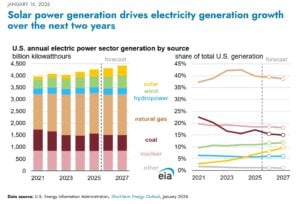
At the same time, solar is becoming one of the country’s fastest-growing power sources. In its latest outlook, the EIA said utility-scale solar generation in the U.S. is expected to grow from 290 billion kilowatt-hours in 2025 to 424 billion kilowatt-hours by 2027.
The EIA also said nearly 70 GW of new solar capacity is scheduled to come online in 2026 and 2027. That would increase U.S. solar operating capacity by 49% compared with the end of 2025.
Texas Solar Capacity Supports Tesla and SpaceX
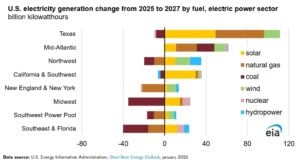
Texas is expected to lead much of that growth. Solar generation in the ERCOT grid is forecast to rise from 56 billion kilowatt-hours in 2025 to 106 billion kilowatt-hours by 2027. Battery storage is also growing to help balance solar power throughout the day.
This helps explain why Texas is such an important part of Tesla’s reported plan. The state already plays a big role in Tesla’s manufacturing footprint. It is also one of the hottest solar markets in the country.
For Tesla, building solar equipment or solar products in Texas could support more than just the grid. Reuters said Musk plans to use much of the capacity for Tesla itself, while some could also help power SpaceX satellites.
That would turn solar into a strategic asset across Musk’s wider business empire. It would also tie clean power more closely to Tesla’s long-term growth story, especially as energy demand from artificial intelligence and data infrastructure keeps rising across the country.
Snapshot of US Solar Imports
Even with more local manufacturing, the U.S. solar market still depends heavily on imported parts. Solar Power World reviewed U.S. International Trade Commission data and found that the United States imported 33 GW of silicon solar panels in 2025. It also imported 21 GW of silicon solar cells.
That cell figure is especially important because it shows that U.S. panel assembly is growing faster than domestic cell production. America may be building more panels at home, but it still imports many of the core components needed to make them.
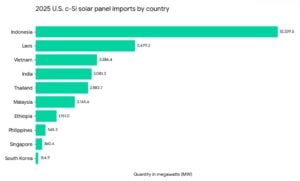
The report said the U.S. has around 50 GW of silicon panel assembly capacity, but less than 5 GW of domestic cell manufacturing output. That means plenty of cells still have to be imported. Notably, most imported cells came from Indonesia and Laos in 2025, while South Korea was also a major supplier.
This is where Tesla could make a difference. If it builds large-scale solar cell and panel manufacturing in the U.S., it could help close one of the biggest gaps in the domestic solar supply chain.
Still, there is an irony here. To reduce America’s dependence on foreign solar products, Tesla may first need to buy Chinese machines.
A Massive Opportunity, But Also a Huge Challenge
If the deal happens, it would be a major win for Chinese solar equipment companies. Many of them have faced weak domestic demand because China has already built too much manufacturing capacity.
For Tesla, the order could lay the foundation for a giant U.S. solar platform. It could support the company’s long-term energy strategy at a time when America needs more electricity, more solar, and more battery storage.
But the challenge is enormous.
Building 100 GW of solar manufacturing capacity in just a few years would be a staggering task. Tesla would need factories, workers, permits, raw materials, logistics, and smooth equipment delivery. It would also need stable trade rules and a supportive policy environment.
The company has already faced supply chain setbacks before. Reuters previously reported that production preparations for the Cybertruck and Semi in the U.S. were disrupted last year after component shipments from China were suspended following higher tariffs on Chinese goods. This history shows how exposed U.S. manufacturing can still be to trade tensions.
If speculations are true, Musk appears to be thinking far beyond electric vehicles, i.e., building a larger clean energy system around solar, batteries, manufacturing, and power demand from new technologies like AI.
For now, Reuters’ report shows a simple reality. The U.S. wants a homegrown solar industry. Tesla may want to help build one. But China still holds many of the tools needed to make that goal real.
The post Is Tesla Building a 100 GW U.S. Solar Giant With Chinese Equipment? appeared first on Carbon Credits.
Carbon Footprint
EU Plans Major Carbon Pricing Overhaul and €30B Clean Tech Boost to Drive Decarbonization

The European Union is preparing to make large changes to its carbon pricing system. EU Commission President Ursula von der Leyen announced that the bloc will revise its Emissions Trading System (ETS) and launch a new €30 billion cleantech investment fund. These moves aim to support the bloc’s climate goals and help industry cope with shifting energy markets.
The announcements came after a summit of EU leaders focused on energy prices and economic challenges. Rising global energy prices and geopolitical pressures are affecting Europe’s economy and industry.
The new proposals aim to improve the EU’s carbon pricing system. They will also encourage investment in clean technology throughout the bloc.
Von der Leyen said:
“The Emissions Trading System is working. It has massively reduced gas consumption. Because of that, it has reduced our dependency on imports of fossil fuels, and it has reduced our vulnerability. And it has driven major investments in the energy transition in the low-carbon energy sources like renewables and nuclear that are homegrown and give us independence. But we need to modernise it and make it more flexible.”
What Is the EU Emissions Trading System and Why Change It?
The EU’s Emissions Trading System is the bloc’s main carbon pricing tool. It was set up in 2005 to reduce greenhouse gas emissions from major industrial sectors. These include electricity and heat generation, steel, cement, chemicals, and commercial aviation.
Under the ETS, companies must buy permits for each ton of carbon dioxide they emit. The total number of permits is capped to reduce emissions over time.
Over nearly two decades, the ETS has helped reduce Europe’s dependence on fossil fuels and encouraged investment in cleaner energy. It is often viewed as a cornerstone of the EU’s climate policy.
The EU ETS continues to generate large revenues that fund climate action across Europe. In 2025, total ETS auction revenues exceeded €43 billion, with about €24 billion going directly to EU member states.
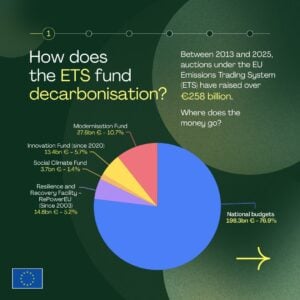
The remaining funds were allocated to EU-level programs such as the Innovation Fund, Modernisation Fund, and the Social Climate Fund. Overall, ETS revenues since 2013 have surpassed €258 billion, making it one of the world’s largest carbon market funding sources.
However, rising energy costs are pressuring European industries. They started with the war in Ukraine and are now impacted by conflicts in the Middle East. Some member states have asked for a review of the ETS to ease short‑term burdens.
Planned changes “in the next days” may include:
- Updating benchmarks for free allowances given to the industry.
- Strengthening the Market Stability Reserve, which manages the supply of carbon allowances to stabilize prices.
Future changes will seek a “more realistic trajectory.” They may also extend free allocation for some industries past 2034.
Carbon Pricing in Europe: The Stakes and the Context
Carbon pricing has been a key driver of investment in clean energy. ETS prices influence how companies weigh fossil fuels versus low‑carbon options. In recent weeks, ETS prices have fluctuated, partly in response to talks about reform and broader energy market volatility.
Recent reports noted that benchmark EU carbon prices jumped almost 10% after policy statements from EU leadership.
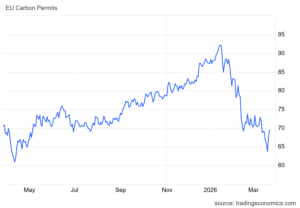
Market stability is a core concern. The ETS’s design includes mechanisms to support consistent carbon prices, especially during times of economic stress. A strong and predictable carbon price can help investors commit to long‑term clean energy projects. Conversely, sudden changes can raise costs for industrial players and weaken investment incentives.
At the same time, formal industry and civil society groups have called for regulatory certainty. They say stable carbon pricing is key for planning big clean energy projects. It also helps the EU keep its role as a leader in global climate efforts. These groups emphasize that unpredictable policy shifts could slow clean industrial growth and raise risk for new projects.
A New €30 Billion Cleantech Fund to Boost Decarbonization
Alongside ETS reform, von der Leyen announced plans for a €30 billion ETS Investment Booster. This new fund will support decarbonization and clean technology projects across Europe. It will be financed by revenues from the ETS, meaning carbon pricing will help fund climate action directly.
The booster fund will operate on a “first-come, first-served” basis to support ready‑to‑deploy projects. Von der Leyen said that the fund will ensure access for lower‑income member states. This is intended to promote fairness across the EU and help balance regional disparities in clean technology investment.
The new fund complements existing EU climate finance mechanisms. The Innovation Fund has backed many projects. These include renewable energy, energy storage, and industrial decarbonization.
In 2024, the Innovation Fund provided €4.8 billion in grants. This supported 85 innovative net-zero projects. These efforts helped reduce nearly 476 million tonnes of CO₂ in the first decade.
Expanding funding sources for clean industrial investments reflects a broader EU trend. The Clean Industrial Deal, launched in 2025, plans to raise over €100 billion. This funding will support clean technology manufacturing, create jobs, boost energy efficiency, and promote circular economy solutions.
Renewables, Baseload, and Energy Market Trends in Europe
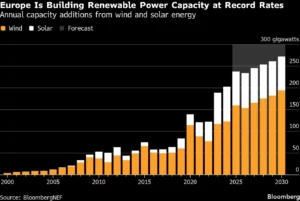
The EU’s net‑zero journey sits against a backdrop of changing energy markets. Renewable energy deployment in Europe continues to grow rapidly.
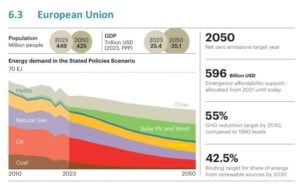
Wind and solar now make up an increasing share of electricity generation in many member states. These technologies are expected to gain further market share as costs fall and grid integration improves.
However, the need for stable and resilient power systems has grown. Renewable sources like wind and solar are variable by nature. This increases interest in baseload options like geothermal, hydropower, nuclear, and storage paired with renewables.
Meanwhile, global energy prices have remained volatile. Brent crude prices rose above $110 per barrel due to geopolitical tensions. This increase is driving up electricity and heating costs in Europe. These price swings can influence industrial competitiveness and household energy bills.
EU leaders view carbon pricing and investment in decarbonization as key to reducing long-term risks from unstable fossil fuel markets. Policymakers want to use ETS revenues for clean technologies. This will help reduce the need for imported fuels and boost energy independence.
Industry Reaction: Balancing Flexibility and Climate Signals
The proposed changes have drawn mixed reactions. Some industry groups welcomed the updates to the ETS. They said the funding support could help reduce short-term cost pressures. Others warn that too much flexibility could weaken long‑term climate signals and reduce investment certainty.
Civil society organizations have stressed the importance of maintaining carbon pricing integrity. They believe a strong, predictable ETS is key. It will boost investment in electrification, renewables, energy efficiency, and circular economy solutions. Maintaining the market’s rules‑based design, supporters say, will help the EU stay on track with its 2030 and 2040 climate targets.

The European Council has invited the Commission to present a formal ETS review by July 2026 at the latest. This timeline reflects the urgency of balancing climate goals with current economic pressures.
Looking Ahead: Combining Policy and Investment for Climate Goals
The post EU Plans Major Carbon Pricing Overhaul and €30B Clean Tech Boost to Drive Decarbonization appeared first on Carbon Credits.

-
Climate Change7 months ago
Guest post: Why China is still building new coal – and when it might stop
-
Greenhouse Gases7 months ago
Guest post: Why China is still building new coal – and when it might stop
-

 Greenhouse Gases2 years ago
嘉宾来稿:满足中国增长的用电需求 光伏加储能“比新建煤电更实惠”
-
Climate Change2 years ago
Bill Discounting Climate Change in Florida’s Energy Policy Awaits DeSantis’ Approval
-

 Climate Change2 years ago
嘉宾来稿:满足中国增长的用电需求 光伏加储能“比新建煤电更实惠”
-
Climate Change Videos2 years ago
The toxic gas flares fuelling Nigeria’s climate change – BBC News
-

 Carbon Footprint2 years ago
US SEC’s Climate Disclosure Rules Spur Renewed Interest in Carbon Credits
-

 Renewable Energy5 months ago
Sending Progressive Philanthropist George Soros to Prison?