Connect with us

Published

on

EU Plans Major Carbon Pricing Overhaul and €30B Clean Tech Boost to Drive Decarbonization

The European Union is preparing to make large changes to its carbon pricing system. EU Commission President Ursula von der Leyen announced that the bloc will revise its Emissions Trading System (ETS) and launch a new €30 billion cleantech investment fund. These moves aim to support the bloc’s climate goals and help industry cope with shifting energy markets.

The announcements came after a summit of EU leaders focused on energy prices and economic challenges. Rising global energy prices and geopolitical pressures are affecting Europe’s economy and industry.

The new proposals aim to improve the EU’s carbon pricing system. They will also encourage investment in clean technology throughout the bloc.

Von der Leyen said:

“The Emissions Trading System is working. It has massively reduced gas consumption. Because of that, it has reduced our dependency on imports of fossil fuels, and it has reduced our vulnerability. And it has driven major investments in the energy transition in the low-carbon energy sources like renewables and nuclear that are homegrown and give us independence. But we need to modernise it and make it more flexible.”

What Is the EU Emissions Trading System and Why Change It?

The EU’s Emissions Trading System is the bloc’s main carbon pricing tool. It was set up in 2005 to reduce greenhouse gas emissions from major industrial sectors. These include electricity and heat generation, steel, cement, chemicals, and commercial aviation.

Under the ETS, companies must buy permits for each ton of carbon dioxide they emit. The total number of permits is capped to reduce emissions over time.

Over nearly two decades, the ETS has helped reduce Europe’s dependence on fossil fuels and encouraged investment in cleaner energy. It is often viewed as a cornerstone of the EU’s climate policy.

The EU ETS continues to generate large revenues that fund climate action across Europe. In 2025, total ETS auction revenues exceeded €43 billion, with about €24 billion going directly to EU member states.
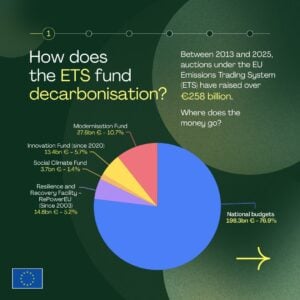
EU ETS revenue 2025

The remaining funds were allocated to EU-level programs such as the Innovation Fund, Modernisation Fund, and the Social Climate Fund. Overall, ETS revenues since 2013 have surpassed €258 billion, making it one of the world’s largest carbon market funding sources.

However, rising energy costs are pressuring European industries. They started with the war in Ukraine and are now impacted by conflicts in the Middle East. Some member states have asked for a review of the ETS to ease short‑term burdens.

Planned changes “in the next days” may include:

  • Updating benchmarks for free allowances given to the industry.
  • Strengthening the Market Stability Reserve, which manages the supply of carbon allowances to stabilize prices.

Future changes will seek a “more realistic trajectory.” They may also extend free allocation for some industries past 2034.

Carbon Pricing in Europe: The Stakes and the Context

Carbon pricing has been a key driver of investment in clean energy. ETS prices influence how companies weigh fossil fuels versus low‑carbon options. In recent weeks, ETS prices have fluctuated, partly in response to talks about reform and broader energy market volatility.

Recent reports noted that benchmark EU carbon prices jumped almost 10% after policy statements from EU leadership.
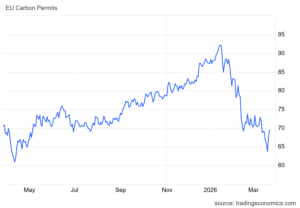
EU ETS carbon price

Market stability is a core concern. The ETS’s design includes mechanisms to support consistent carbon prices, especially during times of economic stress. A strong and predictable carbon price can help investors commit to long‑term clean energy projects. Conversely, sudden changes can raise costs for industrial players and weaken investment incentives.

At the same time, formal industry and civil society groups have called for regulatory certainty. They say stable carbon pricing is key for planning big clean energy projects. It also helps the EU keep its role as a leader in global climate efforts. These groups emphasize that unpredictable policy shifts could slow clean industrial growth and raise risk for new projects.

A New €30 Billion Cleantech Fund to Boost Decarbonization

Alongside ETS reform, von der Leyen announced plans for a €30 billion ETS Investment Booster. This new fund will support decarbonization and clean technology projects across Europe. It will be financed by revenues from the ETS, meaning carbon pricing will help fund climate action directly.

The booster fund will operate on a “first-come, first-served” basis to support ready‑to‑deploy projects. Von der Leyen said that the fund will ensure access for lower‑income member states. This is intended to promote fairness across the EU and help balance regional disparities in clean technology investment.

The new fund complements existing EU climate finance mechanisms. The Innovation Fund has backed many projects. These include renewable energy, energy storage, and industrial decarbonization.

In 2024, the Innovation Fund provided €4.8 billion in grants. This supported 85 innovative net-zero projects. These efforts helped reduce nearly 476 million tonnes of CO₂ in the first decade.

Expanding funding sources for clean industrial investments reflects a broader EU trend. The Clean Industrial Deal, launched in 2025, plans to raise over €100 billion. This funding will support clean technology manufacturing, create jobs, boost energy efficiency, and promote circular economy solutions.

Renewables, Baseload, and Energy Market Trends in Europe

The EU’s net‑zero journey sits against a backdrop of changing energy markets. Renewable energy deployment in Europe continues to grow rapidly.
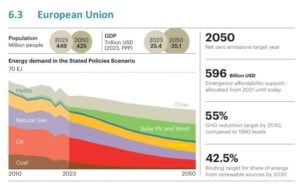
European Union energy demand under net zero

Wind and solar now make up an increasing share of electricity generation in many member states. These technologies are expected to gain further market share as costs fall and grid integration improves.
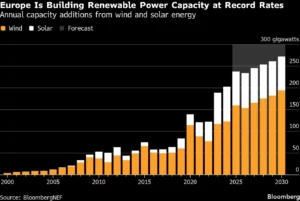
Europe renewable power capacity forecast 2030

However, the need for stable and resilient power systems has grown. Renewable sources like wind and solar are variable by nature. This increases interest in baseload options like geothermal, hydropower, nuclear, and storage paired with renewables.

Meanwhile, global energy prices have remained volatile. Brent crude prices rose above $110 per barrel due to geopolitical tensions. This increase is driving up electricity and heating costs in Europe. These price swings can influence industrial competitiveness and household energy bills.

EU leaders view carbon pricing and investment in decarbonization as key to reducing long-term risks from unstable fossil fuel markets. Policymakers want to use ETS revenues for clean technologies. This will help reduce the need for imported fuels and boost energy independence.

Industry Reaction: Balancing Flexibility and Climate Signals

The proposed changes have drawn mixed reactions. Some industry groups welcomed the updates to the ETS. They said the funding support could help reduce short-term cost pressures. Others warn that too much flexibility could weaken long‑term climate signals and reduce investment certainty.

Civil society organizations have stressed the importance of maintaining carbon pricing integrity. They believe a strong, predictable ETS is key. It will boost investment in electrification, renewables, energy efficiency, and circular economy solutions. Maintaining the market’s rules‑based design, supporters say, will help the EU stay on track with its 2030 and 2040 climate targets.

EU 2040 climate goal
Source: EC

The European Council has invited the Commission to present a formal ETS review by July 2026 at the latest. This timeline reflects the urgency of balancing climate goals with current economic pressures.

Looking Ahead: Combining Policy and Investment for Climate Goals

The EU’s planned changes mark an important step for climate policy. Reforming carbon pricing and launching a €30 billion cleantech fund will help drive decarbonization.

The ETS has already helped cut emissions by putting a cost on pollution and supporting cleaner energy. Using ETS revenues for clean technology will expand this impact. It will speed up renewable energy and support low-carbon industries.

These actions support the EU’s targets to reach climate neutrality by 2050 and cut emissions by at least 55% by 2030. The next phase of policy decisions will shape carbon markets, energy prices, and Europe’s clean energy transition.

The post EU Plans Major Carbon Pricing Overhaul and €30B Clean Tech Boost to Drive Decarbonization appeared first on Carbon Credits.

Continue Reading

Carbon Footprint

SBTi Net-Zero Standard V2: What the Revision Means for Every Business

Published

on

The Science Based Targets initiative (SBTi) just rolled out a major revision to its Net-Zero Standard, Version 2.0. It changes how companies set climate targets, how much room they actually have to hit those targets, and how carbon credits fit into a credible net-zero strategy. Below, we break down what’s changing, when it takes effect, and why it matters even if your business isn’t formally an SBTi participant.

Key takeaways

  • SBTi is the default reference point for corporate climate action: 51% of Fortune Global 500 companies now hold net-zero targets, up from 8% in 2020, and over 11,000 organizations worldwide have SBTi-validated targets.
  • Net Zero Standard V2 redefines climate leadership as reducing emissions and mitigating ongoing emissions, not reduction alone.
  • The new standard adds flexibility through five-year cycles, a “best efforts” standard, and an Asset Transition Method for companies whose path to net-zero doesn’t fit a straight-line trajectory.
  • Voluntary carbon credits are formally recognized for the first time, with reduction and removal credits accepted from 2027, and removals required from 2035.
  • Companies with 2030 targets keep using V1 for their current cycle and move to V2 in 2028; companies without targets can start using V2 on February 1, 2027.

Why every business needs to understand the SBTi Net-Zero Standard revision

The Science Based Targets initiative (SBTi) has become the default reference point for credible corporate climate action. Net-zero targets are now held by 51% of Fortune Global 500 (FG500) companies, up dramatically from just 8% in 2020, and more than 11,000 organizations worldwide have set SBTi-validated targets.

However, SBTi’s influence extends well beyond the companies formally participating in the program. Every business in the value chain of an SBTi participant will have to reduce its own carbon emissions, and businesses that aren’t SBTi participants themselves still look to the program for guidance on climate action.

In short, SBTi gives every business a credible blueprint for climate action, and companies that follow its principles can pursue climate action with confidence, whether or not they’re formally part of the program.

How will the Net Zero Standard revision affect business climate action?

SBTi participation is expected to grow. Despite strong target-setting participation among the F500, only 17% of companies use the SBTi Net Zero Standard V1 beyond target setting, largely because its rules have been seen as too rigid to apply in practice. Much of the Net Zero Standard revision has focused on creating more flexibility to enable higher participation. Medium and small businesses will also increasingly feel pressure for climate action, since SBTi mandates that its participants reduce carbon emissions across their value chains.

Net Zero Standard V2 also redefines climate leadership: leading climate action now means reducing emissions and mitigating ongoing emissions. Reducing your own emissions while ignoring the emissions you continue to release along the way is no longer considered leadership. Supporting voluntary carbon projects with high-integrity carbon credits is now backed by the leading authority on corporate climate action.

What lessons shaped the Net Zero Standard V2 revision?

The revision reflects a few learnings about what actually drives climate progress, and how SBTi built those lessons into the new standard.

Net Zero Standard V1 Learnings Net Zero Standard V2 Implementation
Making real short-term progress is more important and more difficult than making big long-term promises Focus on short-term climate progress
Every company has a different path to net zero that doesn’t always fit generalized net-zero rules Create asset transition plans based on each company’s unique asset lifecycles and capital planning
We need to mitigate our ongoing emissions to keep global carbon emissions in check Reduce global carbon emissions by financing voluntary carbon projects with high-integrity carbon credits

What are the key changes between the old and new Net Zero Standard?

Both versions of the standard are grounded in net-zero by 2050. However, the old standard treated climate leadership as simply reducing emissions, expected a long-term commitment to net zero, based emission reduction targets on generalized net-zero goals, revoked status from companies that fell behind on targets, and ignored voluntary carbon projects entirely.

The new standard treats climate leadership as reducing emissions and mitigating ongoing emissions. It shifts the focus to short-term progress through five-year cycles, and it bases emission reduction targets on both the net-zero goal and a company’s own asset decarbonization plan. A new Asset Transition Method lets companies set decarbonization targets through asset plans with committed, verifiable steps; an ambitious but achievable path based on a company’s starting point, financial resources, and technology, with multiple pathways to reflect the unique opportunities and constraints of different industries and companies.

Crucially, the new standard moves to a “best efforts” basis that creates real flexibility on progress against targets. Businesses that miss their targets can keep their status if they’ve used “every lever” within their control, and minimum progress rules will be set out in the SBTi Assurance Manual.

Finally, the new standard formally uses voluntary carbon projects to mitigate ongoing emissions. From 2027 through 2034, this mitigation is recognized, and both carbon reduction and removal credits are accepted. From 2035 forward, mitigation with carbon removal credits becomes required, with durability matching between the removal and the emission it offsets.

Old Net Zero Standard New Net Zero Standard
Grounded in net-zero by 2050 Grounded in net-zero by 2050
Climate leadership is reducing emissions Climate leadership is reducing emissions and mitigating ongoing emissions
Make a long-term commitment to net-zero Focus on short-term progress in 5-year cycles
Emission reduction targets are based on net-zero goal
  • Emission reduction targets are based on net-zero goal and asset decarbonization plan
  • Adds SBTi’s Asset Transition Method
  • Decarbonization targets are set through asset plans with committed, verifiable steps
  • Ambitious but achievable path based on starting point, financial resources, technology
  • Multiple pathways for unique opportunities and constraints of industries and companies
Businesses who fall behind targets lose status
  • “Best efforts” basis creates flexibility on progress to targets
  • Businesses that miss targets can keep status if they used “every lever” in their control
  • Minimum progress rules will be provided in the SBTi Assurance Manual
Ignores voluntary carbon projects
  • Uses voluntary carbon projects to mitigate ongoing emissions
  • 2027–2034: Mitigation is recognized. Carbon reduction and removal credits are accepted.
  • 2035 forward: Mitigation with carbon removal credits is required, with durability matching.

When does the new Net Zero Standard take effect?

Companies with existing 2030 targets should continue using the old Net Zero Standard for their current cycle, and start using the new Net Zero Standard in 2028 to set targets for the next cycle (2030–2035).

Companies that don’t yet have targets can use the new Net Zero Standard starting February 1, 2027.

What are SBTi’s Category A and Category B companies?

The new Net Zero Standard splits companies into two categories, with different requirements attached to each.

Category A covers large companies from all countries and medium-sized companies from high-income countries. A company from any country qualifies if it meets at least one of: net turnover of €450 million or more, or 1,000 or more full-time employees. A company from a high-income country qualifies if its Scope 1 and 2 emissions are 10,000 tCO2e or more, or if it meets at least two of: balance sheet of €25 million or more, net turnover of €50 million or more, or 250 or more full-time employees.

Category B covers small companies from all countries and medium-sized companies from lower-income countries.

How do Scope 1 targets work under Net Zero Standard V2?

Scope 1 targets aim to transition companies to net-zero direct emissions by 2050 or sooner, and companies can choose from three approaches.

  1. Absolute emissions reduction follows a straight-line emissions trajectory from the target base year to the net-zero year.
  2. Emissions intensity reduction lets companies follow sector-specific pathways designed to reflect the reduction opportunities available in sectors like steel, cement, or chemicals.
  3. Asset transition is designed for companies whose capital stock turnover doesn’t follow a linear or sector pathway. These companies design a transition plan to operate existing assets efficiently and replace them with low-carbon assets, using predetermined milestones.

How do Scope 2 targets work under Net Zero Standard V2?

Scope 2 targets address emissions from purchased electricity through three pathways:

  1. Reducing electricity consumption,
  2. Reducing grid consumption by installing onsite or direct-line offsite clean energy generation, and
  3. Cleaning up the regional grid using market-based tools like PPAs, RECs, and GOs that drive clean energy development.

V2 introduces a dual Scope 2 framework requiring two separate targets, with an overall goal of 100% low-carbon electricity by 2040.

The location-based target addresses the carbon intensity of a company’s physical power use, and requires companies to show that their grid consumption is falling and/or that their physical grid use is getting cleaner; in other words, that their market-based solutions are actually making the grid cleaner.

The market-based (or zero-carbon electricity) target tracks a company’s use of low-carbon power generation contracts and Energy Attribute Certificates. It requires geographical matching of these certificates with electricity consumption based on deliverability regions (grid regions); annual matching is allowed, though hourly matching is encouraged. Category A companies with large electricity loads must report the percentage of their Scope 2 electricity consumption matched with low-carbon attributes on an hourly basis, and there’s an optional recognition framework for companies that meet hourly matching thresholds.

How do Scope 3 targets work under Net Zero Standard V2?

Scope 3 targets share the same 2050-or-sooner net-zero goal, but companies set near-term targets only for material emissions sources in their value chain and areas where they have real influence. Long-term Scope 3 targets are generally not required.

Limited, justified exclusions are allowed for near-term targets, including categories that individually account for less than 5% of total Scope 3 emissions, and activities where a company lacks practical influence, like leased assets it doesn’t operationally control, or the processing of sold products. Optional exclusions are also available in specific categories.

Companies can choose from three approaches to near-term Scope 3 targets:

  1. An overarching emissions reduction target, which follows a linear contraction of emissions from the base year to residual emissions of 10% or less by 2050 or sooner;
  2. An overarching supplier/customer alignment target, benchmarked against a growing share of tier 1 suppliers and customers reaching net-zero by 2050 or sooner; or
  3. A category- or activity-specific target, tailored for companies with concentrated emissions in particular Scope 3 categories or high-emitting activities.

What is “ongoing emissions mitigation” under the new SBTi standard?

This is one of the most significant additions in Net Zero Standard V2. Accelerated climate contributions are needed to help the world achieve climate objectives, limit temperature overshoot, mitigate transition risks, and support the scale-up of climate solutions, and V2 formally recognizes that. Ongoing emissions mitigation runs as a parallel track to companies also reducing their own emissions.

The framework is initially voluntary, with recognition available at three contribution levels to encourage early action.

  1. Engaged companies address more than 1% of total Scope 1, 2, and 3 emissions.
  2. Advanced companies address more than 10% of total Scope 1, 2, and 3 emissions, including 100% of Scope 1 and 2 emissions.
  3. Leadership companies address 100% of total Scope 1, 2, and 3 emissions with a contribution budget of $80/tCO2e.

Carbon credits used for this purpose have to meet certain quality standards. They must be ex-post (issued after the mitigation has actually occurred), independently third-party-assured, emissions reductions or removals, measured in tCO2e, that occur within five years prior to the reporting year. They must be sourced from outside the company’s own value chain. Further minimum criteria will be set to align with high-integrity frameworks, with additional details on the recognition program expected in the second half of 2026.

Starting in 2035, carbon removals become mandatory for Category A companies. From that point, the carbon removal coverage requirement rises linearly from 1% of Scope 1–3 emissions to 100% by a company’s net-zero year. Within that, 10% of long-lived GHG emissions must specifically be covered by durable removals, also rising linearly to 100% by the net-zero year.

How must companies neutralize residual emissions?

At a company’s net-zero target year and thereafter, it must reduce its Scope 1, 2, and 3 emissions to zero or to residual levels, and neutralize all residual emissions using eligible carbon removals. Those removals have to meet two conditions: they must occur within the same reporting period as the residual emissions they’re neutralizing, and long-lived GHGs must be neutralized with long-lived removals, matching the durability of the removal to the atmospheric lifetime of the emission being addressed.

What is the SBTi implementation hierarchy?

Net Zero Standard V2 also lays out how companies should prioritize their actions for credible target delivery, in three tiers.

  1. Direct actions, at the activity level, are actions that reduce emissions at the source within a company’s own operations and value chain; things like efficiency improvements, fuel switching, and engaging suppliers and customers to reduce their emissions.
  2. Actions within shared systems, or activity pools that reduce the emissions of shared systems like electricity or gas grids. This includes market instruments that convey low-carbon attributes, such as PPAs, RECs, and GOs, all of which must meet minimum integrity criteria that SBTi will elaborate on in future guidance.
  3. Sector-level actions relate to the same type of activity occurring in a relevant geography or system, in a way that meaningfully reduces the emissions a company is responsible for.

How Terrapass helps businesses meet the new SBTi standard

As the rules around carbon credits become more rigorous, the quality of the credits behind them matters more than ever. Terrapass has expanded our global network of carbon projects: more project types, locations, prices, ICVCM CCPs, and UN SDGs, spanning super-pollutant destruction, nature-based solutions, and durable removals. We offer Green-e® Climate Certification and we only source from third-party-verified projects on ICVCM-Eligible registries.

We also help clients with impact beyond carbon: EACs, RECs, and GOs including Green-e® Certified credits that support leading renewable energy projects; water credits that support water restoration projects; and custom environmental product needs like RNG and SAF. Wherever your organization is on its sustainability journey, we help clients around the world address climate risk, advance their environmental and social goals, and get the most out of their sustainability budgets.

FAQ: SBTi Net-Zero Standard revision

What is the SBTi Net-Zero Standard?

It’s the framework the Science Based Targets initiative publishes for companies that want validated, credible net-zero targets tied to limiting global warming.

What is changing in the SBTi Net Zero Standard V2 revision?

The biggest changes are more flexibility (five-year cycles and a “best efforts” standard), a new Asset Transition Method for companies whose emissions don’t follow a straight-line path, and formal recognition of voluntary carbon credits for mitigating ongoing emissions.

When do companies need to switch to the new SBTi standard?

If your company already has 2030 targets, you keep using V1 for your current cycle and move to V2 in 2028. If you don’t have targets yet, you can start using V2 as of February 1, 2027.

Can companies use carbon credits to meet SBTi targets?

They can. Under V2, high-integrity carbon reduction and removal credits count toward mitigating ongoing emissions from 2027 through 2034. Starting in 2035, only removal credits count, and they need to be durability-matched to the emissions they offset.

What’s the difference between Category A and Category B companies under SBTi?

Category A is large companies everywhere plus medium-sized companies in high-income countries, based on thresholds like revenue, headcount, or emissions. Category B is small companies everywhere and medium-sized companies in lower-income countries.

What happens if a company misses its SBTi target?

Under the old standard, falling behind could cost a company its SBTi status. Under V2’s “best efforts” approach, a company can hold onto its status as long as it’s used every lever within its control, with minimum progress rules coming in the SBTi Assurance Manual.

Sources: This post is based on Terrapass’s internal analysis of the SBTi Corporate Net-Zero Standard V2.0. Facts and figures were checked against SBTi’s official V2.0 announcement, SBTi’s Corporate Net-Zero Standard V2.0 — Chapter 6: Ongoing Emissions Responsibility, Trellis’s coverage of the standard, Trellis’s reporting on Ongoing Emissions Recognition costs, Sylvera’s analysis of what comes next, Anthesis Group’s Fortune 500 net-zero commitments research, and Climate Impact Partners’ seventh annual FG500 analysis, as reported by CarbonUnits.com.

The post SBTi Net-Zero Standard V2: What the Revision Means for Every Business appeared first on Terrapass.

Continue Reading

Carbon Footprint

How to improve Scope 3 data accuracy for CSRD

Published

on

For most businesses, the emissions that matter most sit outside their own walls. Scope 3 emissions, everything generated across your value chain, from the suppliers who make your inputs to the customers who use your products, typically make up the majority of a company’s total carbon footprint. Under the Corporate Sustainability Reporting Directive (CSRD), those value-chain emissions now have to be measured and disclosed with a rigour that spend-based estimates alone struggle to satisfy. This guide sets out how to improve Scope 3 data accuracy for CSRD: the calculation methods open to you, how to move from estimates to verified supplier data, and how to govern that data so it holds up to audit.

Continue Reading

Carbon Footprint

How community stewardship makes carbon credits durable

Published

on

A carbon credit is a commitment that extends well into the future. The tonne of CO₂ compensated for today from a nature-based carbon project must remain out of the atmosphere for good, which means the forest behind the credit has to remain standing long after the transaction is complete. For any buyer, this raises a defining question: What ensures that the forest endures?

Continue Reading

Trending

Copyright © 2022 BreakingClimateChange.com

