

Disseminated on behalf of Surge Battery Metals Inc.
Global lithium markets are reacting to a major policy change in China. Beijing announced it will phase out VAT export rebates on battery products. The move caused a surge in lithium-related material prices and caught the attention of producers, buyers, and investors worldwide.
This change is more than a short-term lithium price spike. It may shift global lithium supply chains. Companies that relied heavily on Chinese exports now need to think about alternative sources. Non-Chinese producers, especially in stable countries, could gain a competitive advantage.
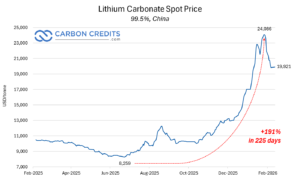
China’s rebate rollback affects how battery makers plan production and exports. Some companies may sell more lithium at home or adjust prices for overseas shipments. This policy highlights that government rules can shape the lithium market just as much as supply and demand.
Global Supply Chains Feel the Shock
China has long been the leader in battery-grade lithium production and battery manufacturing. Export rebates made Chinese batteries and lithium products cheaper for global buyers. Removing these rebates changes the economics for Chinese companies.
One short-term effect may be less lithium available for export. Companies could focus on domestic sales or reduce shipments abroad due to higher costs. Buyers in other regions may need to seek new suppliers or invest in local production.
This shows that geopolitics and policy now influence lithium markets heavily. Global buyers are increasingly aware of supply risks caused by policy changes. As a result, companies with high-quality lithium projects in politically stable countries are likely to become more important.
NILI: A Stable Bet in Uncertain Times
Surge Battery Metals (TSX-V: NILI | OTCQX: NILIF) is in a strong position to benefit from these changes. Its flagship project, the Nevada North Lithium Project (NNLP), is located in a mining-friendly U.S. region. The project has access to roads, power, skilled labor, and regulatory clarity, which reduce risks for development.
Unlike areas where policies can change quickly, Surge Battery Metals offers a stable, high-quality lithium source. Early exploration at Nevada North shows lithium clay grades of up to 8,070 ppm, considered high for clay-based deposits.
More notably, ongoing metallurgical tests show the project could operate at competitive costs and deliver strong financial returns. This makes NILI ready to meet the growing demand from electric vehicles (EVs), grid storage, and other industrial applications.
China’s export policy change increases the strategic importance of projects like Nevada North. Buyers who want a secure supply of lithium may turn to projects in stable regions. Surge Battery Metals is well-positioned to fill that role.
Strategic Advantages Beyond Location
Surge is also building a strong team to advance the project. Recent executive hires bring experience from the battery supply chain, including sourcing lithium for automakers. This expertise helps NILI form strong partnerships and prepare for commercial production.
With China cutting export rebates, some buyers may face higher costs or delays. NILI’s Nevada project can provide a reliable alternative. This is especially important for North American battery makers and EV companies that want supply security close to home.
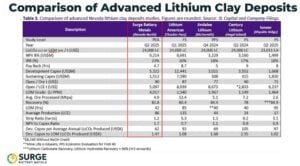
The project’s economic potential is strong. Preliminary assessments indicate Nevada North could produce tens of thousands of tonnes of lithium carbonate equivalent (LCE) per year, 86,300.
The project is now moving toward a Pre-Feasibility Study targeted for completion in late 2026, with engineering led by global firm Fluor Corporation.
The project also benefits from favorable operating costs, US$5,243/t LCE, and the potential to expand its resource base through continued drilling. Surge recently strengthened this position with new drill results from Nevada North.
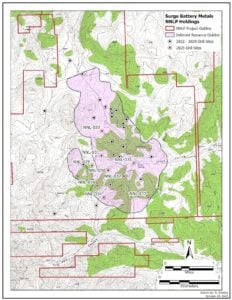
The company reported a 30.6-meter intercept grading 4,196 ppm lithium from surface in a 640-meter step-out hole to the southeast. This wide step-out confirms that strong lithium grades extend beyond the current resource boundary.
In infill drilling, Surge also reported 116 meters averaging 3,752 ppm lithium, including 32.1 meters grading 4,521 ppm near surface. This confirms the presence of a strong, high-grade core within the deposit.
These results highlight the scale and growth potential of the project. These factors make NILI a strategically important player in the global lithium market.
Key advantages that position Surge Battery Metals strategically in the market today:
- NILI’s 100% owned NNLP: 20,000+ acres prime Nevada clay – grades rival brine peers.
- Recent Wins: Oct 2025 BLM plan filed; Q1 2026 drilling planned.
- Investor Edge: TSX-V NILI up 25% post-China news – early positioning pays.
SEE MORE: Lithium Prices Climb Again in 2026, Sending Stocks Upward
The Bigger Picture: Supply Chain Security Matters
The lithium market is changing. In the past, supply and demand drove prices and investment decisions. Today, policy, geopolitics, and supply chain security are just as important. China’s export rebate rollback shows how quickly government decisions can affect global markets.
Companies with projects in stable, well-regulated regions are becoming more valuable. Investors and battery makers are looking for high-quality lithium resources that can provide a consistent supply without the risk of sudden policy changes. NILI’s Nevada North project fits this need.
The market is also paying more attention to long-term demand trends. Beyond EVs, lithium is needed for industrial storage systems, AI data centers, and grid-scale energy storage.
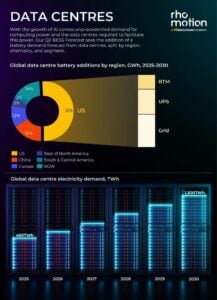
Benchmark’s insights show that data centre electricity demand will rise sharply. Battery energy storage systems (BESS) will be crucial for ensuring power reliability as data centre capacity expands. The growing need for BESS will boost long-term demand for lithium storage. This reinforces lithium projects like NILI’s Nevada North, which can help meet future energy storage needs for expanding data centers.
Long-Term Implications for Investors and Industry
The Nevada North Lithium Project offers high-grade lithium in a politically stable region, with strong infrastructure and skilled labor. The company is positioning itself to meet rising demand from both EVs and other battery markets.
The policy shift in China highlights this strategic importance. With reduced incentives for Chinese exports, buyers are looking for alternative sources. NILI provides a safe, reliable, and high-quality supply, making it a strong partner for battery manufacturers in North America and beyond.
The company’s focus on commercial readiness further strengthens its position. Experienced executives and industry veterans are helping NILI form partnerships and prepare for eventual production. This approach ensures that Nevada North is not just a resource but a fully integrated solution for the lithium supply chain.
NILI in the New Supply Chain Era
For investors, projects like NILI offer exposure to high-grade resources in stable jurisdictions. For battery manufacturers, Nevada North represents a secure supply chain option that can reduce dependence on any single country or region.
China’s policy change is a reminder that supply chain risk matters in the lithium market. Investors, manufacturers, and policymakers are increasingly focused on reliable and diversified sources of lithium.
For anyone looking for safe, high-quality lithium, Surge Battery Metals is a company to consider. As global supply chains adjust to policy changes, the lithium junior is well-positioned to take advantage of new opportunities and strengthen its role in the lithium market.
Live Lithium Spot Price
DISCLAIMER
New Era Publishing Inc. and/or CarbonCredits.com (“We” or “Us”) are not securities dealers or brokers, investment advisers, or financial advisers, and you should not rely on the information herein as investment advice. Surge Battery Metals Inc. (“Company”) made a one-time payment of $75,000 to provide marketing services for a term of three months. None of the owners, members, directors, or employees of New Era Publishing Inc. and/or CarbonCredits.com currently hold, or have any beneficial ownership in, any shares, stocks, or options of the companies mentioned.
This article is informational only and is solely for use by prospective investors in determining whether to seek additional information. It does not constitute an offer to sell or a solicitation of an offer to buy any securities. Examples that we provide of share price increases pertaining to a particular issuer from one referenced date to another represent arbitrarily chosen time periods and are no indication whatsoever of future stock prices for that issuer and are of no predictive value.
Our stock profiles are intended to highlight certain companies for your further investigation; they are not stock recommendations or an offer or sale of the referenced securities. The securities issued by the companies we profile should be considered high-risk; if you do invest despite these warnings, you may lose your entire investment. Please do your own research before investing, including reviewing the companies’ SEDAR+ and SEC filings, press releases, and risk disclosures.
It is our policy that information contained in this profile was provided by the company, extracted from SEDAR+ and SEC filings, company websites, and other publicly available sources. We believe the sources and information are accurate and reliable but we cannot guarantee them.
CAUTIONARY STATEMENT AND FORWARD-LOOKING INFORMATION
Certain statements contained in this news release may constitute “forward-looking information” within the meaning of applicable securities laws. Forward-looking information generally can be identified by words such as “anticipate,” “expect,” “estimate,” “forecast,” “plan,” and similar expressions suggesting future outcomes or events. Forward-looking information is based on current expectations of management; however, it is subject to known and unknown risks, uncertainties, and other factors that may cause actual results to differ materially from those anticipated.
These factors include, without limitation, statements relating to the Company’s exploration and development plans, the potential of its mineral projects, financing activities, regulatory approvals, market conditions, and future objectives. Forward-looking information involves numerous risks and uncertainties and actual results might differ materially from results suggested in any forward-looking information. These risks and uncertainties include, among other things, market volatility, the state of financial markets for the Company’s securities, fluctuations in commodity prices, operational challenges, and changes in business plans.
Forward-looking information is based on several key expectations and assumptions, including, without limitation, that the Company will continue with its stated business objectives and will be able to raise additional capital as required. Although management of the Company has attempted to identify important factors that could cause actual results to differ materially, there may be other factors that cause results not to be as anticipated, estimated, or intended.
There can be no assurance that such forward-looking information will prove to be accurate, as actual results and future events could differ materially. Accordingly, readers should not place undue reliance on forward-looking information. Additional information about risks and uncertainties is contained in the Company’s management’s discussion and analysis and annual information form for the year ended December 31, 2025, copies of which are available on SEDAR+ at www.sedarplus.ca.
The forward-looking information contained herein is expressly qualified in its entirety by this cautionary statement. Forward-looking information reflects management’s current beliefs and is based on information currently available to the Company. The forward-looking information is made as of the date of this news release, and the Company assumes no obligation to update or revise such information to reflect new events or circumstances except as may be required by applicable law.
The post China Cuts Battery Export Rebates, Sending Lithium Prices Up and Boosting NILI’s Role in Global Lithium Supply appeared first on Carbon Credits.

The post Promoting Improved Cooking Practices in Nigeria appeared first on Terrapass.
For most companies, the largest figure in the carbon inventory is not the office, the vehicle fleet, or the electricity bill. It sits upstream, in the goods and materials a business buys to make and sell its products. These purchased inputs form the bulk of a company’s Scope 3 emissions, which routinely exceeds everything the business controls directly, and can add up to 90% of their global footprint.




