President Donald Trump’s cuts to the US overseas aid budget are fuelling concern in African communities about how they will deal with the worsening impacts of climate change, as Climate Home found when visiting a now-halted project in Malawi that protected forests and provided poorer, rural people with ways of making money that enabled them to cope better with drought.
Malawians in the areas that benefited from the USAID-backed programme criticised the decision. The chair of Mbatamile village’s natural resources management committee, Lucia Kasimu, said: “It is our plea that the US government rescind its decision – to help the poor. It is their money we know, but this will leave many people suffering from climate change.”
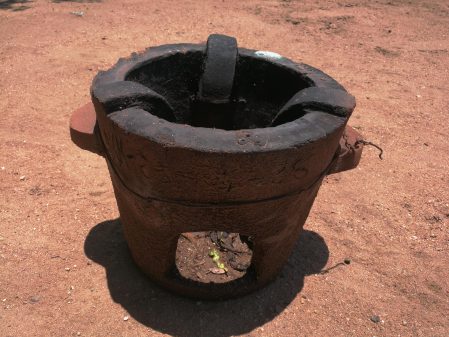
Since 2019, the Modern Cooking for Healthy Forests Accelerator (MCHF) programme – co-funded by the UK – has been teaching people in Salima district to make stoves that use less firewood, cultivate mangoes, produce honey from bee-keeping and grow trees, whose wood they can use or sell.
But a spokesperson for American consulting firm Tetra Tech, which led the MCHF project, told Climate Home last month it was “under a stop-work order from USAID until further notice”, after Trump implemented a 90-day freeze on foreign assistance, including climate projects, on his first day in office.
Drought resilience
Last year, drought killed thousands of cattle across Southern Africa, including in Malawi, as there was not enough grass and water to sustain them. The vice-chair of Mbatmile’s resources committee, Enock Joseph, said the skills taught by theforest programme allowed villagers to earn additional income and buy food when drought or other climate–driven disasters strike.
“Animals are dying due to drought and people are suffering as a result of climate change. Salima is prone to drought – and when there is hunger, people rely on these economic activities to survive,” he said.
With more efficient cookstoves, the project also aimed to reduce demand for firewood in a bid to protect Malawi’s forests. Almost all Malawian households depend on wood or charcoal for cooking and heating. The MCHF also supported the government’s national forest inventory, which tracks levels of forest cover.
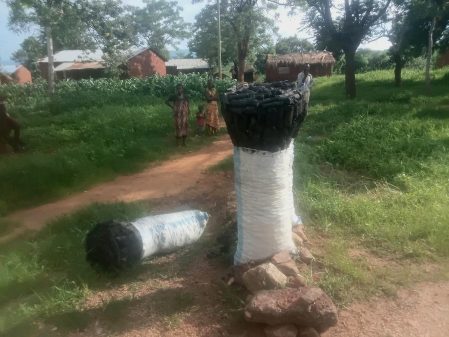
An efficient cookstove (left). Charcoal for sale along the road in Malawi (below).
Joseph said nobody else would be trained to produce cookstoves, honey or mangoes and patrols to stop logging in Thuma forest would end, warning that tree-cutting for charcoal was likely to increase.
He told Climate Home it was wrong for the US to cut aid so abruptly, leaving recipients and employees out of pocket in a food crisis. “For the project to end just like this is like removing an oxygen supply machine from a patient in an ICU so that he dies quickly,” Joseph added.
Tetra Tech declined to comment further. The UK’s Foreign, Commonwealth and Development Office did not comment on its specific support for the MCHF project but told Climate Home it is working “to assess the implications of the US funding pause across development programmes”.
While Trump had criticised USAID in general before winning the presidential election, there was no indication he would immediately freeze its spending or launch drastic cuts so rapidly.
Since he took power, his administration has said in court filings it will try to slash over 90% of the foreign aid agency’s budget – although it remains unclear if that effort will be successful, given that USAID’s budget is controlled largely by Congress.
After Trump’s move, the UK followed suit by announcing plans to slash its aid budget from 0.5% of GDP to 0.3%. Germany, France, the Netherlands and several other European nations have also proposed aid cuts in recent months.
Trump’s cuts to USAID projects are hurting communities in the Global South, particularly in Africa. Bloomberg reported that US has scrapped support for the Power Africa programme, which provided grants for renewable energy on the continent, and the World Food Programme this week said it would have to close its Southern Africa office in Johannesburg in expectation of US and European funding cuts.
The US has also ended its participation in – and financing for – the Just Energy Transition Partnerships, which aimed to shift South Africa, Indonesia and Vietnam from coal to clean energy. German Development State Secretary Jochen Flasbarth said the US move was “regrettable” but with European nations, Canada and Japan still involved he was “convinced” the partnerships would be successful.
But Mattias Söderberg, global climate lead at DanChurchAid, told Climate Home that USAID cuts will have not only humanitarian impacts on people but also “huge security and geopolitical consequences”.
“I understand if there is a political will to change the policies in USA,” he said. “However, I can’t understand the way the cut was done. Funding commitments were cancelled and contracts broken. This way of closing down is disrupting the work of local organisations, and development actors.”
The head of the United Nations has called on all countries to deliver plans for phasing out their production and consumption of fossil fuels, as rising oil prices and climate shocks threaten energy and human security.
In his farewell speech to the UN General Assembly (UNGA) in New York on Tuesday, outgoing UN Secretary-General António Guterres for the first time urged “every government to adopt a national plan to transition away from fossil fuels” aligned with limiting warming to 1.5C. The plans, he said, should include “clear timelines and protection for affected workers and communities”.
“We know fossil fuel interests won’t step aside on their own. For decades, Big Oil has treated the atmosphere as an open sewer – and cashed in on the consequences,” Guterres told diplomats in his speech opening the leaders’ segment of the assembly, also calling out the industry’s windfall profits after Russia’s invasion of Ukraine.
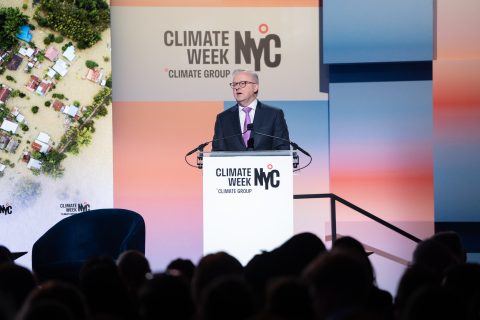
Leaders highlighted the national security risks posed by global warming and fossil fuel dependency at New York Climate Week
At last year’s COP30 climate summit in Belém, a group of about 80 governments led a failed push to develop a global roadmap to transition away from fossil fuels. Brazil instead proposed to draft a voluntary report that will be presented this year ahead of COP31 after countries and organisations submitted their views to the process.
Governments first agreed to transition away from fossil fuels in energy systems at COP28 in Dubai in 2023, but have since failed to agree at UN climate talks on how to move forward with that commitment, as efforts to do so have been effectively blocked by large fossil fuel-producing countries.
France, Netherlands issue plans
A few countries have moved forward with their own transition plans. France launched the first one at an international conference on the issue in April and the Netherlands followed suit this month. Not being major fossil fuel producers, both European nations aim to end their coal, oil and gas consumption by 2050, although the Dutch plan was criticised for not setting specific phase-out dates for the dirty fuels.
Adão Soares Barbosa, climate ambassador from Timor-Leste and chair of the Least Developed Countries (LDC) group in the UN climate negotiations, told a press briefing on Tuesday that last year’sdiscussions on shifting away from fossil fuels need to continue at COP31, adding that developed countries should lead the way with transition plans and curb their use of fossil fuels.
“We are expecting that we can make a request to major-emitting countries to limit emissions from this sector,” he said. “For LDCs, we’ll also try to reduce fossil fuel use, but it will depend on national circumstances.”
Samoa’s lead negotiator Anna Rasmussen said small island states haveoutlinedtheir energy transition plans in their nationally determined contributions (NDCs) – countries’ plans for meeting the Paris Agreement goals – but added “we’re still waiting” for climate finance to help implement those plans.
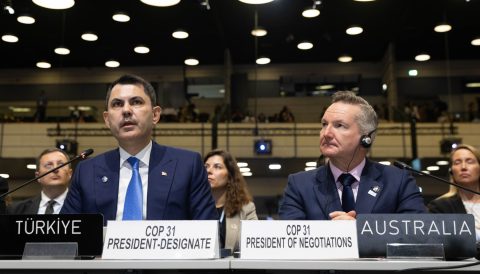
Despite the global push to clean up the energy mix, countries leading climate talks are themselves also expanding fossil fuel production. COP31 co-presidents Australia and Türkiye have both recently given the green light to mine and drill more coal, oil and gas, and still depend on fossil fuels for 60% and 56% of their electricity production respectively.
COP30 host nation Brazil has also persisted with its plans to explore potential new oil reserves near the mouth of the Amazon River – a region known as the Equatorial Margin.
These are moving ahead despite President Luiz Inácio Lula da Silva announcing last year at the Belém climate summit that the country would develop its own fossil fuel phase-out plan. This is still under development with little information about its progress and may be hampered by elections next month.
“We have achieved our self sufficiency in oil and will continue to explore the potential of new reserves, such as those in the Equatorial Margin,” Lula said in his speech to the UNGA on Tuesday. “But we will not abandon the environmental agenda,” he insisted. “We will move forward with the roadmap for the decarbonisation of the Brazilian economy.”
Transition far cheaper than status quo
Speaking at the main Climate Week NYC venue, Mads Christensen, executive director of Greenpeace International, said given the fast-shifting cost dynamics for both fossil fuels and renewables, countries should revise their existing energy plans because they are now out of date.
Gas power generation now costs around 150 euros per megawatt compared with around 50 euros for solar with battery storage – making the latter two-thirds cheaper.
“If these plans were updated, I think we would have a much faster transition because it simply makes good financial sense,” he said.
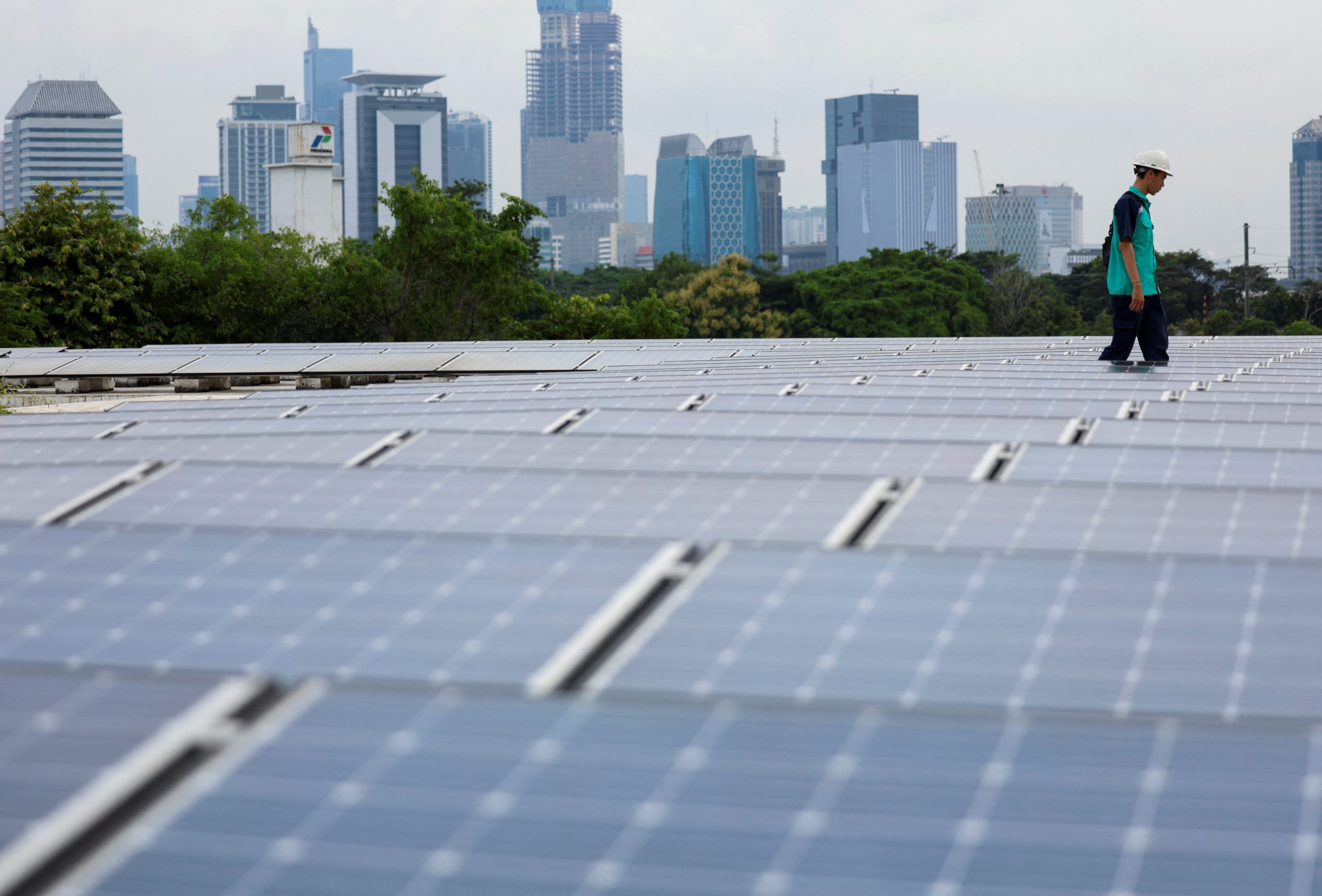
A technician walks next to solar panels that partially provide electrical power to the Grand Mosque of Istiqlal in Jakarta, Indonesia (Photo: REUTERS/Willy Kurniawan)
A technician walks next to solar panels that partially provide electrical power to the Grand Mosque of Istiqlal in Jakarta, Indonesia (Photo: REUTERS/Willy Kurniawan)
Tzeporah Berman, founder and chair of the Fossil Fuel Treaty Initiative, told Climate Home News that the Santa Marta process for transitioning away from fossil fuels (TAFF), launched at April’s conference, could help countries discuss, design and develop their national roadmaps, as well as mobilise the international cooperation required to actually deliver them.
“Many countries want not only national roadmaps but a global roadmap off the highway to hell,” she added. “A global plan is necessary to ensure the rules aren’t rigged against those who want to do the right thing and so all countries can make credible commitments.”
The second TAFF conference will be held in the Pacific island nation of Tuvalu next spring, co-chaired by Ireland. In New York, Tuvalu’s climate minister Maina Vakafua Talia called for stepped-up efforts to tackle the fossil fuel use that is threatening his country’s “demise” by driving global warming.
“The world is running out of time, and so I ask every government to come to… Tuvalu with solutions – real solutions, not false solutions – for us to ensure that we have a pathway and a way forward,” he urged.
COP31’s flagship initiative to accelerate the electrification of the world’s economy has been criticised for failing to include a commitment to produce the power from clean energy.
Governments that sign the voluntary pledge at this year’s UN climate summit will commit to increasing electricity’s share of total energy consumption to 35% globally by 2035 in line “with pathways consistent with keeping 1.5C alive”, the text unveiled by the Turkish presidency on Tuesday says.
While the document says that the electrification goal is “complementary to efforts to expand renewable energy and improve energy efficiency”, governments are not explicitly asked to commit to producing the extra power with clean sources and driving down greenhouse gas emissions.
The text instead says the “use of clean electricity” will vary according to national circumstances. Fossil fuels are not mentioned by name, although the pledge cites the COP28 Global Stocktake decision, which called for “transitioning away from fossil fuels” in energy systems.
Türkiye and Australia are pushing coal, oil and gas at home with no national timeline for their own fossil fuel phase-out
COP31 president Murat Kurum said earlier this month that the push to make electrification more “widespread” – through measures like the rollout of electric vehicles and heat pumps – will “automatically” lead to a reduction in the use of fossil fuels.
But many campaigners disagree, criticising the proposed pledge for failing to give an explicit signal on the fossil fuel transition.
Lack of clarity on energy sources
“Let’s not let electrification become the Trojan horse of our times, used to hide new fossil fuel consumption rather than promote renewable energy,” Claire Smith from civil society umbrella group Beyond Fossil Fuels said in reaction to the pledge’s publication.
She added that the commitment will only help address the climate crisis if electrification is powered by a flexible energy system where solar and wind are complemented by enhanced grids and storage.
The pledge’s text says that the electricity goal should be supported by “diverse and sustainable energy sources”, but it stops short of explaining what these sources are.
Alden Meyer, an international climate policy expert and senior associate at think-tank E3G, said the details of the pledge matter to how effective it will be in helping bring planet-heating emissions down.
“It has to be clean, and we haven’t got enough clarity on a guarantee that it will be a decarbonisation move,” he told Climate Home News.
According to an annual electricity review from energy think-tank Ember, in 2025 renewables edged ahead of coal power for the first time in 100 years. Continued growth in solar and wind pushed the share of renewables above a third of global electricity generation to just under 34%, compared with coal at 33%, it said.
Janet Milongo, energy Transition lead at CAN International, said success cannot be measured simply by how much of the world’s final energy consumption becomes electric.
“We must ask what generates that electricity, who has access to it, who owns the infrastructure, and whether it is helping communities transition away from fossil fuels,” she added.
Electrification alone can’t meet climate goals
Analysis published by the IEA on Tuesday, alongside the pledge, found that it would already be cost-effective to raise electricity’s share of global energy use from 23% today to around 33% with existing technologies, putting the COP31 goal “within striking distance”. Based on current policies, however, the share reaches only about 30% by 2035.
Hitting the 35% target would cut fossil fuel importers’ import bills by around $400 billion a year by 2035, the IEA said. At the higher prices caused by the conflict in the Middle East, that saving rises to more than $500 billion.
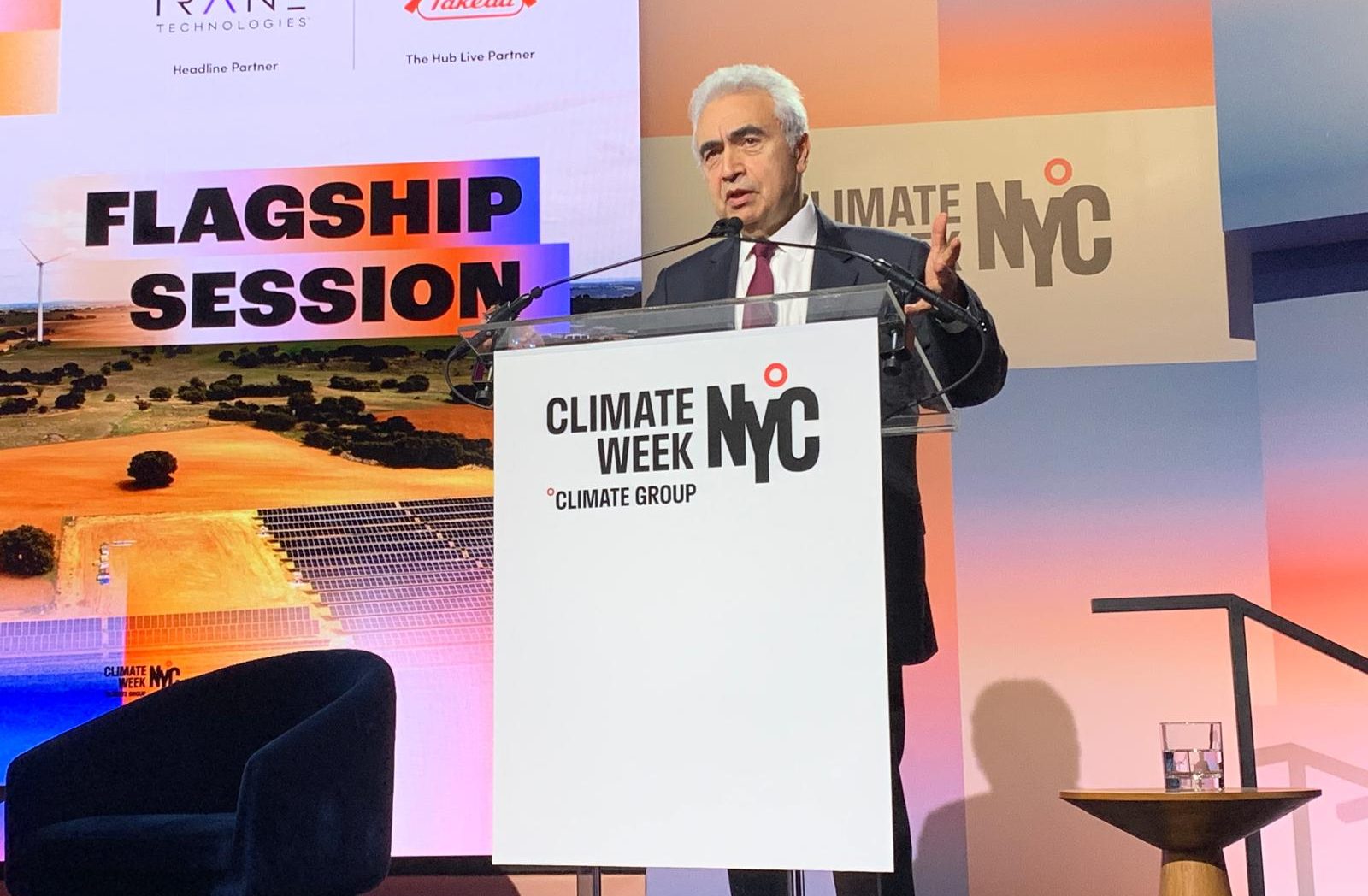
Speaking at New York Climate Week on Tuesday, IEA executive director Fatih Birol said the agency’s figures show that in 2026, about 80% of all new power plants built will run on renewables, with a few percentage points coming from nuclear power and the rest from fossils fuels. “So therefore, electrification itself will lead reduction of the [greenhouse gas] emissions,” he added.
IEA Executive Director Fatih Birol speaks at Climate Week NYC on September 22, 2026 (Photo: Megan Rowling / Climate Home News)
IEA Executive Director Fatih Birol speaks at Climate Week NYC on September 22, 2026 (Photo: Megan Rowling / Climate Home News)
However, the IEA warned in its new report that electrification “by itself is not enough” to meet the world’s climate targets. It noted that, if “low-emission” sources of power continue to simply grow in line with current policy scenarios, that would be only just enough to cover the extra demand from electrification, driving a modest decline in emissions.
Matt Webb, associate director of global clean power diplomacy at E3G, said the pledge is a “welcome signal of leadership” and can help COP31 be a “critical moment” for countries to double down on the energy commitments made at COP28.
But to secure the full benefits of electrification, he added, it is essential that we “urgently clean up” by speeding up the rollout of renewables and developing credible national plans to transition away from fossil fuels.
People around the world have donated almost $90 million to a government-led campaign to help Nepal recover from its recent devastating Himalayan flood, according to a Nepali climate negotiator, even as the UN chief slammed the tiny amount of money in a new fund to deal with such disasters.
Individuals and companies from Nepal and abroad have chipped in from $5 to “many millions” of dollars to the Prime Minister’s Disaster Relief Fund, Manjeet Dhakal, an advisor to the poorest countries at UN climate talks, told an event on Monday focused on early warning systems.
The prompt and substantial response from the public contrasts with the slower, more limited support that is potentially on offer from the UN’s new Fund for Responding to Loss and Damage (FRLD), set up by governments to compensate developing countries for climate disasters.
Over three weeks have passed since Nepal’s finance and environment ministers asked the FRLD board to take an urgent decision to allocate funding to help Nepal protect people and restore essential services in the wake of the disaster, which caused around 1,450 deaths and left more than 5,000 people missing.
“Time is of the essence,” the ministers wrote in an appeal to the FRLDon August 31, which was swiftly followed by a letter from a group of developing-country board members urging the FRLD board’s co-chairsto organise an extraordinary meeting to come up with a response.
Loss and damage fund hesitates
Yet, despite informal online meetings, the co-chairs have yet to convene a meeting with the power to allocate funds. The board’s next scheduled meeting begins on December 15.
Dhakal said on Monday that the request has “received some positive response, but still there is some discussion ongoing about how to respond to that”.
“If they can’t respond in a timely manner, then is [the fund] fit for purpose in terms of disasters that the world would be facing in the coming years? The scale and intensity of these disasters is increasing,” he said.
With just $820 million pledged to it by rich countries and not all of that yet delivered, the FRLD has earmarked just $350 million to spend in its initial phase and without further contributions could run out of money next year.
Because of these limited funds, and a huge number of requests for funding totalling nearly $3 billion, the FRLD has said it will only give out a maximum of $20 million to each project for now. It has yet to approve funding for any projects.
Dhakal recently told The Nation magazine that this amount was just a “symbolic gesture”. Nepal’s government has estimated the costs of recovery and reconstruction at $4.8 billion,with homes, roads, bridges, hospitals and hydropower stations in the affected area needing to be repaired and rebuilt.
“Ridiculously small” funding
In a speech to the UN General Assembly on Tuesday, the body’s outgoing Secretary-General António Guterres criticised the “ridiculously small” level of funds made available by wealthy governments to the FRLD. Developed countries should “make the loss and damage fund work at scale”, he said.
Secretary-General António Guterres speaks at UNGA (Photo: UN Photo/ Loey Felipe)
The Portuguese diplomat told world leaders that when he travelled to Nepal three years ago, he had “sounded the alarm on accelerating glacier melt, warning that the rooftops of the world are caving in”.
“Some dismissed it all as overstating dangers, but as tragic events have shown, impacts are arriving sooner, hitting harder, and spreading further than many anticipated,” he said.
A recent study by scientists with the World Weather Attribution group found that climate change contributed to the rock-ice avalanche which sparked a huge flash flood along a river valley on the Nepal-Tibet border.
Speaking at a separate event in New York on Monday, leading climate scientist Johan Rockström highlighted those findings on the role of global warming in the Himalayan disaster.
“This will be potentially the first poster-child case of a loss and damage invoice, because here we have a proven case of a catastrophe which would not have occurred if it hadn’t been for human-caused climate change,” he said.







 Greenhouse Gases2 years ago
 Climate Change2 years ago
 Renewable Energy11 months ago
 Carbon Footprint2 years ago