


Top Notable Renewable Energy Companies in Indonesia (as of Feb 20, 2024)
Defining the “top” renewable energy companies is subjective and depends on factors like installed capacity, project diversity, and innovation. However, here are 10 notable companies driving Indonesia’s renewable energy transition:
Solar Energy:
- Alva Energi: Mission: “energy for all,” focusing on remote and underserved areas.
- PT. Sumber Energi Surya Nusantara (SESNA Group): Leading solar energy company with project development, financing, and installation services.
- PT Surya Utama Nuansa (SUN Energy): Prominent player in rooftop solar market with customized solutions for homes and businesses.
- Canadian Solar Inc.: Global solar panel manufacturer with a significant presence in Indonesia.
- Trina Solar Co. Ltd.: Major solar panel manufacturer with operations in Indonesia.
Hydropower:
- PT PLN (Persero): State-owned electricity company managing a large portion of Indonesia’s hydropower capacity.
- PT Indonesia Power: Private company with a significant portfolio of hydropower plants.
Geothermal:
- PT Pertamina Geothermal Energy (PGE): Subsidiary of Pertamina, focusing on geothermal development.
- Star Energy Geothermal Pte. Ltd.: Singapore-based company with geothermal projects in Indonesia.
Other Renewables:
- Lumare Energi: Developing innovative Ocean Thermal Energy Conversion (OTEC) technology for clean and reliable power.
Remember: This list is not exhaustive, and the landscape of Indonesia’s renewable energy sector is constantly evolving. Consider your specific needs and priorities when choosing a renewable energy solution.

KPIs for Top Renewable Energy Companies in Indonesia
Determining the best KPIs for different companies can be complex, as each might prioritize different aspects. However, here are some relevant KPIs you can consider for the listed companies, categorized by their specific renewable energy focus:
Solar Energy:
- Total installed capacity (MW): Measures the overall contribution to generation capacity.
- Number of projects completed: Shows active development and market reach.
- Average cost per kWh generated: Reflects affordability and competitiveness.
- Rooftop solar market share: Relevant for companies like SUN Energy.
- Innovation in technology or solutions: Measures commitment to advancement.
Hydropower:
- Total installed capacity (MW): Similar to solar energy, measures generation contribution.
- Average electricity generation (GWh per year): Indicates operational efficiency.
- Contribution to grid stability and peak demand management.
- Environmental impact, including dam management and ecosystem preservation.
Geothermal:
- Total installed capacity (MW): Measures generation contribution.
- Number of active wells and geothermal fields: Shows resource utilization and development.
- Average electricity generation (GWh per year): Reflects operational efficiency.
- Exploration success rate and new field development progress: Measures growth potential.
- Carbon footprint and greenhouse gas emission reduction achieved.
Other Renewables (Lumare Energi):
- Pilot project progress and demonstration of OTEC technology effectiveness.
- Cost competitiveness compared to established renewables.
- Investment secured for scaling up deployment.
- Environmental impact and potential for marine biodiversity conservation.
Additional KPIs:
- Safety record and accident rate.
- Job creation and community development initiatives.
- Transparency and corporate governance practices.
- Customer satisfaction and service quality.
Data Sources:
- Company websites and annual reports.
- Indonesian Ministry of Energy and Mineral Resources (ESDM) data.
- Industry publications and reports.
Remember: This is not an exhaustive list, and the specific KPIs chosen will depend on your individual interests and priorities. You can further customize these KPIs to fit your specific research goals and questions.
https://www.exaputra.com/2024/02/top-notable-renewable-energy-companies.html



 Well, if I had the IQ of a squirrel and believed that Fauci colluded with hundreds of other top scientists around the world to enslave the planet’s population, I would jump right on board.
Doesn’t work for me, though.
Today, however, belief in science and reason makes me a communist.
If you want a steady stream of information about the supposed value that ExxonMobil is bringing to the world, you may want to sign up for this.
These people are playing for keeps, btw. They’re destroying a little piece more of this planet every day, and they understand that completely.
But there is money at stake. Lots of it.
ExxonMobil Has a PR Campaign that Will Appeal to Some People
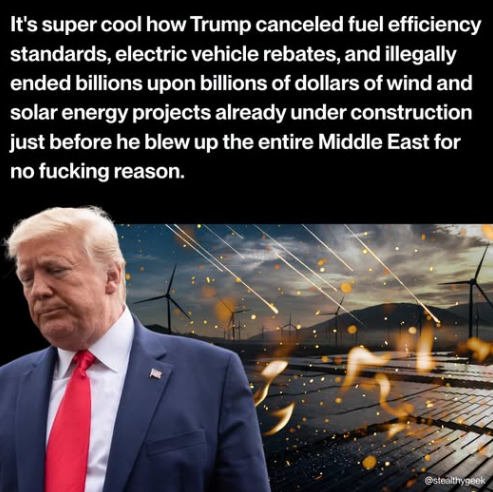 To the reader who sent me this meme:
I wouldn’t say that Trump’s illegal invasion of Iran was done for “no … reason.”
What he did created world chaos and caused most Americans in particular to suffer. The more desperate we become, the more likely we’ll be to accept his repeated claims that “Only I can fix it.”
Chaos also helps to justify a claim of a “national emergency” that Trump could use to cancel the 2026 midterms. If November happens as everyone predicts, this will the end of his political and legal future.
Destroying renewable energy to further enrich his Big Oil megadonors makes Trump that much more powerful.
We’re in a pathetic position.
I’m not one to say, “I told you so,” but since my adolescence, I predicted that big money in government would soon ruin this country.



-

 Greenhouse Gases2 years ago
嘉宾来稿:满足中国增长的用电需求 光伏加储能“比新建煤电更实惠”
-
Climate Change1 year ago
Guest post: Why China is still building new coal – and when it might stop
-
Greenhouse Gases1 year ago
Guest post: Why China is still building new coal – and when it might stop
-

 Climate Change2 years ago
嘉宾来稿:满足中国增长的用电需求 光伏加储能“比新建煤电更实惠”
-

 Renewable Energy11 months ago
Sending Progressive Philanthropist George Soros to Prison?
-
Climate Change2 years ago
Bill Discounting Climate Change in Florida’s Energy Policy Awaits DeSantis’ Approval
-
Greenhouse Gases1 year ago
嘉宾来稿:探究火山喷发如何影响气候预测
-

 Carbon Footprint2 years ago
US SEC’s Climate Disclosure Rules Spur Renewed Interest in Carbon Credits