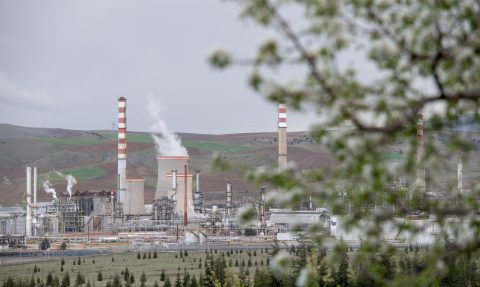
The world’s largest producer of renewable fuel for planes, Neste, is sourcing key ingredients for its “green” fuel from an opaque supply chain that enables fresh palm oil to be passed off as waste, highlighting a global problem facing the aviation industry.
Many governments and airlines are pinning their hopes for more climate-friendly flying on sustainable aviation fuel (SAF). Finnish biofuels giant Neste says it makes SAF with 100% “renewable waste and residue raw material”, such as animal fat and used cooking oil (UCO).
But Climate Home News and Swedish broadcaster SVT found that Neste’s biggest Malaysian supplier of UCO accepted fresh palm oil during a public drive intended to collect waste oil, without asking questions or carrying out checks.
Our investigation did not uncover direct evidence that this or other virgin palm oil has been used by Neste to produce SAF. But industry experts say that, once oil supplies are mixed at source, it is hard for refiners to keep it out of their supply chain.
Neste indicated it would look into our findings, adding that it is currently not aware of any verified cases of fraud that are directly connected to its raw material sourcing.
Planet-heating palm oil
Mounting evidence of widespread fraud risks in the SAF supply chain raises doubts about the climate benefits of the aviation sector’s main green strategy for the years ahead, analysts say.
Palm oil that has not been used for cooking or frying is not permitted under rules on which raw materials can be made into SAF supplied in Europe, Neste’s largest market, because of its links to deforestation.
The clearing of forests for palm oil plantations in Southeast Asia and beyond has long been associated with the loss of carbon-storing jungle, posing a threat to efforts to tackle planet-heating emissions and protect endangered wildlife.
Analysis of Malaysian custom records indicates that Neste sourced around 250,000 tonnes of UCO from Malaysia in 2024. That is more than double the total amount collected in the country annually, according to estimates published by Brussels-based NGO Transport and Environment (T&E). Discrepancies like these have fuelled suspicions about what UCO shipments from Malaysia contain.

A former director at Neste, speaking on condition of anonymity, told Climate Home News that, while the Finnish firm is a highly professional operator, no fuel producer can claim with 100% certainty that its supply chain does not include virgin palm oil or mislabelled raw materials due to the complexity of the sector and weak enforcement by regulators.
The findings add to questions about the integrity of green jet fuel after an investigation by Climate Home News and The Straits Times last year uncovered similar flaws in the supply chain. With more countries mandating the use of small but growing amounts of SAF, and fuel producers scrambling for limited raw materials, barely used and virgin palm oil is being passed off as UCO to traders, industry sources told us.
‘Very high’ fraud incidence
Demand for SAF has surged as governments and airlines promise to cut emissions from a sector with few low-carbon alternatives. Its backers say SAF can reduce planet-heating emissions by up to 80% over kerosene jet fuel when made with waste materials like used cooking oil that do not take up land for food crops or drive deforestation.
But the growing gap between what the world’s kitchens and food factories can realistically provide and what the aviation industry requires has created a clear incentive for fraud.
Is the world’s big idea for greener air travel a flight of fancy?
That holds true in Malaysia, a key sourcing country for SAF suppliers like Neste, where government-subsidised palm oil for cooking can be bought cheaply and then sold on for a higher price as UCO. For that reason, there are additional requirements that the oil should not be deliberately contaminated or manipulated for profit.
“The opportunity, or incidents, of fraud is very high,” Vasu R Vasuthewan, former Malaysia head for the ISCC, a global biofuels certification body, told The Straits Times last year.
No questions asked
On a Saturday in mid-January, dozens of people arrive at the central square in the historic city of Melaka carrying plastic bottles of all shapes and sizes filled with cooking oil.
A banner above a stall advertises a public collection drive organised by Evergreen Oil & Feed, Malaysia’s largest supplier of UCO to Neste and a provider to other multinational fuel companies, including Repsol and Shell.
The idea is simple: individuals bring used cooking oil from home and receive 3 Malaysian ringgit per litre, the equivalent of about $0.65.
Among those bringing greasy containers that morning is an undercover reporter sent by SVT to put the system to the test. She carries a transparent plastic jerry can. Inside it is not waste oil from a kitchen, but fresh palm oil she had poured into the container earlier that day.
The journalist steps forward and hands the jerry can to a volunteer. Without asking any questions about the oil’s origin or contents, the volunteer places it on a scale and notes the weight. He then unscrews the cap and pours the liquid into a large plastic drum, mixing it with oil brought in by other members of the public.
Afterwards, the reporter walks to a nearby table where another volunteer asks her to fill out a simple form before receiving payment for the oil. She writes down a fake name and phone number. No verification is requested, and the cash changes hands.
The blue plastic drum is sealed and loaded onto the back of a truck, which will transport the batch to Evergreen Oil & Feed’s processing facility on the outskirts of Melaka. There, the oil will enter the industrial supply chain that feeds the global market for “waste-based” biofuels, including SAF.
Checks intended to catch fraud
Evergreen Oil & Feed did not reply to a request for comment on what happened at its UCO collection in January. In May 2025, the company’s owner CK Lau told The Straits Times that the firm follows the “proper processes” in its collection based on requirements established by International Sustainability and Carbon Certification (ISCC), the leading certification scheme recognised by the European Commission.
Carl Nyberg, senior vice president for renewable products at Neste, said in an interview with SVT that ensuring the traceability and integrity of the raw materials used in the production of green fuels is of utmost importance for the Finnish firm.
“If we receive concerns or hints that there are anomalies or suspicions around the raw materials we receive, we go in and investigate and then we stop the supplies from such suppliers,” he added.

After watching the footage of the oil collection in Melaka, Nyberg said Neste would “take this on board and dig a bit deeper” to understand the background. “Our objective is, of course, to ensure that we have suppliers that are behaving correctly, delivering the feedstocks that they have promised to deliver us, as we have in the contract,” he added.
A Neste spokesperson later added in a statement that each raw material shipment may undergo additional checks, including “advanced laboratory testing” performed at the company’s own facilities. “Based on the results of analyses on the raw materials we have received, we have not received raw material cargoes with typical profiles of crude palm oil,” they added.
Neste exports outweigh collection
As Neste’s largest provider of UCO in Malaysia, Evergreen Oil & Feed supplied the Finnish giant with more than 50,000 tonnes of the raw material – enough to fill 20 Olympic-sized swimming pools – in the first half of 2025, according to customs data obtained by SVT.
In total, Neste sourced around 250,000 tonnes of UCO from all the Malaysian traders it dealt with in 2024, the data showed.
However, only 100,000 tonnes of UCO are estimated to be collected annually in Malaysia, according to a 2024 analysis by consultancy Stratas Advisors for T&E. “Our suspicion is that not all of these volumes are legit waste oils, suggesting that some of them could be [virgin] palm oil,” said Simon Suzan, a data analyst at T&E.
Under the current system, the entire SAF supply chain largely relies on a long paper trail rooted in self-declarations submitted by restaurants, factories and households providing the UCO, alongside sporadic inspections at the points where the raw material is collected.
In Europe, the verification of green fuel supply chains largely rests on certification systems like ISCC, which is led by the biofuels industry and, according to one source, enjoys “a kind of monopoly” in the sector. The body issues sustainability certificates to commodities traders and fuel suppliers.
ISCC says its certification process supports “sustainable, fully traceable, deforestation-free and climate-friendly supply chains”. But the certifier has come under frequent criticism from campaigners and researchers, who argue that its auditing system relies heavily on company-provided data and can struggle to detect fraud in complex global supply chains.
Watch the full Swedish documentary, “When can I fly green?”, on SVT Play
The problems in Malaysia are not isolated. A separate investigation by AFP and SourceMaterial recently found that Indonesian companies targeted in a palm oil fraud probe had supplied European firms including Neste and Eni.
In February, Indonesian police detained 11 people over suspicions that local companies had conspired with government officials to pass off palm oil as a waste byproduct called palm oil mill effluent (POME), including by offering bribes.
Neste said it had instructed its supplier to exclude the implicated Indonesian companies from its supply chain after the investigation became public. Analysis of periodic samples from shipments between 2023 and 2025 were “consistent with palm-derived waste”, not palm oil, it added. There is no suggestion that Neste had any knowledge of, or involvement in, the alleged Indonesian fraud.
EU ‘not happy’ about fraud risks
Neste turns the raw materials it buys from Southeast Asia and other regions into renewable fuels at its refineries in Singapore, the Netherlands and Finland.
Last year, the company sold nearly three-quarters of its renewable fuels, including SAF, in Europe, where green fuels are central to efforts to reduce the climate impact of aviation. The European Union, alongside the UK, introduced the world’s first SAF mandates in January 2025, requiring fuel suppliers to blend at least 2% SAF with conventional kerosene.
Anna-Kaisa Itkonen, EU spokesperson for climate and energy, said the European Commission is “of course not happy” about the risk of virgin palm oil contaminating the SAF supply chain.
“This was not the purpose when we started the policy and when we wanted to create this global wake-up call of greening aviation,” she added in an interview with SVT. “It undermines the policy because it is basically [de]frauding those who are complying with the rules.”
-
Will the EU finally make waste pay for its growing carbon footprint?
A decision by Brussels to bring refuse incineration into the EU Emissions Trading System would restore a basic principle: the polluter pays -
Doubts over European SAF rules threaten cleaner aviation hopes, investors warn
Transport officials in Brussels and the UK seek to reassure the sustainable aviation fuel industry that blending mandates at airports are here to stay


Itkonen said the European Commission is doing the best it can within its remit, but enforcement is up to individual member states. “We also have the possibility to make these rules more stringent and look into them and revise them,” she added.
Even if regulation is tightened, ensuring fraud-free SAF supplies will not be an easy task, industry insiders warn.
The former Neste director told Climate Home News that, with poor enforcement of the rules especially in source countries, complete control of the supply chain is practically impossible for companies handling enormous volumes of raw materials, like the Finnish firm.
“I don’t think anyone can say 100% putting their hand on a Bible,” the ex-employee added when asked whether Neste could confidently claim no virgin palm oil enters its SAF supply chain.
“The market needs a level playing field. If Neste rejects questionable supply, competitors will accept it. It’s a market-wide problem of fraudulent feedstocks.”
The post Top green jet fuel producer linked to suspect waste-oil supply chain appeared first on Climate Home News.
Top green jet fuel producer linked to suspect waste-oil supply chain

June Rubis is a steering group committee member for the Cali Fund, from Sarawak in Malaysian Borneo.
At COP16 in Cali, governments made a significant commitment: at least half of the funding from the new Cali Fund should support the self-identified needs of Indigenous Peoples and local communities, including women and youth. It was a watershed moment for multilateral benefit-sharing.
The challenge now is to translate that commitment into access arrangements that recognise the different institutions, priorities and decision-making processes of Indigenous Peoples and local communities.
For generations, biodiversity and traditional Indigenous knowledge have provided significant value to companies who depend on nature’s genetic diversity to discover new drugs that fight diseases, create products that improve health, and grow crops resilient to extreme heat and flooding events. While some compounds are sampled directly from the source country, increasingly the digital blueprints are held in online public databases which are freely accessible to use for innovation and research.
Countries urged to ramp up “insufficient” nature policies at COP17
The Cali Fund was established at COP16 to encourage commercial users of Digital Sequence Information, or DSI, to share benefits arising from its use. Estimates suggest it could generate over $3.5 billion a year – a stark contrast to the modest $10,656 currently committed to the fund from just five SMEs, underlining how much progress must be made at COP17 over the next two weeks.
The COP16 decision that set up the fund offers two routes for money to reach Indigenous Peoples and local communities: through government authorities, and through direct payments to institutions identified by Indigenous Peoples and local communities themselves.
Varied ways of organising
Indigenous Peoples and local communities organise through a wide range of institutions. Some have national or regional organisations experienced in managing international grants. Others work through territorial organisations, customary institutions, community associations, cooperatives or networks. Some have professional finance teams and audited accounts; others have extensive experience governing territories, collective resources or conservation work without having been organised around international funding requirements.
For direct access, some questions are already apparent. Which institutions should be able to receive funds? How should they be identified? What fiduciary standards should apply? How should safeguards and accountability work where institutional capacities differ? What support may be needed where institutions have strong community mandates but less experience with international finance?
Comment: Protecting nature is a public duty, not a Wall Street profit opportunity
If access is designed mainly around institutions that already meet the expectations of large international finance mechanisms, early funding will tend to favour those already familiar to funders. They will gain further experience and become better positioned for future funding, while institutions with less administrative capacity may remain outside the system despite strong community mandates and long histories of stewardship.
These first decisions matter most, because they set the terms for everyone who follows.
The role of intermediaries requires care. Some Indigenous organisations may want a fiscal host to hold and manage funds on their behalf. Communities may choose to work through an NGO they trust. Government-facilitated arrangements may work well in particular national contexts.
What matters is the function an intermediary performs and the authority that comes with it. Providing administrative support is different from deciding which Indigenous organisations qualify, which priorities can receive support, or how success will be assessed. Direct access means communities keep that decision-making authority.
Decision-making power
The COP16 decision refers to institutions that Indigenous Peoples and local communities identify. But authority among Indigenous Peoples does not sit in one kind of body. It may sit with territorial organisations, customary institutions, community associations or combinations of these. Legal recognition and customary authority do not always align neatly.
Global deforestation slowed in 2025 but Brazil’s election could undo “fragile” gains
An important feature of the Cali Fund’s governance is that Indigenous Peoples and local communities participate as full members of the Steering Committee, rather than as observers. Seven Indigenous Peoples and local community representatives, one from each of the seven socio-cultural regions, participate in consensus-based decision-making alongside representatives of governments and UN entities. Six additional representatives from civil society, scientific institutions and the private sector participate as observers.
That representation carries responsibility. Institutional legitimacy, access and representation take different forms across the seven socio-cultural regions. Indigenous Peoples and local communities members therefore have an important role in bringing those differences into the Fund’s governance and in ensuring that arrangements developed for one context do not become the assumed model for everyone else.
Safeguards and clear responsibilities
COP17 can establish the core principles and direction, while allowing operational pathways to develop in ways that respond to different regional contexts. The decisions countries take in Yerevan will shape how that flexibility is realised in practice.
The choices made around access will influence which institutions are able to participate, which routes become established and which forms of authority are recognised within the funding architecture. The aim should be an architecture with enough structure to maintain confidence while allowing for different forms of Indigenous and community governance.
A credible direct-access pathway will need safeguards, financial oversight and clear responsibilities. This would give the 50% commitment a stronger institutional foundation.
The Cali Fund’s importance will ultimately depend not only on how much funding reaches Indigenous Peoples and local communities, but on whether they are able to determine how the money is accessed, governed and used. This requires access pathways that recognise their institutions, priorities and decision-making processes, rather than requiring them to conform to a single predetermined model.
The post COP17 must settle who decides how Cali Fund money is disbursed appeared first on Climate Home News.
COP17 must settle who decides how Cali Fund money is disbursed
The UK government has approved extraction at the Jackdaw gas field in the North Sea, despite acknowledging that this decision could make it harder for Britain to convince other countries to move away from fossil fuel production.
UK energy secretary Miatta Fahnbulleh approved the drilling on Wednesday after months of high-profile debate, fuelled in part by interventions from US President Donald Trump. She argued that the project would boost energy security in the wake of the Middle East fossil fuel crisis, protect hundreds of jobs and add £2.9 billion ($3.88bn) to the UK economy.
She said Jackdaw’s gas would be cleaner than imported gas and would not prevent the UK from meeting its legally-binding carbon targets and its goal of net zero by 2050. As the field is already licensed, she said extraction was consistent with the Labour Party’s 2024 manifesto promise not to issue any new oil and gas licenses.
The same morning, the government announced a new Energy Wealth Fund to reinvest oil and gas revenues in the climate transition. It will start with £2 billion ($2.67bn) from the government and be topped up over time with tax revenues from offshore oil and gas production.

Climate campaigners in the UK and abroad were quick to condemn the decision, while a leading legal expert told Climate Home News it goes against the advice of the International Court of Justice. Meanwhile, the government’s own documents reveal that it recognises the drilling could damage the UK’s reputation and its ability to push forward the global transition away from fossil fuels.
“Climate leadership” blow
The 92-page decision document says Fahnbulleh “acknowledges that international standing on climate is important and accepts that a decision to grant consent may not further the UK’s international climate leadership.”
It adds: “She acknowledges concerns about the potential implications for the UK’s credibility and influence – including the difficulty inherent in encouraging other states to move away from fossil fuel production while the UK continues, in a limited and transitional way, to draw on its own domestic resources.”
While noting that Jackdaw has not been issued with a new license – just permission to extract gas – the document says Fahnbulleh “accepts this does not fully resolve the underlying tension in the UK’s position” but “considers this alongside the substance of the UK’s wider record [on emissions reduction], which remains significant”.
It continues that she accepts these concerns are “legitimate” and weigh against approving gas extraction, but only gives this argument a “moderate negative weight” set against the benefits of gas production.
“Huge” wrong signal
In international climate talks, the UK has long supported the transition away from fossil fuels and is one of very few major oil and gas producers to ban new licenses. Across the North Sea, the Norwegian government continues to make offshore areas available for oil and gas exploration through annual licensing rounds.
Climate experts and campaigners shared the concern, acknowledged in the decision document, that approving Jackdaw could set a precedent for fossil fuel production elsewhere. Sam Fankhauser, professor of climate change economics at Oxford University, said the direct climate impact of Jackdaw is “much smaller than the debate around it would suggest” but the “wrong signal it sends, however, is huge”.
-
Carbon capture industry faces tough future, as UK raids green spending
Despite a spate of projects getting underway, the mood at an industry conference in London this week was low with government subsidies set to shrink -
Paris Agreement committee names three countries snubbing it over NDCs
More than 30 countries have failed to submit an NDC, but only three have repeatedly ignored the committee’s efforts to engage with them -