

Jonathan Brearley became chief executive of the UK’s energy regulator Ofgem in 2020.
Since then, he has seen the organisation through the Covid-19 pandemic, the impact of Russia’s war in Ukraine and the subsequent energy crisis.
In January, it was announced that Brearley will continue in the role until 2030, the target date for the UK’s electricity system to run on clean power.
This gives him an important position in overseeing the country’s electricity and gas networks, as well as the energy markets, retailers and consumer prices during a period of huge transition.
Carbon Brief sat down with Brearley to discuss the energy network, “zonal” pricing, the Spanish blackout and what is next for protecting customers from high energy prices.
- On the next decade: “If you fast forward to 10 years’ time…our energy is going to come from lots of different places.”
- On electricity network rollout: “We should have built the network faster.”
- On Ofgem’s scope: “If I think back to…2020, I don’t think I’d have imagined how fast we would change the things that we do.”
- On price control frameworks: “If we get that right, if we get that infrastructure on time, then that takes the country to a much more stable and secure place.”
- On zonal pricing: “There are benefits, economic benefits, from single pricing, but it brings uncertainty…[I]t’s a balanced judgment. It’s not just a slam dunk.”
- On the clean-power 2030 goal: “The interaction between zonal and clean power is this question of cost of capital and uncertainty.”
- On protecting customers: “We are trying to have a stable system…one that allows us to manage this international volatility that, quite frankly, no government or regulator can control.”
- On the Spanish blackout: “I think we’ll all have to be vigilant.”
- On zero-carbon power: “The job for all of us is to be really careful about the security of supply.”
- On “rebalancing” energy-bill policy costs: “We’ll all have to be mindful of the distributional consequences of any change.”
- On equity in the transition: “There’s a really big challenge for all of us, [around] how are we going to get some of this kit into people’s homes.”
- On energy bills: “There’s greater awareness and I think greater importance in people’s lives.”
- On misinformation: “We see part of our job as being that sort of authoritative voice.”
- On the role of gas: “It’s about diversifying [the energy system] so that, were a shock to hit, we would be in a much more attenuated place.”
- On wind “constraint” costs: “The best way to avoid constraint costs is to have the network to transport the electricity, ”
- On customers and the energy transition: “There is a really interesting discussion we should have publicly, about how customers are going to see this change.”
Carbon Brief: How do you think the UK’s energy system will look in a decade and what will it mean for consumers?
Jonathan Brearley: So, I might answer that by just stepping back and thinking about how it’s already changed, and therefore how it might change in the future.
If you go back to 10 years ago when we started this low-carbon transition journey really, it was all about growing energy at the back end. So different forms of power generation, in particular, and to be honest, my life, your life, everyone’s life, has not really changed much in the way we use energy. Most of us still heat our homes using the same kind of heaters, usually gas heaters. We still use electricity in the same way we did, frankly, in the 70s and 80s.
But if you fast forward to 10 years’ time – and you’re beginning to see this already, actually increasingly – our energy is going to come from lots of different places. So it’s going to come, for example, from solar panels, which we may have on our roofs. We may be using our cars both for sourcing their fuel from electricity, but also being used to help us manage our own energy within our homes.
So I think this is all going to become very real and very visible for families and for businesses.
I think the question for me is, how do we make sure that that transition is a positive one, and how can we make sure that people get the benefits of that? And I think the benefits could be really big.
CB: Sort of implicit in what you just said is a bit of the fact that we thought a lot about the generation, we thought about the renewables, but the networks for something that feels like it’s only really become a focus in the last couple of years.
Do you think that we should have paid more attention to that sooner? Or do you think lots of people were, but it just wasn’t getting the sort of media attention that renewables were?
JB: So I think, without a doubt – and I’ve said this many times with hindsight – we should have built the network faster. You know, it’s clear that we now need to build fast to meet the ambition of renewables that we have.
Now, some of that is about how those ambitions change over time. But quite frankly, we’ve got a huge task now to get our networks in place. And you know, in a system where the place we generate is going to change, the type of generation we have is going to change, we need the network to match. And that’s really what Ofgem’s focus has been for a number of years now, to try and get that going. And quite frankly, I think it is going quite fast.
CB: Do you think that Ofgem’s scope and focus have changed an awful lot, in even just the last five years or since the energy crisis?
JB: Hugely. I mean, I think it’s changed hugely. Even if I think back to when I was CEO in 2020, I don’t think I’d have imagined how fast we would change the things that we do.
So take that network’s kind of piece. Even in 2020, we were still running price controls pretty much in the way we’ve run them before, [whereas] right now, our network regulation is starting from the understanding that pace is important. The speed at which we move, the speed at which we get investment in the system, is the best way we are going to protect customers.
So with something we called ASTI, the accelerated strategic transmission investment program. We have a whole programme now focused on making sure that, as far as possible, our kind of regulation of the money doesn’t get in front of project development.
Now, quite frankly, we’re about to come out with RIIO, our price control settlement. I think what we will say to the industry, to ourselves, to industry and to government, is, “look, there’s a massive challenge now. We’re making this money available, but we have to deliver, and that means making sure we get that network on time so that this new system we’re building works for the whole country.”
CB: How’s RIIO going to change from previous price framework periods?
JB: Well, I think there are two elements for me. First of all, we have to make sure that we invest in the system that we have. So all infrastructure regulators, in my opinion, need to learn the lessons from the last 10 years to make sure that the system we have maintains high [level of] security of supply and delivers high-quality services to customers.
But also, we are sort of embarking on this big build program to make sure that we are ready to take on all of this new generation.
Now, if we get that right, if we get that infrastructure on time, then that takes the country to a much more stable and secure place, which is something that I think in today’s world that customers will value extremely, hugely.
CB: With talking about the networks and how much is changing, you previously said you would support a shift to zonal pricing. Given how fraught the debate is, could you give me some of the core reasons behind backing such a shift?
JB: So look, I’ve shared my personal view on this and, quite frankly, that’s a Jonathan Brearley view, not a view of the whole organisation. And the reason I say that is because this is a really balanced argument.
So the problem we will all have is how to make sure we can run this new system as efficiently as possible. So, how do we minimise payments to generators to switch off because we simply can’t move their power around? And how do we make sure that the operation of our batteries, our interconnectors and our generators all fit together?
There are basically two options. There’s zonal pricing, which I prefer, because I think when you get there – even though it’s a long journey – this adapts more organically and more easily.
But there is a path you take where you adapt the national system that we have. You probably have to change your transmission charging and probably have to do more planning of infrastructure that could take you to somewhere near the same place.
Now I know the secretary of state is balancing those two things together. The argument is fairly simple in my mind: there are benefits, economic benefits, from single pricing, but it brings uncertainty. The question is, does that uncertainty drive up the cost of capital so much that it actually outweighs the benefits that you might get? And that’s what he’ll be grappling with.
Either way, we’ll support him in that delivery. I’ve given my view, but it’s a balanced judgment. It’s not just a slam dunk.
CB: You mentioned within that, that zonal pricing is a long journey. Do you think that the timeframe within which it could be implemented could potentially jeopardise [the government’s target of] clean power by 2030?
JB: So I think the interaction between zonal and clean power is this question of cost of capital and uncertainty. That’s the same trade-off I’ve just laid out and that’s where I think will be on the secretary of state’s mind when he makes that decision.
CB: In the shorter term, we’ve already touched on how things have changed since the energy price crisis and that being driven by surging gas prices in particular.
How much can Ofgem do to protect customers and consumers from similar situations in the future, given that gas still has such a role in setting wholesale market prices?
JB: Well, look, I mean I think that’s our mission. We’ve all got to learn collectively from the last few years. When you distill it back – all the regulatory detail, all of the conversations about how we manage technically – we found ourselves in a situation where this country’s energy needs were, in the vast majority, being provided by an international gas market that we don’t control.
Now, we saw the impact when we had to withdraw from Russia as a major supplier and we saw the price spikes we saw in 2022-24. What all of us want to do is build a system where we never face that kind of situation again.
So the thing about building the infrastructure we’re talking about, both through networks and through the upcoming auctions for offshore wind and onshore wind, is that we will have a system that is much more stable.
So there’s some very early analysis that we’re doing that I don’t have sort of full figures for, that asks the question, “Well, imagine we had a gas crisis in 2030 when this is all built”. And the early indications from that analysis are actually [that] we would be a lot better off as a country.
The main thing we are trying to do is have a stable system, a system that’s more within our domestic control, not totally within our domestic control, but one that allows us to manage this international volatility that, quite frankly, no government or regulator can control.
CB: Talking about international volatility, we’ve had the report this week from the Spanish government into the causes of the blackout. Then we’ve also had [grid operator] Redeia sort of pushing back against certain elements of it.
What is Ofgem taking from that situation, to learn about how it could manage potentially similar situations in the UK?
JB: Well, I think it’s still early days. We’re still digesting the report and we will make sure that we, the system operator and the network companies and indeed, the generators learn from what happened in Spain.
I guess, stepping back from the specifics, there are some reasons to take comfort. I think we have thought a lot about things like system inertia and some of the problems you might get when you see thermal generation declining, but I think we’ll all have to be vigilant. This is a big change and we’ll have to make sure the system works in all scenarios.
And look, the thing about incidents such as what happened in Spain is that they are great ways for us to make sure our system is more resilient. But there’s nothing I’ve seen from the reports yet that makes me think that there’s something we’re absolutely missing in the UK. But as I say, early days and much more work to do to get through that.
CB: With Britain being an islanded grid, it strikes me as being very different from the one in Spain.
Are there any particular countries that Ofgem can look at, sort of learn lessons from, or do you always sort of have to take a step back and go, but we are an island, we don’t have the level of interconnection that other places do, and we do need to be slightly more independent because of that.
JB: Well, that’s an interesting question. I suppose that as we look at our interconnection program, we’re going to build out up to roughly around 18 gigawatts (GW) of interconnection. So I don’t think we are going to be an island in 10 years’ time, coming back to sort of where we started.
There is always a question, if you are more separate from another market, as to how you manage, particularly looking back at the gas crisis. If you look at our gas market and how we connect to Europe, and what we might need from them. But I don’t think we’re so different that we can’t take lessons from European countries either.
And actually, I think when you look at Spain, Portugal and their interaction with France, one of the things I hear is a question that’s being asked is, should you have more interconnection for Spain, because, actually, there weren’t many outlets to begin to share some of these sorts of factors that play.
CB: That’s interesting, because I think lots of the focus has just been on how Spain was interconnected with Portugal, and that was almost a problem for Portugal.
JB: Well, that’s right, but if you look at the two of them together and how they connect to the rest of Europe, I don’t know the numbers, but I would imagine it’s a million miles away from where we are.
CB: With Britain expected to have periods of zero-carbon electricity generation for the first time this year, what are the biggest challenges Ofgem is facing in facilitating this transition?
JB: Well, I think it’s a really positive step. Now, let’s be clear, we will all be vigilant. And I imagine Fintan [Slye] and the system operator will be super vigilant, to make sure they understand how the system will work and how they’ll manage some of the changes that a zero-carbon system brings.
But it’s a great step forward and I think as we gradually get into this, the job for all of us is to be really careful about the security of supply, to remember that that is always the customer’s number one concern, and to begin to learn the lessons.
The thing for me is this great change that Ed Miliband is instituting through 2030, the new generation, the new network. For me, it’s all now about the efficiency of that. Making sure that’s efficient, economic and delivers what customers need.
Now the other thing, I think from the gas crisis is, although there are still tensions between the trilemma – I think we can’t pretend the trilemma has completely gone away – they are much lower than when I started 10 years ago, where we had a real sort of trade off between very high cost renewables and very low cost thermal.
So I think there’s a lot of work for us to do, but look, I’m glad we’ve made that step, and I hope it continues to do so.
CB: Do you think there needs to be work to rebalance the levies on electricity bills to sort of continue to tackle some of these core imbalances in the cost to consumers?
JB: So another trilemma is levies on electricity, what you might put on gas and what a taxpayer might take. You know, as a regulator without a fiscal mandate, of course I would love the taxpayer to take more of the burden, but I don’t face the challenges that the chancellor faces.
I think there is always going to be a question in the current system as to how, if you want people to take up electricity as their option for heating and for transport, how you make that economic, particularly through heating. But the thing we’ll all have to be mindful of is the distributional consequences of any change.
So what we think broadly is actually what you’ve got to do is step back and think about those customers that are really struggling. So, if you have low-income customers that are finding it hard in today’s market as is, how are you going to protect them through any transition?
And I think that goes beyond the question about levies actually. I think systemically, we need to do more for affordability, to give ourselves flexibility, to make changes like that that might make the system more efficient.
CB: Do you think the energy industry as a whole is doing enough to ensure that everyone is brought along with the transition? That everyone gets the benefits of being able to charge an EV at home and stuff like that, even if it requires quite a big upfront cost. Are we doing enough overall?
JB: So the thing I want to recognise is that, particularly for suppliers, but actually across the industry, people have worked really hard to protect vulnerable customers. You know, we’ve had things to work through, like prepayment meters, but most companies now have really focused on trying to make sure they understand customers in difficult financial circumstances, for example.
Now there’s always more we can do, and as a regulator, we’re always going to be pushing to make that response better. So [things like a] quick response to people in debt, making sure that you get them onto an affordable repayment plan and you work hard with those families to get them back in a more stable position.
I’m really pleased with the government’s announcement today [19 June 2025] that there’s more people going to get the “warm home discount”, and we’re going to play our part in that. We’re going to introduce debt relief initiatives that tackle the stock of debt that’s been left over since the crisis. So things are beginning to move.
In the short term, I think that as we make this transition, there’s a really big challenge for all of us, which you’ve highlighted, which is how are we going to get some of this kit into people’s homes, for people that aren’t able to finance that themselves? So I’m looking to the “warm homes plan”. I was pleased to see that was money allocated in the spending review [for the warm homes plan], where we will actually be [able to] support some of the most vulnerable customers to benefit from this.
And look, there’s a myth out there that I think we should challenge, that poorer or lower-income households and vulnerable customers don’t want to engage with this market.
I mean, interestingly, I’ve talked to a lot to [EV] charging companies for example, and they’ll point out to me, they’ll point out to me that a lot of EV users are people who’ve got those through disability payments and are engaging in a more flexible market and are seeing those benefits.
So the more of that we can create, the better I think it will spread the benefits of the change.
CB: It’s interesting. Why do you think there is less awareness that people who are considered sort of lower income aren’t as engaged?
JB: So there is some evidence, actually. So some of the consumer work we’ve done does say that, in general, if you have vulnerabilities, you might engage less with things like switching. But I think we’ve got to be imaginative about this. And if you have policy and policy funding, then there must be a much better way to get people involved.
Like I say, when you see people getting electric vehicles, for example, through personal independence allocations, things like that, then you can see people do engage. So there’s plenty of scope there to do more.
CB: Do you think there’s a greater awareness of what goes into energy bills than there was five years ago or before the energy crisis? And does that change how consumers then interact with you and what they call for from Ofgem?
JB: Well, I’ll tell you one thing that I’ve done now for three or four years, which is, I’ve phoned customers up individually. And so my teams find me someone – they do pre-warn them – and I phone them up and ask very general questions.
So I don’t go in there with a series of specifics, I just say, “how do you feel about your energy company? How would you feel about your energy provision? And what would you change?”
And I guess that the change that I am noticing, for understandable reasons, is that it’s much more front of mind than it’s ever been before.
So I think back to sort of when I started in Ofgem in 2015, I told people what I did, there was sort of moderate interest, put it that way. Now, everybody has an opinion about what should happen and the way we should configure the system.
So I think there’s, there’s greater awareness, and I think greater importance in people’s lives. You know, people have seen the impact of high prices, and most people have the question, well, how do I help myself get out of that?
CB: From Ofgem’s point of view, are there any specific areas where you think there’s mis- or disinformation that’s particularly harming your work, particularly in the media?
JB: So, you know, there is [currently] a much wider debate now about net-zero, and I think that is a shift. So right the way back when we developed the Climate Change Act in 2006/7, we had a House of Commons that I think had five dissenting votes out of the whole House – something like that, certainly less than 10. [Five Conservative MPs voted against the bill.]
So we are seeing a much more vigorous debate about what we should do. Now my view is we should also welcome that we all need to test our plans and test what we’re doing, but I think we have to be careful to ground that, as far as possible, in the analysis.
What we do, when we talk about the impact of what we do, we try and ground that as best we can within the economics we have within this building and the things that we see outside of there. I think that’s hard when the debate becomes more emotional, but that is, we see part of our job as being that sort of authoritative voice, basing things as far as we can on the evidence that we see.
CB: Do you think it would be useful if there was a clearer presentation of things like curtailment costs in the media?
JB: So the system operator does do work on sharing the curtailment costs, so they do and will share their analysis around this. I think the question is, how those might change over time, and being clear on the range of possibilities there.
The problem we have – and look, I’ve been around this very long time, is that projections are just projections. So I was looking back at some projections on constraint costs from 10 years ago, and put it this way, they were way out.
You know, I also always talk about my time in the department in the early sort of 2010s we thought the idea that solar was going to take off in the UK to be completely mad, because it was six times the market price and we have no sun in Britain. That was a kind of general statement. And both of those things have turned out to be wrong.
So one of the things I think we’re all going to have to get used to is understanding that the range of possibilities is still quite wide, and it’s how you have the debate within that, how you talk about how you manage risks.
The thing that we focus on as a result of that is to say, “look, let’s have a look at our portfolio of energy”. As I say, it’s majority gas. What we’re doing, I think, through the infrastructure bill that we’re putting in place, is really moving to a place that’s more stable.
There’s not going to be no gas in 2030, there’s plenty of gas in both our heating system and indeed, there’ll still be gas in our electricity system. But it’s about diversifying that so that were a shock to hit, we would be in a much more attenuated place. And I think that’s better for all customers.
CB: So I know I asked you what the UK energy system will look like in the next 10 years, but what’s on Ofgem’s plate for the near future? What’s next for you? What’s your biggest focus?
JB: Well, our big thing in the next couple of weeks will be RIIO. Now that is on network price control.
To be open, when I first came into Ofgem in 2016, that was a large part of my job. I came as networks director at that point, or networks partner, I think it was called.
And what we’re going to see, I think again, is the regulator moving fast to unlock the investment we need to build this system. So we’ve worked very hard for the companies, now we are always, unashamedly going to challenge them on the amount of money they need and the returns that they get, but equally, we are thoughtful about the pace at which we need to put this infrastructure in place.
As I say, coming out of this will have an impact on customers’ bills, because we have to fund the infrastructure that we are paying for. But we do think that is offset, really, by two things.
First of all, a reduction in those constraint costs, because the best way to avoid constraint costs is to have the network to transport the electricity, but also to get out of this volatility, so to be away from a place where we are as vulnerable as we were in 2022. So that’s what’s on our mind in terms of the conclusions that we’ll come out with.
But it’s a big challenge. The challenge is to us, to industry, to government. Now, what do we need to do? We need to unlock the money as those projects progress. The government needs to make sure that planning permission is there, that we have nothing in terms of the sort of wider regulatory landscape that gets in the way. And the network companies need to deliver, [as] we are giving them a vast amount of money on behalf of customers. This would be fantastic for customers if those projects get in the ground, but if they’re delayed, then I think customers have a right to be asking the question why.
CB: Is there anything else you like to add? Anything you think more people should talk about that no one ever asks you about?
JB: Oh, that’s a very good question. What should people talk about that they don’t ask about? I’ll tell you what we should talk about is – almost going back to the first question – I think there is a really interesting discussion we should have publicly, about how customers are going to see this change.
You know, how is it going to look and feel? Where regulators are terrible is in thinking about the shape of services. You know, how do you design something that people really want? You’ve got some great companies out there doing it. A lot of the retailers are now getting involved in this conversation. You’ve got a lot of small startups.
But I do think, once we continue the debate about the investment that we need, the next question is, “well, how does this work for people?” So I’m really excited by things like the government’s “warm homes plan”, because I think that is a really good way to get a conversation about what infrastructure do we need, how do we best use it, and how do we change all of our lives for the better?
The interview was conducted by Molly Lempriere at Ofgem’s head office in Canary Wharf, London, on 19 June 2025.




The post The Carbon Brief Interview: Ofgem CEO Jonathan Brearley appeared first on Carbon Brief.

Drought and heatwaves occurring together – known as “compound” events – have “surged” across the world since the early 2000s, a new study shows.
Compound drought and heat events (CDHEs) can have devastating effects, creating the ideal conditions for intense wildfires, such as Australia’s “Black Summer” of 2019-20 where bushfires burned 24m hectares and killed 33 people.
The research, published in Science Advances, finds that the increase in CDHEs is predominantly being driven by events that start with a heatwave.
The global area affected by such “heatwave-led” compound events has more than doubled between 1980-2001 and 2002-23, the study says.
The rapid increase in these events over the last 23 years cannot be explained solely by global warming, the authors note.
Since the late 1990s, feedbacks between the land and the atmosphere have become stronger, making heatwaves more likely to trigger drought conditions, they explain.
One of the study authors tells Carbon Brief that societies must pay greater attention to compound events, which can “cause severe impacts on ecosystems, agriculture and society”.
Compound events
CDHEs are extreme weather events where drought and heatwave conditions occur simultaneously – or shortly after each other – in the same region.
These events are often triggered by large-scale weather patterns, such as “blocking” highs, which can produce “prolonged” hot and dry conditions, according to the study.
Prof Sang-Wook Yeh is one of the study authors and a professor at the Ewha Womans University in South Korea. He tells Carbon Brief:
“When heatwaves and droughts occur together, the two hazards reinforce each other through land-atmosphere interactions. This amplifies surface heating and soil moisture deficits, making compound events more intense and damaging than single hazards.”
CDHEs can begin with either a heatwave or a drought.
The sequence of these extremes is important, the study says, as they have different drivers and impacts.
For example, in a CDHE where the heatwave was the precursor, increased direct sunshine causes more moisture loss from soils and plants, leading to a drought.
Conversely, in an event where the drought was the precursor, the lack of soil moisture means that less of the sun’s energy goes into evaporation and more goes into warming the Earth’s surface. This produces favourable conditions for heatwaves.
The study shows that the majority of CDHEs globally start out as a drought.
In recent years, there has been increasing focus on these events due to the devastating impact they have on agriculture, ecosystems and public health.
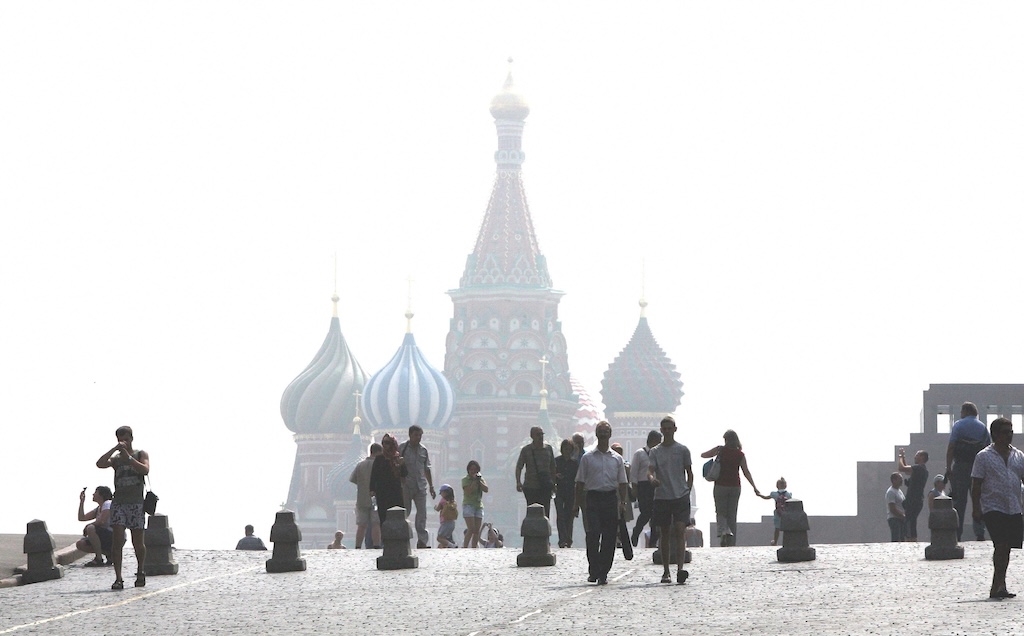
In Russia in the summer of 2010, a compound drought-heatwave event – and the associated wildfires – caused the death of nearly 55,000 people, the study notes.
The record-breaking Pacific north-west “heat dome” in 2021 triggered extreme drought conditions that caused “significant declines” in wheat yields, as well as in barley, canola and fruit production in British Columbia and Alberta, Canada, says the study.
Increasing events
To assess how CDHEs are changing, the researchers use daily reanalysis data to identify droughts and heatwaves events. (Reanalysis data combines past observations with climate models to create a historical climate record.) Then, using an algorithm, they analyse how these events overlap in both time and space.
The study covers the period from 1980 to 2023 and the world’s land surface, excluding polar regions where CDHEs are rare.
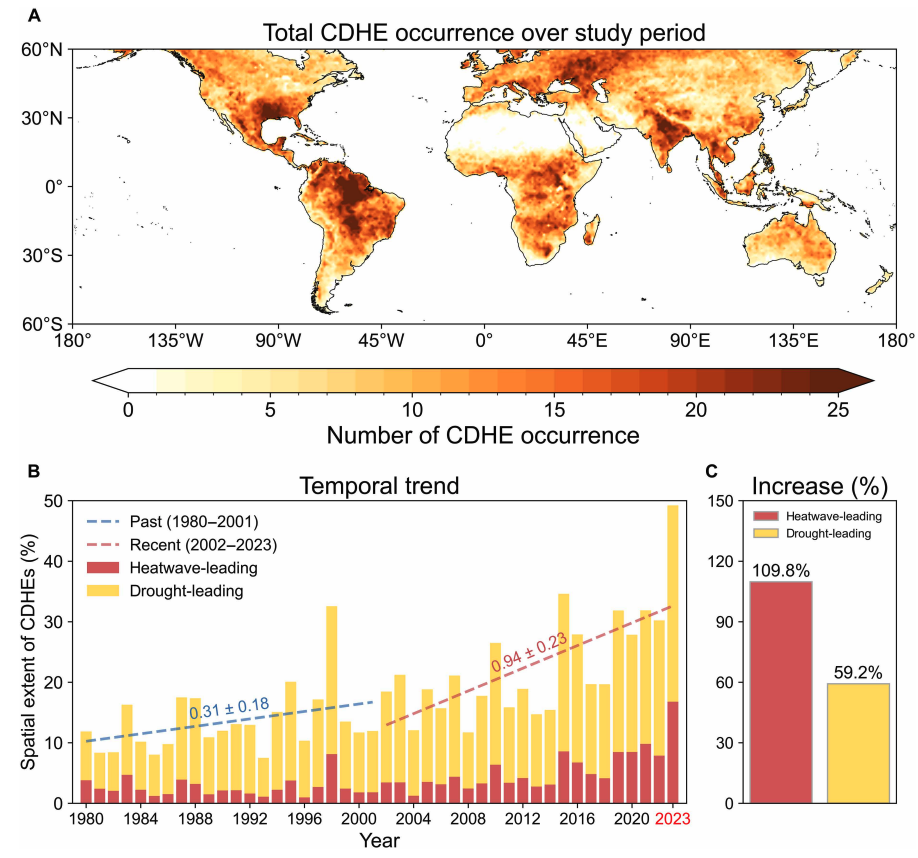
The research finds that the area of land affected by CDHEs has “increased substantially” since the early 2000s.
Heatwave-led events have been the main contributor to this increase, the study says, with their spatial extent rising 110% between 1980-2001 and 2002-23, compared to a 59% increase for drought-led events.
The map below shows the global distribution of CDHEs over 1980-2023. The charts show the percentage of the land surface affected by a heatwave-led CDHE (red) or a drought-led CDHE (yellow) in a given year (left) and relative increase in each CDHE type (right).
The study finds that CDHEs have occurred most frequently in northern South America, the southern US, eastern Europe, central Africa and south Asia.
Threshold passed
The authors explain that the increase in heatwave-led CDHEs is related to rising global temperatures, but that this does not tell the whole story.
In the earlier 22-year period of 1980-2001, the study finds that the spatial extent of heatwave-led CDHEs rises by 1.6% per 1C of global temperature rise. For the more-recent period of 2022-23, this increases “nearly eightfold” to 13.1%.
The change suggests that the rapid increase in the heatwave-led CDHEs occurred after the global average temperature “surpasse[d] a certain temperature threshold”, the paper says.
This threshold is an absolute global average temperature of 14.3C, the authors estimate (based on an 11-year average), which the world passed around the year 2000.
Investigating the recent surge in heatwave-leading CDHEs further, the researchers find a “regime shift” in land-atmosphere dynamics “toward a persistently intensified state after the late 1990s”.
In other words, the way that drier soils drive higher surface temperatures, and vice versa, is becoming stronger, resulting in more heatwave-led compound events.
Daily data
The research has some advantages over other previous studies, Yeh says. For instance, the new work uses daily estimations of CDHEs, compared to monthly data used in past research. This is “important for capturing the detailed occurrence” of these events, says Yeh.
He adds that another advantage of their study is that it distinguishes the sequence of droughts and heatwaves, which allows them to “better understand the differences” in the characteristics of CDHEs.
Dr Meryem Tanarhte is a climate scientist at the University Hassan II in Morocco, and Dr Ruth Cerezo Mota is a climatologist and a researcher at the National Autonomous University of Mexico. Both scientists, who were not involved in the study, agree that the daily estimations give a clearer picture of how CDHEs are changing.
Cerezo-Mota adds that another major contribution of the study is its global focus. She tells Carbon Brief that in some regions, such as Mexico and Africa, there is a lack of studies on CDHEs:
“Not because the events do not occur, but perhaps because [these regions] do not have all the data or the expertise to do so.”
However, she notes that the reanalysis data used by the study does have limitations with how it represents rainfall in some parts of the world.
Compound impacts
The study notes that if CDHEs continue to intensify – particularly events where heatwaves are the precursors – they could drive declining crop productivity, increased wildfire frequency and severe public health crises.
These impacts could be “much more rapid and severe as global warming continues”, Yeh tells Carbon Brief.
Tanarhte notes that these events can be forecasted up to 10 days ahead in many regions. Furthermore, she says, the strongest impacts can be prevented “through preparedness and adaptation”, including through “water management for agriculture, heatwave mitigation measures and wildfire mitigation”.
The study recomme