

Weather Guard Lightning Tech
Siemens Rejects SGRE Sale, Quali Drone Thermal Imaging
Allen, Joel, and Yolanda discuss Siemens Energy’s decision to keep their wind business despite pressure from hedge funds, with the CEO projecting profitability by 2026. They cover the company’s 21 megawatt offshore turbine now in testing and why it could be a game changer. Plus, Danish startup Quali Drone demonstrates thermal imaging of spinning blades at an offshore wind farm, and Alliant Energy moves forward with a 270 MW wind project in Wisconsin using next-generation Nordex turbines.
Sign up now for Uptime Tech News, our weekly newsletter on all things wind technology. This episode is sponsored by Weather Guard Lightning Tech. Learn more about Weather Guard’s StrikeTape Wind Turbine LPS retrofit. Follow the show on YouTube, Linkedin and visit Weather Guard on the web. And subscribe to Rosemary’s “Engineering with Rosie” YouTube channel here. Have a question we can answer on the show? Email us!
The Uptime Wind Energy Podcast brought to you by Strike Tape, protecting thousands of wind turbines from lightning damage worldwide. Visit strike tape.com. And now your hosts, Alan Hall, Rosemary Barnes, Joel Saxon, and Yolanda Padron. Welcome to the
Allen Hall: Uptime Wind Energy Podcast. I’m your host, Alan Hall. I’m here with Yolanda Padron and Joel Saxon.
Rosemary Burns is climbing the Himalayas this week, and our top story is Semen’s Energy is rejecting the sail of their wind business, which is a very interesting take because obviously Siemens CESA has struggled. Recently due to some quality issues a couple of years ago, and, and back in 2024 to 25, that fiscal year, they lost a little over 1 billion euros.
But the CEO of Siemens energy says they’re gonna stick with the business and that they’re getting a lot of pressure, obviously, from hedge funds to do something with that business to, to raise the [00:01:00] valuations of Siemens energy. But, uh, the CEO is saying, uh, that. They’re not gonna spin it off and that would not solve any of the problems.
And they’re, they’re going to, uh, remain with the technology, uh, for the time being. And they think right now that Siemens Gomesa will be profitable in 2026. That’s an interesting take, uh, Joel, because we haven’t seen a lot of sales onshore or offshore from Siemens lately.
Joel Saxum: I think they’re crazy to lose. I don’t wanna put this in US dollars ’cause it resonates with my mind more, but 1.36 billion euros is probably what, 1.8 million or 1.8.
Billion dollars.
Allen Hall: Yeah. It’s, it’s about that. Yeah.
Joel Saxum: Yeah. So, so it’s compounding issues. We see this with a lot of the OEMs and blade manufacturers and stuff, right? They, they didn’t do any sales of their four x five x platform for like a year while they’re trying to reset the issues they had there. And now we know that they’re in the midst of some blade issues where they’re swapping blades at certain wind farms and those kind of things.[00:02:00]
But when they went to basically say, Hey, we’re back in the market, restarting, uh, sales. Yolanda, have you heard from any of your blade network of people buying those turbines?
Yolanda Padron: No, and I think, I mean, we’ve seen with other OEMs when they try to go back into getting more sales, they focus a lot on making their current customers happy, and I’m not sure that I’ve seen that with the, this group.
So it’s, it’s just a little bit of lose lose on both sides.
Joel Saxum: Yeah. And if you’re, if you’re trying to, if you’re having to go back and basically patch up relationships to make them happy. Uh, that four x five x was quite the flop, uh, I would say, uh, with the issues that it had. So, um, there’s, that’d be a lot of, a lot of, a lot of nice dinners and a lot of hand kissing and, and all kinds of stuff to make those relationships back to what they were.
Allen Hall: But at the time, Joel, that turbine fit a specific set of the marketplace, they had basically complete control of that when the four x five [00:03:00] x. Was an option and and early on it did seem to have pretty wide adoption. They were making good progress and then the quality issues popped up. What have we seen since and more recently in terms of.
The way that, uh, Siemens Ga Mesa has restructured their business. What have we heard?
Joel Saxum: Well, they, they leaned more and pointed more towards offshore, right? They wanted to be healthy in, they had offshore realm and make sales there. Um, and that portion, because it was a completely different turbine model, that portion went, went along well, but in the meantime, right, they fit that four x five x and when I say four x five x, of course, I mean four megawatt, five megawatt slot, right?
And if you look at, uh, the models that are out there for the onshore side of things. That, that’s kind of how they all fit. There was like, you know, GE was in that two x and, and, uh, uh, you know, mid two X range investors had the two point ohs, and there’s more turbine models coming into that space. And in the US when you go above basically 500 foot [00:04:00] above ground level, right?
So if your elevation is a thousand, once you hit 1500 for tip height on a turbine, you get into the next category of FAA, uh, airplane problems. So if you’re going to put in a. If you were gonna put in a four x or five x machine and you’re gonna have to deal with those problems anyways, why not put a five and a half, a six, a 6.8, which we’ve been seeing, right?
So the GE Cypress at 6.8, um, we’re hearing of um, not necessarily the United States, but envision putting in some seven, uh, plus megawatt machines out there on shore. So I think that people are making the leap past. Two x three x, and they’re saying like, oh, we could do a four x or five x, but if we’re gonna do that, why don’t we just put a six x in?
Allen Hall: Well, Siemens has set itself apart now with a 21 megawatt, uh, offshore turbine, which is in trials at the moment. That could be a real game changer, particularly because the amount of offshore wind that’ll happen around Europe. Does that then if you’re looking at the [00:05:00] order book for Siemens, when you saw a 21 Mega Hut turbine, that’s a lot of euros per turbine.
Somebody’s projecting within Siemens, uh, that they’re gonna break even in 2026. I think the way that they do that, it has to be some really nice offshore sales. Isn’t that the pathway?
Joel Saxum: Yeah. You look at the megawatt class and what happened there, right? So what was it two years ago? Vestas? Chief said, we are not building anything past the 15 megawatt right now.
So they have their, their V 2 36 15 megawatt dark drive model that they’re selling into the market, that they’re kind of like, this is the cap, like we’re working on this one now we’re gonna get this right. Which to be honest with you, that’s an approach that I like. Um, and then you have the ge So in this market, right, the, the big megawatt offshore ones for the Western OEMs, you have the GE 15 megawatt, Hayley IX, and GE.
ISS not selling more of those right now. So you have Vestas sitting at 15, GE at 15, but not doing anymore. [00:06:00] And GE was looking at developing an 18, but they have recently said we are not doing the 18 anymore. So now from western OEMs, the only big dog offshore turbine there is, is a 21. And again, if you were now that now this is working out opposite inverse in their favor, if you were going to put a 15 in, it’s not that much of a stretch engineering wise to put a 21 in right When it comes to.
The geotechnical investigations and how we need to make the foundations and the shipping and the this and the, that, 15 to 21, not that big of a deal, but 21 makes you that much, uh, more attractive, uh, offshore.
Allen Hall: Sure if fewer cables, fewer mono piles, everything gets a little bit simpler. Maybe that’s where Siemens sees the future.
That would, to me, is the only slot where Siemens can really gain ground quickly. Onshore is still gonna be a battle. It always is. Offshore is a little more, uh, difficult space, obviously, just because it’s really [00:07:00] Chinese turbines offshore, big Chinese turbines, 25 plus megawatt is what we’re talking about coming outta China or something.
European, 21 megawatt from Siemens.
Joel Saxum: Do the math right? That, uh, if, if you have, if you have won an offshore auction and you need to backfill into a megawatts or gigawatts of. Of demand for every three turbines that you would build at 15 or every four turbines you build at 15, you only need three at 21.
Right? And you’re still a little bit above capacity. So the big, one of the big cost drivers we know offshore is cables. You hit it on the head when you’re like, cables, cables, cables, inter array cables are freaking expensive. They’re not only expensive to build and lay, they’re expensive to ensure, they’re expensive to maintain.
There’s a lot of things here, so. When you talk about saving costs offshore, if you look at any of those cool models in the startup companies that are optimizing layouts and all these great things, a lot of [00:08:00] them are focusing on reducing cables because that’s a big, huge cost saver. Um, I, I think that’s, I mean, if I was building one and, and had the option right now, that’s where I would stare at offshore.
Allen Hall: Does anybody know when that Siemens 21 megawatt machine, which is being evaluated at a test site right now, when that will wrap up testing, is it gonna be in the next couple of months?
Joel Saxum: I think it’s at Estro.
Allen Hall: Yeah, it is, but I don’t remember when it was started. It was sometime during the fall of last year, so it’s probably been operational three, four months at this point.
Something like that.
Joel Saxum: If you trust Google, it says full commercial availability towards the end, uh, of 28.
Allen Hall: 28. Do you think that the, uh, that Siemens internally is trying to push that to the left on the schedule, bringing from 2028 back into maybe early 27? Remember, AR seven, uh, for the uk the auction round?[00:09:00]
Just happened, and that’s 8.4 gigawatts of offshore wind. You think Siemens is gonna make a big push to get into that, uh, into the water there for, for that auction, which is mostly RWE.
Joel Saxum: Yeah, so the prototype’s been installed for, since April 2nd, 2025. So it’s only been in there in the, and it’s only been flying for eight months.
Um, but yeah, I mean, RWE being a big German company, Siemens, ESA being a big German company. Uh, of course you would think they would want to go to the hometown and and get it out there, but will it be ready? I don’t know. I don’t know. I, I personally don’t know. And there’s probably people that are listening right now that do have this information.
If this turbine model has been specked in any of the pre-feed documentation or preferred turbine suppliers, I, I don’t know. Um, of course we, I’m sure someone does. It’s listening. Uh, reach out, shoot us at LinkedIn or something like that. Let us know, but. Uh, yeah, I mean, uh, [00:10:00] Yolanda, so, so from a Blades perspective, of course you’re our local, one of our local blade experts here.
It’s difficult to work, it’s gonna be difficult to work on these blades. It’s a 276 meter rotor, right? So it’s 135 meter blade. Is it worth it to go to that and install less of them than work on something a little bit smaller?
Yolanda Padron: I think it’s a, it’s a personal preference. I like the idea of having something that’s been done.
So if it’s something that I know or something that I, I know someone who’s worked with them, so there’s at least a colleague or something that I, I know that if there’s something off happening with the blade, I can talk to someone about it. Right? We can validate data with each other because love the OEMs, but they’re very, it’s very typical that they’ll say that anything is, you know.
Anything is, is not a serial defect and anything is force majeure and wow, this is the first time I’m seeing this in your [00:11:00] blade. Uh, so if it’s a new technology versus old technology, I’d rather have the old one just so I, I at least know what I’m dealing with. Uh, so I guess that answers the question as far as like these new experimental lights, right?
As far as. Whether I would rather have less blades to deal with. Yes, I’d rather have less bilities to, to deal with it. They were all, you know, known technologies and one was just larger than the other one.
Joel Saxum: Maybe it boils down to a CapEx question, right? So dollar per megawatt. What’s gonna be the cost of these things be?
Because we know right now could, yeah, kudos to Siemens CESA for actually putting this turbine out at atrial, or, I can’t remember if it’s Australia or if it’s Keyside somewhere. We know that the test blades are serial number 0 0 0 1 and zero two. Right. And we also know that when there’s a prototype blade being built, all of the, well, not all, but you know, the majority of the engineers that [00:12:00] have designed it are more than likely gonna be at the factory.
Like there’s gonna be heavy control on QA, QEC, like that. Those blades are gonna be built probably the best that you can build them to the design spec, right? They’re not big time serial production, yada, yada, yada. When this thing sits and cooks for a year, two years, and depending on what kind of blade issues we may see out of it, that comes with a caveat, right?
And that caveat being that that is basically prototype blade production and it has a lot of QC QA QC methodologies to it. And when we get to the point where now we’re taking that and going to serial blade production. That brings in some difficulties, or not difficulties, but like different qa, qc methodologies, um, and control over the end product.
So I like to see that they’re get letting this thing cook. I know GE did that with their, their new quote unquote workhorse, 6.8 cypress or whatever it is. That’s fantastic. Um, but knowing that these are prototype [00:13:00] machines, when we get into serial production. It kind of rears its head, right? You don’t know what issues might pop up.
Speaker 5: Australia’s wind farms are growing fast, but are your operations keeping up? Join us February 17th and 18th at Melbourne’s Pullman on the park for Wind energy ONM Australia 2026, where you’ll connect with the experts solving real problems in maintenance asset management and OEM relations. Walk away with practical strategies to cut costs and boost uptime that you can use the moment you’re back on site.
Register now at WM a 2020 six.com. Wind Energy o and m Australia is created by wind professionals for wind professionals because this industry needs solutions, not speeches.
Allen Hall: While conventional blade inspections requires shutting down the turbine. And that costs money. Danish Startup, Qualy Drone has demonstrated a different approach [00:14:00] at the.
Ruan to Wind Farm in Danish waters. Working with RDBE, stack Craft Total Energies and DTU. The company flew a drone equipped with thermal cameras and artificial intelligence to inspect blades while they were still spinning. Uh, this is a pretty revolutionary concept being put into action right now ’cause I think everybody has talked about.
Wouldn’t it be nice if we could keep the turbines running and, and get blade inspections done? Well, it looks like quality drone has done it. Uh, the system identifies surface defects and potential internal damage in real time and without any fiscal contact, of course, and without interrupting power generations.
So as the technology is described, the drone just sits there. Steady as the blades rotate around. Uh, the technology comes from the Aquatic GO Project, uh, funded by Denmark’s, EUDP program. RDBE has [00:15:00] confirmed plans to expand use of the technology and quality. Drone says it has commercial solutions ready for the market.
Now we have all have questions about this. I think Joel, the first time I heard about this was probably a year and a half ago, two years ago in Amsterdam at one of the Blade conferences. And I said at the time, no way, but they, they do have a, a lot of data that’s available online. I, I’ve downloaded it and it’s being the engineer and looked at some of the videos and images they have produced.
They from what is available and what I saw, there’s a couple of turbines at DTU, some smaller turbines. Have you ever been to Rust, Gilda and been to DTU? They have a couple of turbines on site, so what it looked like they were using one of these smaller turbines, megawatt or maybe smaller turbine. Uh, to do this, uh, trial on, but they had thermal movie images and standard, you know, video images from a drone.
They were using [00:16:00] DGI and Maverick drones. Uh, pretty standard stuff, but I think the key comes in and the artificial intelligence bit. As you sit there and watch these blades go around, you gotta figure out where you are and what blades you’re looking at and try to splice these images together that I guess, conceptually would work.
But there’s a lot of. Hurdles here still, right?
Joel Saxum: Yeah. You have to go, go back from data analysis and data capture and all this stuff just to the basics of the sensor technology. You immediately will run into some sensor problems. Sensor problems being, if you’re trying to capture an image or video with RGB as a turbine is moving.
There’s just like you, you want to have bright light, a huge sensor to be able to capture things with super fast shutter speed. And you need a global shutter versus a rolling shutter to avoid some more of that motion blur. So there’s like, you start stepping up big time in the cost of the sensors and you have to have a really good RGB camera.
And then you go to thermal. So now thermal to have to capture good [00:17:00]quality thermal images of a wind turbine blade, you need backwards conditions than that. You need cloudy day. You don’t want to have shine sheen bright sunlight because you’re changing the heat signature of the blade. You are getting, uh, reflectance, reflectance messes with thermal imagery, imaging sensors.
So the ideal conditions are if you can get out there first thing in the morning when the sun is just coming up, but the sun’s kind of covered by clouds, um, that’s where you want to be. But then you say you take a pic or image and you do this of the front side of the blade, and then you go down to the backside.
Now you have different conditions because there’s, it’s been. Shaded there, but the reason that you need to have the turbine in motion to have thermal data make sense is you need the friction, right? So you need a crack to sit there and kind of vibrate amongst itself and create a localized heat signature.
Otherwise, the thermal [00:18:00] imagery doesn’t. Give you what you want unless you’re under the perfect conditions. Or you might be able to see, you know, like balsa core versus foam core versus a different resin layup and those kind of things that absorb heat at different rates. So you, you, you really need some specialist specialist knowledge to be able to assess this data as well.
Allen Hall: Well, Yolanda, from the asset management side, how much money would you generate by keeping the turbines running versus turning them off for a standard? Drone inspection. What does that cost look like for a, an American wind farm, a hundred turbines, something like that. What is that costing in terms of power?
Yolanda Padron: I mean, these turbines are small, right? So it’s not a lot to just turn it off for a second and, and be able to inspect it, right? Especially if you’re getting high quality images. I think my issues, a lot of this, this sounds like a really great project. It’s just. A lot of the current drone [00:19:00] inspections, you have them go through an AI filter, but you still, to be able to get a good quality analysis, you have to get a person to go through it.
Right. And I think there’s a lot more people in the industry, and correct me if I’m wrong, that have been trained and can look through an external drone inspection and just look at the images and say, okay, this is what this is Then. People who are trained to look at the thermal imaging pictures and say, okay, this is a crack, or this is, you know, you have lightning damage or this broke right there.
Uh, so you’d have to get a lot more specialized people to be able to do that. You can’t just, I mean, I wouldn’t trust AI right now to to be the sole. Thing going through that data. So you also have to get some sort of drone inspection, external drone inspection to be able to, [00:20:00] to quantify what exactly is real and what’s not.
And then, you know, Joel, you alluded to it earlier, but you don’t have high quality images right now. Right? Because you have to do the thermal sensing. So if you’re. If you’re, if you don’t have the high quality images that you need to be able to go back, if, if, if you have an issue to send a team or to talk to your OE em or something, you, you’re missing out on a lot of information, so, so I think maybe it would be a good, right now as it stands, it would be a good, it, it’d be complimentary to doing the external drone inspections.
I don’t think that they could fully replace them. Now.
Joel Saxum: Yeah, I think like going to your AI comment like that makes absolute sense because I mean, we’ve been doing external drone inspections for what, since 2016 and Yeah. And, and implementing AI and think about the data sets that, that [00:21:00] AI is trained on and it still makes mistakes regularly and it doesn’t matter, you know, like what provider you use.
All of those things need a human in the loop. So think about the, the what exists for the data set of thermal imagery of blades. There isn’t one. And then you still have to have the therm, the human in the loop. And when we talk to like our, our buddy Jeremy Hanks over at C-I-C-N-D-T, when you start getting into NDT specialists, because that’s what this is, is a form of NDT thermal is when you start getting into specialist, specialist, specialist, specialist, they become more expensive, more specialized.
It’s harder to do. Like, I just don’t think, and if you do the math on this, it’s like. They did this project for two years and spent 2 million US dollars per year for like 4 million US dollars total. I don’t think that’s the best use of $4 million right now. Wind,
Allen Hall: it’s a drop in the bucket. I think in terms of what the spend is over in Europe to make technologies better.
Offshore wind is the first thought because it is expensive to turn off a 15 or 20 megawatt turbine. You don’t want to do that [00:22:00] and be, because there’s fewer turbines when you turn one off, it does matter all of a sudden in, in terms of the grid, uh, stability, you would think so you, you just a loss of revenue too.
You don’t want to shut that thing down. But I go, I go back. To what I remember from a year and a half ago, two years ago, about the thermal imaging and, and seeing some things early on. Yeah, it can kind of see inside the blade, which is interesting to me. The one thing I thought was really more valuable was you could actually see turbulence on the blade.
You can get a sense of how the blade is performing because you can in certain, uh, aspect angles and certain temp, certain temperature ranges. You can see where friction builds up via turbulence, and you can see where you have problems on the blade. But I, I, I think as we were learning about. Blade problems, aerodynamic problems, your losses are going to be in the realm of a percent, maybe 2%.
So do you even care at that point? It, it must just come down then to being able to [00:23:00] keep a 15 megawatt turbine running. Okay, great. Uh, but I still think they’re gonna have some issues with the technology. But back to your point, Joel, the camera has to be either super, uh, sensitive. With high shutter speeds and the, and the right kind of light, because the tiff speeds are so high on a tiff speed on an offshore turbine, what a V 2 36 is like 103 meters per second.
That’s about two hundred and twenty two hundred thirty miles per hour. You’re talking about a race car and trying to capture that requires a lot of camera power. I’m interested about what Quality Drone is doing. I went to that website. There’s not a lot of information there yet. Hopefully there will be a lot more because if the technology proves out, if they can actually pull this off where the turbines are running.
Uh, I don’t know if to stop ’em. I think they have a lot of customers [00:24:00]offshore immediately, but also onshore. Yeah, onshore. I think it’s, it’s doable
Joel Saxum: just because you can. I’m gonna play devil’s advocate on this one because on the commercial side, because it took forever for us to even get. Like it took 3, 4, 5, 6 years for us to get to the point where you’re having a hundred percent coverage of autonomous drones.
And that was only because they only need to shut a turbine down for 20 minutes now. Right. The speed’s up way up. Yeah. And, and now we’re, we’re trying to get internals and a lot of people won’t even do internals. I’ve been to turbines where the hatches haven’t been open on the blades since installation, and they’re 13 years, 14 years old.
Right. So trying to get people just to do freaking internals is difficult. And then if they do, they’re like, ah, 10% of the fleet. You know, you have very rare, or you know, a or an identified serial of defect where people actually do internal inspections regularly. Um, and then, so, and, and if you talk about advanced inspection techniques, advanced inspection techniques are great for specific problems.
That’s the only thing they’re being [00:25:00] accepted for right now. Like NDT on route bushing pullouts, right? They, that’s the only way that you can really get into those and understand them. So specific specialty inspection techniques are being used in certain ways, but it’s very, very, very limited. Um, and talk to anybody that does NDT around the wind industry and they’ll tell you that.
So this to me, being a, another kind of niche inspection technology that I don’t know if it’s has the quality that it is need to. To dismount the incumbent, I guess is what I’m trying to say.
Allen Hall: Delamination and bond line failures and blades are difficult problems to detect early. These hidden issues can cost you millions in repairs and lost energy production. C-I-C-N-D-T are specialists to detect these critical flaws before they become a. Expensive burdens. Their non-destructive test technology penetrates deep to blade materials to find voids and cracks.
Traditional inspections [00:26:00] completely. Miss C-I-C-N-D-T Maps. Every critical defect delivers actionable reports and provides support to get your blades back in service. So visit cic ndt.com because catching blade problems early will save you millions.
After five years of development, Alliant Energy is ready to build one of Wisconsin’s largest wind farms. The Columbia Wind Project in Columbia County would put more than 40 turbines across rural farmland generating about 270 megawatts of power for about 100,000 homes. The price tag is roughly $730 million for the project.
The more than 300 landowners have signed lease agreements already, and the company says these are next generation turbines. We’re not sure which ones yet, we’re gonna talk about that, that are taller and larger than older models. Uh, they’ll have to be, [00:27:00] uh, Alliant estimates the project will save customers about $450 million over the 35 years by avoiding volatile fuel costs and.
We’ll generate more than $100 million in local tax revenue. Now, Joel, I think everybody in Europe, when I talk to them ask me the the same thing. Is there anything happening onshore in the US for wind? And the answer is yes all the time. Onshore wind may not be as prolific as it was a a year or two ago, but there’s still a lot of new projects, big projects going to happen here.
Joel Saxum: Yeah. If you’ve been following the news here with Alliant Energy, and Alliant operates in that kind of Iowa, Minnesota, Wisconsin, Illinois, that upper. Part of the Midwest, if you have watched a or listened to Alliant in the news lately, they recently signed a letter of intent for one gigawatt worth of turbines from Nordex.[00:28:00]
And, uh, before the episode here, we’re doing a little digging to try to figure out what they’re gonna do with this wind farm. And if you start doing some math, you see 277 megawatts, only 40 turbines. Well, that means that they’ve gotta be big, right? We’re looking at six plus megawatt turbines here, and I did a little bit deeper digging, um, in the Wisconsin Public Service Commission’s paperwork.
Uh, the docket for this wind farm explicitly says they will be nordex turbines. So to me, that speaks to an N 1 63 possibly going up. Um, and that goes along too. Earlier in the episode we talked about should you use larger turbines and less of them. I think that that’s a way to appease local landowners.
That’s my opinion. I don’t know if that’s the, you know, landman style sales tactic they used publicly, but to only put 40 wind turbines out. Whereas in the past, a 280 megawatt wind farm would’ve been a hundred hundred, [00:29:00]20, 140 turbine farm. I think that’s a lot easier to swallow as a, as a, as a local public.
Right. But to what you said, Alan. Yeah, absolutely. When farms are going forward, this one’s gonna be in central Wisconsin, not too far from Wisconsin Dells, if you know where that is and, uh, you know, the, the math works out. Alliant is, uh, a hell of a developer. They’ve been doing a lot of big things for a lot of long, long time, and, uh, they’re moving into Wisconsin here on this one.
Allen Hall: What are gonna be some of the challenges, Yolanda being up in Wisconsin because it does get really cold and others. Icing systems that need to be a applied to these blades because of the cold and the snow. As Joel mentioned, there’s always like 4, 5, 6 meters of snow in Wisconsin during January, February.
That’s not an easy environment for a blade or or turbine to operate in.
Yolanda Padron: I think they definitely will. Um, I’m. Not as well versed as Rosie as [00:30:00] in the Canadian and colder region icing practices. But I mean, something that’s great for, for people in Wisconsin is, is Canada who has a lot of wind resources and they, I mean, a lot of the things have been tried, tested, and true, right?
So it’s not like it’s a, it’s a novel technology in a novel place necessarily because. On the cold side, you have things that have been a lot worse, really close, and you have on the warm side, I mean just in Texas, everything’s a lot warmer than there. Um, I think something that’s really exciting for the landowners and the just in general there.
I know sometimes there’s agreements that have, you know, you get a percentage of the earnings depending on like how many. Megawatts are generated on your land or something. So that will be so great for that community to be able [00:31:00] to, I mean, you have bigger turbines on your land, so you have probably a lot more money coming into the community than just to, to alliance.
So that’s, that’s a really exciting thing to hear.
Allen Hall: That wraps up another episode of the Uptime Wind Energy Podcast. If today’s discussion sparked any questions or ideas, we’d love to hear from you. Reach out to us on LinkedIn and don’t forget to subscribe so you never miss an episode. And if you found value in today’s discussion, please leave us a review.
It really helps other wind energy professionals discover the show For Rosie, Yolanda and Joel, I’m Allen Hall and we’ll see you next time on the Uptime Wind Energy Podcast.

Here’s a short video from Elle Cordova that reminds us that science is something of a rarity in human history.
The great tyrants of history have done their best to cause the people they ruled to reject science, simply to ensure the masses are ignorant, terrified, superstitious, and thus easily controlled.
The current political administration is particularly engrossed in the rejection of science. I wonder why.
 Are you saying that the ascendency of a criminal sociopath made Western Civilization great?
Not sure how credible that is to people with the IQ of an artichoke.
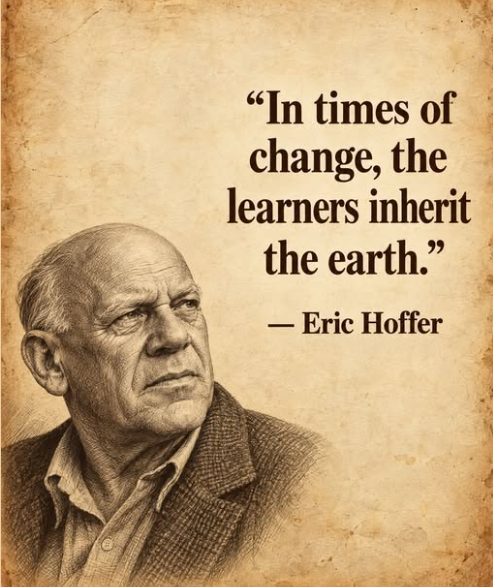 What Eric Hoffer, 20th Century American philosopher and social critic said here is interesting. But is it true? Does it have any relevance to our world today?
At this point, it doesn’t seem that the meek shall inherit the Earth. And it seems just as unlikely that the learners will have any better luck.
It looks like the world, dominated by the fairly greedy, will soon be dominated by the supremely greedy, those who really don’t care one iota about anyone but themselves–billionaires aspiring to become worth hundreds of billion dollars.
This runs counter to the norms of all societies that came before us. Never in our past have we had a civilization dominated by people who did care about their children’s future. Not even the most brutal kings and ruthless pharaohs of the past condemned future generations to dust.
https://www.2greenenergy.com/2026/10/08/whom-will-inherit-the-earth/


