

Developed nations including the UK, Norway, Canada, Australia and the EU are pushing back on a proposal at COP30 to create a just transition mechanism to bolster and unify efforts to help workers and communities adversely affected by the shift away from fossil fuels, the plan’s backers say.
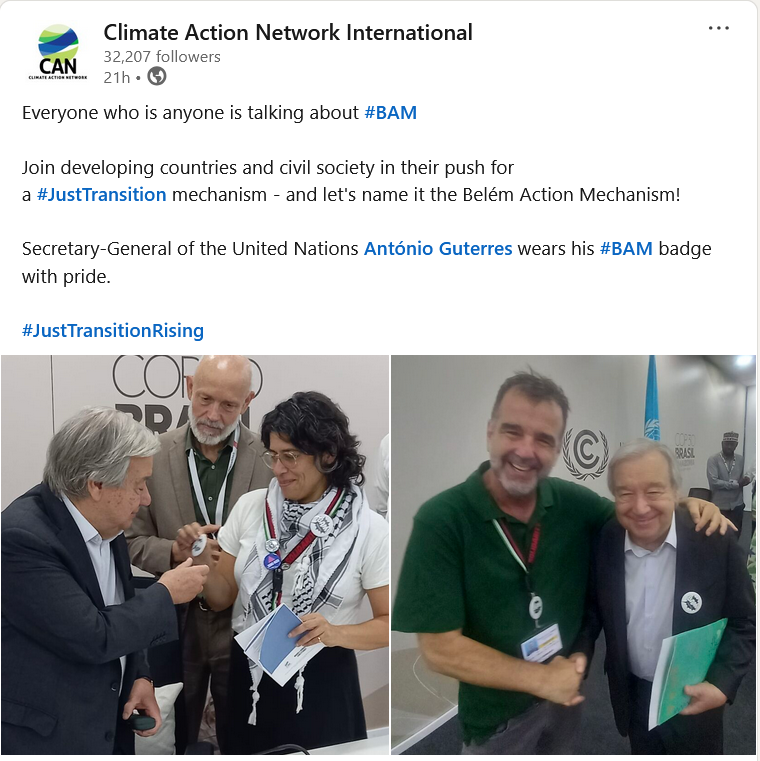
Championed by civil society activists who have dubbed it the “Belém Action Mechanism” (BAM), the proposal to establish a dedicated global facility won backing at the climate talks from the largest group of developing nations, the G77+China. Under the proposal, developing countries would receive financial and technical assistance aimed at ensuring a fair transition to clean energy.
A global green shift is expected to change the nature of employment in sectors such as coal mines, oil refineries, construction and car factories. Jobs will be lost in high-carbon industries and new ones created in clean technology supply chains, bringing both threats and opportunities for the affected workers and their families and communities.
Activists say establishing an institutional framework is vital to making sure global climate action to cut emissions does not end up leaving anyone behind.
-
As fossil fuels dominate Amazon COP, a roadmap to end deforestation falls behind
More than 40 countries are calling for a plan to implement the COP26 commitment to end deforestation by 2030, which is far off track -
Pressure builds for fossil fuel transition plan at COP30
More than 80 countries issue a call for the summit outcome to include a commitment to develop a roadmap for the world to shift away from oil, gas and coal -
“Biofuels COP” stirs debate on how to clean up cars where EVs are tricky
As Brazil and carmakers like Toyota promote biofuels to cut road transport emissions in rural areas of the Global South, some climate campaigners say electric vehicles must be the top priority


But a significant number of developed countries are “generally not being positive about the mechanism”, said Anabella Rosemberg, senior advisor on just transition at Climate Action Network International, adding that they did not see the need for a coordination unit on just transition policies.
“Basically these countries do not want any new or innovative way of bringing the just transition community together,” Rosemberg said, referring to the proposals for the mechanism aimed at facilitating global dialogue, sharing best practice and informing new policy around the world.
The draft text on the UN’s Just Transition Work Programme released on Tuesday included several alternatives to the mechanism, including an action plan and a policy toolbox to help countries advance their just transition plans and turn principles into concrete national strategies.
UN Secretary-General António Guterres welcomed the calls for the mechanism, as well as the “growing coalition asking for clarity on the transition away from fossil fuels”.
“Governments must support workers and communities still relying on coal, oil and gas with training, protection and new opportunities to go on with their lives in a positive way,” he said at COP30 on Thursday.
Sharing know-how, and financing
Supporters of the BAM proposal say just transition efforts are currently fragmented and would benefit from having an institutional mechanism to pull together funding and policymaking experiences, as well as fostering cooperation between different agencies and financial institutions working to support just transition.
“What we are trying to do with the mechanism is to really help the countries that want to put [just transition] strategies in place access much faster the capacity and the financing that is out there,” Rosemberg said.
Bert De Wel, global climate policy coordinator at the International Trade Union Confederation (ITUC), said a mechanism could help countries introduce just transition policies “with a strong focus on labour rights, trade union participation and social dialogue”.
Integrate just transition instead, says Norway
Some opponents of creating a new mechanism say just transition efforts would be better advanced by strengthening existing institutions rather than building a new one.
“This is most efficient because then the committees can start working without delay,” a spokesperson from the Norwegian Ministry for Climate and Environment told Climate Home News, adding that existing bodies under the Paris Agreement already cover most of the topics in the just transition draft decision, including finance, technology development and transfer, and capacity building
“It takes many years to develop a new mechanism,” the spokesperson said, even if countries can overcome their current differences over its potential scope and mandate. In the meantime, Norway supports developing guidance for existing bodies to better integrate just transition into their work.

“Not a fund”
The fear that a BAM could become another source of financial demands is one of the biggest concerns for the EU and developed countries, De Wel said. But while public finance is needed to roll out a just transition, he said “this doesn’t mean that these issues need to be sourced in the just transition mechanism”.
A just transition for renewables: Why COP30 must put people before power
He said the mechanism would seek to get multilateral development banks and other funders on board to make sure that money is being spent in a way that “respects labour criteria” and does not stop the Global South accessing resources that are already available.
Rosemberg said there have been questions around whether the mechanism would be a new fund but the civil society and G77 proposals clarify that the two things are not the same. “This is much more a facility for accelerating delivery of finance that already exists than a new fund,” she said.
Rosemberg said, however, that what would need to be funded is the operation of the BAM, which would cost about $10 million per year. This money would support research and the setting up of a secretariat, Kuda Manjojo of Power Shift Africa told Climate Home.
The post Rich nations push back on calls for new just transition mechanism appeared first on Climate Home News.
Rich nations push back on calls for new just transition mechanism

In recent years, the monsoon season in Pakistan has taken a new and dangerous turn.
July and August typically bring high levels of rainfall across the country, and while flooding isn’t uncommon, the extent and severity could be readily predicted.
These patterns have now changed. In 2022, extreme rainfall swept Pakistan and huge swathes of the country were under water. Sindh province experienced levels of rain 508% above average for the time of year.
Extreme weather in Pakistan is becoming the norm. The past 15 years have brought widespread flooding, loss of life and billions in financial costs. A post-disaster report, produced by the Pakistan Government, stated that the 2022 floods were “a wake-up call for systemic changes to address the underlying vulnerabilities to natural hazards”, citing the country’s lack of climate-resilient infrastructure.
But heavy rainfall is only one of the water-related issues that Pakistan faces. In a country with huge geographical diversity, from sweltering deserts to freezing mountain tops, the water stresses are equally as varied. In many regions the key concern is a lack of reliable, clean water that can be used to grow crops and feed families.
We must invest in early warning systems to tackle crises like Kenya’s drought
The risks of the Indus
The Indus River plays a critical role in Pakistan. This major artery travels almost the entire length of the country, an estimated 2,000 km, from the Himalayas to the Arabian Sea. It is a crucial economic lever, supporting nearly 90% of Pakistan’s food production and 25% of its overall GDP. What happens to this river – both human and natural impacts – has huge consequences for the rest of the country.
The government and civil society agree that urgent action is required to protect Pakistan’s fragile water resources. A new adaptation project – SAFER Pakistan – is seeking to address these concerns with solutions that can be used to solve similar climate-related issues elsewhere.
The US$ 10 million project is led by ICIMOD, an intergovernmental research centre, alongside UNICEF, and financed by the Adaptation Fund. The intention is to tackle six key issues that people face in the Indus Basin: cryosphere risks, drying springs, groundwater, pollution, unsustainable water use, and community resilience.
In practice this means exploring different solutions that put communities in control of their own adaptive capacity. One solution under development is the use of community early warning systems.
Pakistan’s ‘monster disaster’ brings climate compensation into focus
A warning sign
According to researchers, early warning systems “aim to empower affected communities against hazards and help them to sufficiently prepare before disasters strike.”
The northern provinces of Pakistan – Gilgit-Baltistan and Khyber Pakhtunkhwa – are the main focus for testing these systems. In this mountainous region the Indus is fed by thousands of glaciers which sustain water flow during the dry season. At the same time, increased temperatures and unpredictable weather patterns are changing how these glaciers behave, leading to avalanches, increased snowmelt, and landslides.
As glaciers start to melt due to climate change, they can form large lakes high up on the mountain that can pose a serious threat to the communities living below. When these natural dams fail, huge quantities of water come careening down the mountain, a phenomenon called glacial lake outburst flood.
The SAFER project is exploring how to use local knowledge and observations of the mountain to ensure people know how and when to evacuate when these outbursts occur. This human intelligence will be combined with data from remote sensors to save lives and livelihoods. In total, over 435,000 people will be impacted by the project.
“Early warning systems often serve as the backbone of a multi-faceted response to reduce climate disaster risk,” commented Mikko Ollikainen, head of the Adaptation Fund. “But local information is often just as valuable as the real-time data you receive from sensors or satellites,” he added.
Climate disasters challenge right to safe and adequate housing
Shaping an effective response
Community early warning systems – together with other preventive adaptation measures – are proving a popular solution to extreme weather events.
A separate adaptation project in the mountains of Central Asia is grappling with the same problem of glacial flooding. In this case, with US$6.5 million in funding from the Adaptation Fund, UNESCO has been implementing early warning systems across Kazakhstan, Kyrgyzstan, Tajikistan and Uzbekistan for the past five years, with considerable success.
Diana Aripkhanova, a project officer at UNESCO, and based in Kazakhstan, told Climate Home that glacier lake outburst floods “represent an increasing climate-related hazard across the high mountain regions of Central Asia”.
“These events can trigger destructive floods and debris flows that affect downstream communities, infrastructure, and livelihoods,” she added.
The project utilises real-time data drawn from weather monitoring stations with community preparedness to shape a fast and effective response to life-threatening flooding. This includes training people on evacuation routes, safe locations and simulation drills. In addition, the project has tried preventative measures such as planting hundreds of trees in valleys prone to landslides to provide greater stabilisation.
In total, four early warning systems have been installed across the four countries involved in the project covering seven high-risk areas. As a result, UNESCO estimates these systems are protecting over 100,000 people.
“Early warning systems are a key risk reduction measure, allowing communities to evacuate in time and reduce potential loss of life and damage to assets,” added Aripkhanova.
Community participation
The active role of each community is built into these interventions. Ensuring local people are core contributors is seen as crucial to building long-term climate resilience.
These communities are witnessing the threats from climate change materialise on a yearly basis, and researchers are now tapping into that understanding when implementing adaptation projects.
After the 2022 floods, Pakistan’s development minister, Ahsan Iqbal, wrote that “there is an opportunity to do things differently” and that “enhancing Pakistan’s resilience to shocks and stresses amidst climate change, especially for the poorest…is essential for the country’s future.”
The climate shocks remain as strong as ever, but using the right tools and simple solutions can soften the blow when they occur.
Adam Wentworth is a freelancer writer based in Brighton, UK
The post Early warning systems are saving lives in Central Asia appeared first on Climate Home News.
From the Amazon to the Mekong, migratory freshwater fish underpin food security for millions, but over 300 species need urgent conservation intervention, warns a new UN report.
Beneath the surface of the planet’s rivers and lakes, the historically heaving migrations of freshwater fish are thinning out. The blubbery-lipped Siamese giant carp of Asia’s Mekong River, the mottled brown goonch of India’s Ganges and the ancient-in-appearance beluga sturgeon of Europe’s Danube River are declining.
Climate Change
Border Communities Remain in the Dark About Federal Government’s Billion-Dollar Buoy Project
The industrial-grade buoys, already being installed in Brownsville, Texas, are meant to prevent unauthorized crossings. But experts warn the buoys could intensify flooding and change the river’s course.
Reporting supported by the Water Desk at the University of Colorado, Boulder.
Border Communities Remain in the Dark About Federal Government’s Billion-Dollar Buoy Project

From Oversupply to Opportunity: AEMC’s Nickel Upside in a Tightening Market

All This Changed When Trump Came Along

Take a Cool Guess—The Fun Quiz on Renewable Energy and Environmental Sustainability. Today’s Topic: World’s Happiest Countries
-
Climate Change7 months ago
Guest post: Why China is still building new coal – and when it might stop
-
Greenhouse Gases7 months ago
Guest post: Why China is still building new coal – and when it might stop
-

 Greenhouse Gases2 years ago
嘉宾来稿:满足中国增长的用电需求 光伏加储能“比新建煤电更实惠”
-
Climate Change2 years ago
Bill Discounting Climate Change in Florida’s Energy Policy Awaits DeSantis’ Approval
-

 Climate Change2 years ago
嘉宾来稿:满足中国增长的用电需求 光伏加储能“比新建煤电更实惠”
-
Climate Change Videos2 years ago
The toxic gas flares fuelling Nigeria’s climate change – BBC News
-

 Carbon Footprint2 years ago
US SEC’s Climate Disclosure Rules Spur Renewed Interest in Carbon Credits
-

 Renewable Energy5 months ago
Sending Progressive Philanthropist George Soros to Prison?