As negotiations on a Belém “Mutirão” decision dragged on beyond the Wednesday deadline the COP30 presidency had targeted, UN chief António Guterres called on governments to agree a balanced political package that would require compromise and courage.
Such a package should be “concrete on funding adaptation, credible on emissions cuts, bankable on finance”, he told journalists on Thursday morning.
He rallied behind a demand from the world’s poorest countries to triple finance to help them adapt to more extreme weather and rising seas to $120 billion by 2030.
He noted that communities on the frontlines are watching the UN summit – “counting flooded homes, failed harvests, lost livelihoods and asking ‘how much more must we suffer?’” “They have heard enough excuses, they demand results,” he added.
COP30 Bulletin Day 9: Belém package elusive as Lula steals the show
He warned that an “inevitable” temporary overshoot of the 1.5C warming limit in the Paris Agreement means “more heat and hunger, more disasters and displacements”.
“For millions, adaptation is not an abstract goal,” the Portuguese official insisted. “It is the difference between rebuilding and being swept away, between replanting and starving, between staying on ancestral lands or losing it forever.”
Adaptation needs are “skyrocketing and the overshoot will push them even higher”, he added. Despite this, developed countries’ commitment to double adaptation finance to at least $40 billion by this year “is slipping away”, he warned.
Poorest countries appeal for more adaptation finance at COP30
The latest estimate of developing countries’ annual climate adaptation needs for 2035 outstrips current funding by at least 12 times, with rich nations providing just $26 billion in 2023, according to the annual UN Adaptation Gap Report.
If current trends continue, developed countries are set to miss the 2025 target that they committed to at COP26 four years ago, UNEP’s report said.
“So tripling adaptation finance by 2030 is essential,” Guterres said, adding that it is also “possible and desirable” and he hoped developed countries would “accept to engage in this objective” at COP30 if their concerns on emissions reductions are addressed.
He noted that a new fund to help countries recover from loss and damage is practically empty and called for it to be capitalised. During COP30, the fund has received tiny pledges totalling less than $16 million from Iceland, Japan and Luxembourg. It has now secured combined promises of nearly $800 million but only around half of that is in the bank.
Guterres urged funders, including wealthy governments, climate funds and development banks “to step up and prevent further tragedies”. “It’s about survival, it’s about justice – and for Indigenous peoples, it is also about protecting cultures and homelands that sustain our planet’s vital ecosystems,” he added.
To ramp up emissions-cutting efforts and bring warming back down to 1.5C, he said countries’ national climate plans (NDCs) should be the “floor not the ceiling”, with the responsibility on big emitters to do more.
He did not explicitly back a roadmap to transition away from fossil fuels, as more than 80 countries are pushing for at the talks, but said governments should implement the energy shift they signed up to at COP28 and ensure it is done in a fair way.
Asked if he wanted the US to return to the UN climate process, which climate-change denier President Donald Trump has abandoned, Guterres said “we are waiting for you”, quipping “hope is the last thing that dies”.
Germany pledges €1 billion to TFFF forest fund
Germany has joined a handful of countries pledging money to the Tropical Forest Forever Facility (TFFF), but the conservation mechanism launched by Brazilian President Luiz Inácio Lula da Silva ahead of COP30 is still far short of the $25 billion in public funds it aims to secure.
Following talks between government ministers and Lula yesterday, Germany said it would contribute one billion euros ($1.1 billion) over the next 10 years, praising the “innovative approach” of the investment-driven multilateral fund proposed by Brazil.
The TFFF is a blended finance instrument that will invest in financial markets and pay a share of any returns to tropical countries that are protecting their rainforests. At least 20% of all payments must be allocated to Indigenous people and local communities. Read this Climate Home News explainer for more details of how the fund works.

“It’s about protecting the tropical rainforests, the lungs of our planet,” a statement by Germany’s development and environment ministers said after Wednesday’s meeting.
At a press conference this Thursday, German environment minister said the country will disburse $100 million every year over a decade in the form of a grant, which experts said could allow for larger payouts to forest countries since the fund wouldn’t have to pay interest. The money would come from the country’s foreign aid budget.
Germany’s promise of support follows a Norwegian pledge of 3 billion euros over the coming decade – which are conditional to other donors also contributing money to the fund, while Brazil and Indonesia have pledged $1 billion each, with Colombia offering $250 million. France has also said it will consider contributing 500 million euros over the next five years.
But campaigners were critical of the German contribution, as the world’s third-largest economy has pledged about the same amount as Brazil and Indonesia. A group of German NGOs sent a letter to government officials requesting the country to pledge at least $2.5 billion for the TFFF.
“That the German government is investing in the TFFF is important and the right thing to do. Nevertheless, the investment amount of one billion euros is a disappointment,” said Felix Finkbeiner, founder of Germany-based conservation NGO Plant-for-the-Planet.
Florian Titze, WWF-Germany Head of International Policy, also said the sum was “disappointing”, given that Chancellor Frierich Merz told world leaders at COP30 that the country would pledge a “considerable” amount. “The federal government should now successively increase the German amount and distribute it over the next few years.”
The total pledged so far to the TFFF amounts to roughly $7 billion. However, experts noted that, because Norway’s pledge is conditional and doesn’t count toward the $10bn target set by the Brazilians at COP30, the fund has been left with about a $6bn shortfall.
British climate minister Ed Miliband said on Monday the UK government was keeping “the option of an investment under review”.
Talks have also been held with China, the United Arab Emirates, Australia, Japan and Canada, Brazilian TFFF official João Paulo de Resende told Climate Home News last month. None of those countries have so far announced pledges
De Resende said securing political support was more important at this stage than funding promises, which can come later.
-
COP30 Bulletin Day 7: Brazil sets out options to agree a Belém package
The COP30 presidency signposts how governments could land a political decision covering climate finance, trade measures and the emissions cuts needed to limit warming to 1.5C -
COP30 Bulletin Day 8: Draft decision draws battle lines on fossil fuel transition, finance and trade
Countries are working on a “Mutirão” decision that will be at the heart of a Belém political package to drive forward multilateral climate action -
COP30 Bulletin Day 9: Belém package elusive as Lula steals the show
After spending the day in high-level meetings at COP30, Brazil’s president says rich nations need to help poor ones on climate action, while a planned early deal is yet to emerge


Roman ruins and lots of hotels – Türkiye’s pitch to host COP31
Outlining their ultimately successful bid to host COP31, Turkish officials pitched the country as a lower-emissions choice due to its location at the crossroads of Europe and Asia, and played up the rich cultural heritage and top-level tourist facilities of the resort city of Antalya.
Australian Minister for Climate Change and Energy Chris Bowen announced last night that his country was ceding the summit’s hosting rights to Türkiye, though Australia – which had greater support for its candidacy – will lead the negotiations.
Türkiye’s pitch for the talks to be held in Antalya, made in a presentation to delegates at the Bonn climate talks in June, promised to deliver a “zero-waste COP”, with a strong focus on heritage sites such as nearby Roman ruins and a shrine to Saint Nicholas of Myra, the inspiration for Santa Claus. The presentation’s slides also praised the Mediterranean city’s food and golf courses.
Turkish officials argued that a COP held in Antalya would have a smaller carbon footprint than Australia’s proposal of Adelaide due to its central geographical location, and also sought to emphasise the city’s urban transport network as well as its strong local logistics and supply chain.

Antalya, which is a similar size to Belém, with a population of roughly 1.5 million people, is popular with European and Russian sun-seekers in summer. By November, when the COP will be held, temperatures will have dropped to highs of about 21C (70F). That means COP delegates won’t have to compete with as many tourists for the 628,000 beds that the Turkish government says the city has to offer – far more than Belém.
But at a time of worries about democratic backsliding in Türkiye, hosting COP31 in Antalya may draw concerns.
Mahir Ilgaz, a Turkish regional programme director at Oil Change International, voiced concern about the decision, noting in a social media post that elected mayors – including Antalya’s – have been replaced by government-appointed trustees.
“Colleagues working on local engagement are already wondering how to operate safely and meaningfully in that context”, he wrote on LinkedIn.
Meanwhile, a former Turkish climate diplomat told Climate Home News that they were disappointed Turkiye would not hold the presidency.
“We bear the burden, but they hold the power. We have the drum but they hold the drumstick. We do the work but they make the decisions,” the official said.

The post COP30 Bulletin Day 10: UN chief backs call to triple adaptation finance appeared first on Climate Home News.
COP30 Bulletin Day 10: Talks disrupted as fire causes evacuation

When oil and gas shipments stopped flowing through the Strait of Hormuz at the start of the Iran war, Southeast Asian nations were left reeling as the supply crunch laid bare their acute reliance on fossil fuel imports.
As prices soared, governments in the region scrambled to introduce emergency energy-saving measures – from a four-day working week to curbs on air conditioning. Thailand revived decommissioned coal plants while the Philippines, which imports nearly all of its oil, declared a “national energy emergency”.
But the crisis has also prompted renewed resolve to find a long-term solution to their vulnerability at a time when electricity demand is booming to power the region’s growing industry, cooling needs and the mushrooming of energy-hungry data centres.
At the heart of Southeast Asian nations’ response is a longstanding infrastructure project to connect the region’s power grids by 2045 and enable cross-border trading of clean electricity through a network of underground and subsea interconnectors.
-
Southeast Asia’s fragile grids threaten billions in clean energy investment
Renewables developers need reliable electricity infrastructure and stable policies to help the region meet climate goals and surging demand for power -
UN backs push to upgrade grids slowing clean power uptake in Africa and SE Asia
The Global Grids Accelerator will help turn national and regional plans to expand electricity infrastructure into viable projects on the ground -
China keeps Indonesia’s battery dream afloat but future less certain
Chinese capital and technology turned Indonesia into the world’s top nickel supplier, but its dependence on China and the rise of nickel-free batteries could upset its battery ecosystem plans
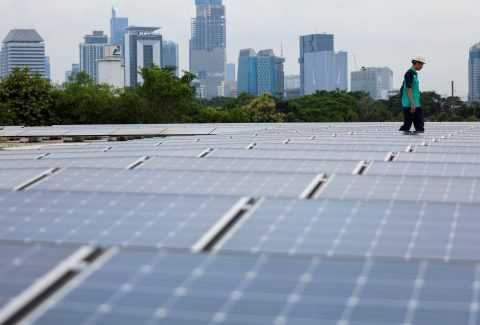
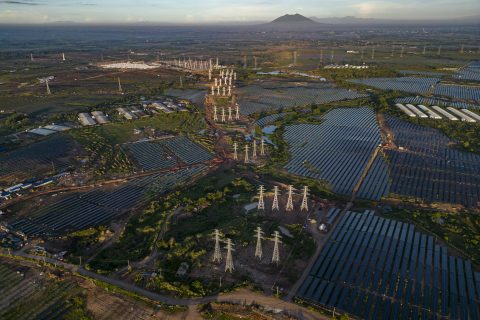
The plans will allow nations with high renewable energy generation potential to trade surplus power to their neighbours and major demand centres like Singapore, helping to integrate more renewables into the power mix and reduce reliance on fossil fuel imports.
“[It] will give us more energy security,” the Philippines’ energy secretary, Sharon Garin, told a press conference after a meeting of the Association of Southeast Asian Nations’ (ASEAN) energy ministers last week, when they discussed accelerating the delivery of the regional grid as part of measures to respond to the energy crisis.
“The Philippines is rich in solar power, Malaysia is rich in hydropower and Indonesia has geothermal: different countries have different resources. [The ASEAN Power Grid] will optimise the utilisation of renewables to the benefits of each member state,” said Garin.
But turning this decade-old political vision into a reality has been slow, held up by painstaking work to harmonise a patchwork of regulatory and legal frameworks and mobilise the private capital needed to build cross-border infrastructure.
More than $300 billion is needed to expand and modernise the region’s fragile grids to support the projected energy demand increase by 2050. This includes $27 billion required to deliver the cross-border interconnections by 2040, according to the International Energy Agency (IEA).
Every year of delay could cost the region billions of dollars in additional fuel costs and lock in new gas infrastructure for decades to come, according to analysis by global energy think-tank Ember.
The building block for energy security
With electrification high on the agenda of the COP31 climate talks in Türkiye next month, there is growing attention on the need to modernise and expand grid infrastructure to cope with growing electricity use and more renewables in the power mix.
Clean electrification and energy efficiency could deliver about a third of cumulative carbon emission reductions between 2026 and 2050, according to the International Renewable Energy Agency’s World Energy Outlook. But delivering that would require doubling annual global grid investment to $1 trillion between now and 2035.
Last month, the UN launched an initiative to accelerate investment into expanding and modernising grids in Southeast Asia and Africa.
First conceptualised in 1997, the ASEAN Power Grid has gained fresh impetus in recent years as countries turn to renewables to cut their emissions and move away from volatile fossil fuel markets.
Energy supply disruption caused by wars in Ukraine and the Middle East has strengthened the case for regional grid connections. Before this year’s conflict began, the Middle East accounted for 60% of Southeast Asia’s crude oil imports. Competition for fewer, more expensive oil and gas shipments has left Southeast Asia facing a $160 billion energy import bill this year. Based on current policies, this could rise to $400 billion by mid-century.
In the Philippines last week, energy ministers agreed on an enhanced planning framework to deliver the ASEAN Power Grid and made progress on regulatory guidelines.
Garin said ministers were considering accelerating the project’s delivery. “The first study was to connect [by] 2045 – that’s too far,” she said.
A strong business case
The economic benefits of the plan have “captured the political imagination” of leaders in the region, Robert Cooke, grids advocacy lead at the Global Renewables Alliance, told Climate Home News. “The business case is stronger than ever,” he said.
“If countries were to go about building their own separate grids, of course that would be an expensive endeavour. But the discussion around the ASEAN Power Grid includes what costs could we share in building out this grid,” added Tiza Mafira, director of the Indonesia office for the Climate Policy Initiative.
Stronger grids would help the region meet collective targets to increase the share of renewable energy in total primary energy supply from 14% to 30% and in installed power capacity from 34% to 45% by 2030.
Connecting and pooling dispersed renewable resources would also help smooth local power shortages caused by daily and seasonal variations, reducing the need for backup gas plants and battery storage.
The IEA found the ASEAN Power Grid could help unlock some of the 20 terawatts of untapped solar and wind potential across Southeast Asia – an amount around 55 times the region’s current total power capacity.
From lines on a map to shovels in the ground
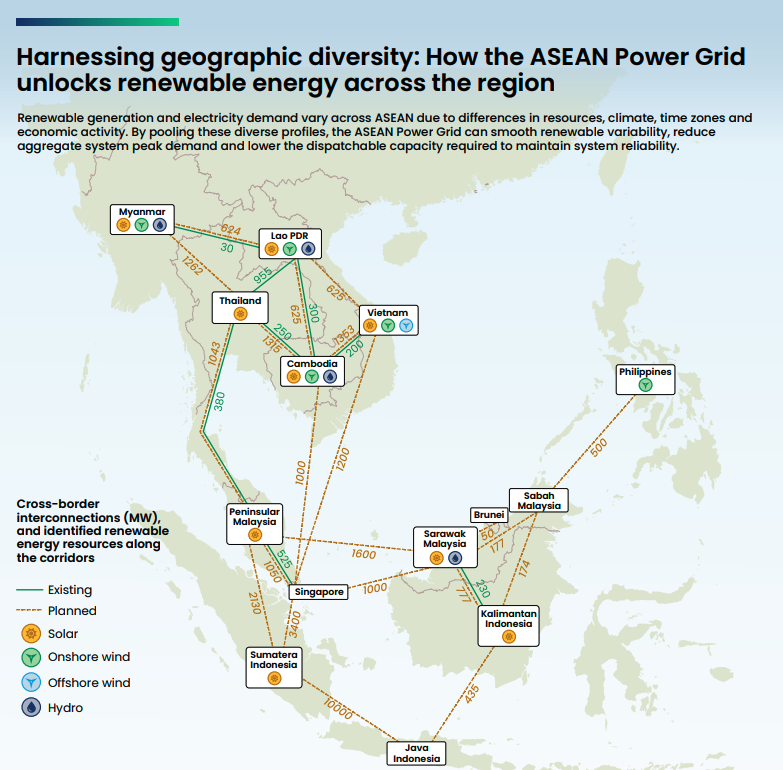
Rather than building a single unified network, the ASEAN Power Grid is developing cross-border links between neighbouring countries and smaller groups of nations.
As of 2025, nine of 18 priority interconnection projects are operational – accounting for around 10 GW of capacity with an additional 13.7 GW planned by 2040.
Source: Ember
A power line channelling up to 200 MW of clean electricity generated from hydropower in Laos to Singapore via Thailand and Malaysia has emerged as a key building block for grid-to-grid trading.
Progress on technical discussions will also help provide the clarity the private sector needs to invest in bankable projects, said Cooke.
In 2025, the Asian Development Bank and the World Bank announced a dedicated funding initiative to support the project.
“The enabling pieces are emerging,” said Monalisa Dimalanta, former chair of the Philippine Energy Regulatory Commission and the National Renewable Energy Board. “But the timelines remain unclear and a 2045 vision cannot answer today’s emergency,” she said.
“A power grid… that exists only on paper will not keep the lights on.”
Singapore: the delivery test
The implications of failing to deliver the ASEAN Power Grid are most acute in Singapore.
Constrained by space, with few renewable energy resources and dependent on gas for more than 90% of its electricity mix, Singapore has emerged as a leading proponent of a regional power grid as it seeks to achieve net-zero emissions by 2050.
To meet its power needs, the city-state aims to import 6 GW of low-carbon electricity by 2035, around one-third of its energy demand – a target which it is set to miss, however.
The plans heavily rely on building interconnectors to import solar power from Indonesia across the South China Sea. Around 40% of the ASEAN Power Grid’s planned interconnections are directed towards Singapore.