

Más de la mitad de los países no se han comprometido a proteger el 30% de sus tierras y mares para 2030 en sus planes de biodiversidad presentados a la ONU, a pesar de que hace menos de tres años firmaron un acuerdo global para hacerlo, según revela una investigación de Carbon Brief y the Guardian.
En diciembre de 2022, casi todas las naciones acordaron proteger “el 30% de la tierra y el mar de la Tierra por la naturaleza” a finales de la década. Este compromiso, denominado “30×30”, es el objetivo principal del Marco Mundial de Biodiversidad de Kunming-Montreal (MMB), a menudo comparado con el “Acuerdo de París para la naturaleza”.
Sin embargo, 70 de los 137 países (51%) que han presentado planes a la ONU en los que describen cómo cumplirán los objetivos del MMB no se comprometen a cumplir la meta “30×30” dentro de sus fronteras, según el análisis de estos documentos realizado por Carbon Brief y the Guardian.
Dentro de estos países, hay unos que se comprometen a proteger un porcentaje menor de su territorio para la naturaleza y otros que no se comprometen explícitamente a alcanzar un objetivo numérico.
El análisis muestra que los países que no se han comprometido a la meta “30×30” en sus planes de la ONU representan poco más de un tercio de la superficie terrestre.
La lista incluye algunas de las naciones con mayor riqueza natural del planeta, como Indonesia, Perú y Sudáfrica, además de países desarrollados como Finlandia, Noruega y Suiza.
En declaraciones para Carbon Brief y the Guardian, una nación dijo que cumplir con la meta “30×30” dentro de sus fronteras sería “extremadamente difícil” de lograr, mientras que otra dijo que los países en desarrollo, en particular, no deberían enfrentarse a una “carga innecesariamente pesada” para alcanzar la meta global.
La investigación muestra que “muchos países no han sido lo suficientemente ambiciosos con sus compromisos nacionales de conservación y, como resultado, actualmente no estamos en camino de alcanzar colectivamente la meta global de 30×30”, dijo un experto.
Un tercio de la Tierra
En la cumbre sobre la naturaleza COP15, realizada en 2022, los países acordaron el Marco Mundial de Biodiversidad Kunming-Montreal (MMB), un amplio conjunto de objetivos y metas con el propósito general de detener y revertir la pérdida de biodiversidad para 2030.
La meta 3 del MMB, que establece que los países deben garantizar que “al menos” el 30% de la Tierra esté en áreas protegidas o regida por otras medidas de conservación para 2030 “30×30”, es considerado por muchos como el objetivo insignia del acuerdo y se ha comparado con el objetivo de temperatura de 1.5°C del Acuerdo de París en artículos de prensa y discursos que subrayan su importancia.
Se pidió a todos los países que enviaran sus planes al Convenio de las Naciones Unidas sobre la Diversidad Biológica en los que se describiera cómo cumplirían los objetivos del MMB en sus territorios antes de la cumbre de la naturaleza COP16 en 2024. Dichos planes se conocen como estrategias y planes de acción nacionales en materia de diversidad biológica, o “EPANDB“.
Una investigación independiente de Carbon Brief y the Guardian realizada el pasado mes de octubre reveló que el 85% de los países no cumplieron el plazo para presentar sus EPANDB, y algunos argumentaron que el plazo era demasiado complicado o que no pudieron acceder a fondos para ayudar a preparar sus documentos.
A los países que no pudieron presentar sus EPANDB se les pidió que, en su lugar, presentaran objetivos nacionales a la ONU. Se trata de simples listas de metas que los países intentarán alcanzar sin un plan de acción que los acompañe.
Para el 24 de febrero de 2025, 44 países y la UE habían presentado sus EPANDB a la ONU, mientras que 124 partes habían presentado metas nacionales. (Dado que algunos países enviaron objetivos nacionales y EPANDB, esto significa que, en total, 137 países han presentado algún tipo de plan).
Para investigar si los países se han comprometido con la promesa “30×30” dentro de los límites de sus planes, Carbon Brief y the Guardian analizaron el texto completo de cada EPANDB, así como cualquier objetivo que fuera etiquetado como relacionado con la meta 3 del MMB.
El análisis revela que, de los 137 países que han enviado planes al CDB, más de la mitad (70 países, es decir, el 51%) no se comprometen a proteger el 30% de sus tierras y mares para 2030.
De estos, 21 países no proporcionaron un objetivo numérico para proteger su superficie terrestre, 26 establecieron objetivos de protección de la tierra inferiores al 30% y ocho establecieron objetivos de protección de la tierra iguales o superiores al 30%, pero objetivos de protección del mar inferiores al 30%.
De los países restantes, 13 no presentaron ningún objetivo relacionado con la cobertura de las áreas protegidas. Otros dos establecieron objetivos más allá de 2030.
Otros 10 países, es decir, el 7%, no dejan claro en los planes que presentaron si tienen o no un compromiso que cumpla las condiciones de “30×30”. Entre ellos se encuentran: países que especifican que protegerán el 30% de las “zonas de especial importancia”; países que dieron un objetivo de mejora, pero no proporcionaron una base de referencia; y países que entregaron solo una o dos metas.
Solo el 42% de los países (57 en total) se comprometen a proteger el 30% de la superficie terrestre y marina para 2030.
La siguiente gráfica muestra los países que han entregado sus EPANDB y/o metas nacionales a la ONU. En la gráfica, los países están agrupados según el porcentaje de tierra que se han comprometido a proteger y el tamaño de cada burbuja representa su superficie terrestre. (Los países agrupados alrededor de la línea del 30% y marcados en gris se han comprometido a proteger el 30% de la superficie terrestre).
Los países agrupados debajo de “sin objetivo” son aquellos que no se han comprometido a una meta numérica para proteger su tierra o aquellos que han elaborado un plan, pero no han incluido una meta de área protegida.
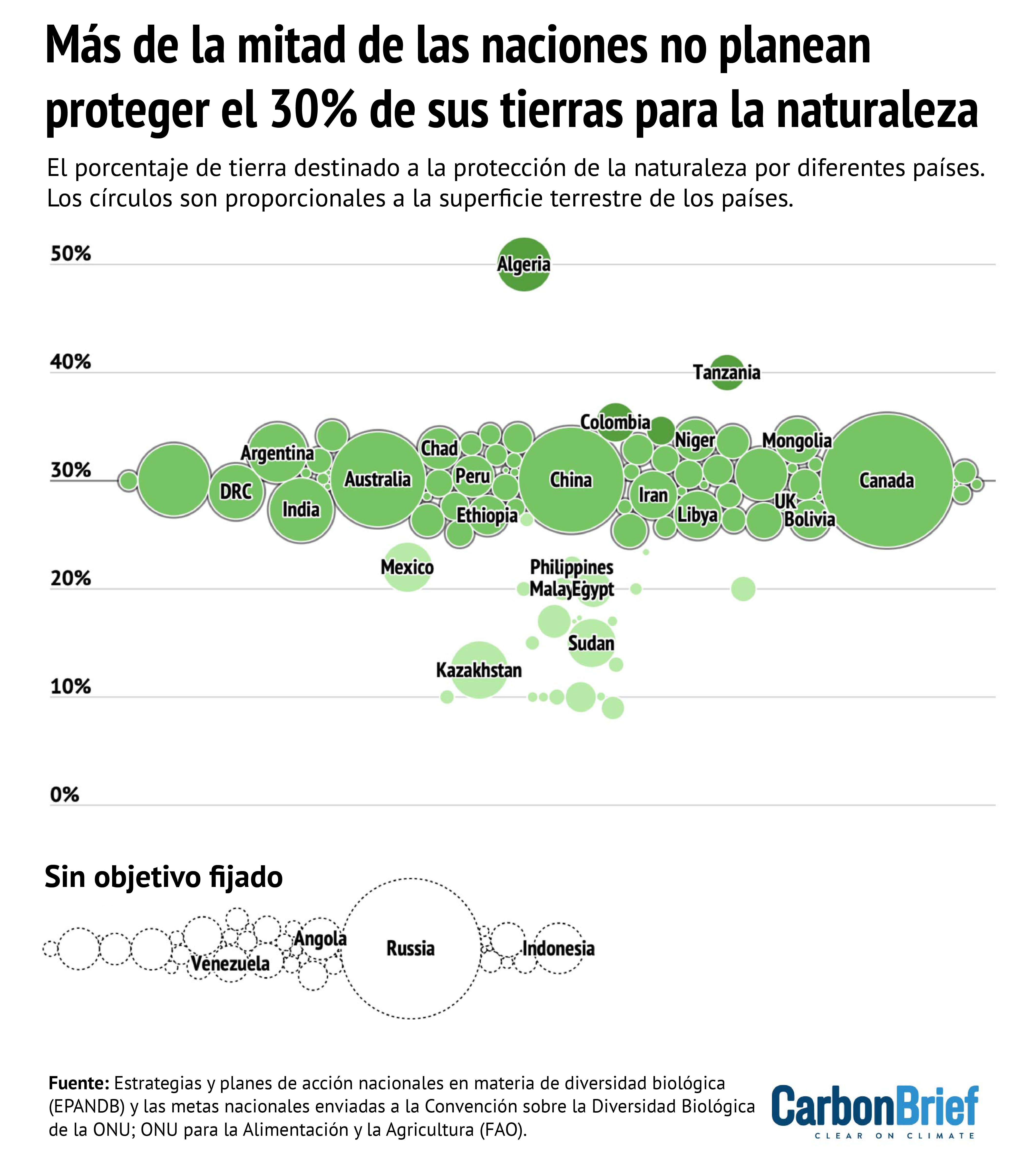
El análisis muestra que, en conjunto, más de un tercio de la superficie terrestre está cubierta por un compromiso que no cumple la meta “30×30”, mientras que alrededor de la mitad está cubierta por un compromiso “30×30”.
El análisis también revela que siete de los 17 países “megadiversos“, que en conjunto albergan el 70% de la biodiversidad mundial, no se han comprometido con la iniciativa 30×30. Entre ellos se encuentran Indonesia, Malasia, México, Perú, Filipinas, Sudáfrica y Venezuela.
Otros 61 países no han presentado una EPANDB ni metas nacionales, por lo que no se han evaluado en el análisis. Entre ellos se encuentra la nación con mayor biodiversidad del mundo, Brasil.
Las cifras tampoco incluyen a EE. UU., que, aunque es un país megadiverso, no forma parte del CDB y, por lo tanto, no está sujeto a los objetivos y metas del MMB.
El expresidente de EE. UU. Joe Biden comprometió a su país con el compromiso “30×30”. Sin embargo, el plan de políticas Proyecto 2025, que Donald Trump está siguiendo en gran medida, pide que se elimine el objetivo.
La UE entregó una EPANDB que abarca sus 27 Estados miembros y se compromete con el 30×30.
Sin embargo, los países individuales también son parte del CDB y se espera que entreguen sus propios planes nacionales. Para el propósito de este análisis, se consideró que los Estados miembros de la UE cumplían con el compromiso “30×30” solo si presentaban su propia EPANDB o su objetivo nacional que lo hiciera.
‘Extremadamente desafiante’
Carbon Brief y the Guardian contactaron a países megadiversos y naciones desarrolladas para preguntarles por qué habían optado por no comprometerse con el “30×30” en sus planes de la ONU.
Indonesia, un país megadiverso que alberga la tercera selva tropical más grande del mundo, no dio una meta numérica sobre la cantidad de su territorio que puede proteger para la naturaleza en su EPANDB.
Un portavoz del gobierno afirma que Indonesia considera que “no es esencial declarar explícitamente que el objetivo de protección del 30% es para las áreas terrestres y marinas” de su territorio, y explica:
“Indonesia considera que todos debemos entender que el Marco Mundial de la Diversidad Biológica es realmente global. Y, al ser global, es natural que este marco se aplique de forma global y colectiva, sin imponer una carga innecesariamente pesada a algunos de nosotros.
“Indonesia se ha comprometido a alcanzar objetivos ambiciosos pero prácticos para el MMB, haciendo hincapié en el hecho de que no todas las partes están al mismo nivel si los objetivos se evalúan numéricamente”.
El portavoz añade que “gestionar la biodiversidad no es una tarea fácil” y que “se debe mantener el equilibrio de los aspectos económicos, sociales y medioambientales, especialmente en países en desarrollo como Indonesia”.
En su Estrategia y Plan de Acción Nacional sobre la Diversidad Biológica, México, una nación megadiversa, se compromete a proteger el 30% de sus océanos, pero solo el 22% de su tierra.
La Dra. Andrea Cruz Angón, coordinadora de estrategias y políticas de biodiversidad de la Conabio, la comisión de biodiversidad del gobierno federal, afirma que las metas aún están “siendo revisadas y ajustadas” por las agencias federales correspondientes.
Añade que los objetivos se elaboraron tras la celebración de talleres “con gobiernos subnacionales, jóvenes, pueblos indígenas y comunidades afromexicanas” para identificar “barreras y oportunidades para que estos actores se comprometan voluntariamente con los objetivos”.
Finlandia, uno de los estados miembros de la UE, aún no ha publicado una EPANDB, pero en agosto de 2024 presentó a la ONU sus metas nacionales para cumplir los objetivos del MMB. En estos planes, Finlandia no se compromete con el “30×30”.
Un portavoz del gobierno finlandés dice que todavía estaba preparando su EPANDB y que, por lo tanto, ninguno de sus objetivos es definitivo, pero añade:
“Lograr un aumento del 30% en el área protegida para 2030 sería extremadamente difícil, ya que para alcanzar esta meta, por ejemplo, el área protegida en las zonas terrestres tendría que aumentar unas 700,000 hectáreas al año”.
En su Estrategia Nacional de Biodiversidad, Noruega se comprometió a proteger el 30% de su territorio para la naturaleza para 2030, pero afirma que todavía está evaluando su meta de protección de los océanos y “volverá con un plan sobre cómo lograr un objetivo futuro de manera que también facilite el uso sostenible de las zonas marinas noruegas”.
Un portavoz de Noruega afirma que la nación está “comprometida a contribuir al objetivo 30×30”, y añade:
“Aún no se ha establecido una meta nacional de conservación para las zonas marinas noruegas. Esto se debe a un proceso nacional en curso para evaluar qué zonas marinas pueden ser reconocidas como protegidas a través de ‘otras medidas efectivas de conservación basadas en áreas’ (OECM), de acuerdo con los criterios [de biodiversidad de la ONU].
“La conclusión de este proceso aclarará el estado actual de conservación de las aguas noruegas y, en consecuencia, nos permitirá establecer una meta nacional”.
‘Volver a empezar’
Inger Andersen, directora ejecutiva del Programa de las Naciones Unidas para el Medio Ambiente, declara a Carbon Brief y the Guardian que “30×30” es una “meta global y la forma en que los países lo asuman a nivel nacional será diferente en todo el mundo, dependiendo de las circunstancias nacionales”.
Ella refiere el Informe Planeta Protegido 2024, que muestra que solo el 17.6% de la tierra y el 8.4% del océano se conservan actualmente para la naturaleza, a solo cinco años de llegar al plazo de “30×30”, y añade:
“A medida que el mundo se enfrenta a una crisis de pérdida de naturaleza y biodiversidad, está claro que debemos ir mucho más lejos, mucho más rápido. Esto no será posible sin apoyo financiero, técnico y de capacidad para muchos países”.
En respuesta a la investigación de Carbon Brief y the Guardian, Brian O’Donnell, director de la Campaign for Nature, un grupo que aboga por la meta 30×30, dice:
“Muchos países no han sido lo suficientemente ambiciosos con sus compromisos nacionales de conservación y, como resultado, actualmente no estamos en vías de cumplir colectivamente la meta global de “30×30”. Esto es preocupante y hay que tomar medidas para poner al mundo en buen camino”.
Para encaminarse hacia el “30×30”, los países desarrollados deben “financiar directamente” la meta para permitir que los países en desarrollo protejan más de sus territorios para la naturaleza, dice, y añade que el compromiso “30×30” también debe ser defendido a un nivel superior por los líderes mundiales y la ONU.
Añade que los países que no se comprometan con “30×30” en sus planes de la ONU “deberían volver a empezar y actualizar sus planes con otros en los que la conservación esté a la altura del desafío de la pérdida de biodiversidad y las necesidades de las comunidades”.
El análisis completo de Carbon Brief y the Guardian puede encontrarse aquí.



The post Revelado: Más de la mitad de las naciones no protegen el 30% de la tierra y el mar en sus planes de biodiversidad de la ONU appeared first on Carbon Brief.

Drought and heatwaves occurring together – known as “compound” events – have “surged” across the world since the early 2000s, a new study shows.
Compound drought and heat events (CDHEs) can have devastating effects, creating the ideal conditions for intense wildfires, such as Australia’s “Black Summer” of 2019-20 where bushfires burned 24m hectares and killed 33 people.
The research, published in Science Advances, finds that the increase in CDHEs is predominantly being driven by events that start with a heatwave.
The global area affected by such “heatwave-led” compound events has more than doubled between 1980-2001 and 2002-23, the study says.
The rapid increase in these events over the last 23 years cannot be explained solely by global warming, the authors note.
Since the late 1990s, feedbacks between the land and the atmosphere have become stronger, making heatwaves more likely to trigger drought conditions, they explain.
One of the study authors tells Carbon Brief that societies must pay greater attention to compound events, which can “cause severe impacts on ecosystems, agriculture and society”.
Compound events
CDHEs are extreme weather events where drought and heatwave conditions occur simultaneously – or shortly after each other – in the same region.
These events are often triggered by large-scale weather patterns, such as “blocking” highs, which can produce “prolonged” hot and dry conditions, according to the study.
Prof Sang-Wook Yeh is one of the study authors and a professor at the Ewha Womans University in South Korea. He tells Carbon Brief:
“When heatwaves and droughts occur together, the two hazards reinforce each other through land-atmosphere interactions. This amplifies surface heating and soil moisture deficits, making compound events more intense and damaging than single hazards.”
CDHEs can begin with either a heatwave or a drought.
The sequence of these extremes is important, the study says, as they have different drivers and impacts.
For example, in a CDHE where the heatwave was the precursor, increased direct sunshine causes more moisture loss from soils and plants, leading to a drought.
Conversely, in an event where the drought was the precursor, the lack of soil moisture means that less of the sun’s energy goes into evaporation and more goes into warming the Earth’s surface. This produces favourable conditions for heatwaves.
The study shows that the majority of CDHEs globally start out as a drought.
In recent years, there has been increasing focus on these events due to the devastating impact they have on agriculture, ecosystems and public health.
In Russia in the summer of 2010, a compound drought-heatwave event – and the associated wildfires – caused the death of nearly 55,000 people, the study notes.

The record-breaking Pacific north-west “heat dome” in 2021 triggered extreme drought conditions that caused “significant declines” in wheat yields, as well as in barley, canola and fruit production in British Columbia and Alberta, Canada, says the study.
Increasing events
To assess how CDHEs are changing, the researchers use daily reanalysis data to identify droughts and heatwaves events. (Reanalysis data combines past observations with climate models to create a historical climate record.) Then, using an algorithm, they analyse how these events overlap in both time and space.
The study covers the period from 1980 to 2023 and the world’s land surface, excluding polar regions where CDHEs are rare.
The research finds that the area of land affected by CDHEs has “increased substantially” since the early 2000s.
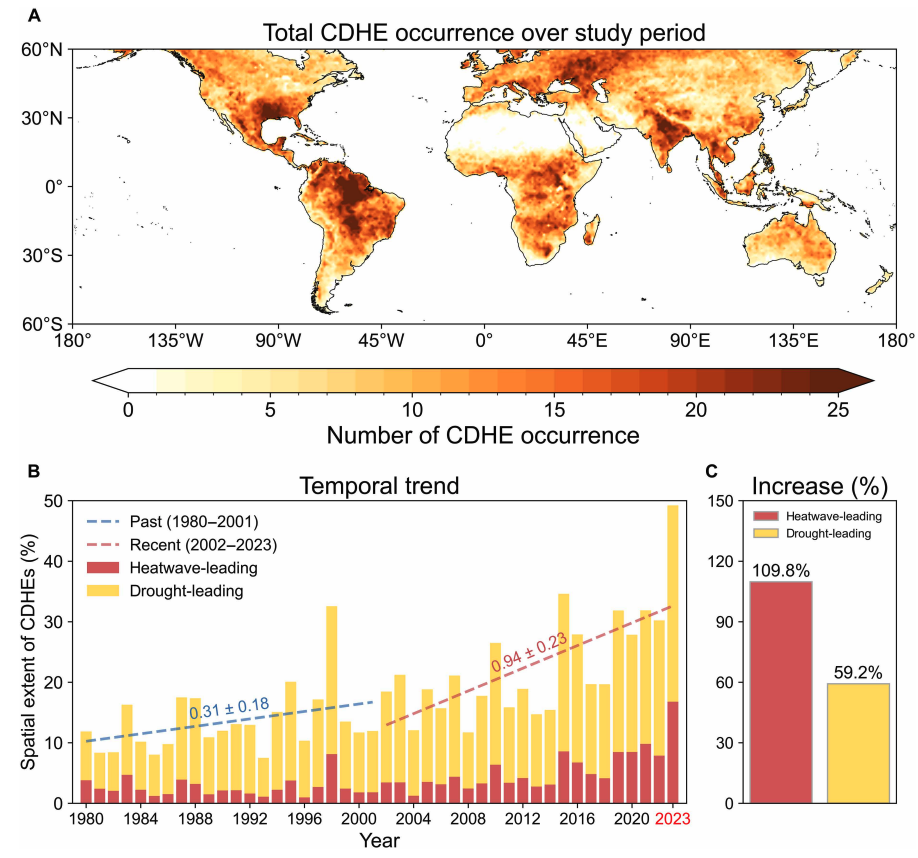
Heatwave-led events have been the main contributor to this increase, the study says, with their spatial extent rising 110% between 1980-2001 and 2002-23, compared to a 59% increase for drought-led events.
The map below shows the global distribution of CDHEs over 1980-2023. The charts show the percentage of the land surface affected by a heatwave-led CDHE (red) or a drought-led CDHE (yellow) in a given year (left) and relative increase in each CDHE type (right).
The study finds that CDHEs have occurred most frequently in northern South America, the southern US, eastern Europe, central Africa and south Asia.
Threshold passed
The authors explain that the increase in heatwave-led CDHEs is related to rising global temperatures, but that this does not tell the whole story.
In the earlier 22-year period of 1980-2001, the study finds that the spatial extent of heatwave-led CDHEs rises by 1.6% per 1C of global temperature rise. For the more-recent period of 2022-23, this increases “nearly eightfold” to 13.1%.
The change suggests that the rapid increase in the heatwave-led CDHEs occurred after the global average temperature “surpasse[d] a certain temperature threshold”, the paper says.
This threshold is an absolute global average temperature of 14.3C, the authors estimate (based on an 11-year average), which the world passed around the year 2000.
Investigating the recent surge in heatwave-leading CDHEs further, the researchers find a “regime shift” in land-atmosphere dynamics “toward a persistently intensified state after the late 1990s”.
In other words, the way that drier soils drive higher surface temperatures, and vice versa, is becoming stronger, resulting in more heatwave-led compound events.
Daily data
The research has some advantages over other previous studies, Yeh says. For instance, the new work uses daily estimations of CDHEs, compared to monthly data used in past research. This is “important for capturing the detailed occurrence” of these events, says Yeh.
He adds that another advantage of their study is that it distinguishes the sequence of droughts and heatwaves, which allows them to “better understand the differences” in the characteristics of CDHEs.
Dr Meryem Tanarhte is a climate scientist at the University Hassan II in Morocco, and Dr Ruth Cerezo Mota is a climatologist and a researcher at the National Autonomous University of Mexico. Both scientists, who were not involved in the study, agree that the daily estimations give a clearer picture of how CDHEs are changing.
Cerezo-Mota adds that another major contribution of the study is its global focus. She tells Carbon Brief that in some regions, such as Mexico and Africa, there is a lack of studies on CDHEs:
“Not because the events do not occur, but perhaps because [these regions] do not have all the data or the expertise to do so.”
However, she notes that the reanalysis data used by the study does have limitations with how it represents rainfall in some parts of the world.
Compound impacts
The study notes that if CDHEs continue to intensify – particularly events where heatwaves are the precursors – they could drive declining crop productivity, increased wildfire frequency and severe public health crises.
These impacts could be “much more rapid and severe as global warming continues”, Yeh tells Carbon Brief.
Tanarhte notes that these events can be forecasted up to 10 days ahead in many regions. Furthermore, she says, the strongest impacts can be prevented “through preparedness and adaptation”, including through “water management for agriculture, heatwave mitigation measures and wildfire mitigation”.
The study recommends reassessing current risk management strategies for these compound events. It also suggests incorporating the sequences of drought and heatwaves into compound event analysis frameworks “to enhance climate risk management”.
Cerezo-Mota says that it is clear that the world needs to be prepared for the increased occurrence of these events. She tells Carbon Brief:
“These [risk assessments and strategies] need to be carried out at the local level to understand the complexities of each region.”



The post Heatwaves driving recent ‘surge’ in compound drought and heat extremes appeared first on Carbon Brief.
Heatwaves driving recent ‘surge’ in compound drought and heat extremes
Greenhouse Gases
DeBriefed 6 March 2026: Iran energy crisis | China climate plan | Bristol’s ‘pioneering’ wind turbine
Welcome to Carbon Brief’s DeBriefed.
An essential guide to the week’s key developments relating to climate change.
This week
Energy crisis
ENERGY SPIKE: US-Israeli attacks on Iran and subsequent counterattacks across the Middle East have sent energy prices “soaring”, according to Reuters. The newswire reported that the region “accounts for just under a third of global oil production and almost a fifth of gas”. The Guardian noted that shipping traffic through the strait of Hormuz, which normally ferries 20% of the world’s oil, “all but ground to a halt”. The Financial Times reported that attacks by Iran on Middle East energy facilities – notably in Qatar – triggered the “biggest rise in gas prices since Russia’s full-scale invasion of Ukraine”.
‘RISK’ AND ‘BENEFITS’: Bloomberg reported on increases in diesel prices in Europe and the US, speculating that rising fuel costs could be “a risk for president Donald Trump”. US gas producers are “poised to benefit from the big disruption in global supply”, according to CNBC. Indian government sources told the Economic Times that Russia is prepared to “fulfil India’s energy demands”. China Daily quoted experts who said “China’s energy security remains fundamentally unshaken”, thanks to “emergency stockpiles and a wide array of import channels”.
‘ESSENTIAL’ RENEWABLES: Energy analysts said governments should cut their fossil-fuel reliance by investing in renewables, “rather than just seeking non-Gulf oil and gas suppliers”, reported Climate Home News. This message was echoed by UK business secretary Peter Kyle, who said “doubling down on renewables” was “essential” amid “regional instability”, according to the Daily Telegraph.
China’s climate plan
PEAK COAL?: China has set out its next “five-year plan” at the annual “two sessions” meeting of the National People’s Congress, including its climate strategy out to 2030, according to the Hong Kong-based South China Morning Post. The plan called for China to cut its carbon emissions per unit of gross domestic product (GDP) by 17% from 2026 to 2030, which “may allow for continued increase in emissions given the rate of GDP growth”, reported Reuters. The newswire added that the plan also had targets to reach peak coal in the next five years and replace 30m tonnes per year of coal with renewables.
ACTIVE YET PRUDENT: Bloomberg described the new plan as “cautious”, stating that it “frustrat[es] hopes for tighter policy that would drive the nation to peak carbon emissions well before president Xi Jinping’s 2030 deadline”. Carbon Brief has just published an in-depth analysis of the plan. China Daily reported that the strategy “highlights measures to promote the climate targets of peaking carbon dioxide emissions before 2030”, which China said it would work towards “actively yet prudently”.