

2024年,清洁能源技术对中国经济的贡献率首次达到10%以上,相关销售和投资总额达到13.6万亿元人民币(1.9万亿美元)。
在2024年,清洁能源行业推动了四分之一的国内生产总值(GDP)增长,其市场规模已超过房地产销售。
Carbon Brief根据官方、行业数据和分析师报告进行的最新行业分析显示,清洁技术在中国经济中的作用日益增强,尤其是所谓的“新三样”行业,即太阳能、电动汽车和电池。
本篇分析对“清洁能源”行业的定义较为宽泛,涵盖可再生能源、核能、电网、储能、电动汽车和铁路。这些技术和基础设施是中国推动能源生产和使用脱碳的关键。
其他关键调研结果包括:
- 2024年清洁能源投资达到6.8万亿元人民币(9400亿美元),同比增长7%。相比2023年40%的增速,这一增长有所放缓,但符合预期趋势。
- 中国对清洁能源的投资规模接近全球对化石燃料的投资总额,其体量相当于沙特阿拉伯的经济总量。
- 作为“新三样”,电动汽车、电池和太阳能仍然是清洁能源行业的核心驱动力,三者创造了四分之三的附加值,并吸引了该行业一半以上的投资。
- 2024年,清洁能源行业经济产出的增长拉动了其对GDP的贡献,而2023年主要依靠投资增长带动。
- 若考虑整个生产链的产值,清洁能源行业对中国经济的总体贡献为 13.6万亿元人民币(1.9万亿美元),略高于GDP总量的10%。
- 该行业的增长速度是中国整体经济增速的三倍,占2024年GDP增长的26%。
- 值得注意的是,若无清洁技术的增长,中国2024年的GDP增速可能仅为3.6%,远低于官方公布的5.0%目标。
展望2025年,清洁能源投资可能会进一步增长,因为许多大型项目正加快推进,以试图在“十四五”规划(2021-2025年)结束前完工。
在此之后,清洁能源行业的发展将很大程度上取决于下一份五年规划设定的新目标和政策,该计划即于今年制定。
清洁能源达到GDP里程碑
2023年,在清洁能源行业巨大的产能投资浪潮推动下,该行业贡献了中国约40%的经济增长。
正如去年的分析所预测,超常规的投资增长率在2024年不可避免地会降温,而新的数据也证明了这一趋势。
尽管如此,2024年清洁能源行业的投资仍然保持增长,并且该行业的商品和服务产值增速依然超过20%。
因此,正如下图所示,2024年清洁能源行业占中国GDP的比重首次超过10%。
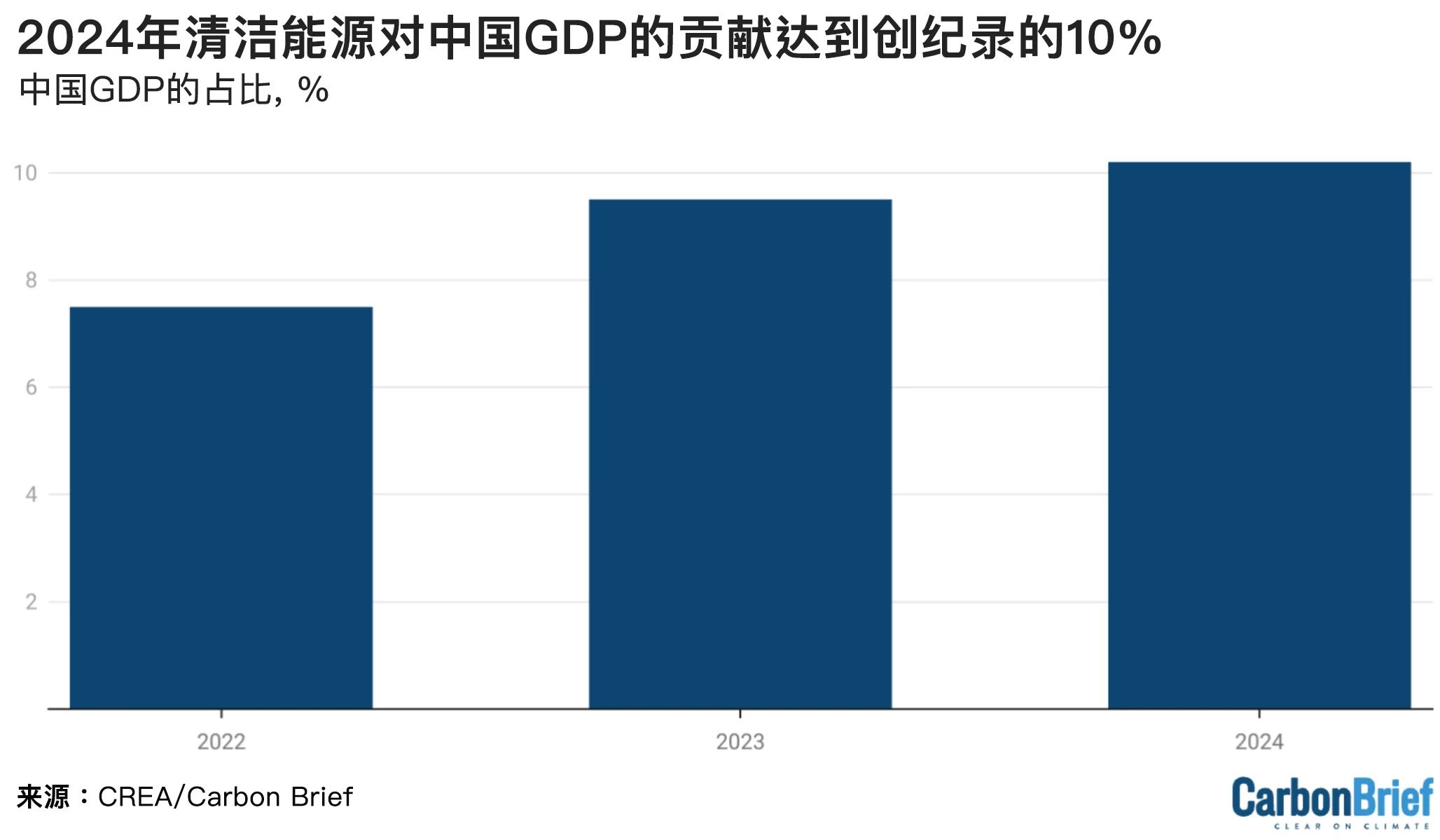
清洁能源行业对中国经济的整体贡献达到13.6万亿元人民币(1.9万亿美元),其规模与沙特阿拉伯或瑞士等主要经济体相当。
同时,该行业在中国经济中的比重已超过房地产销售(9.6万亿元人民币)和农业(9.1万亿元人民币)。
电动汽车和太阳能是增长主要驱动力
2024年清洁能源行业的生产和投资总值预计增长了13%,自2022年以来则增长了50%,如下图所示。

这些行业的商品和服务产值增长了21%,达到6.8万亿元人民币(9500亿美元)。
总体而言,电动汽车生产是最具价值的细分行业,其次是清洁能源生产、铁路运输、电力传输与储存,以及能源效率。
下表详细列出了各行业和活动的具体数据。

价格下跌促进采用,但对生产商构成挑战
在全球大多数经济体都在担忧高通胀之际,中国却面临通货紧缩的压力,主要原因是制造业快速扩张,而国内需求相对疲软。
多个关键清洁能源行业都受到这一趋势的影响。尽管产量不断增长,但供过于求导致收入和利润增长乏力,使该行业的实际贡献在一定程度上被忽视。
以太阳能电池板制造为例,尽管产量大幅增长,但行业名义产值下降了41%。

不过,由于项目数量激增,加上太阳能电池板成本仅占整个太阳能发电项目成本的不到三分之一,太阳能项目的投资名义价值仍保持稳定。
太阳能发电电力价值增长了40%,使得太阳能行业对名义GDP增长的总体贡献率上升至正值。
总体来看,清洁能源行业的增加值按名义计算增长了约8.5%,低于实际增长率的15%,但仍远高于GDP增速,占名义GDP增长的17%。
2024年12月,一场重要的年度经济政策会议强调,需要“积极营造绿色低碳产业健康发展生态”。这表明政府可能会采取措施解决清洁制造业供应过剩和该行业盈利能力较弱的问题。
清洁能源经济快速增长的影响
清洁能源行业连续第二年在中国经济增长目标的实现中发挥了关键作用。
供应增加和价格下降的双重因素,导致中国清洁能源部署速度远超几年前的预期,同时也促进了清洁能源在新兴海外市场的部署。
预计这一增长趋势将在2025年延续,这主要得益于多个重大项目都致力于在“十四五”规划(2021-2025年)收官前完工。
2025年以后,该行业的发展将在很大程度上取决于今年即将完成的下一个五年计划(2026-2030年)中的新目标和政策。
随着近几年清洁能源发电装机容量的闪电式扩张,该行业正陷入盈利能力下降和产能过剩的困境。
若要恢复行业盈利能力,中国既需要保持强劲的国内需求,也需要采取措施解决产能过剩问题。此外,弃电问题(尤其对太阳能发电产生限制)也亟需解决,以确保市场需求能持续释放。
根据中国主要部委提出的2030年和2035年目标所显示的初步迹象,中国难以将关键清洁能源技术需求维持在2023-2024年水平。
如果清洁能源行业在下一个五年规划时期的目标低于当前部署速度,该行业可能从拉动GDP增长的推动力转变为拖累因素,并加剧供过于求的问题。相反,更具雄心的清洁能源目标将有助于保持该行业对经济的积极贡献。
鉴于清洁能源在投资增长中发挥的重要作用,政府的经济刺激措施可能会支持清洁能源领域的投资。
此外,清洁能源现在在中国经济增长中的关键作用,也使得政策制定者更有动力确保该行业的健康发展。


The post 分析:2024年清洁能源对中国GDP的贡献将达到创纪录的10% appeared first on Carbon Brief.

Drought and heatwaves occurring together – known as “compound” events – have “surged” across the world since the early 2000s, a new study shows.
Compound drought and heat events (CDHEs) can have devastating effects, creating the ideal conditions for intense wildfires, such as Australia’s “Black Summer” of 2019-20 where bushfires burned 24m hectares and killed 33 people.
The research, published in Science Advances, finds that the increase in CDHEs is predominantly being driven by events that start with a heatwave.
The global area affected by such “heatwave-led” compound events has more than doubled between 1980-2001 and 2002-23, the study says.
The rapid increase in these events over the last 23 years cannot be explained solely by global warming, the authors note.
Since the late 1990s, feedbacks between the land and the atmosphere have become stronger, making heatwaves more likely to trigger drought conditions, they explain.
One of the study authors tells Carbon Brief that societies must pay greater attention to compound events, which can “cause severe impacts on ecosystems, agriculture and society”.
Compound events
CDHEs are extreme weather events where drought and heatwave conditions occur simultaneously – or shortly after each other – in the same region.
These events are often triggered by large-scale weather patterns, such as “blocking” highs, which can produce “prolonged” hot and dry conditions, according to the study.
Prof Sang-Wook Yeh is one of the study authors and a professor at the Ewha Womans University in South Korea. He tells Carbon Brief:
“When heatwaves and droughts occur together, the two hazards reinforce each other through land-atmosphere interactions. This amplifies surface heating and soil moisture deficits, making compound events more intense and damaging than single hazards.”
CDHEs can begin with either a heatwave or a drought.
The sequence of these extremes is important, the study says, as they have different drivers and impacts.
For example, in a CDHE where the heatwave was the precursor, increased direct sunshine causes more moisture loss from soils and plants, leading to a drought.
Conversely, in an event where the drought was the precursor, the lack of soil moisture means that less of the sun’s energy goes into evaporation and more goes into warming the Earth’s surface. This produces favourable conditions for heatwaves.
The study shows that the majority of CDHEs globally start out as a drought.
In recent years, there has been increasing focus on these events due to the devastating impact they have on agriculture, ecosystems and public health.
In Russia in the summer of 2010, a compound drought-heatwave event – and the associated wildfires – caused the death of nearly 55,000 people, the study notes.

The record-breaking Pacific north-west “heat dome” in 2021 triggered extreme drought conditions that caused “significant declines” in wheat yields, as well as in barley, canola and fruit production in British Columbia and Alberta, Canada, says the study.
Increasing events
To assess how CDHEs are changing, the researchers use daily reanalysis data to identify droughts and heatwaves events. (Reanalysis data combines past observations with climate models to create a historical climate record.) Then, using an algorithm, they analyse how these events overlap in both time and space.
The study covers the period from 1980 to 2023 and the world’s land surface, excluding polar regions where CDHEs are rare.
The research finds that the area of land affected by CDHEs has “increased substantially” since the early 2000s.
Heatwave-led events have been the main contributor to this increase, the study says, with their spatial extent rising 110% between 1980-2001 and 2002-23, compared to a 59% increase for drought-led events.
The map below shows the global distribution of CDHEs over 1980-2023. The charts show the percentage of the land surface affected by a heatwave-led CDHE (red) or a drought-led CDHE (yellow) in a given year (left) and relative increase in each CDHE type (right).
The study finds that CDHEs have occurred most frequently in northern South America, the southern US, eastern Europe, central Africa and south Asia.

Threshold passed
The authors explain that the increase in heatwave-led CDHEs is related to rising global temperatures, but that this does not tell the whole story.
In the earlier 22-year period of 1980-2001, the study finds that the spatial extent of heatwave-led CDHEs rises by 1.6% per 1C of global temperature rise. For the more-recent period of 2022-23, this increases “nearly eightfold” to 13.1%.
The change suggests that the rapid increase in the heatwave-led CDHEs occurred after the global average temperature “surpasse[d] a certain temperature threshold”, the paper says.
This threshold is an absolute global average temperature of 14.3C, the authors estimate (based on an 11-year average), which the world passed around the year 2000.
Investigating the recent surge in heatwave-leading CDHEs further, the researchers find a “regime shift” in land-atmosphere dynamics “toward a persistently intensified state after the late 1990s”.
In other words, the way that drier soils drive higher surface temperatures, and vice versa, is becoming stronger, resulting in more heatwave-led compound events.
Daily data
The research has some advantages over other previous studies, Yeh says. For instance, the new work uses daily estimations of CDHEs, compared to monthly data used in past research. This is “important for capturing the detailed occurrence” of these events, says Yeh.
He adds that another advantage of their study is that it distinguishes the sequence of droughts and heatwaves, which allows them to “better understand the differences” in the characteristics of CDHEs.
Dr Meryem Tanarhte is a climate scientist at the University Hassan II in Morocco, and Dr Ruth Cerezo Mota is a climatologist and a researcher at the National Autonomous University of Mexico. Both scientists, who were not involved in the study, agree that the daily estimations give a clearer picture of how CDHEs are changing.
Cerezo-Mota adds that another major contribution of the study is its global focus. She tells Carbon Brief that in some regions, such as Mexico and Africa, there is a lack of studies on CDHEs:
“Not because the events do not occur, but perhaps because [these regions] do not have all the data or the expertise to do so.”
However, she notes that the reanalysis data used by the study does have limitations with how it represents rainfall in some parts of the world.
Compound impacts
The study notes that if CDHEs continue to intensify – particularly events where heatwaves are the precursors – they could drive declining crop productivity, increased wildfire frequency and severe public health crises.
These impacts could be “much more rapid and severe as global warming continues”, Yeh tells Carbon Brief.
Tanarhte notes that these events can be forecasted up to 10 days ahead in many regions. Furthermore, she says, the strongest impacts can be prevented “through preparedness and adaptation”, including through “water management for agriculture, heatwave mitigation measures and wildfire mitigation”.
The study recommends reassessing current risk management strategies for these compound events. It also suggests incorporating the sequences of drought and heatwaves into compound event analysis frameworks “to enhance climate risk management”.
Cerezo-Mota says that it is clear that the world needs to be prepared for the increased occurrence of these events. She tells Carbon Brief:
“These [risk assessments and strategies] need to be carried out at the local level to understand the complexities of each region.”




The post Heatwaves driving recent ‘surge’ in compound drought and heat extremes appeared first on Carbon Brief.
Heatwaves driving recent ‘surge’ in compound drought and heat extremes
Greenhouse Gases
DeBriefed 6 March 2026: Iran energy crisis | China climate plan | Bristol’s ‘pioneering’ wind turbine
Welcome to Carbon Brief’s DeBriefed.
An essential guide to the week’s key developments relating to climate change.
This week
Energy crisis
ENERGY SPIKE: US-Israeli attacks on Iran and subsequent counterattacks across the Middle East have sent energy prices “soaring”, according to Reuters. The newswire reported that the region “accounts for just under a third of global oil production and almost a fifth of gas”. The Guardian noted that shipping traffic through the strait of Hormuz, which normally ferries 20% of the world’s oil, “all but ground to a halt”. The Financial Times reported that attacks by Iran on Middle East energy facilities – notably in Qatar – triggered the “biggest rise in gas prices since Russia’s full-scale invasion of Ukraine”.
‘RISK’ AND ‘BENEFITS’: Bloomberg reported on increases in diesel prices in Europe and the US, speculating that rising fuel costs could be “a risk for president Donald Trump”. US gas producers are “poised to benefit from the big disruption in global supply”, according to CNBC. Indian government sources told the Economic Times that Russia is prepared to “fulfil India’s energy demands”. China Daily quoted experts who said “China’s energy security remains fundamentally unshaken”, thanks to “emergency stockpiles and a wide array of import channels”.
‘ESSENTIAL’ RENEWABLES: Energy analysts said governments should cut their fossil-fuel reliance by investing in renewables, “rather than just seeking non-Gulf oil and gas suppliers”, reported Climate Home News. This message was echoed by UK business secretary Peter Kyle, who said “doubling down on renewables” was “essential” amid “regional instability”, according to the Daily Telegraph.
China’s climate plan
PEAK COAL?: China has set out its next “five-year plan” at the annual “two sessions” meeting of the National People’s Congress, including its climate strategy out to 2030, according to the Hong Kong-based South China Morning Post. The plan called for China to cut its carbon emissions per unit of gross domestic product (GDP) by 17% from 2026 to 2030, which “may allow for continued increase in emissions given the rate of GDP growth”, reported