Carbon Footprint
Renewables Plus Storage Surge as Battery Costs Drop Record Low, BNEF Reports



Battery energy storage has entered a new era. Costs have fallen to historic lows, and deployments are accelerating across major markets. According to BloombergNEF’s (BNEF) Levelized Cost of Electricity 2026 report, the economics of grid storage shifted dramatically in 2025 — even as other clean energy technologies became more expensive.
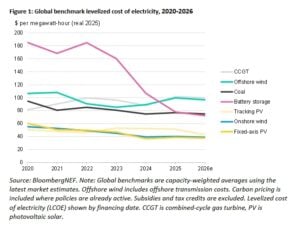
- The global benchmark cost for a four-hour battery storage project dropped 27% year-on-year to $78 per megawatt-hour (MWh) in 2025.
That marks the lowest level since BNEF began tracking the data in 2009. As a result, batteries are now reshaping how power systems balance renewable energy and meet rising electricity demand.
At the same time, solar and wind projects faced cost pressures. Supply chain constraints, weaker resource quality in some regions, and policy reforms in mainland China pushed up benchmark costs. However, despite these short-term headwinds, BNEF expects long-term clean energy costs to continue declining through 2035.

Battery Storage Breaks Records While Solar and Wind Stall
In 2025, battery storage clearly stood out. The $78/MWh benchmark for a four-hour system reflected a steep and rapid decline. Lower battery pack prices, stronger competition among manufacturers, and better system design all helped drive the drop.
By contrast, solar and wind moved in the opposite direction. The global benchmark cost for a fixed-axis solar farm rose 6%, reaching $39/MWh. Onshore wind increased to $40/MWh. Offshore wind climbed sharply to $100/MWh due to tight supply chains and financing challenges.
Thermal power also became more expensive. The levelized cost of electricity (LCOE) for new combined cycle gas turbine (CCGT) plants jumped 16% to $102/MWh — the highest level recorded. Equipment price increases and strong demand for gas turbines, partly fueled by data center expansion, kept costs elevated. Coal plants also faced higher capital expenses.
Yet even with solar and wind costs rising in 2025, BNEF projects that innovation and scale will push prices down again over the next decade. By 2035, the firm expects:
- Solar LCOE to fall 30%
- Battery storage to decline 25%
- Onshore wind to drop 23%
- Offshore wind to decrease 20%
These projections suggest the current cost increases are temporary rather than structural.
China’s Cost Advantage
Wind energy told a more mixed story.
Mainland China retained a cost advantage. However, projects built in lower wind-speed regions pushed up the global benchmark. Onshore wind projects outside mainland China saw a 4% cost decline, but the global average rose 2% due to Chinese market dynamics.
Offshore wind faced deeper challenges. Supply chain bottlenecks increased turbine and installation costs across major markets. In the United Kingdom, recently financed offshore wind projects now cost 69% more than they did five years ago. BNEF expects offshore wind costs to remain elevated until at least 2030.
Still, in the United States, wind power regained its position as the cheapest source of new electricity generation in 2025. Rising gas turbine costs pushed wind ahead of gas for the first time since 2023.
EV Overcapacity Slashes Battery Prices
One major factor behind the storage cost collapse is manufacturing overcapacity in the electric vehicle (EV) sector.
China’s lithium-ion battery production capacity surpassed 2 terawatt-hours in 2024. That was about 60% higher than total battery demand. As a result, manufacturers competed aggressively on price, which benefited grid-scale storage buyers.
Battery pack prices for EVs fell 8% in 2025 to a record low of $108 per kilowatt-hour, according to BNEF’s December survey. Lower pack prices directly reduced the cost of large storage projects. Meanwhile, system-level improvements — including better integration and optimized engineering — improved performance and reduced overall project expenses.
According to Amar Vasdev, senior energy economics associate at BNEF and lead author of the report, manufacturing overcapacity and better system designs are transforming the economics of large energy storage projects. In six markets, the LCOE of a four-hour battery system has already dropped below $100/MWh.
That threshold is critical. At those levels, battery storage becomes highly competitive with fossil fuel peaking plants.
- RELATED: China’s One Month Lithium Battery Energy Storage Installations Beat America’s One Whole Year
Lower Battery Costs Drive Renewables Plus Storage Boom Worldwide
Lower battery costs are accelerating hybrid renewable development. In 2025 alone, developers added 87 gigawatts of co-located solar and storage projects worldwide. These combined systems delivered electricity at an average cost of $57/MWh.
This model solves one of solar’s biggest challenges — intermittency. Batteries allow solar farms to store excess daytime generation and dispatch it later when demand peaks. As storage becomes cheaper, solar-plus-storage projects become more financially attractive and reliable.
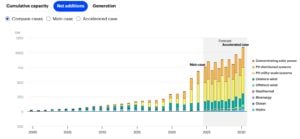
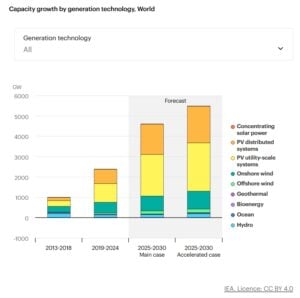
BNEF expects annual global energy storage additions to reach 220 GW by 2035, growing at a compound annual rate of nearly 15%. If that projection holds, batteries will become central to grid balancing worldwide.

The U.S. Storage Boom Accelerates
The United States is emerging as a key growth engine for battery deployment.
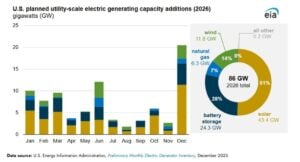
According to the February 2026 Electric Power Monthly report from the U.S. Energy Information Administration (EIA), 86 GW of new utility-scale capacity is expected to come online in 2026. Of that total, 26.3 GW will come from battery storage.
That represents the largest single-year capacity expansion in more than two decades. Solar and battery storage together account for nearly 79% of planned additions.
Texas has become a hotspot for battery development. As of July 2025, the state had 12.2 GW of storage capacity operating. Developers rushed projects online ahead of summer peak demand, including nearly 1 GWh brought online by esVolta across three projects.
California continues to lead nationally, with more than 12 GW of operational storage capacity. Projects such as the Rexford solar-plus-storage facility in Tulare County strengthened the state’s position as a grid storage pioneer.

Meanwhile, New England expanded its footprint with large-scale additions to the ISO New England grid. These projects demonstrate that battery storage is no longer confined to a few early-adopter markets.
Australia’s Breakout Year
Australia also delivered a major milestone in 2025. The country commissioned 4.9 GWh of utility-scale battery storage during the year — more than the combined total installed between 2017 and 2024.
In the fourth quarter alone, over 1,000 MW of new capacity came online. Large projects, including the 500 MW Liddell battery system in New South Wales, highlighted the rapid pace of expansion.
Australia’s experience shows how quickly storage can scale once policy support, market design, and financing align.
Data Centers Drive the “Race for Electrons”
A powerful new demand driver is reshaping electricity markets: data centers.
The rapid expansion of AI and cloud computing has triggered strong demand for reliable power. Gas turbine orders surged as operators sought firm capacity. This demand doubled U.S. turbine capital costs in just two years.
However, higher gas costs are improving the competitiveness of renewables and storage. In regions like California and parts of Texas, co-located solar and four-hour battery systems can already meet a significant share of data center demand at lower cost than new gas plants.
Grid interconnection queues and gas turbine supply constraints are also slowing fossil fuel projects. In contrast, solar and storage systems can often deploy more quickly.

As Vasdev explained, the world is in a “race for electrons” to meet rising demand from electrification and data centers. In many markets, renewables are not only cheaper for new builds — they are now undercutting the operating costs of existing fossil fuel plants.
Solar beats new coal and gas across most Asia-Pacific markets. Wind is the lowest-cost new generation source in the U.S. and Canada. Solar consistently outcompetes fossil fuels in Southern Europe, while wind dominates in Northern Europe.
From Niche Technology to Grid Backbone
Battery storage has moved beyond its early-stage niche. It is now central to power system planning.
As storage costs fall, batteries strengthen renewable energy revenues, stabilize grids, and reduce reliance on fossil-fuel peaking plants. Instead of building new gas capacity for short-duration peaks, operators can increasingly rely on storage-led balancing.
BNEF’s annual LCOE report analyzed more than 800 recently financed projects across over 50 markets and 28 technologies. Its expanded coverage of the Middle East and Africa highlights how storage economics are improving globally, not just in mature markets.
The broader message is clear. While 2025 delivered mixed signals for clean power costs, battery storage emerged as the clear winner. Manufacturing overcapacity, technological learning, and intense competition have driven prices to record lows.
Looking ahead, continued cost declines could accelerate the global shift toward renewable-dominated grids supported by flexible storage. In that transition, batteries are no longer optional. They are becoming the backbone of a reliable, low-carbon electricity system.
The post Renewables Plus Storage Surge as Battery Costs Drop Record Low, BNEF Reports appeared first on Carbon Credits.