

A Brazil-led initiative that is pulling together a global roadmap to end deforestation will invite countries to produce their own voluntary pathways to halt and reverse forest loss by 2030, experts managing the process said this week.
At last year’s COP30 climate summit in the Brazilian Amazon city of Belém, a group of around 80 countries led a failed push to start developing two new global roadmaps – one to stop deforestation by 2030 and another to transition away from fossil fuels. All countries signed up to these commitments in a landmark deal at COP28 in Dubai, but little progress has been made to implement them since then.
As a bridging alternative, Brazil’s COP30 presidency agreed to draft two voluntary versions of these roadmaps. COP30 officials said a final version of the deforestation roadmap will be published by September this year, after receiving more than 130 written submissions from countries.
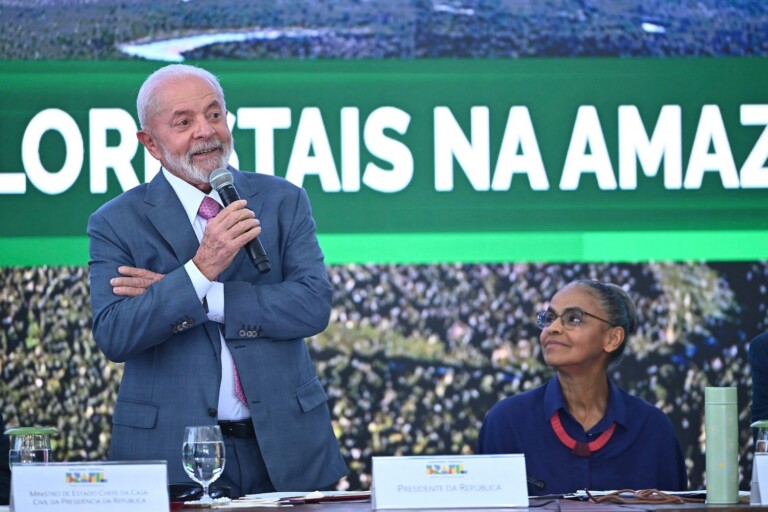
This Monday, Juliano Assunção, executive director of Climate Policy Initiative/PUC-Rio in Brazil and an advisor to the COP30 presidency on deforestation, presented a first outline of the roadmap to countries at the United Nations Forum on Forests in New York (UNFF21).
Assunção said the roadmap “will not prescribe a single model”, but would rather invite countries to translate commitments they have already made to halt and reverse deforestation by 2030 – which is a longstanding global goal – “into forest roadmaps grounded on regional and national diagnosis”.
In 2025, the world lost 4.3 million hectares of tropical primary rainforest, an area roughly the size of Denmark, according to annual data published by Global Forest Watch. While that was 36% lower than in 2024 when climate-fuelled fires pushed forest loss to a record high, deforestation was still 70% higher than it should to be to meet the 2030 international pledge to end it, the report said.
-
Paris Agreement committee snubbed over missing NDC climate plans
Many governments have still not submitted a nationally determined contribution to the UN, breaching a key requirement of the Paris Agreement -
Scientists warn El Niño could intensify climate extremes in 2026
Climatologists say a particularly powerful weather pattern could amplify wildfire risk, heatwaves and flooding worldwide as global temperatures continue to rise


What will be in the roadmap?
Assunção said the COP30 team “were positively surprised by the level of depth and how comprehensive” the contributions from countries and experts were in the consultation phase for the global roadmap, noting that these served to inform the current outline.
The plan is for the global roadmap report to be structured in two parts: one on the social, economic and environmental risk of continued forest loss; and a second presenting a menu of options to tackle deforestation by 2030.
“The roadmap will be practical, based on countries’ experiences. It will help identify the key challenges, and understand their drivers, which vary quite differently among different countries. It’s going to be drawing on existing policy tools,” Assunção told countries at the UN forests meeting this week.
The COP30 advisor said that, while countries can draft national plans, there’s also “a lot of room for international co-operation”, which governments themselves requested as part of the consultation.
The roadmap will include a sub-section on international co-operation, which will include how countries can share tools such as satellite platforms to improve monitoring systems, how to improve the finance architecture to channel more resources for forests, and how to align international regulations on trade, crime and due diligence to protect forests.
Indigenous groups warn Amazon oil expansion tests fossil fuel phase-out coalition
Marco Tulio Cabral, a diplomat at Brazil’s Ministry of Foreign Affairs who leads the deforestation roadmap process, told governments that, while the document is not a negotiated outcome, the COP30 presidency is “investing a lot of time and effort” in talking with countries to “make as good a text as we can” that represents a range of views.
He noted that, while the COP30 initiative for a fossil-fuel phase-out roadmap led to a coalition of countries that gathered for a first landmark conference in Santa Marta last month, a similar dedicated push is not necessarily expected for a deforestation roadmap.
“The supportive actors and those who oppose it are very different, so there are limits to what we can do together or associate one thing with the other,” Cabral said.

Forest nations seek focus on local realities
Countries at the UN event were supportive of the roadmap, but also expressed the need to offer real alternatives to rural communities.
Joseph Malassi, climate advisor at the Ministry of Environment of the Democratic Republic of Congo (DRC), said that in the Congo basin – the planet’s second-largest rainforest – deforestation “is not caused by vast industrial or infrastructure projects, but rather by extreme poverty” as local people cut down trees for firewood, minerals or crops.
“The roadmap will be confronted with these realities,” Malassi said, adding that it should avoid competing with other UN forest initiatives already working at the intersection of conservation and development.
Nicholas Suryobasuindro of Indonesia’s Ministry of Forests, which manages another mega-diverse rainforest basin, welcomed the Brazilian roadmap, adding it will need to address the “complex interaction between land use chains, economic pressure, spatial planning challenges and development needs”.
Finance will be key to dealing with these realities, according to Carolyn Rodrigues-Birkett, Guyana’s permanent ambassador to the UN. She said the roadmap should take into account an existing six-point plan to scale up forest finance launched last year by 34 countries.
Two options in that plan in particular have potential to drive up funding for forest protection and “must immediately receive strong international support”, she added. They are a new rainforest fund called the Tropical Forest Forever Facility (TFFF) – launched last year by Brazil and supported by several donor governments – and “high-integrity jurisdictional” carbon markets, which refers to government-led sales of carbon credits from large forested areas.
“Both approaches can support countries with different forest and deforestation profiles, including countries with historically low deforestation rates achieved with sustainable forest management,” Rodrigues-Birkett said.
The post COP30 roadmap to end deforestation will invite countries to draft domestic plans appeared first on Climate Home News.
COP30 roadmap to end deforestation will invite countries to draft domestic plans

The board of the Fund for Responding to Loss and Damage (FRLD) will decide on Thursday on whether to “provisionally set aside” $20 million for Nepal to deal with some of the effects of the climate-driven flood it suffered in August.
The motion, seen by Climate Home News, has been drafted by a group of board members from both developed and developing countries and so is likely to pass easily at the fund’s first-ever extraordinary board meeting on October 22.
It invites the government of Nepal to submit a proposal for how to use the money, with the board then deciding at one of its regular board meetings whether to approve the proposal or not.
While Nepali officials have described $20 million as merely “symbolic” in the face of the $4.8 billion estimated costs of recovery and reconstruction, it would be the first time the new FRLD – agreed in 2022 months after devastating floods in Pakistan – has set aside money for a specific disaster.
Until now the fund has only taken requests through a single call for proposals, launched at COP30 in Belém last November, that gave countries six months to submit requests.
Most of the 180 projects the FRLD is currently considering are designed to help countries avoid damage from future climate disasters, for example by strengthening responses to floods in Bangladesh and Lagos.
The draft decision says Nepal’s proposal will serve as a pilot for how funding requests can be submitted outside of the fund’s current timetable. That could let governments seek funds quickly after a climate disaster strikes, rather than waiting for the next call.
This arrangement would set the fund apart from other United Nations funds designed for climate adaptation or cutting emissions like the Green Climate Fund.
Climate campaigners from Fill the Fund said the draft decision is “a real step forward” as it is “the first time this Fund has moved to respond to a specific disaster”.
Too little, too late
The FRLD was agreed by governments at COP27, set up and operationalised at COP28 in 2023 but has yet to award any money. The 180 funding requests it is currently considering would cost around $2.8 billion, but it only has $350 million to allocate.
The United Nations Secretary-General António Guterres has described the amount of money available in the fund as “ridiculously small” and Fill the Fund said $20 million “is a meaningful signal but it is a drop against an ocean of need”.
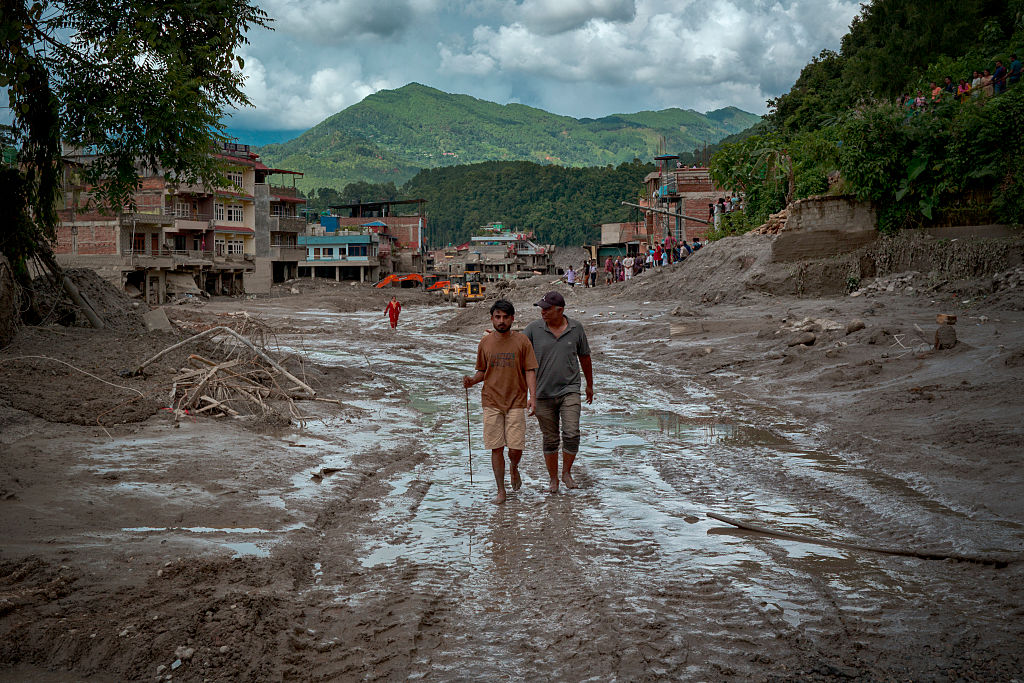
A glacial rock and ice collapse sent a torrent of water and debris through Nepal and the Chinese-administered region of Tibet on August 26. It killed more than 1,400 people, left thousands more missing and destroyed homes, bridges, roads and hydropower plants. Nepal’s finance and environment ministers quickly appealed to the FRLD board for funds, saying that “time is of the essence”.
Their call was followed swiftly by a letter from developing country FRLD board members urging the board’s co-chairs to organise an extraordinary meeting to allocate funds to Nepal.
But developed countries initially called for an informal consultation rather than a full board meeting. It took a further 45 days for the board’s co-chairs to organise an extraordinary board meeting for October 22 and to draft a motion for adoption.
Fill the Fund called for a permanent way of the fund rapid responding to disasters as “Nepal should not have required historic letters, an informal drafting group and the Fund’s first-ever extraordinary meeting simply to unlock an emergency response. The next country cannot wait two months and a bureaucratic marathon. Speed must be built in, not improvised.”
The post UN’s loss and damage fund set to give Nepal $20m for flood recovery appeared first on Climate Home News.
UN’s loss and damage fund set to give Nepal $20m for flood recovery
Some 58% of countries have met a UN call to submit new pledges on addressing nature loss – two years after the original deadline – according to Carbon Brief analysis.
Countries were asked to submit new pledges, known as national biodiversity strategies and action plans (NBSAPs), by the start of the COP16 biodiversity summit in October 2024.
After only 15% of nations met the original deadline, countries agreed at the summit to a new text that “urges” countries to release their NBSAPs “as soon as possible”.
Carbon Brief analysis shows that 113 countries have now come forward with new NBSAPs – up from 55 nations a year ago.
Countries will gather in Yerevan, Armenia, next week for COP17.
COP17 marks the halfway point of the Kunming-Montreal Global Biodiversity Framework (GBF), a landmark agreement made in 2022 to reverse nature decline by 2030.
The summit will provide the stage for the first global review of countries’ progress towards meeting the targets of the GBF.
Global review
In Montreal, Canada, in 2022, nearly every country in the world agreed to the GBF. The overall “mission” of the framework is to “halt and reverse” biodiversity loss by 2030.
The GBF includes a list of 23 targets for 2030. They cover an expansive range of topics, including restoring ecosystems, addressing climate change and providing developing nations with finance to help cover the costs of protecting nature.
As part of the GBF and its underlying documents, countries agreed to a schedule for monitoring their progress towards achieving the 2030 targets.
This included the preparation of a “global report” of progress coordinated by the UN, which will inform a “global review” undertaken by countries at COP17.
The global report draws on countries’ NBSAPs and national targets. It also draws on countries’ seventh national reports, which were due to be submitted to the UN in February of this year.
Carbon Brief analysis shows that 113 out of 196 parties (58%) have now met the call to produce a new NBSAP – up from 55 nations just a year ago.
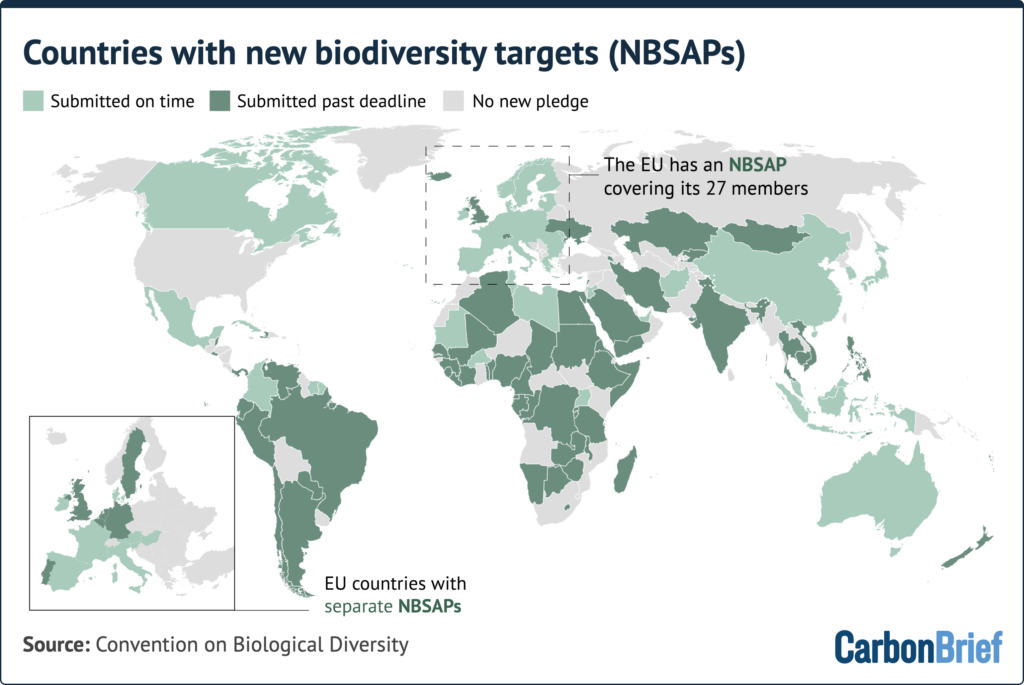
Since last year, many African nations have now published new NBSAPs.
African countries that have released new plans in the last year include: Algeria, Benin, Botswana, Cameroon, Comoros, Congo, Côte d’Ivoire, the Democratic Republic of Congo, Egypt, Equatorial Guinea, Eritrea, Ethiopia, Gabon, Gambia, Guinea, Lesotho, Liberia, Madagascar, Malawi, Mali, Namibia, Rwanda, Senegal, Sierra Leone, Somalia, Sudan, Zambia and Zimbabwe.
More South American nations have also published new NBSAPs. This includes Brazil – the world’s most biodiverse nation – as well as Belize and Chile.
COP17 host nation Armenia published its new NBSAP in April.
According to the GBF and its underlying documents, countries that were “not in a position” to meet the deadline to submit NBSAPs ahead of COP16 were requested to instead submit national targets.
Unlike NBSAPs, national targets simply list biodiversity goals that countries will aim for, without an accompanying plan for how they will be achieved.
Four of the world’s megadiverse nations – countries that account for the majority of Earth’s species – have not yet published new NBSAPs. These countries are Papua New Guinea, Peru, South Africa and the US.
The US is the only UN member country that is not a signatory to the UN Convention on Biological Diversity.
The country with the most land on Earth, Russia, has also not produced a new NBSAP.
By the end of COP16, some 119 parties had produced at least one national target. Two years later, this figure has risen to 175, or 89% of countries.
In addition, around half of countries met the deadline to produce their seventh national reports by February of this year. This figure has now risen to 73% of countries.
Over the past two years, many developing countries have expressed concerns that a lack of available funding has prevented them from publishing their NBSAPs.
A spokesperson for the Global Environment Facility (GEF), the multilateral fund that provides funding to help with the preparation of NBSAPs, told Carbon Brief in 2025 that 120 out of 139 countries that had requested financial support since COP16 had been able to access it.
The spokesperson added that the UN Environment Programme was “working to resolve outstanding issues” to allow the remaining 19 countries to access financial assistance.
Related

The post COP17: Which countries have released new pledges to tackle nature loss? appeared first on Carbon Brief.
COP17: Which countries have released new pledges to tackle nature loss?