

The Financial Times reported that the Pentagon plans to spend up to $1 billion on critical minerals. This move aims to cut U.S. reliance on China for essential metals in defense, clean energy, and advanced tech. Led by the Defense Logistics Agency (DLA), this program is the largest U.S. strategic mineral acquisition since the Cold War.
Significantly, the Pentagon’s plan is part of Trump’s broader “One Big Beautiful Bill Act” (OBBA) to enhance domestic and allied resources. Under OBBA, the DLA will use a $7.5 billion allocation to:
-
Expand the U.S. stockpile by 2027 ($2 billion)
-
Invest in mineral and processing supply chains ($5 billion)
-
Launch a Pentagon credit program to support private mining and refining projects ($500 million)
Washington’s Strategic Push: From Market Reliance to State Control
China’s control over global mineral supply chains has raised national security concerns. The country refines 80–90% of rare earths and dominates other key metals, such as cobalt and nickel.
Recent Chinese export limits on rare earths have raised concerns in the U.S. Washington views these limits as an effort to weaponize mineral exports. The Pentagon’s stockpiling shows a move from market-driven sourcing to state-led resource security.
Trump Targets China with 100% Tariffs
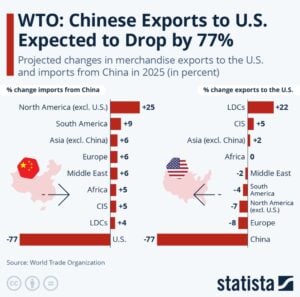
As per the latest news, President Trump has confirmed plans to impose 100% tariffs on all Chinese imports starting on November 1. He labeled China’s export limits a “hostile act.” He noted the timeline might change, saying, “Right now it is. Let’s see what happens.”
On Truth Social, Trump accused Beijing of manipulating supply chains and warned of “100% tariffs… over and above any tariff they are currently paying.”
This tariff announcement follows China’s decision to limit rare earth exports. These actions link industrial policy more closely to national security.
Pentagon Boosts Stockpile with High-Value Minerals
According to the Financial Times, the Pentagon’s buying spree targets four key minerals vital for defense and clean energy:
-
Cobalt – Up to $500 million. Used in batteries, superalloys, and medical implants.
-
Antimony – About $245 million, partly sourced from U.S. Antimony Corp. Key for flame retardants, batteries, and defense components.
-
Tantalum – Around $100 million. Essential for missile systems and aerospace parts.
-
Scandium – A combined $45 million, reportedly from Rio Tinto and APL Engineered Materials. Used in aerospace alloys and electronics.
These purchases will expand the U.S. national stockpile, which already holds $1.3 billion in metals. The new acquisitions focus on materials critical for weapons production, energy systems, and high-tech manufacturing.
A defense official told the FT that several Pentagon offices are now “flush with cash” for mineral procurement. The government is also exploring offshore mineral resources in the Pacific Ocean, rich in nickel, cobalt, copper, and manganese.
Alaska’s Ambler Road Project Approval
President Trump approved the long-contested Ambler Road Project in Alaska. This 211-mile corridor will connect the Dalton Highway to vast mineral deposits in the northwest.
This decision reverses a Biden-era block and is seen as a vital step toward U.S. resource independence. It opens access to copper, zinc, and rare earth elements essential for clean energy and defense manufacturing.
Mineral Stockpiling: Shielding the Nation from Supply Shocks
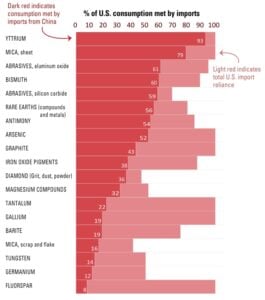
The U.S. imports over 80% of its critical minerals and relies heavily on foreign refining, according to the U.S. Geological Survey (USGS). This dependence exposes the country to significant supply risks, especially amid rising geopolitical tensions.
The International Energy Agency (IEA) estimates that China controls 90% of rare earth refining and significant percentages of nickel and cobalt refining. Such dominance highlights the risk of relying on a single country for critical inputs.
Thus, to tackle these challenges, the U.S. is building a stockpile of critical minerals. This will reduce supply risks, maintain production of weapons and advanced technologies, and support domestic mining investment.
In short, this stockpile acts as strategic insurance, safeguarding industrial capabilities and boosting national security.
The U.S. aligns with a global trend in mineral stockpiling. The EU requires reserves under its Critical Raw Materials Act. India launched a National Mineral Security Strategy in 2025, while Japan maintains a months-long reserve of rare earths.
Minerals with Net Import Reliance on China
Market Impact and Industry Response
The Pentagon’s stockpiling effort has caught attention in mining and rare earth stocks. Companies like U.S. Antimony and MP Materials are gaining interest as Washington increases mineral procurement.
For example, the DLA’s plan for 3,000 tonnes of antimony—about one-eighth of U.S. annual demand—may stabilize the market for this volatile metal. Analysts expect similar effects for other targeted minerals as demand becomes clearer.
In conclusion, the Pentagon’s $1 billion mineral stockpile plan marks a clear shift. The U.S. government is no longer waiting for markets to secure resources. Instead, it is actively building reserves, funding domestic projects, and aligning economic policy with defense needs.
As competition for minerals increases, the Pentagon’s stockpiling is a defensive strategy and a clear signal. It shows that the next big race among global powers will be for critical minerals. These are vital for future technologies, not oil.
The post Pentagon’s $1B Mineral Stockpile Boosts U.S. Independence from China appeared first on Carbon Credits.

EU carbon credit claims changed on 27 September 2026, the day the Directive (EU) 2024/825 began to apply across the European Union. The change is narrow. It changes how a company can talk about the credits it buys. A product can no longer be called neutral on the strength of compensation alone; however, every specific, evidenced statement about what a company measured, reduced, and funded stays fully available.

The post Promoting Improved Cooking Practices in Nigeria appeared first on Terrapass.



-
Climate Change1 year ago
Guest post: Why China is still building new coal – and when it might stop
-

 Greenhouse Gases2 years ago
嘉宾来稿:满足中国增长的用电需求 光伏加储能“比新建煤电更实惠”
-
Greenhouse Gases1 year ago
Guest post: Why China is still building new coal – and when it might stop
-

 Climate Change2 years ago
嘉宾来稿:满足中国增长的用电需求 光伏加储能“比新建煤电更实惠”
-

 Renewable Energy12 months ago
Sending Progressive Philanthropist George Soros to Prison?
-
Climate Change2 years ago
Bill Discounting Climate Change in Florida’s Energy Policy Awaits DeSantis’ Approval
-
Greenhouse Gases1 year ago
嘉宾来稿:探究火山喷发如何影响气候预测
-

 Climate Change2 years ago
Analysis: China’s CO2 falls 1% in Q2 2024 in first quarterly drop since Covid-19