

A new programme to boost the climate resilience of drought-hit farmers in Iraq. Electricity installations that would give millions across Southern Africa access to clean energy. The conservation of critical ecosystems in Honduras to help local communities improve their livelihoods at home instead of needing to migrate to countries like the United States.
These and hundreds more climate programmes funded by the US government risk disappearing as an administration led by President Donald Trump and tech billionaire Elon Musk threatens to shutter the state aid agency, USAID, and slash overseas development assistance.
“I think this is the end of US [government] climate funding,” predicted Karen Mathiasen, a project director with the Center for Global Development, a Washington-based think-tank. In an interview with Climate Home, she described as “shocking” the speed and brazenness with which the government is attempting to dismantle its foreign aid arm.
Which countries have not ratified the Paris climate agreement?
Aid organisations and contractors have been grappling with an unprecedented crisis since, on his first day in office, Trump ordered a 90-day funding freeze during which a programme-by-programme review would be carried out.
As the world’s largest bilateral development assistance agency, USAID is a major provider of grant-based finance for climate action in the Global South. Its climate programmes – amounting to close to half a billion dollars in 2024 – help countries cut greenhouse gas emissions and protect their citizens from the escalating effects of global warming.
Secretary of State Marco Rubio – who is now in charge of USAID’s work – said last week that only projects that make “America safer, stronger or more prosperous” will survive the cull, without explaining which criteria would be used for the assessment.
‘Devastating’ consequences
The sudden move has thrown the development world into disarray, with organisations forced to halt their operations overnight and furlough or lay off staff without being able to obtain clear information or guidance from US officials.
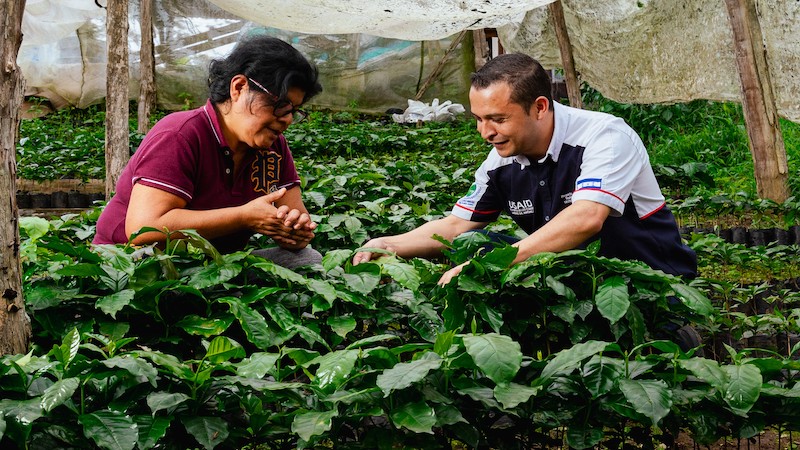
A USAID project in Honduras strengthens the sustainability of coffee farming. Credit: USAID/Honduras Transforming Market
Speaking to Climate Home, aid workers involved in USAID-funded climate projects in the Global South painted a picture of bewilderment and confusion.
“We are no longer able to transfer funds to our local partners – and it will be really hard for them to manage costs,” explained one senior official at a global humanitarian group, underscoring the “devastating” consequences of the funding freeze for frontline organisations.
Working in conflict-afflicted regions, the aid group supports projects to build climate resilience that struggle to attract any financing outside of development money, said the official, adding “that has all gone away now”.
“For many programmes a 90-day pause is as good as a cancellation because you lose all momentum, you lose community connection, you lose the trust you built up with communities which is vital to success,” they added.
Separately, in Malawi, Climate Home has learned that all USAID-funded projects have been halted, with staff members being told to remain at home, just as the country was hit by deadly floods last week.
Climate aid powerhouse
Climate Home analysed USAID’s portfolio of climate projects before its website went offline late last week, soon after Trump-ally Musk, the world’s richest man, labelled the agency as “a criminal organisation”, without providing evidence – and called for its closure.
We spent the weekend feeding USAID into the wood chipper.
Could gone to some great parties.
Did that instead. https://t.co/0V35nacICW
— Elon Musk (@elonmusk) February 3, 2025
One of USAID’s single largest climate projects supports the large-scale roll-out of clean energy facilities across Southern Africa. With total budgeted funding of $84.5 million up to 2028, the programme aims to set up 3 million new electricity connections and avoid 14 million tonnes of planet-heating emissions – equivalent to the annual carbon footprint of Ivory Coast.
Other large US-backed renewable energy projects target Central Asia, Eastern Europe, Ecuador, Colombia and Bangladesh. The vast majority of these are implemented by profit-making American corporations that would be financially hit by any funding cuts.
Climate adaptation also features prominently in USAID’s portfolio. In the last year alone, the agency committed $22 million to boost the ability of farming communities in Iraq to deal with climate-related drought and $18.5 million to help the adoption of climate resilience measures in Palestine. Similar initiatives have been in place in dozens more countries across the Pacific, South Asia, sub-Saharan Africa and Latin America.
Many other USAID projects include climate-related activities – even if they are not explicitly labelled as such – especially in very fragile and conflict-affected regions.
“No future”
It is impossible to predict what will happen to USAID and its thousands of programmes in what is a fast-changing situation – although many staff are due to be placed on administrative leave at the end of this week amid rumours it will be be folded into the State Department. Any fundamental reforms of the agency, and especially its touted abolition, would legally need to be approved by the Republican-controlled Congress.
But, as far as climate action is concerned, some experts believe the writing is already on the wall.
Shell dodges paying compensation for sham carbon credits in China
Along with the wider funding freeze, on his January 20 inauguration day Trump explicitly ordered federal agencies to explain how they would “revoke or rescind” policies implemented to support his predecessor Joe Biden’s international climate finance plan.
“I see no future [for climate projects],” the humanitarian official said, speaking anonymously due to the sensitivity of the situation, adding that it remains to be seen whether some resilience-building activities could be woven into humanitarian assistance, which is more likely to be continued. “But anything that talks significantly, or even marginally, about climate change doesn’t have a future.”
CGD’s Mathiasen, who offered a similar view, said adaptation finance stands to suffer the most severe consequences from the aid pullback. “It will further create further challenges to an agenda that’s already horrendously underfunded, while needs are real and growing,” she added.
The outlook might be less gloomy for renewable energy projects which offer higher returns and could more easily tap other financing sources. For instance, in sub-Saharan Africa, development banks have committed more than $50 billion to an ambitious “Mission 300” initiative aiming to provide 300 million energy-poor people with electricity by 2030.
African governments opt for gas-run cars over EVs to drive down transport emissions
“It is hard to tell yet [what will happen],” said Saliem Fakir, executive director of the Africa Climate Foundation, “but generally large power projects rely on multiple funders – and we also have significant flows of funds from the Gulf States.”
Other major global powers, like China, might be looking to fill the gap as developing nations conclude they can no longer rely on US funding. “The US reputation will suffer as the US will be seen as an unreliable partner and a non-rational actor,” said Mathiasen. “For that reason, this is extraordinarily short-sighted”.
Climate finance goals harder to reach?
Faten Aggad, executive director of the African Future Policies Hub, told Climate Home that an “unprecedented” shift in international aid flows should prompt recipient countries to reevaluate their policies.
“It is a reminder that ODA [overseas development assistance] is not an economic development strategy,” she said. “Countries will need to work on structural solutions to fund their needs, and that includes looking beyond direct financial transfers from development partners.”
But, in the near-term, it will be difficult to quickly find alternative sources of finance for projects dependent on US grants, Aggad warned.
A US retreat from aid funding could also significantly affect the ability of developed countries to fulfill their promise of channelling at least $300 billion a year in climate finance to developing nations by 2035 – an agreement struck just over two months ago at COP29.
In 2022, US contributions accounted for 12% of developed countries’ climate finance through bilateral channels and multilateral climate funds under the previous $100-billion annual goal, according to analysis by US-based think-tank the Natural Resources Defense Council.
In comments made last week, Ani Dasgupta, president and CEO of the World Resources Institute, said “it is still too early to tell what US cuts will mean for reaching the $300-billion and $1.3-trillion [climate finance] goals by 2035 – but they may impact the pace of the scale-up.”
(Reporting by Matteo Civillini; additional reporting by Vivian Chime; editing by Megan Rowling)
The post “No future”: Climate projects face existential threat after Trump’s aid shutdown appeared first on Climate Home News.
“No future”: Climate projects face existential threat after Trump’s aid shutdown

A company has proposed to build a crude oil pipeline crossing the Canadian border near where the long-contested project would have entered the United States.
No project better embodies the nation’s wild swings in climate and energy policy than the Keystone XL pipeline.
Climate Change
Meeting Climate Targets Requires Humanity to Reorient Its Relationship With Nature, New Study Says
A team including scientists, Indigenous people and conservationists point to the ecosystem connecting Yellowstone and the Yukon as an example of a region where humans and nature are flourishing together.
Governments cannot reach their climate goals without rethinking humanity’s relationship to the Earth.
Meeting Climate Targets Requires Humanity to Reorient Its Relationship With Nature, New Study Says
Climate Change
Severe Exposure to ‘Forever Chemicals’ During Pregnancy Could Lead to Childhood Asthma
A new Swedish study focuses on very high levels of PFAS exposure in drinking water.
Exposure to “forever chemicals” during pregnancy could increase the risk of childhood asthma, according to new research from Sweden.
Severe Exposure to ‘Forever Chemicals’ During Pregnancy Could Lead to Childhood Asthma


-
Climate Change8 months ago
Guest post: Why China is still building new coal – and when it might stop
-
Greenhouse Gases8 months ago
Guest post: Why China is still building new coal – and when it might stop
-

 Greenhouse Gases2 years ago
嘉宾来稿:满足中国增长的用电需求 光伏加储能“比新建煤电更实惠”
-
Climate Change2 years ago
Bill Discounting Climate Change in Florida’s Energy Policy Awaits DeSantis’ Approval
-

 Climate Change2 years ago
嘉宾来稿:满足中国增长的用电需求 光伏加储能“比新建煤电更实惠”
-
Climate Change Videos2 years ago
The toxic gas flares fuelling Nigeria’s climate change – BBC News
-

 Renewable Energy6 months ago
Sending Progressive Philanthropist George Soros to Prison?
-

 Carbon Footprint2 years ago
US SEC’s Climate Disclosure Rules Spur Renewed Interest in Carbon Credits