

Here at Climate Home News we tell you what happens inside the air-conditioned boardrooms, government ministries and negotiating halls where people in suits discuss the politics of climate change – but we also like to take a step back and look at the effects their decisions have on the real world.
As the year comes to an end, we have made a list of the stories we feel embody that spirit, published during 2024. If you’d like to receive stories like this in your inbox every Friday in 2025, subscribe to our free weekly newsletter. And if you want to stay up to date with our work, follow us on BlueSky, LinkedIn, Instagram and TikTok.
- On beaches of Gaza and Tel Aviv, two tales of one heatwave
- Germany uses funding to pressure climate groups on Israel-Gaza war
- Saudi visa crackdown left heatwave-hit Hajj pilgrims scared to ask for help
- Where East African oil pipeline meets sea, displaced farmers bemoan “bad deal” on compensation
- Indonesia turns traditional Indigenous land into nickel industrial zone
- Greenpeace Africa in disarray as restructuring meets resistance
- In Nagorno-Karabakh, Azerbaijan’s net zero vision clashes with legacy of war
- World Bank climate funding greens African hotels while fishermen sink
- From cyclone to drought, Zimbabwe’s climate victims struggle to adapt
1. On beaches of Gaza and Tel Aviv, two tales of one heatwave
As 2023 became 2024, the biggest international story was Israel’s invasion, and continued bombing of, the Palestinian territory of Gaza after Hamas militants targeted an Israeli music festival, killing more than 1,100 people. That incident unleashed ongoing attacks by Israel that have caused the deaths of more than 46,000 Palestinians.
But larger numbers have died as an indirect result of the war – for example, when many Gazans were left without shelter or cooling during a climate change-fuelled heatwave that struck in April and May.
Our reporter in Gaza, Taghreed Ali, spoke to two fathers in refugee camps who had lost children to the heat – against which the flimsy protection of their nylon tents, where they waved food containers as makeshift fans, was no match.
Just north of there, our reporter in Israel – Jessica Buxbaum – spoke to beachgoers in Tel Aviv. With their homes still intact, their main concerns were the cost of air-conditioning, the threat of power cuts and drooping house plants.
Climate change affects everyone, but it doesn’t affect everyone equally.

Beaches in Gaza (left) and Tel Aviv (right) in May 2024 (Photos: Taghreed Ali and Jessica Buxbaum)
2. Germany uses funding to pressure climate groups on Israel-Gaza war
Many climate activists continued to speak out against the Israeli government’s role in the growing humanitarian crisis in Gaza but came under pressure to stay quiet on the issue from one of the Israeli government’s biggest political backers – Germany.
The German government funds many climate campaign groups in the Global South and, we revealed, used this financial leverage to try to silence criticism of Israel’s offensive. Some activists complied, but others didn’t and suffered financially when contracts were put on hold or their funding was cut.
Veteran British climate activist Asad Rehman said climate justice activists were questioning their partnerships with German civil society, as well as the government. “How can we ally and work together with German organisations that are not prepared to stand up against their own government?” he asked.

Protesters at COP28 in Dubai (Photos: Cop28/Christopher Pike)
3. Saudi visa crackdown left heatwave-hit Hajj pilgrims scared to ask for help
Another reminder that climate change hits some people harder than others came in June, as 1.5 million Muslims descended on Mecca for the annual Hajj pilgrimage.
As temperatures soared to an unusually high 52C, wealthy pilgrims travelled from air-conditioned hotels to the holy sites by bus and were offered medical help if they needed it.
Poorer pilgrims, however, who had snuck in to the city without the expensive proper visa avoided public transport and cooling centres for fear of deportation. Instead, they walked 19 kilometres in the extreme heat. Over 1,300 died – more than 80% of whom did not have official Hajj permits.
Instead of promising to look after irregular pilgrims better, Saudi Arabia and other governments have reacted by cracking down on the travel agents who organise unofficial trips. We’ll find out next June if that approach has worked or not.

Muslim worshippers make their way to cast stones as part of a symbolic stoning of the devil ritual on June 18, 2023. (Photo: Medhat Hajjaj/apaimages)
4. Where East African oil pipeline meets sea, displaced farmers bemoan “bad deal” on compensation
Governments may have agreed to “transition” away from fossil fuels at COP28 in Dubai last year, but the building of fossil fuel infrastructure continues, harming the planet and sometimes local communities.
Our reporter – who did not want to be named due to fears of government retaliation – travelled to the spot in Tanzania where a 1,400 km-long new pipeline will meet the sea so that the oil it is due to transport from Uganda can be shipped abroad.
Climate Home found that people evicted from their homes to make way for the East African Crude Oil Pipeline (EACOP) – a joint venture between the two countries, French firm TotalEnergies and the China National Offshore Oil Corporation – and its port had been warned off talking to journalists but they complained to us about the terms of their compensation nonetheless.
“I am angry that the government took advantage of our ignorance of legal matters and gave us a bad deal that we couldn’t argue against,” said one.
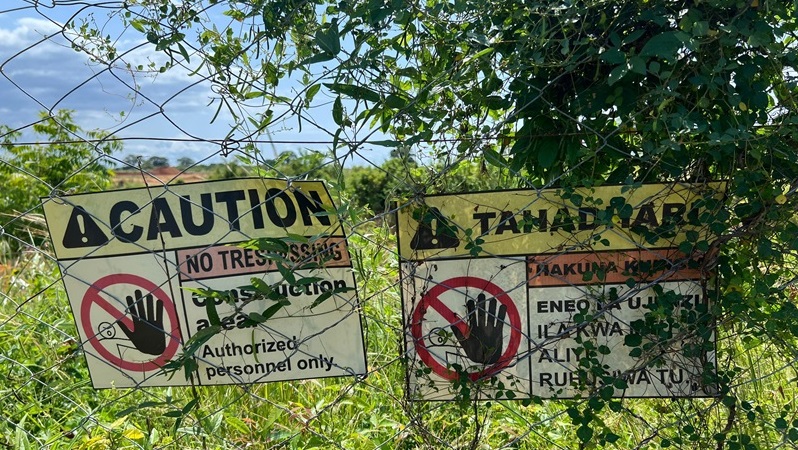
Land by the ocean has been closed off to the public (Photo: Climate Home News)
5. Indonesia turns traditional Indigenous land into nickel industrial zone
Green energy projects can hurt locals too though. The world needs nickel to make electric vehicles, preventing the climate change and air pollution caused by fossil fuel-powered vehicles.
Indonesia has the world’s largest reserves of the silvery white metal. But one of its mines on the island of Sulawesi has displaced Indigenous people, with police arresting those who resist. Nature-rich forests, meanwhile, have been chopped down by politically-connected nickel bosses.
“It’s not to say that nickel mining can’t take place in Indonesia. But it has to be done in a way that’s a lot more careful,” one campaigner said.
Stories like this and others in our Clean Energy Frontiers series are having an impact. This year, the United Nations Secretary-General backed a report calling for human rights, the environment and nature to be respected by those digging up these minerals the world needs for the energy transition.
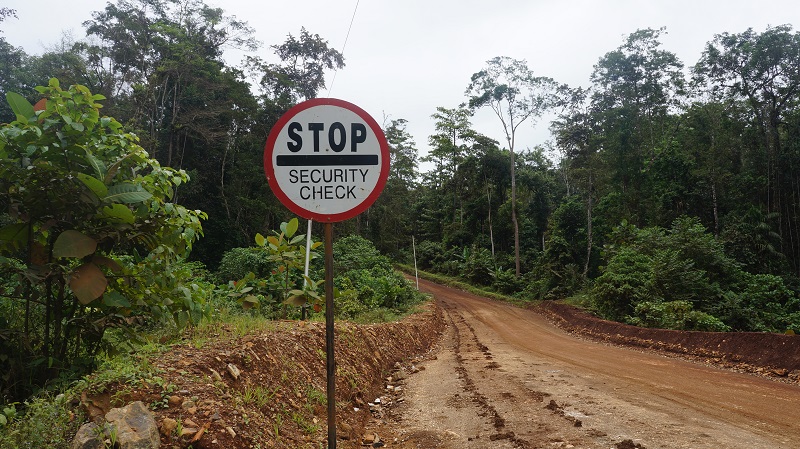
Road to the SCM nickel mine in southeast Sulawesi, Indonesia, which holds one of the world’s largest reserves of nickel. (Photo: Franco Bravo Dengo)
6. Greenpeace Africa in disarray as restructuring meets resistance
At Climate Home News, we aim to hold the powerful to account. That means governments and corporations but also large international campaign groups – and there’s no bigger name than Greenpeace.
We spoke to former staff and consulted leaked documents to reveal turmoil at its African branch. A restructuring led by a new boss has resulted in mass job losses, court cases, a retreat from the Democratic Republic of Congo and heated debates over strategies on LGBT+ issues and government relations.
Legal proceedings against lay-offs continue in South Africa and Senegal while, in Amsterdam, parent organisation Greenpeace International has stayed silent.
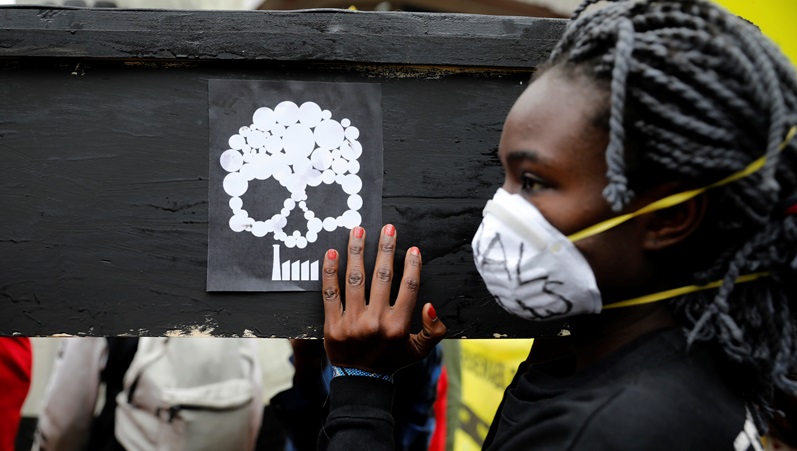
A Greenpeace activist protests against a coal plant in Kenya, on June 12, 2019. (Photo: Baz Ratner/Reuters)
7. In Nagorno-Karabakh, Azerbaijan’s net zero vision clashes with legacy of war
Oil and gas-reliant Azerbaijan and the rest of Central Asia have stayed under the climate radar for a long time. But that changed as Azerbaijan’s capital Baku hosted COP29 in 2024, thrusting the authoritarian regime and its energy policies into the limelight.
Azerbaijan’s government spent big money taking journalists, including our own Matteo Civillini, to see its new “smart villages”, hydropower plants and solar energy installations in the conflict-torn region of Nagorno-Karabakh.
What they didn’t draw attention to – but Climate Home reported anyway – was that Armenians had been chased out of these villages less than a year before our visit. “It’s greenwashing of an ethnic cleansing,” one analyst said.

Azerbaijan President Ilham Aliyev tours the “smart” village of Aghali in an electric cart. (Photo: Azerbaijan Presidency)
8. World Bank climate funding greens African hotels while fishermen sink
COP29 was Azerbaijan’s COP – but also the “finance COP”. Figures of millions, billions and trillions of dollars shot around in press releases, while journalists struggled to differentiate between verbs like “mobilise” and “provide”.
But what exactly is counted in the figures that make up climate finance? How about when you help Qatar’s sovereign wealth fund and a huge hotel corporation buy up a chain of African hotels and spruce them up to luxury standard in an energy-efficient manner? If you ask the World Bank Group – which has ambitious targets to increase climate finance – this makes the cut.
Our reporter Jack Thompson hung out at one of these five-star hotels in Senegal (not the worst assignment) and then spoke to local fishermen just down the coast, who said they’d rather the money was spent helping them protect the beaches that are their workplace from rising sea levels.
With wealthy nations pledging at COP29 to increase their climate finance to $300 billion a year by 2035 – much of it coming from development institutions like the World Bank – this story, an award finalist, shows the importance of questioning the top-line numbers.

Le Lamantin Hotel, in Saly, Senegal, where a standard room costs about $220 a night. (Photo: Jack Thompson)
9. From cyclone to drought, Zimbabwe’s climate victims struggle to adapt
And in Zimbabwe we found more evidence that quantity isn’t all that matters. You can spend all you want on a climate project but if it’s badly-designed, it’s no use.
That’s what Matteo Civillini learned from a visit to the country’s eastern highlands, where cyclone victims have been moved out of a storm-prone area and into a drought-prone one where the authorities lack the money to build a planned dam. Out of the frying pan into the fire, you might say.
People in the resettled community said that, despite the cyclone risks, they miss their old home and its bountiful water supply. “We’d never run out of water – we could always access fresh food,” one said. “Here it’s more difficult.”

Tambudzai Chikweya stands in front of her home in Runyararo. Photo: Matteo Civillini
(Writing by Joe Lo, editing by Megan Rowling)
The post Nine of our best climate change stories from 2024 appeared first on Climate Home News.

The industry group pays politicians to convince voters that natural gas is the “most affordable and reliable energy source.”
PHILADELPHIA—Sitting on a dais at the private Fitler Club for what was billed as a discussion about “the Path to a Clean Energy Future,” former Philadelphia Mayor Michael Nutter played to his audience.
Lawmakers failed to bring back formal public hearings in electric rate cases and constrained state environmental regulators. But citizen opposition helped kill a move to end PSC elections.
MONTGOMERY, Ala.—Despite setbacks and some significant legislative defeats, Alabama environmentalists’ biggest takeaway from the 2026 legislative session is that growing citizen opposition to weak regulation and high energy prices has put real pressure on elected officials and begun to change the political landscape, slowly but surely.
As the Alabama Legislature Adjourns, Environmentalists See a Silver Lining
Climate Change
After a Slow Start on Climate, Zohran Mamdani Faces Scrutiny Over Parks Budget and Environmental Promises
Climate-conscious New Yorkers hope the mayor hasn’t forgotten them.
During his New York City mayoral campaign, Zohran Mamdani courted votes from environmentalists. He promised to expand green spaces in public schools and equip them with renewable energy, to meet the demands of the city’s building electrification laws and to increase investments in city parks.


-
Climate Change8 months ago
Guest post: Why China is still building new coal – and when it might stop
-
Greenhouse Gases8 months ago
Guest post: Why China is still building new coal – and when it might stop
-

 Greenhouse Gases2 years ago
嘉宾来稿:满足中国增长的用电需求 光伏加储能“比新建煤电更实惠”
-
Climate Change2 years ago
Bill Discounting Climate Change in Florida’s Energy Policy Awaits DeSantis’ Approval
-

 Climate Change2 years ago
嘉宾来稿:满足中国增长的用电需求 光伏加储能“比新建煤电更实惠”
-
Climate Change Videos2 years ago
The toxic gas flares fuelling Nigeria’s climate change – BBC News
-

 Renewable Energy6 months ago
Sending Progressive Philanthropist George Soros to Prison?
-

 Carbon Footprint2 years ago
US SEC’s Climate Disclosure Rules Spur Renewed Interest in Carbon Credits