

Hundreds of scientists gathered in Oxford last week to discuss the many different ways of removing carbon dioxide from the atmosphere and the role it can play in tackling climate change.
The third international conference on negative CO2 emissions focused on the latest science, policy gaps and methods of carbon dioxide removal (CDR). (Carbon Brief also reported from the first conference in Gothenburg in 2018.)
Discussions ranged from the potential of different technologies to the need to avoid CDR methods drawing attention away from emissions reductions.
Around 360 scientists, researchers, industry representatives and other stakeholders attended the four-day event at the University of Oxford, along with more than 150 people online.
Talks centred on the “natural” and “novel” ways to take CO2 from the atmosphere and store it on land, underground or in the ocean.
Carbon Brief attended the conference to report on the dozens of plenaries and parallel sessions that focused on a wide range of issues around CO2 removal.
- The state of CO2 removal
- What CO2 removal techniques were discussed?
- How is CDR included in government policies?
- How does CDR fit into future emissions pathways?
- What are the potential problems with CO2 removal?
- What are the next steps for CO2 removal?
The state of CO2 removal
Dr Steve Smith – the executive director of Oxford Net Zero and CO2RE – kicked off the conference in the opening plenary.
Smith is the lead author on the second “State of CDR” report, which outlines the current state of knowledge around CDR, and used his talk to outline some of its findings. (Read Carbon Brief’s nine key takeaways from the report here.)
Smith explained that “conventional” CDR – mainly through land use, land-use change and forestry activities – make up the “lion’s share” of current CDR efforts, accounting for almost all of the current 2bn tonnes of CO2 removed from the atmosphere each year. (Humans emit around 40bn tonnes each year.)

“Novel” CDR methods currently remove a much-smaller 1.3m tonnes of CO2 each year – less than 0.1% of total carbon dioxide removals – he noted.
Of the novel approaches, he explained that biochar is the main player. This is followed by bioenergy with carbon capture and storage (BECCS), which is confined to “essentially two plants in the US”.
All other CDR efforts, such as direct air carbon capture and storage (DACCS) are a “tiny, tiny sliver”. This breakdown is outlined in the graphic from the report below.

Smith noted that almost all current model simulations that limit future warming to 1.5C above pre-industrial levels use CDR methods such as BECCS.
However, he said that many models – such as those that feed into reports from the Intergovernmental Panel on Climate Change (IPCC) – begin their projections from the year 2020. Many models assume that emissions already peaked in 2020, but emissions today are continuing to rise. Smith warned:
“We are already overshooting.”

Speaking to Carbon Brief at the conference, Smith said that there is a “tension” between fast and responsible action to scale up carbon dioxide removals. He added:
“People are seeing the urgency of the climate problem and saying we need to scale lots of things now and fast.
“So probably the basic biogeochemical principles are sound, but [an important step is] actually measuring how much carbon is taken up, how quickly and what are the broader impacts on the environment and on people.”
In a separate session, experts discussed “measurement, reporting and verification” – ways to assess methods of CDR technologies to ensure they are working effectively. This is similar to discussions around monitoring the voluntary carbon market. (See Carbon Brief’s special series on carbon offsetting for more.)
Dr Paul Zakkour from Carbon Counts, a climate and energy consulting company, opened the second day of the conference by discussing the importance and challenges of monitoring, reporting and verifying claims about CO2 removals.

Zakkour said the most important principles for any carbon removal carbon credits are ensuring that they are real, measurable, additional, not double counted, not leaking and permanent.
He said there are more than 50 methodologies crediting “natural” methods of CDR such as forest management and soil organic carbon.
There are around 20 methodologies for novel CDR methods. Almost all of these methodologies were developed in just the past three years, he said.
However, he added that it is unclear how many projects are actually using these methodologies to enter voluntary carbon markets.
Zakkour noted that there is a “compromise” between ramping up carbon removals and ensuring they are done effectively, safely and in line with best scientific practices.
What CO2 removal techniques were discussed?
Over the four-day conference, there were dozens of breakout sessions discussing different CO2 removal techniques, ranging from bioenergy with carbon capture and storage (BECCS) to enhanced rock weathering. Carbon Brief focuses on a few of the methods here:
Forestry
Among the land-based CDR methods, forestry was a major point of discussion.
Dr Yuan Yao from Yale University discussed her ongoing research into sequestering carbon through afforestation and reforestation on “marginal land” in Brazil. Her research team examined the CO2 impacts of “innovative forest mosaics”.

Xueyuan Gao from the University of Maryland, whose research is currently under peer review, developed a novel framework to try and detect tropical tree cover gains, using forest management and cover change datasets. The study particularly focused on former agricultural lands.
At a separate session focused on Earth system modelling, Prof Julia Pongratz – a group leader at the Max Planck Institute for Meteorology – told the conference that modelling studies on large-scale afforestation and reforestation often involve “unrealistic” or “unambitious” spatiotemporal patterns.
Pongratz presented a pattern of afforestation and reforestation that she and her team developed. The pattern is aligned with “ambitious” country pledges and would result in 600m hectares of afforested/reforested land by 2060, while staying in line with “biodiversity and techno/socio/economic considerations”, she said.
This level of afforestation and reforestation would capture enough CO2 to offset global warming by 0.2C by the end of the century, Pongratz told the conference.
And at another session, Dr Clemens Schwingshackl, a researcher at the Ludwig Maximilian University of Munich, presented results from the state of CDR report on afforestation and reforestation. He explained that CDR from these two sources currently capture around 2,000m tonnes of CO2 (MtCO2) per year – equivalent to around 5-6% of current fossil fuel emissions.
He added that there are “hotspots” of tree planting. The main one is in China, where there are lots of forest plantations, he explained. And the other is in Europe, where a long history of deforestation is now being reversed in many areas.
Dr Kate Dooley, a lecturer in human geography at the University of Melbourne, presented the results of the 2022 land gap report, which assesses how much land is required to meet current NDCs and net-zero pledges.
Dooley, who is lead author on the report, explained that 194 countries were assessed and that, collectively, their afforestation, reforestation and BECCS pledges require one billion hectares of land. This is an ”unprecedented” amount of land-use change, which could increase risks to ecosystems, food security and the durability of carbon stocks, she warned.
She added that 70% of the total land required by these climate pledges comes from just a few, high-emitting countries.
Bioenergy with carbon capture and storage
Another session focused on bioenergy with carbon capture and storage (BECCS), a technology where plants are burned for energy and the resulting CO2 emissions are captured from air and stored under land or sea.
Dr Mai Bui from Imperial College London outlined research around minimising the cost of BECCS while ensuring the technology is CO2-efficient.

Her research shows that using biomass with a “low carbon footprint” and reducing supply chain emissions can help to maximise the overall CO2 removals of BECCS. She said that this is important in ensuring that the technology is implemented correctly, noting:
“You can do BECCs badly and end up emitting more CO2 than you can capture.”
Prof Iain Donnison from Aberystwyth University discussed the possibilities and realities of upscaling “perennial biomass crops” in the UK for the purpose of removing GHG emissions.
He said that a “significant challenge” with BECCS is producing enough wood and other types of biomass to burn for the technology.
He and other researchers are looking at the technical barriers to scaling up biomass crops, trialling different plant options such as miscanthus. Another issue around increasing growth of biomass crops is incentivising farmers to grow them, he said, adding:
“How do we get these to be seen as a more usual option for farmers?”
Dr Sabine Egerer from the Ludwig Maximilian University of Munich discussed research looking at the different levels of efficiency of various land-based CO2 removal methods, namely afforestation and planting biomass crops for use in CDR technologies.
This research, which is currently undergoing peer review, finds that biomass plantations are more efficient at removing carbon from the atmosphere over time. But this varies in different parts of the world, such as China where afforestation has more benefits.
Kristine Karstens from the Potsdam Institute for Climate Impact Research discussed ongoing research into the benefits of different ways to use biomass in CDR – residue recycling and BECCS.
Her findings show that using agricultural residues for BECCS has more benefits for carbon removal overall compared to residue recycling, per tonne of biomass.
Separately, Ruben Prutz – a PhD student at the Mercator Research Institute – talked about the implications of land-based CDR for biodiversity.

He looked at more than 130,000 species globally, and mapped how afforestation and BECCS would change biodiversity refugia – habitats that are less prone to extreme changes in environmental conditions than surrounding areas, and which often act as safe havens for species.
He showed that the impacts of land-based CDR are unequally distributed, mainly falling on countries in the global south.
There were also two conference sessions on direct air carbon capture, in which scientists discussed technological developments and the different engineering challenges that face the sector.

Soils and biochar
The ability of soils to sequester carbon from the atmosphere was a key discussion point at the conference. There was also a session on biochar – charcoal that is added to soils rather than burned as a fuel.
Prof Pete Smith from the University of Aberdeen discussed an ongoing systematic review looking at the side effects of different types of CDR on biodiversity, air, water quality and other factors (see: What are the next steps for CO2 removal?).

Smith said the research is not expected to yield “big shifts in the cost and potentials” of these methods, but it aims to provide deeper analysis on the co-benefits and trade-offs of each method.
He added that previous research has found there is a potential to remove 5bn tonnes of CO2-equivalent (GtCO2e) each year from soils.
Dr Jeewani Peduru Hewa from Bangor University discussed ongoing research on greenhouse gas removals through peatland restoration, including applying biochar to peatlands.

A number of universities and NGOs are working together to restore different peatland sites across the UK to assess whether “innovative” land management can secure long-term greenhouse gas removal systems, she said, noting:
“When peatlands are healthy they are good for carbon sequestration. But if we drain the peatlands for agriculture or something else, it is a problem.”
Rewetting peatlands helps them to absorb carbon dioxide, but this can also cause methane emissions to rise. Her experimental research findings show that applying biochar to peatlands can lower both CO2 and methane emissions.
These findings were concluded over the course of one year and further research is needed to assess impacts over a longer time period, she said.
Marine CO2 removal
Removing carbon through the ocean was another significant discussion point at the conference.
Speaking in a plenary session on measuring, reporting and verification, Prof David Ho from the University of Hawaiʻi at Mānoa said that marine carbon removal still has many challenges to overcome before it is feasible on a wide scale.
Assessing this type of carbon removal is “challenging” due to the ocean’s natural variability, carbonate chemistry, ocean mixing and circulation, Ho said. It is difficult to pinpoint one specific reason for a change or an increase in CO2 sequestration.

Ho said that “abiotic” methods of marine CO2 removal are “easier” to monitor, report on and verify. These include ocean alkalinity enhancement. Last month, the carbon removals registry Isometric said it released a “world first” protocol for ocean alkalinity carbon removal.
Asked by an audience member about whether marine CO2 removal should be excluded from carbon markets due to the level of uncertainties, Ho said the ocean has the “potential” to make an impact, but advised caution. He added:
“I think if we can do a good job of quantifying the uncertainties…this is how ramp-ups can work. If buyers and sellers can trust each other, I think the ocean can certainly play a role.”

In a separate session on marine CO2 removal, Dr Miranda Boettcher – a researcher at the German Institute for International and Security Affairs – presented the results of a workshop that she ran in Germany, in which she asked participants to rank the main risks of marine CDR.

She highlighted public opinion, political dynamics, the “performance” of science and pressure from industry as key conditions that will drive policy developments in marine CDR.
Separately, Dr Christine Merk – deputy director of the Global Commons and Climate Policy research centre at the Kiel Institute – presented the results of a survey held in six different countries on public perceptions of marine CDR.
She found that more than 80% of people in Germany and Canada had never heard of marine CDR, compared to 28% and 41% in Taiwan and China, respectively. She added that people are least likely to have heard of ocean acidity enhancement and most likely to have heard of marine-based BECCS.
How is CDR included in government policies?
The conference heard from a number of researchers about the role of government in regulating CO2 removal, including a plenary panel session dedicated to the topic of CDR in national policymaking.
Prof Gideon Henderson, a professor of Earth sciences and chief scientific adviser to the UK’s Department of Environment, Food and Rural Affairs (Defra), spoke about how CDR is used in carbon markets.
Henderson said that a government’s role is to fix market failures through regulation and deregulation, and to be stewards of the environment. However, he noted that governments cannot easily regulate the voluntary carbon market and said it should “try to get more engaged” – for example, by implementing monitoring, reporting and verification measures.
He added that the voluntary carbon market is “not trusted” by many people, but argued that it is important to keep the market going, to enable experts to try things out and eventually build a more trusted system.
Speaking on national policies, he said that countries are “not quite there yet” and argued that CDR measures should be included in countries’ nationally determined pledges under the Paris Agreement.
Dr Fabiola Zerbini, director at the department of forests at Brazil’s Ministry of the Environment, told the conference that the country has pledged to restore 12m hectares of deforested land and reach “zero deforestation” by 2030.
The role of the government as a “catalyst” for this type of action is “key”, she said. She argued that until forests and the environmental services that they provide are considered to have “real value”, the system will need to be regulated by governments.
Prof Jennifer Wilcox, former principal deputy assistant secretary at the US Department of Energy, told the conference about the CDR projects in place in the US. She highlighted the regional direct air capture (DAC) hubs program, which is investing $3.5bn into direct air capture.
She also talked about how the fossil fuel companies responsible for extraction could play an important role in CDR:
“It could be interesting for the energy companies responsible for resource extraction to realise they could leverage their structures to put carbon back into the ground. [We] need to steer energy companies so that when they put infrastructure in, it can be used for CDR.”
When asked about the upcoming US election, she said that the administration has put frameworks in place that will make their work sustainable and so she did not think that a Republican victory would cause all current projects to be “erased”. However, she did express concern about whether measures would be kept in place to make sure that the projects “benefit people”.
Dr Fabien Ramos, carbon removals lead at the European Commission, talked about policies that the EU is putting in place to monitor and verify CDR in its emission trading system, and the regulations being put in place to assess the quality of carbon offsets.
In a separate session on global policy, Harry Smith, a researcher from the University of East Anglia, presented his work on the inclusion of “residual” or “hard-to-abate” emissions in national policies. (Read Carbon Brief’s coverage of this study.)
Smith analysed the national climate strategies of 71 counties, and found that only 26 of them quantify residual emissions at the time of reaching net-zero emissions.

He noted that countries define their own residual emissions and found that the percentage of a country’s peak emissions that it considers “residual” can range from 5% to 50%.
He also explained that despite making up the majority of residual emissions, agricultural emissions are “hardly mentioned as residual”. Industry sources are mentioned the most, he found.
In a separate session, Klaas Korte from the Helmholtz-Centre for Environmental Research discussed ongoing research into policies to incentivise the efficient use of CO2 removal in the agriculture sector.
“Carbon farming” – farm practices focused on climate mitigation – may be one way to bridge the gap between the EU’s “ambitious targets” to cut agricultural emissions and the reality of these cuts so far, he said.
His research showed a number of ways to make carbon farming more attractive than conventional methods: subsidising costs of CDR measures, implementing CDR requirements on state-owned lands and excluding conventional practices on state-owned land.
The best solution, he said, is a mix of payment for public goods that avoid adverse environmental effects and bridging knowledge gaps among farmers and other landowners.
Dr Lauri Kujanpää from the VTT Technical Research Centre of Finland discussed the carbon removal possibilities in Finland.
Kujanpää said that his research points to geological storage as a “key solution” for CO2 removal in Finland, but noted that the country currently has no national policy measures for this type of CO2 storage.
How does CDR fit into future emissions pathways?
Dr William Lamb from the Mercator Research Institute on Global Commons and Climate Change discussed recent research on the CDR “gap”, which was covered by Carbon Brief.
The study, published in Nature Climate Change, found that plans to “draw down” CO2 from the atmosphere “fall short” of the quantities needed to limit global warming to 1.5C above pre-industrial levels.
Assessing a range of scenarios for limiting warming to 1.5C, the authors found a “CDR gap” in 2050 of 0.4bn-5.5bn tonnes of CDR per year.
To fill this gap, Lamb said there is a need to identify and quantify country plans around CDR as nations are currently not required to specify these removals in the national plans submitted at COP climate summits.
He highlighted that there are differences in the land-use sector carbon emissions in national inventories and scientific models. (This was covered in more detail in a Carbon Brief guest post last year.)
Most countries only include plans about conventional, land-based CDR methods in their national plans up to 2030, Lamb explained. Some long-term emissions reduction plans include novel techniques such as BECCS.
Dr Matthew Gidden from the International Institute for Applied Systems Analysis discussed similar issues about aligning emissions scenarios from the Intergovernmental Panel on Climate Change (IPCC) with national land emissions inventories.
Gidden said there are a number of differences between the models and inventories, including how countries define their “managed land” and carbon fluxes.
His research, published in Nature last year, aligned the IPCC mitigation pathways with national greenhouse gas inventories to allow a direct comparison. The findings suggested that key emission-cutting goals are “harder to achieve” than currently outlined and that countries would have to reach net-zero emissions sooner than 2050.
Dr Kati Koponen from VTT Technical Research Centre of Finland presented findings from a project assessing the pathways for CDR in the EU.
These findings highlighted the importance of focusing on both natural and novel CDR methods, but also mentioned the need to keep dependence on CDR “to a minimum”.
Koponen said the findings also show that existing EU CDR policies “are not sufficient for deep emission reductions”.
Dr Jennifer Pett-Ridge from the Lawrence Livermore National Laboratory outlined the findings of a recent report on the options for CDR in the US.
The report – put together by almost 70 scientists and 13 institutions – looks at regional possibilities for CDR and storage. Pett-Ridge said the US can reduce 1bn tonnes of CO2 from the atmosphere each year by 2050 using CDR methods, at an annual cost of $129bn.
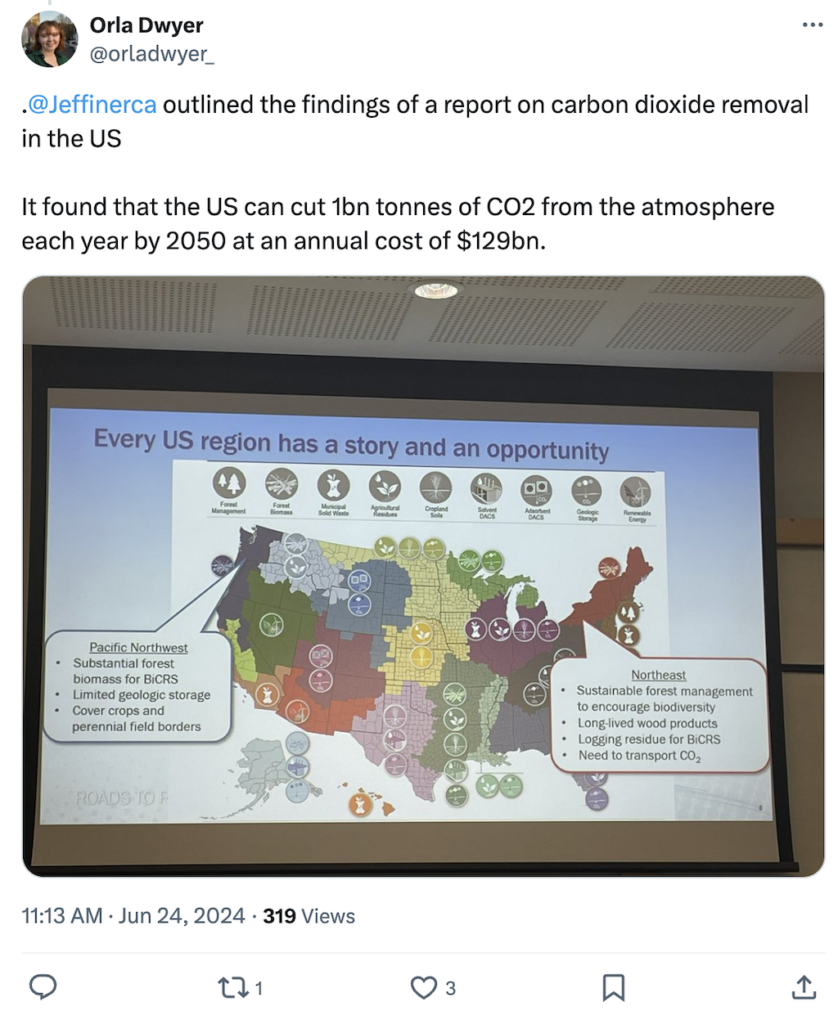
She said it is sensible to initially focus on forestry and soils. Biomass conversion also has big potentials, she added. The researchers also analysed issues in inequity and justice as part of their analysis.
Meanwhile, Prof Kirsten Zickfeld – a professor of climate science at Simon Fraser University – discussed the global temperature response to CDR. She simulated 100GtCO2 of CDR from the atmosphere and calculated how atmospheric CO2 levels changed as the Earth system re-equilibrates.
She then modelled how the temperature of the planet would change in response. Comparing 100GtCO2 of CDR with a simple 100GtCO2 reduction in global emissions, she found that they probably do not have equivalent effects on global temperatures.
However, she says that due to the uncertainty in the models, it is unclear whether carbon removal drives a greater or smaller change in global temperatures than the same amount of reduced CO2 emissions. (Zickfeld explains more about this “asymmetrical” response in a Carbon Brief guest post from 2021.)
In a separate session, Dr Morgan Edwards, an assistant professor at the University of Wisconsin-Madison, talked about the risks of relying on uncertain CDR technologies in climate policy.
Edwards noted how difficult it is to predict the uptake of CDR over the coming century and explained the dangers of scenarios in which politicians rely on high CDR deployment, only for its rollout to be much lower than expected. She concluded that the most robust strategy is “planning for the worst and hoping for the best”.

Finally, Tabea Dorndorf, a doctoral researcher at Potsdam Institute for climate impact research, discussed the relative advantages and disadvantages of biochar, BECCS, DACCS and enhanced rock weathering. She explained that in a “middle of the road” scenario, it is likely that BECCS will be the biggest player, due to its higher carbon and biomass efficiency.

What are the potential problems with CO2 removal?
One of the main concerns around CDR is that promoting negative emissions technologies might draw attention away from the need to reduce emissions – a phenomenon known as “mitigation deterrence”.
The final day of the conference addressed this concern in a plenary session called, “How do we ensure CDR supports emission reductions instead of slowing them?”, chaired by Dr Holly Buck – an assistant professor from the University at Buffalo.

To open the session, Buck invited the conference attendees to fill in a poll, asking how concerned they are that CDR could slow down emissions reductions, and how concerned they are that mitigation deterrence could slow down CDR development.
The results, shown below, show that conference attendees were generally more concerned about the former than the latter.

The panel agreed unanimously that CDR is not a substitute for cutting emissions and that it should only be used for hard-to-abate or “residual” emissions.
Dr Zeke Hausfather, climate research lead at the financial technology company Stripe, warned that if society does not cut emissions, even a “wildly successful” CDR effort will still only reduce global warming from 2.7C to 2.6C by 2100, so mitigation is still crucial. (Haufather is also a climate science contributor for Carbon Brief.)
He added that mitigation deterrence in private companies is one of the main problems with CDR, explaining that it is almost always cheaper for companies to buy a carbon offset than to take action to reduce their own emissions, saying that the low price of CDR offsets do not reflect their true value. (See Carbon Brief’s special series for more on carbon offsets.)
This means that companies are more likely to buy CDR offsets than decarbonise their own industries, Hausfather said, warning that this “lets companies off the hook” on reducing their own emissions.
He told the conference that to correct for this, governments need to “play a much more active role” in regulation.
Hausfather also argued that “in a world in which CDR didn’t exist, global emissions would not be much different,” saying that in his view, the reason people are emitting today is not because they are banking on CDR, but because mitigation is too expensive.
He said there has been plenty of “much-needed” criticism of carbon offsets, highlighting an investigation into Verra carbon offsets, which found that more than 90% are “worthless”.
However, he noted that part of the response to criticism has been a “large-scale retreat by companies” of all types of offsets – including those which are “good”. He said that the negative emissions community needs to be clear about what companies should do, as well as what they shouldn’t.
Dr Nils Markusson – a senior lecturer at Lancaster University’s environment centre – shared his worry that CDR gives governments and companies a reason to delay or avoid decarbonising their economies.
He called it “suspicious” that governments and companies seem “very optimistic about CDR while very pessimistic about mitigation”. He warned that “CDR optimism sits very comfortably alongside a lack of ambition for phasing out fossil fuels” and called it “a way of avoiding politics”.
Dr Sara Nawaz, a researcher at the University of Oxford, shared concerns that companies are responsible for defining their own residual emissions and could define them in the way that best suits them.
Nawaz also noted the danger that CDR could lead to “competition with other resources that are needed for mitigation, for example land, water and energy”. She also told the conference that CDR can “bake in” an “equivalence” between CO2 emissions and removals that may not exist.

Hausfather said that the Science Based Targets Initiative (SBTi) – a “corporate climate action organisation” have “got the framework right” by suggesting separate emissions and removals targets. (The SBTi recently got into hot water over its stance on carbon credits.)
Hausfather also highlighted the problem of greenwashing, telling that audience that he worried that companies would spend some money implementing some CDR, but then spend vast amounts more money publicising it.
Hausfather also noted the tendency for models to be over reliant on CDR. He explained that in many model simulations, global temperatures overshoot key thresholds early in the century and then CDR is used to bring temperature back down later in the century. Models are “far too cavalier about overshoot”, he said.
What are the next steps for CO2 removal?
In the penultimate plenary session of the conference, Prof Sabine Fuss from the Mercator Institute presented the initial stages of a “systematic review ecosystem on CDR”.
She explained that there has been “exponential growth” in literature on CDR, with some 23,000 papers included in the latest IPCC assessment cycle alone.
Hundreds of experts – including many scientists in the conference room – are working to synthesise this literature, Fuss said. She explained that the team has already grouped the studies into “clusters” of different CDR methods and developed a shared protocol so that methods and definitions are consistent across the groups.

For each cluster, an expert-led review team will work to produce an “in-depth paper”, Fuss said. A few group leads presented the early stages of their work.
Mijndert Van der Spek – an associate professor at Heriot Watt University and lead of the DAC group, explained that they “only” have 800 papers to review. Meanwhile, Prof Claudia Kammann, a researcher at Hochschule Geisenheim University, said her team on biochar had 38,000 papers to work with.
There are around 2,000 papers on BECCS to review and more than 2,000 for a cross-cutting topic on “monitoring, reporting and verification”, the respective leads of these teams said.
Dr Finn Muller-Hansen is a researcher at the Mercator research institute and head of a cross-cutting group on public perceptions to CDR. He explained that most of the 165 papers in this area of research are focused on western countries. Most studies showed low awareness of CDR and mixed or positive attitudes towards different methods, he found.
He also outlined the main factors that affect peoples’ opinions of CDR, including the perceived “naturalness” of the method, trust in institutions and perceived risks and benefits of each method.
In the final session of the conference, former Conservative MP and chair of the COP26 climate summit Alok Sharma addressed the attendees. He said that “governments are not acting quickly enough” to tackle CO2 emissions, adding:
“I think that we need to be doing everything very quickly. I don’t think there is some sort of divide between trying to take CO2 out of the atmosphere and doing more in terms of renewables…The pace isn’t fast enough.”

Film director and producer Leila Conners also spoke to conference attendees about her upcoming documentary Legion 44, which focuses on CDR technologies.
This is part of her film trilogy that also included the 11th Hour, a documentary featuring actor Leonardo DiCaprio.
Speaking to Carbon Brief about the range of discussions at the four-day conference, Dr Steve Smith said the discourse has changed since the first negative CO2 emissions conference in 2018. He told Carbon Brief:
“There’s a wider range of methods being looked at and a broader range of disciplines being brought to bear to look at this issue…Policymakers in particular are starting to move on this issue.”
Smith noted that in future, countries “may well need a lot of carbon removal as well as cutting emissions”. He added:
“For me, it’s not really emphasising just the trees or just the technologies. But we have a range of options and we should be exploring all of them at the moment.”
The next negative CO2 emissions conference will be held in Vienna, Austria in 2026.


The post Negative emissions: Scientists debate role of CO2 removal in tackling climate change appeared first on Carbon Brief.
Negative emissions: Scientists debate role of CO2 removal in tackling climate change

N.C. Gov. Josh Stein wants state lawmakers to rethink tax breaks for data centers. The industry’s opacity makes it difficult to evaluate costs and benefits.
Tax breaks for data centers in North Carolina keep as much as $57 million each year into from state and local government coffers, state figures show, an amount that could balloon to billions of dollars if all the proposed projects are built.
The Global Environment Facility (GEF), a multilateral fund that provides climate and nature finance to developing countries, has raised $3.9 billion from donor governments in its last pledging session ahead of a key fundraising deadline at the end of May.
The amount, which is meant to cover the fund’s activities for the next four years (July 2026-June 2030), falls significantly short of the previous four-year cycle for which the GEF managed to raise $5.3bn from governments. Since then, military and other political priorities have squeezed rich nations’ budgets for climate and development aid.
The facility said in a statement that it expects more pledges ahead of the final replenishment package, which is set for approval at the next GEF Council meeting from May 31 to June 3.
Claude Gascon, interim CEO of the GEF, said that “donor countries have risen to the challenge and made bold commitments towards a more positive future for the planet”. He added that the pledges send a message that “the world is not giving up on nature even in a time of competing priorities”.
-
UK imports of “green” jet fuel linked to Amazon deforestation
A Texas refinery shipping sustainable aviation fuel to Europe has sourced beef tallow with links to a meatpacking firm fined over illegal cattle purchases -
Italy pushes coal exit back after gas prices rise
Analysts say the move sends a negative signal, but its impact will be limited given coal’s marginal role in Italy’s energy mix


Donors under pressure
But Brian O’Donnell, director of the environmental non-profit Campaign for Nature, said the announcement shows “an alarming trend” of donor governments cutting public finance for climate and nature.
“Wealthy nations pledged to increase international nature finance, and yet we are seeing cuts and lower contributions. Investing in nature prevents extinctions and supports livelihoods, security, health, food, clean water and climate,” he said. “Failing to safeguard nature now will result in much larger costs later.”
At COP29 in Baku, developed countries pledged to mobilise $300bn a year in public climate finance by 2035, while at UN biodiversity talks they have also pledged to raise $30bn per year by 2030. Yet several wealthy governments have announced cuts to green finance to increase defense spending, among them most recently the UK.
As for the US, despite Trump’s cuts to international climate finance, Congress approved a $150 million increase in its contribution to the GEF after what was described as the organisation’s “refocus on non-climate priorities like biodiversity, plastics and ocean ecosystems, per US Treasury guidance”.
The facility will only reveal how much each country has pledged when its assembly of 186 member countries meets in early June. The last period’s largest donors were Germany ($575 million), Japan ($451 million), and the US ($425 million).
The GEF has also gone through a change in leadership halfway through its fundraising cycle. Last December, the GEF Council asked former CEO Carlos Manuel Rodriguez to step down effective immediately and appointed Gascon as interim CEO.
Santa Marta conference: fossil fuel transition in an unstable world
New guidelines
As part of the upcoming funding cycle, the GEF has approved a set of guidelines for spending the $3.9bn raised so far, which include allocating 35% of resources for least developed countries and small island states, as well as 20% of the money going to Indigenous people and communities.
Its programs will help countries shift five key systems – nature, food, urban, energy and health – from models that drive degradation to alternatives that protect the planet and support human well-being by integrating the value of nature into production and consumption systems.
The new priorities also include a target to allocate 25% of the GEF’s budget for mobilising private funds through blended finance. This aligns with efforts by wealthy countries to increase contributions from the private sector to international climate finance.
Niels Annen, Germany’s State Secretary for Economic Cooperation and Development, said in a statement that the country’s priorities are “very well reflected” in the GEF’s new spending guidelines, including on “innovative finance for nature and people, better cooperation with the private sector, and stable resources for the most vulnerable countries”.
Aliou Mustafa, of the GEF Indigenous Peoples Advisory Group (IPAG), also welcomed the announcement, adding that “the GEF is strengthening trust and meaningful partnerships with Indigenous Peoples and local communities” by placing them at the “centre of decision-making”.
The post GEF raises $3.9bn ahead of funding deadline, $1bn below previous budget appeared first on Climate Home News.
GEF raises $3.9bn ahead of funding deadline, $1bn below previous budget
Tropical cyclones that rapidly intensify when passing over marine heatwaves can become “supercharged”, increasing the likelihood of high economic losses, a new study finds.
Such storms also have higher rates of rainfall and higher maximum windspeeds, according to the research.
The study, published in Science Advances, looks at the economic damages caused by nearly 800 tropical cyclones that occurred around the world between 1981 and 2023.
It finds that rapidly intensifying tropical cyclones that pass near abnormally warm parts of the ocean produce nearly double – 93% – the economic damages as storms that do not, even when levels of coastal development are taken into account.
One researcher, who was not involved in the study, tells Carbon Brief that the new analysis is a “step forward in understanding how we can better refine our predictions of what might happen in the future” in an increasingly warm world.
As marine heatwaves are projected to become more frequent under future climate change, the authors say that the interactions between storms and these heatwaves “should be given greater consideration in future strategies for climate adaptation and climate preparedness”.
‘Rapid intensification’
Tropical cyclones are rapidly rotating storm systems that form over warm ocean waters, characterised by low pressure at their cores and sustained winds that can reach more than 120 kilometres per hour.
The term “tropical cyclones” encompasses hurricanes, cyclones and typhoons, which are named as such depending on which ocean basin they occur in.
When they make landfall, these storms can cause major damage. They accounted for six of the top 10 disasters between 1900 and 2024 in terms of economic loss, according to the insurance company Aon’s 2025 climate catastrophe insight report.
These economic losses are largely caused by high wind speeds, large amounts of rainfall and damaging storm surges.
Storms can become particularly dangerous through a process called “rapid intensification”.
Rapid intensification is when a storm strengthens considerably in a short period of time. It is defined as an increase in sustained wind speed of at least 30 knots (around 55 kilometres per hour) in a 24-hour period.
There are several factors that can lead to rapid intensification, including warm ocean temperatures, high humidity and low vertical “wind shear” – meaning that the wind speeds higher up in the atmosphere are very similar to the wind speeds near the surface.
Rapid intensification has become more common since the 1980s and is projected to become even more frequent in the future with continued warming. (Although there is uncertainty as to how climate change will impact the frequency of tropical cyclones, the increase in strength and intensification is more clear.)
Marine heatwaves are another type of extreme event that are becoming more frequent due to recent warming. Like their atmospheric counterparts, marine heatwaves are periods of abnormally high ocean temperatures.
Previous research has shown that these marine heatwaves can contribute to a cyclone undergoing rapid intensification. This is because the warm ocean water acts as a “fuel” for a storm, says Dr Hamed Moftakhari, an associate professor of civil engineering at the University of Alabama who was one of the authors of the new study. He explains:
“The entire strength of the tropical cyclone [depends on] how hot the [ocean] surface is. Marine heatwave means we have an abundance of hot water that is like a gas [petrol] station. As you move over that, it’s going to supercharge you.”
However, the authors say, there is no global assessment of how rapid intensification and marine heatwaves interact – or how they contribute to economic damages.
Using the International Best Track Archive for Climate Stewardship (IBTrACS) – a database of tropical cyclone paths and intensities – the researchers identify 1,600 storms that made landfall during the 1981-2023 period, out of a total of 3,464 events.
Of these 1,600 storms, they were able to match 789 individual, land-falling cyclones with economic loss data from the Emergency Events Database (EM-DAT) and other official sources.
Then, using the IBTrACS storm data and ocean-temperature data from the European Centre for Medium-Range Weather Forecasts, the researchers classify each cyclone by whether or not it underwent rapid intensification and if it passed near a recent marine heatwave event before making landfall.
The researchers find that there is a “modest” rise in the number of marine heatwave-influenced tropical cyclones globally since 1981, but with significant regional variations. In particular, they say, there are “clear” upward trends in the north Atlantic Ocean, the north Indian Ocean and the northern hemisphere basin of the eastern Pacific Ocean.
‘Storm characteristics’
The researchers find substantial differences in the characteristics of tropical cyclones that experience rapid intensification and those that do not, as well as between rapidly intensifying storms that occur with marine heatwaves and those that occur without them.
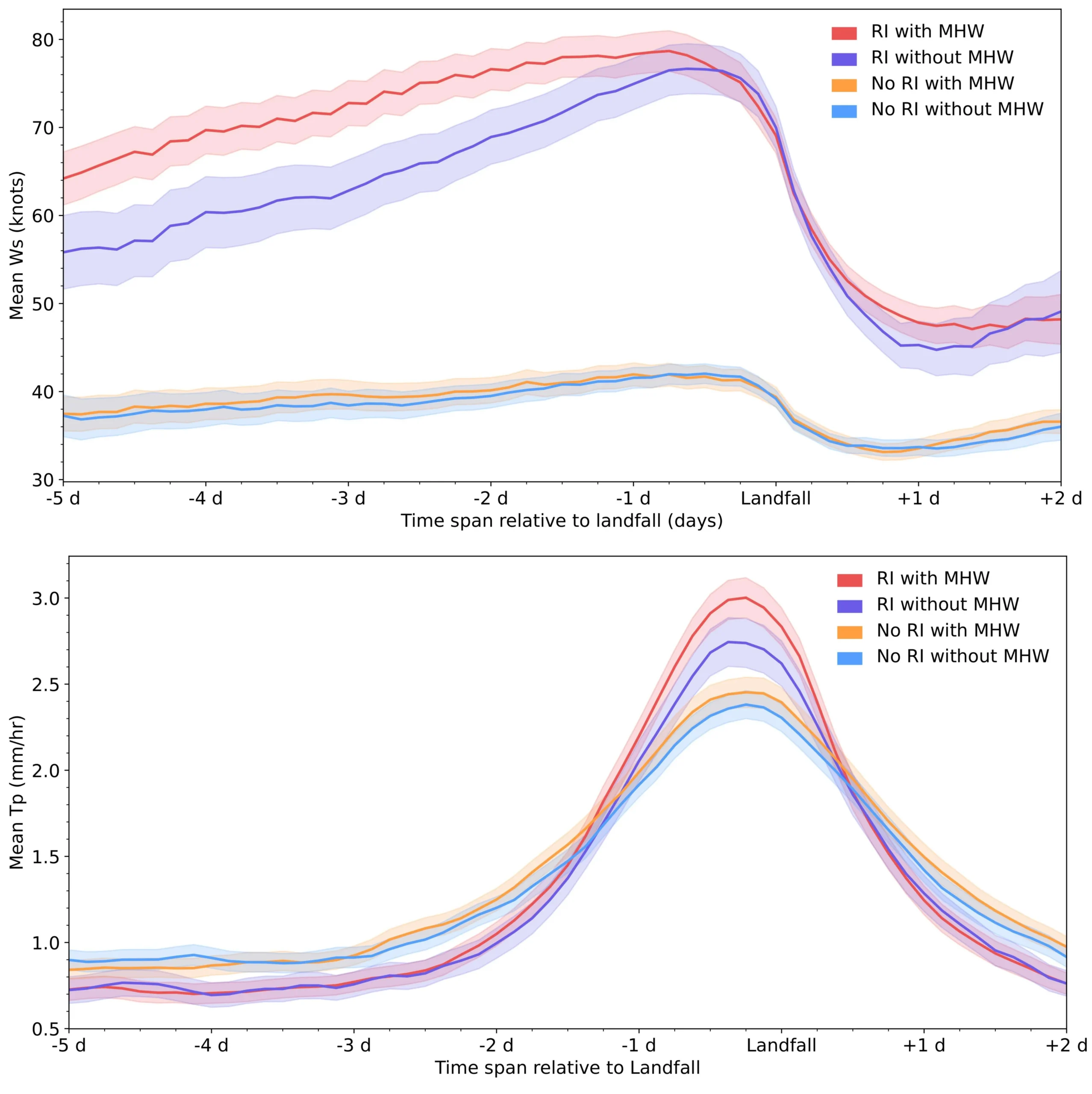
For example, tropical cyclones that do not experience rapid intensification have, on average, maximum wind speeds of around 40 knots (74km/hr), whereas storms that rapidly intensify have an average maximum wind speed of nearly 80 knots (148km/hr).
Of the rapidly intensifying storms, those that are influenced by marine heatwaves maintain higher wind speeds during the days leading up to landfall.
Although the wind speeds are very similar between the two groups once the storms make landfall, the pre-landfall difference still has an impact on a storm’s destructiveness, says Dr Soheil Radfar, a hurricane-hazard modeller at Princeton University. Radfar, who is the lead author of the new study, tells Carbon Brief:
“Hurricane damage starts days before the landfall…Four or five days before a hurricane making landfall, we expect to have high wind speeds and, because of that high wind speed, we expect to have storm surges that impact coastal communities.”
They also find that rapidly intensifying storms have higher peak rainfall than non-rapidly intensifying storms, with marine heatwave-influenced, rapidly intensifying storms exhibiting the highest average rainfall at landfall.
The charts below show the mean sustained wind speed in knots (top) and the mean rainfall in millimetres per hour (bottom) for the tropical cyclones analysed in the study in the five days leading up to and two days following a storm making landfall.
The four lines show storms that: rapidly intensified with the influence of marine heatwaves (red); those that rapidly intensified without marine heatwaves (purple); those that experienced marine heatwaves, but did not rapidly intensify (orange); and those that neither rapidly intensified nor experienced a marine heatwave (blue).
Dr Daneeja Mawren, an ocean and climate consultant at the Mauritius-based Mascarene Environmental Consulting who was not involved in the study, tells Carbon Brief that the new study “helps clarify how marine heatwaves amplify storm characteristics”, such as stronger winds and heavier rainfall. She notes that this “has not been done on a global scale before”.
However, Mawren adds that other factors not considered in the analysis can “make a huge difference” in the rapid intensification of tropical cyclones, including subsurface marine heatwaves and eddies – circular, spinning ocean currents that can trap warm water.
Dr Jonathan Lin, an atmospheric scientist at Cornell University who was also not involved in the study, tells Carbon Brief that, while the intensification found by the study “makes physical sense”, it is inherently limited by the relatively small number of storms that occur. He adds:
“There’s not that many storms, to tease out the physical mechanisms and observational data. So being able to reproduce this kind of work in a physical model would be really important.”
Economic costs
Storm intensity is not the only factor that determines how destructive a given cyclone can be – the economic damages also depend strongly on the population density and the amount of infrastructure development where a storm hits. The study explains:
“A high storm surge in a sparsely populated area may cause less economic damage than a smaller surge in a densely populated, economically important region.”
To account for the differences in development, the researchers use a type of data called “built-up volume”, from the Global Human Settlement Layer. Built-up volume is a quantity derived from satellite data and other high-resolution imagery that combines measurements of building area and average building height in a given area. This can be used as a proxy for the level of development, the authors explain.
By comparing different cyclones that impacted areas with similar built-up volumes, the researchers can analyse how rapid intensification and marine heatwaves contribute to the overall economic damages of a storm.
They find that, even when controlling for levels of coastal development, storms that pass through a marine heatwave during their rapid intensification cause 93% higher economic damages than storms that do not.
They identify 71 marine heatwave-influenced storms that cause more than $1bn (inflation-adjusted across the dataset) in damages, compared to 45 storms that cause those levels of damage without the influence of marine heatwaves.
This quantification of the cyclones’ economic impact is one of the study’s most “important contributions”, says Mawren.
The authors also note that the continued development in coastal regions may increase the likelihood of tropical cyclone damages over time.
Towards forecasting
The study notes that the increased damages caused by marine heatwave-influenced tropical cyclones, along with the projected increases in marine heatwaves, means such storms “should be given greater consideration” in planning for future climate change.
For Radfar and Moftakhari, the new study emphasises the importance of understanding the interactions between extreme events, such as tropical cyclones and marine heatwaves.
Moftakhari notes that extreme events in the future are expected to become both more intense and more complex. This becomes a problem for climate resilience because “we basically design in the future based on what we’ve observed in the past”, he says. This may lead to underestimating potential hazards, he adds.
Mawren agrees, telling Carbon Brief that, in order to “fully capture the intensification potential”, future forecasts and risk assessments must account for marine heatwaves and other ocean phenomena, such as subsurface heat.
Lin adds that the actions needed to reduce storm damages “take on the order of decades to do right”. He tells Carbon Brief:
“All these [planning] decisions have to come by understanding the future uncertainty and so this research is a step forward in understanding how we can better refine our predictions of what might happen in the future.”


The post Marine heatwaves ‘nearly double’ the economic damage caused by tropical cyclones appeared first on Carbon Brief.
Marine heatwaves ‘nearly double’ the economic damage caused by tropical cyclones



-
Climate Change8 months ago
Guest post: Why China is still building new coal – and when it might stop
-
Greenhouse Gases8 months ago
Guest post: Why China is still building new coal – and when it might stop
-

 Greenhouse Gases2 years ago
嘉宾来稿:满足中国增长的用电需求 光伏加储能“比新建煤电更实惠”
-
Climate Change2 years ago
Bill Discounting Climate Change in Florida’s Energy Policy Awaits DeSantis’ Approval
-

 Climate Change2 years ago
嘉宾来稿:满足中国增长的用电需求 光伏加储能“比新建煤电更实惠”
-
Climate Change Videos2 years ago
The toxic gas flares fuelling Nigeria’s climate change – BBC News
-

 Renewable Energy6 months ago
Sending Progressive Philanthropist George Soros to Prison?
-

 Carbon Footprint2 years ago
US SEC’s Climate Disclosure Rules Spur Renewed Interest in Carbon Credits