Connect with us

Published

on

While government delegations and civil society representatives at the pre-COP in Brasilia this week had hoped for bigger advances on key topics, one stood out as winning broad backing for a leap forward at next month’s UN climate summit: adaptation.

Efforts to adapt to worsening extreme weather and rising seas have long trailed behind measures to cut planet-heating emissions in terms of political support and funding. But as storms, droughts, floods and extreme heat take an ever-higher toll across the world, that imbalance could shift significantly at COP30 this week’s discussions suggest.

COP30 president André Corrêa do Lago told Climate Home that he’s hoping for an adaptation package to be agreed in Belém, which would include a new goal to measure progress on adaptation and a new target to increase finance for climate resilience in developing countries.

“An adaptation package would be important. I said during a closed-door meeting that I would like for COP30 to be remembered as an adaptation COP,” Corrêa do Lago said in an interview on the sidelines of pre-COP30.

Natalie Unterstell, president of the Brazilian Talanoa Institute, told Climate Home conversations on adaptation showed clear progress. “Practically all delegations mentioned the need to elevate adaptation to a higher political level in Belém,” she said.

In Brasilia, which attracted delegations from nearly 70 countries, India said COP30 – the first UN climate summit to take place in the Amazon – needs to be a COP of adaptation. Island nation Barbados urged to increase ambition on adaptation, while Palau called for finance for adaptation to be scaled up.

The group of Least-Developed Countries (LDCs), meanwhile, reiterated a proposal to triple adaptation financing flows compared to 2022 – a year in which developed countries provided and mobilised $32.4 billion.

“For the first time at the pre-COP, we heard from more countries in favour of this proposal, but it still doesn’t have the support of everyone, especially not from developed countries,” said Unterstell, who has been following discussions on the topic.

    The context for boosting adaptation finance – which covers only a small share of identified needs – is difficult, with the US slashing most of its aid under Donald Trump and other key donor countries paring back their development spending amid wars and fiscal pressures.

    As a result, adaptation finance is expected to decrease and may only reach $26 billion in 2025, according to projections by NGOs Oxfam and the CARE Climate Justice Centre.

    That would be far short of the estimated $40 billion needed to honour the promise developed countries made four years ago at COP26 in Glasgow to double their adaptation finance from 2019 levels by this year.

    Concerned about this trend, and the huge gap between the funding on offer and their adaptation needs, poorer countries want Belém to be the moment to set a new and ambitious adaptation financing goal for the coming years.

    Unterstell said this could be discussed under the Global Goal on Adaptation and, particularly, the Baku Adaptation Roadmap agreed during COP29 to advance progress on the adaptation provisions of the Paris Agreement. Another option could be its inclusion in a text prepared by the presidency called a cover decision, but it’s still unclear if COP30 will end with one, she said.

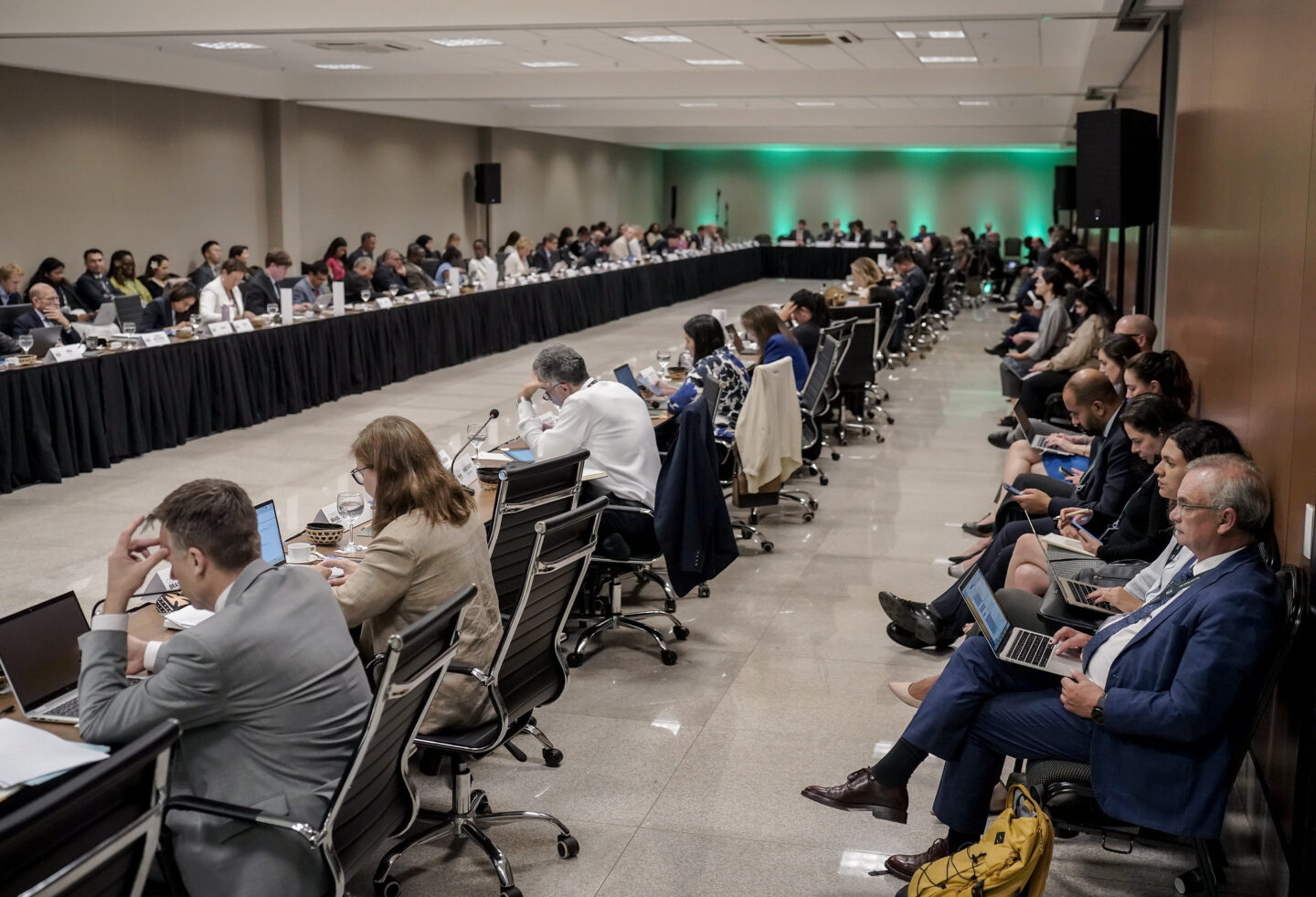
    A room full of country delegates sitting around a long table during Ministerial consultations held on October 15, 2025, during pre-COP30 in Brasilia.
    Ministerial consultations held on October 15, 2025, during pre-COP30 in Brasilia. (Photo: Rafa Neddermeyer/COP30 Brasil Amazônia/PR)

    Decision due on adaptation indicators

    In Brasilia, there was widespread recognition of the need to complete the Global Goal on Adaptation – agreed in the Paris accord 10 years ago – at COP30 by defining the indicators that will guide and monitor adaptation policies in areas such as food production, water and health.

    After a process that began with nearly 10,000 indicators, countries are now discussing a far shorter potential list of 100 that should be decided upon at COP30.

    At the closing of the pre-COP, Ana Paula Chantre Luna de Carvalho Pereira, environment minister of Angola and one of the coordinators for the adaptation talks, said there was still work to be done by the end of the month to finalise the indicators, so they “are applicable globally, flexible, and reflective of implementation and progress in all countries”.

    As coral reefs pass tipping point, ocean protection rises up political agenda

    At the meetings in Brasilia, some governments expressed the need to quickly finalise the definition of the indicators during the first week of COP30 and leave the second week for talks on more political aspects and implementation.

    In response, the COP30 president said this could be possible. Civil society representatives were more sceptical, however, because of the differences among countries regarding the indicators, including the total number listed and which are most important. Finance is another likely sticking point.

    Lucas Di Pietro, policy consultant and former adaptation director at Argentina’s Ministry of Environment, said the indicators are key to translate the political progress into “measurable and comparable results”.

    “Their development must reflect the diversity of contexts and capabilities, allowing each country to adopt those most relevant to its national reality,” said Di Pietro. “Rather than rushing to approve them, it is important that the final result is balanced and linked to the effective provision of means of implementation, such as finance, technology and capacity-building.”

    Many countries – especially some developing ones – consider it essential to include indicators related to the financing provided by developed countries to developing ones, while others argue that all types of financing should be monitored — including private sector investments.

    The post Momentum builds for strong adaptation outcome at COP30   appeared first on Climate Home News.

    https://www.climatechangenews.com/2025/10/15/momentum-strong-adaptation-cop30-brazil-belem-impacts-gga/

    Continue Reading

    Climate Change

    Nonprofit Center Works with Rural Maine Towns to Prepare for and Protect Against Extreme Weather

    Published

    on

    Weather disasters are shared experiences in the Maine foothills and communities are preparing for a wetter, warmer future.

    The December 2023 flood. The 2022 Halloween storm. The Patriots Day storm of 2007. The Great Ice Storm of 1998.

    Nonprofit Center Works with Rural Maine Towns to Prepare for and Protect Against Extreme Weather

    Continue Reading

    Climate Change

    Earth blocks keep homes cool while cutting emissions in Kenya’s drylands

    Published

    on

    In Kenya’s Laikipia County where temperatures can reach as high as 30 degrees Celsius, a local building technology is helping homes stay cooler while supporting education, creating jobs and improving the livelihoods and resilience of community residents, Climate Home News found on a visit to the region.

    Situated in a semi-arid region, houses in Laikipia are mostly built with wood or cement blocks with corrugated iron sheets for roofing. This building method usually leaves the insides of homes scorching hot – and as global warming accelerates, the heat is becoming unbearable.

    Peter Muthui, principal of Mukima Secondary School in Laikipia County, lived in these harsh conditions until 2023, when the Laikipia Integrated Housing Project began in his community.

    Nine of our best climate stories from 2025

    The project uses compressed earth block (CEB) technology, drawing on traditional building methods and local materials – including soil, timber, grass and cow dung – to keep buildings cool in the highland climate. The thick earth walls provide insulation against the heat.

    Peter Muthui, principal of Mukima Secondary School in Laikipia County, stands in front of classroom blocks built with compressed earth blocks (Photo: Vivian Chime)

    Peter Muthui, principal of Mukima Secondary School in Laikipia County, stands in front of classroom blocks built with compressed earth blocks (Photo: Vivian Chime)

    “Especially around the months of September all the way to December, it is very, very hot [in Laikipia], but as you might have noticed, my house is very cool even during the heat,” Muthui told Climate Home News.

    His school has also deployed the technology for classrooms and boarding hostels to ensure students can carry on studying during the hottest seasons of the year. This way, they are protected from severe conditions and school closures can be avoided. In South Sudan, dozens of students collapsed from heat stroke in the capital Juba earlier this year, causing the country to shutter schools for weeks.

    COP30 sees first action call on sustainable, affordable housing

    The buildings and construction sector accounts for 37% of global emissions, making it the world’s largest emitter of greenhouse gases, according to the UN Environment Programme (UNEP). While calls to decarbonise the sector have grown, meaningful action to cut emissions has remained limited.

    At COP28 in Dubai, the United Arab Emirates and Canada launched the Cement and Concrete Breakthrough Initiative to speed up investment in the technologies, policies and tools needed to put the cement and concrete industry on a net zero-emissions path by 2050.

    Canada’s innovation minister, François-Philippe Champagne, said the initiative aimed to build a competitive “green cement and concrete industry” which creates jobs while building a cleaner future.

      Momentum continued at COP30, where the Intergovernmental Council for Buildings and Climate (ICBC) held its first ministerial meeting and adopted the Belém Call for Action for Sustainable and Affordable Housing.

      Coordinated by UNEP’s Global Alliance for Buildings and Construction, the council has urged countries to embed climate considerations into affordable housing from the outset, “ensuring the drive to deliver adequate homes for social inclusion goes hand in hand with minimising whole-life emissions and
      environmental impacts”.

      Homes built with compressed earth blocks in Laikipia (Photo: Julián Reingold)

      Homes built with compressed earth blocks in Laikipia (Photo: Julián Reingold)

      With buildings responsible for 34% of energy-related emissions and 32% of global energy demand, and 2.8 billion people living in inadequate housing, the ICBC stressed that “affordable, adequate, resource-efficient, low-carbon, climate-resilient and durable housing is essential to a just transition, the achievement of the Sustainable Development Goals and the effective implementation of the Paris Agreement”.

      Compressed earth offers local, green alternative

      By using locally sourced materials, and just a little bit of cement, the compressed earth technology is helping residents in Kenya’s Laikipia region to build affordable, climate-smart homes that reduce emissions and environmental impacts while creating economic opportunities for local residents, said Dacan Aballa, construction manager at Habitat for Humanity International, the project’s developers.

      Aballa said carbon emissions in the construction sector occur all through the lifecycle, from material extraction, processing and transportation to usage and end of life. However, by switching to compressed earth blocks, residents can source materials available in their environment, avoiding nearly all of that embedded carbon pollution.

      According to the World Economic Forum (WEF), global cement manufacturing is responsible for about 8% of total CO2 emissions, and the current trajectory would see emissions from the sector soar to 3.8 billion tonnes per year by 2050 – a level that, compared to countries, would place the cement industry as one of the world’s top three or four emitters alongside the US and China.

      Tripling adaptation finance is just the start – delivery is what matters

      Comparing compressed earth blocks and conventional materials in terms of carbon emissions, Aballa said that by using soil native to the area, the process avoids the fossil fuels that would normally have been used for to produce and transport building materials, slashing carbon and nitrogen dioxide emissions.

      The local building technology also helps save on energy that would have been used for cooling these houses as well as keeping them warm during colder periods, Aballa explained.

      Justin Atemi, water and sanitation officer at Habitat for Humanity, said the brick-making technique helps reduce deforestation too. This is because the blocks are left to air dry under the sun for 21 days – as opposed to conventional fired-clay blocks that use wood as fuel for kilns – and are then ready for use.

      Women walk passed houses in the village of Kangimi, Kaduna State, Nigeria (Photo: Sadiq Mustapha)

      Traditional knowledge becomes adaptation mechanism

      Africa’s red clay soil was long used as a building material for homes, before cement blocks and concrete became common. However, the method never fully disappeared. Now, as climate change brings higher temperatures, this traditional building approach is gaining renewed attention, especially in low-income communities in arid and semi-arid regions struggling to cope with extreme heat.

      From Kenya’s highlands to Senegal’s Sahelian cities, compressed earth construction is being repurposed as a low-cost, eco-friendly option for homes, schools, hospitals – and even multi-storey buildings.

      Senegal’s Goethe-Institut in Dakar was constructed primarily using compressed earth blocks. In Mali, the Bamako medical school, which was built with unfired mud bricks, stays cool even during the hottest weather.

      And more recently, in Nigeria’s cultural city of Benin, the just-finished Museum of West African Art (MOWA) was built using “rammed earth” architecture – a similar technology that compresses moist soil into wooden frames to form solid walls – making it one of the largest such structures in Africa.

      The post Earth blocks keep homes cool while cutting emissions in Kenya’s drylands appeared first on Climate Home News.

      Earth blocks keep homes cool while cutting emissions in Kenya’s drylands

      Continue Reading

      Climate Change

      Using energy-hungry AI to detect climate tipping points is a paradox

      Published

      on

      David Sathuluri is a Research Associate and Dr. Marco Tedesco is a Lamont Research Professor at the Lamont-Doherty Earth Observatory of Columbia University.

      As climate scientists warn that we are approaching irreversible tipping points in the Earth’s climate system, paradoxically the very technologies being deployed to detect these tipping points – often based on AI – are exacerbating the problem, via acceleration of the associated energy consumption.

      The UK’s much-celebrated £81-million ($109-million) Forecasting Tipping Points programme involving 27 teams, led by the Advanced Research + Invention Agency (ARIA), represents a contemporary faith in technological salvation – yet it embodies a profound contradiction. The ARIA programme explicitly aims to “harness the laws of physics and artificial intelligence to pick up subtle early warning signs of tipping” through advanced modelling.

      We are deploying massive computational infrastructure to warn us of climate collapse while these same systems consume the energy and water resources needed to prevent or mitigate it. We are simultaneously investing in computationally intensive AI systems to monitor whether we will cross irreversible climate tipping points, even as these same AI systems could fuel that transition.

      The computational cost of monitoring

      Training a single large language model like GPT-3 consumed approximately 1,287 megawatt-hours of electricity, resulting in 552 metric tons of carbon dioxide – equivalent to driving 123 gasoline-powered cars for a year, according to a recent study.

      GPT-4 required roughly 50 times more electricity. As the computational power needed for AI continues to double approximately every 100 days, the energy footprint of these systems is not static but is exponentially accelerating.

      UN adopts first-ever resolution on AI and environment, but omits lifecycle

      And the environmental consequences of AI models extend far beyond electricity usage. Besides massive amounts of electricity (much of which is still fossil-fuel-based), such systems require advanced cooling that consumes enormous quantities of water, and sophisticated infrastructure that must be manufactured, transported, and deployed globally.

      The water-energy nexus in climate-vulnerable regions

      A single data center can consume up to 5 million gallons of drinking water per day – sufficient to supply thousands of households or farms. In the Phoenix area of the US alone, more than 58 data centers consume an estimated 170 million gallons of drinking water daily for cooling.

      The geographical distribution of this infrastructure matters profoundly as data centers requiring high rates of mechanical cooling are disproportionately located in water-stressed and socioeconomically vulnerable regions, particularly in Asia-Pacific and Africa.

      At the same time, we are deploying AI-intensive early warning systems to monitor climate tipping points in regions like Greenland, the Arctic, and the Atlantic circulation system – regions already experiencing catastrophic climate impacts. They represent thresholds that, once crossed, could trigger irreversible changes within decades, scientists have warned.

      Nine of our best climate stories from 2025

      Yet computational models and AI-driven early warning systems operate according to different temporal logics. They promise to provide warnings that enable future action, but they consume energy – and therefore contribute to emissions – in the present.

      This is not merely a technical problem to be solved with renewable energy deployment; it reflects a fundamental misalignment between the urgency of climate tipping points and the gradualist assumptions embedded in technological solutions.

      The carbon budget concept reveals that there is a cumulative effect on how emissions impact on temperature rise, with significant lags between atmospheric concentration and temperature impact. Every megawatt-hour consumed by AI systems training on climate models today directly reduces the available carbon budget for tomorrow – including the carbon budget available for the energy transition itself.

      The governance void

      The deeper issue is that governance frameworks for AI development have completely decoupled from carbon budgets and tipping point timescales. UK AI regulation focuses on how much computing power AI systems use, but it does not require developers to ask: is this AI’s carbon footprint small enough to fit within our carbon budget for preventing climate tipping points?

      There is no mechanism requiring that AI infrastructure deployment decisions account for the specific carbon budgets associated with preventing different categories of tipping points.

      Meanwhile, the energy transition itself – renewable capacity expansion, grid modernization, electrification of transport – requires computation and data management. If we allow unconstrained AI expansion, we risk the perverse outcome in which computing infrastructure consumes the surplus renewable energy that could otherwise accelerate decarbonization, rather than enabling it.

        What would it mean to resolve the paradox?

        Resolving this paradox requires, for example, moving beyond the assumption that technological solutions can be determined in isolation from carbon constraints. It demands several interventions:

        First, any AI-driven climate monitoring system must operate within an explicitly defined carbon budget that directly reflects the tipping-point timescale it aims to detect. If we are attempting to provide warnings about tipping points that could be triggered within 10-20 years, the AI system’s carbon footprint must be evaluated against a corresponding carbon budget for that period.

        Second, governance frameworks for AI development must explicitly incorporate climate-tipping point science, establishing threshold restrictions on computational intensity in relation to carbon budgets and renewable energy availability. This is not primarily a “sustainability” question; it is a justice and efficacy question.

        Third, alternative models must be prioritized over the current trajectory toward ever-larger models. These should include approaches that integrate human expertise with AI in time-sensitive scenarios, carbon-aware model training, and using specialized processors matched to specific computational tasks rather than relying on universal energy-intensive systems.

        The deeper critique

        The fundamental issue is that the energy-system tipping point paradox reflects a broader crisis in how wealthy nations approach climate governance. We have faith that innovation and science can solve fundamental contradictions, rather than confronting the structural need to constrain certain forms of energy consumption and wealth accumulation. We would rather invest £81 million in computational systems to detect tipping points than make the political decisions required to prevent them.

        The positive tipping point for energy transition exists – renewable energy is now cheaper than fossil fuels, and deployment rates are accelerating. What we lack is not technological capacity but political will to rapidly decarbonize, as well as community participation.

        IEA: Slow transition away from fossil fuels would cost over a million energy sector jobs

        Deploying energy-intensive AI systems to monitor tipping points while simultaneously failing to deploy available renewable energy represents a kind of technological distraction from the actual political choices required.

        The paradox is thus also a warning: in the time remaining before irreversible tipping points are triggered, we must choose between building ever-more sophisticated systems to monitor climate collapse or deploying available resources – capital, energy, expertise, political attention – toward allaying the threat.

        The post Using energy-hungry AI to detect climate tipping points is a paradox appeared first on Climate Home News.

        Using energy-hungry AI to detect climate tipping points is a paradox

        Continue Reading

        Trending

        Copyright © 2022 BreakingClimateChange.com