

Large-scale banana plantations in Latin America and the Caribbean could face a “dramatic” reduction in “suitable” growing area by 2080 due to rising temperatures, a new study warns.
Banana production is a labour-intensive process and the $25bn banana industry provides employment for more than one million workers globally. Latin America and the Caribbean are responsible for 80% of the world’s banana exports.
The study, published in Nature Food, investigates how climate change could impact export-driven banana plantations in the world’s biggest banana-exporting region.
It finds rising temperatures will drive a 60% reduction in the land area currently suitable for large-scale banana plantations in the region by 2080.
As the suitable area for banana plantations shrinks, farmers will need to adapt through implementing irrigation, implementing drought-resilient varieties of banana and shifting their growing regions, the study says.
An expert not involved in the study warns that “the current intensive banana industrial model perpetuates certain injustices towards farmers”. She tells Carbon Brief that the research “provides valuable insight about the constraints [and] risks”, adding that it “should be a call for adaptation – and also transforming the industry for the better”.
The banana industry
Bananas are one of the most commonly exported and consumed fruits in the world and a key source of nutrition for more than four million people.
The banana sector is a growing industry, currently worth around $25bn globally. The map below shows the mass of bananas produced in 2022, in tonnes, per country.
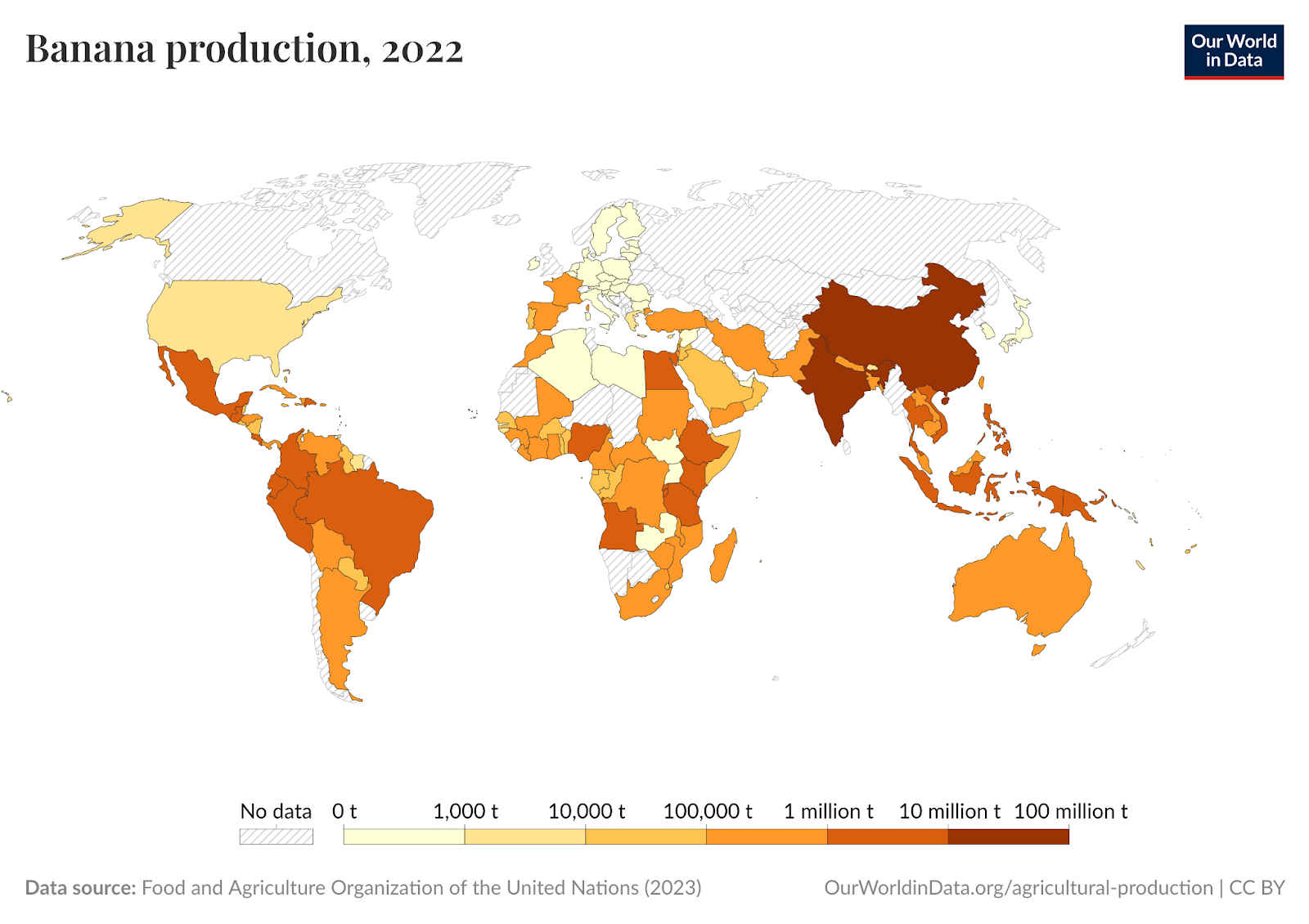
While Asia is the world’s largest banana producer, Latin America and the Caribbean are responsible for around 80% of the world’s banana exports – particularly from Ecuador and Costa Rica.
More than 1,000 different varieties of bananas are grown around the world, with the sweet yellow Cavendish banana making up around half of global banana production. This cultivar is typically grown in large-scale monoculture plantations in Latin America, using extensive irrigation and drainage facilities. Large export plantations can be up to 5,000 hectares in size (50 square kilometres).
Mapping plantations
To assess the distribution of banana plantations throughout Latin America and the Caribbean, the authors developed a high-resolution map of banana production for the year 2019. They used data from NASA’s Sentinel-1 SAR and an algorithm to identify banana plantations in the satellite images.
The authors only include banana plantations larger than 0.5 hectares in area in their map, because the study focuses on bananas grown at a large scale for export. They also do not include banana production by smallholder farmers, as their crops are often in sparser, mixed-cropping systems that are harder to identify in images.

The authors identified and validated more than 360,000 plantations in total.
They authors combined their banana plantation distribution map with a wide range of climatic and socioeconomic data, including temperature, rainfall, elevation, soil acidity, latitude, irrigation infrastructure, human population density and distance to the nearest port.
To identify the conditions best suited for banana plantations, the authors identified ranges for each of these variables where 90% of mapped banana plantations were observed.
The results show that banana plantations are typically found at lower elevations and in more acidic soils than other croplands in the region. They are also found in areas with higher population density and close to ports. Three-quarters of the mapped banana plantations in this study are within 86km of the nearest port, the study finds.
Dr Varun Varma, the lead author of the study, is an ecosystems services modeller at Rothamsted Research in the UK. He tells Carbon Brief that large-scale banana farming “relies heavily on access to labour”. He adds:
“In these intensive export-focussed farms, bananas – a perishable product – are continuously harvested, processed, packaged and made ready for transport by sea in large shipping containers. Being closer to a port would be a logistical advantage.”
The authors also find that irrigation plays an important role in determining where bananas can grow.
Prof Matti Kummu from Aalto University’s water and development research group, who was not involved in the study, praises the authors for considering so many variables. He tells Carbon Brief that this is an “important and impressive study”, adding that its approach could be used for other similar crops.
Rising temperatures
Next, the authors modelled temperature and rainfall over Latin America and the Caribbean, using 12 climate models from the sixth coupled model intercomparison project (CMIP6) under the “middle-of-the-road” SSP2-4.5 warming scenario.
By combining simulations of temperature and rainfall across Latin America and the Caribbean with data on elevation and soil acidity, the authors find that around 3,340,000 square kilometres (km2) of land is currently “suitable” for banana plantations.
Central America, coastal Brazil and the northern and southern borders of the Amazon basin are the most suitable, they say.
Factoring in socioeconomic conditions, such as population density and distance to a port, shrinks the “suitable area” to 990,000km2. This “brings into focus how important socioeconomic factors are, and will be, in adapting to climate change”, Varma says.
The authors also investigated how climate change may impact the “suitable” area for banana plantations over the 21st century. The maps below show how changes in temperature (left) and rainfall (right) are expected to impact the suitability of land for banana plantations under the projected climate in 2061-80.
The colours indicate regions suitable for producing bananas for export in both the recent past (1970 to 2000) and future (blue), those suitable in the recent past, but not in future (red) and those that were not suitable in the recent past, but will be in the future (green).

The authors find that under the SSP2-4.5 scenario, “increasing temperature is the sole climatic driver of suitable area loss”. In contrast, changes in annual rainfall will not noticeably change the distribution of land suitable for banana plantations – partly due to the presence of irrigation, the authors say.
Overall, they find that changes in climate will shrink the area of land suitable for banana plantations by 60%, if no changes are made to irrigation infrastructure or other socioeconomic factors.
Dr Monica Ortiz is an environmental scientist and assistant professor at the University of Concepción in Chile, who was not involved in the study. She tells Carbon Brief:
“60% is no small figure and this means that banana-growers need to do climate-resilient planning to maintain their livelihood and business model.”
The paper finds that implementing more irrigation infrastructure where needed could expand the future suitable area. Adding this adaptation measure would mean that future climate change would only shrink the current area of land suitable for growing bananas by 41%.
The authors find that due to warming, the suitable area for banana production will decline by 2080 in most exporting regions in Latin America and the Caribbean. The study says that Colombia and Venezuela will become “almost entirely suboptimal for export production”.
The authors then used a series of equations developed in paper they published in 2019 to calculate banana yields from data on temperature and rainfall.
Yield in current banana producing areas will decline for most countries, the study says. It finds that “Ecuador and Brazil are the only major producers expected to see yield increases in current banana production areas due to climate change”.
Adaptation
As the area suitable for banana production shrinks, farmers will need to adapt to the changing conditions. These measures include maintaining irrigation supplies and breeding “drought-tolerant banana varieties”, the authors say.
However, they note that farmers in the global south “may be less able to adapt agricultural practices to cope with changing climate than their counterparts in wealthier countries”.
Prof Kenneth Feeley from the University of Miami was not involved in the study, but has conducted separate research on the impacts of climate change on banana growing regions.
He tells Carbon Brief that as a result of widespread irrigation, many growers have turned large areas of “pristine desert habitat” with low rainfall into banana plantations. This is a “major transformation of the ecosystem”, which may not be “good for the environment”, he warns.
Feeley adds that Cavendish bananas are also facing “attacks” from the fungus Fusarium, which are becoming a “major problem for banana production”. The fungus is spread through raindrops bouncing between plants, but the use of drip irrigation can “limit” the spread of the fungus, he explains.
Additionally, lead author Varma notes that rising temperatures are creating “increasingly inhospitable working conditions in this labour-intensive sector”.
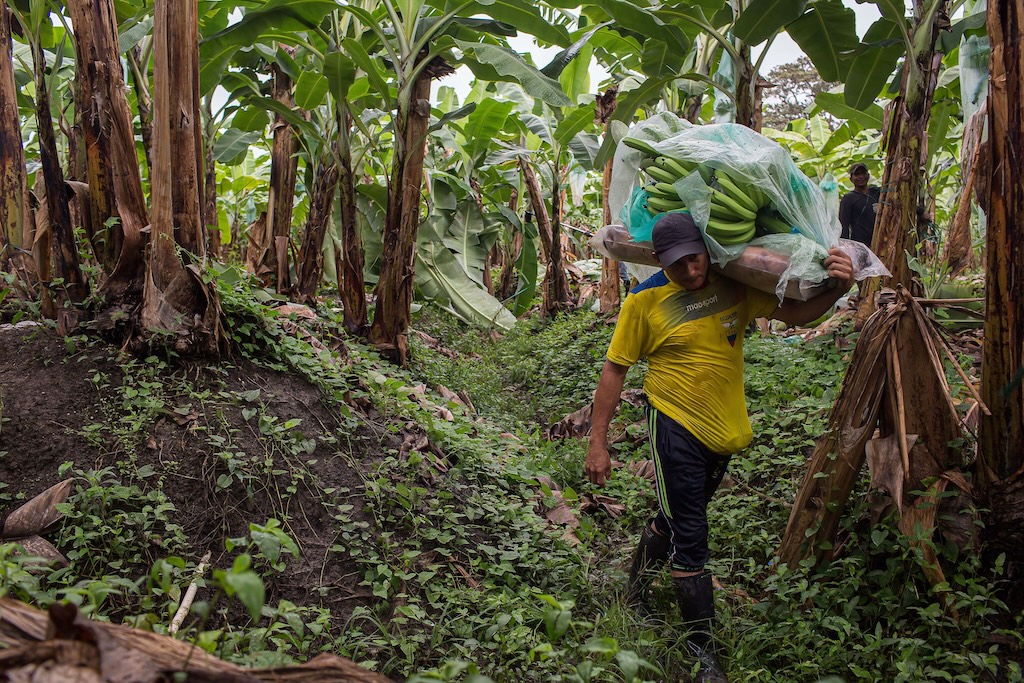
Ortiz tells Carbon Brief that “the current intensive banana industrial model perpetuates certain injustices towards farmers”. She explains that farmers “work hard and are paid little”, adding that women are typically assigned the tasks that are paid the least.
She adds:
“The time is indeed ripe for change. I think the study provides valuable insight about the constraints, risks and should be a call for adaptation – and also transforming the industry for the better.”


The post Major banana exporters could face ‘60% drop’ in growing area due to warming appeared first on Carbon Brief.
Major banana exporters could face ‘60% drop’ in growing area due to warming

Climate Change
After a Slow Start on Climate, Zohran Mamdani Faces Scrutiny Over Parks Budget and Environmental Promises
Climate-conscious New Yorkers hope the mayor hasn’t forgotten them.
During his New York City mayoral campaign, Zohran Mamdani courted votes from environmentalists. He promised to expand green spaces in public schools and equip them with renewable energy, to meet the demands of the city’s building electrification laws and to increase investments in city parks.
That would be American ratepayers—i.e., you.
From our collaborating partner Living on Earth, public radio’s environmental news magazine, an interview by Jenni Doering with Katharine Kollins, the president of Southeastern Wind Coalition.
Who Loses in the Trump Administration’s $1 Billion ‘Deal’ to Abandon Offshore Wind?
County officials have said they will eventually close the incinerator, located in a predominantly Black community. Advocates want a concrete plan.
Minneapolis activists are escalating a decades-long fight by going on a hunger strike to demand that local officials shut down a polluting trash incinerator.
Minneapolis Activists Launch Hunger Strike to Protest Polluting Trash Incinerator

After a Slow Start on Climate, Zohran Mamdani Faces Scrutiny Over Parks Budget and Environmental Promises
Who Loses in the Trump Administration’s $1 Billion ‘Deal’ to Abandon Offshore Wind?
Minneapolis Activists Launch Hunger Strike to Protest Polluting Trash Incinerator
-
Climate Change8 months ago
Guest post: Why China is still building new coal – and when it might stop
-
Greenhouse Gases8 months ago
Guest post: Why China is still building new coal – and when it might stop
-

 Greenhouse Gases2 years ago
嘉宾来稿:满足中国增长的用电需求 光伏加储能“比新建煤电更实惠”
-
Climate Change2 years ago
Bill Discounting Climate Change in Florida’s Energy Policy Awaits DeSantis’ Approval
-

 Climate Change2 years ago
嘉宾来稿:满足中国增长的用电需求 光伏加储能“比新建煤电更实惠”
-
Climate Change Videos2 years ago
The toxic gas flares fuelling Nigeria’s climate change – BBC News
-

 Renewable Energy6 months ago
Sending Progressive Philanthropist George Soros to Prison?
-

 Carbon Footprint2 years ago
US SEC’s Climate Disclosure Rules Spur Renewed Interest in Carbon Credits