

Open and transparent data can accelerate the decarbonisation of China’s industries and boost public interest in climate change, says Ma Jun.
Ma – one of China’s most recognisable environmental activists – says that early experiments with publishing real-time air quality data have paved the way for greater openness from the Chinese government towards publishing greenhouse gas emissions data.
However, he tells Carbon Brief in a wide-ranging interview, more needs to be done to encourage “multi-stakeholder” participation in climate efforts and to improve corporate emissions disclosure.
He also notes that China faces significant “challenges” in reducing emissions from “hard-to-abate” sectors, where companies struggle to find consumers willing to pay a “green premium” for low-carbon versions of their products.
Ma is the founder and director of the Institute of Public and Environmental Affairs (IPE), a Beijing-based NGO focused on environmental information disclosure and public participation.
The IPE is most well-known for developing the Blue Map, China’s first public database for environment data.
Ma has been a long-term advocate for environmental protection in China.
Prior to founding the IPE, he covered environmental pollution as an investigative reporter at the Hong Kong-based South China Morning Post.
He also authored China’s first book on the serious water pollution challenges facing the country.
Speaking to Carbon Brief during the first week of COP30 in Brazil last November, the discussion covered the importance of open data, key challenges for decarbonising industry, China’s climate commitments for 2035, cooperation with the EU and more.
- On how data transparency prevents environmental pollution in China: “From that moment [that the general public began flagging environmental violations on social media], it was no longer easy for mayors or [party] secretaries to try to interfere with the enforcement, because it’s being made so transparent, so public.”
- On encouraging the Chinese government to publish data: “The ministry felt that they had the backing from the people, basically, which helped them to gain confidence that data can be helpful and can be used in a responsible way.”
- On China’s new corporate disclosure rules: “We’re talking about what’s probably the largest scale of corporate measuring and disclosure now happening [anywhere in the world].”
- On air-pollution policies creating a template for climate action: “It started from the pollution control side and now we want to see that happen on the climate side.”
- On paying for low-carbon products: “When we engage with them and ask why they didn’t expand production, they say that producing these items will have a ‘green premium’, but no one wants to pay for that. Their users only want to buy tiny volumes for their sustainability reports.”
- On public perceptions of climate change: “It’s more abstract – [we’re talking about] the end of the century or the polar bears. People don’t feel that it’s linked with their own individual behaviour or consumption choices.”
- On the need for better emissions data: “It will be impossible to get started without proper, more comprehensive measuring and disclosure, and without having more credible data available.”
- On criticism of China’s climate pledge: “In the west, the cultural tendency is that if you want to show that you’re serious, you need to set an ambitious target. Even if, at the end of the day, you fail, it doesn’t mean that you’re bad…But in China, the culture is that it is embarrassing if you set a target and you fail to fully honour that commitment.”
- On global climate cooperation: “The starting point could be transparency – that could be one of the ways to help bridge the gap.”
- On the economics of coal: “There’s no business interest for the coal sector to carry on, because increasingly the market will trend towards using renewables, because it’s getting cheaper and cheaper”.
- On working in China as a climate NGO: “What we’re doing is based on these principles of transparency, the right to know. It’s based on the participation of the public. It’s based on the rule of law. We cherish that and we still have the space to work [on these issues].”
- On the climate consensus in China: “The environment – including climate – is the area with the biggest consensus view in [China]. It could be a test run for having more multi-stakeholder governance in our country.”
The transcript below has been edited for length and clarity.
Carbon Brief: You have been at the forefront of environmental issues in China for decades. How would you describe the changes in China’s approach to climate and environment issues over the time you’ve been observing them?
Ma Jun: I started paying attention to the issues when I got the chance to travel in different parts of China. I was struck by the environmental damage, particularly on the waterways, the rivers and lakes, which do not just have all these eco-impacts, but also expose hundreds of millions to health hazards.
That got me to start paying attention. So I authored a book called China’s Water Crisis and readers kept coming back to me to push for solutions. I delved deeper into the research and I realised that it’s quite complicated – not just that the magnitude [of the problem] is so big, but that the whole issue is quite complicated, because we copied rules, laws and regulations from the west but enforcement remained weak.
There are huge externalities, but companies would rather just cut corners to be more competitive, put simply. Behind that, there was a doctrine before of development at whatever cost. That was the starting point in China – not just for policymakers, even people in the street, if you asked them at that time, most likely [they] would say: “China’s still poor. Let’s develop before we even think about the environment.”
But that started changing, gradually. Unfortunately, it needed the “airpocalypse” in Beijing and the big surrounding regions to really motivate that change.
In 2011, Beijing suffered from very bad smog and millions upon millions of people made their voices heard – that they want clean air.
The government lent an ear to them and decided to start from transparency, monitoring and disclosing data to the public. So two years after it started and people were being given hourly air quality data [in 2011] – you realised how bad it was. In the first month [of 2013], the monthly average was over 150 micrograms. The WHO standard was 10 at the time – now it’s dropped to five. [Some news reports and studies, based on readings published at the time by the US embassy in Beijing, note significantly higher figures.]
We believe that it’s good to have that data – of course, it’s very helpful – but it’s not enough. Keeping children indoors or putting on face masks are not real solutions, we need to address the sources. So we launched a total transparency initiative with 24 other NGOs calling for real-time disclosure of corporate monitoring data.
To our surprise, the ministry made it happen. From 2014, tens of thousands of the largest emitters, every hour, needed to give people air [quality] data, and every two hours for water [quality].
We then launched an app to help visualise that for neighbourhoods. For the first time, people could realise which [companies] are not in compliance. Even super-large factories – every hour, if they were not in compliance, then they would turn from blue to red [in the app].
And so many people made complaints and petitioned openly – sharing that on social media, tagging the official [company] account. That triggered a chain reaction and changed that dynamic that I described.
From that moment, it was no longer easy for mayors or [party] secretaries to try to interfere with the enforcement, because it’s being made so transparent, so public. The [environmental protection] agencies got the backing from the people and knocked the door open – and pushed the companies to respond to the people.
Then, the data is also used to enable market-based solutions, such as green supply chains and green finance.
Starting first with major multinationals and then extending to local companies, companies compared their lists with our lists before they signed contracts. If any of their [supplier] companies were having problems, they could get a push notification to their inbox or cell [mobile] phone.
That motivates 36,000 [companies] to come to an NGO like us – to our platform – to make that disclosure about what went wrong and how we try to fix the problem, and after that measure and disclose more kinds of data, starting with local emission data and now extending to carbon data.
And for banking and green finance, an NGO like us now helps banks track the performance of three million corporations who want to borrow money from them, as part of the due diligence process. These are just tiny examples to try to demonstrate that there’s a real change.
Before, when I got started, the level of transparency was so limited. When we first looked at government data, at the beginning, there were only 2,000 records of enforcement. So we launched an index, assessed performance for 10 years across 120 cities.
During this process, [we also saw] consensus being made. In 2015, China’s amended Environmental Protection Law [came into effect] and created a special chapter – chapter five – titled [information] transparency and public participation. That was the first ever piece of legislation in China to have such a chapter on transparency.
CB: What motivated that? Was it because they’d already seen this big public backlash?
MJ: They started listening to people and the demand for change, for clean air. And then they started seeing how the data can be used – not to disrupt the society, but to help to mobilise people.
The ministry felt that they had the backing from the people, basically, which helped them to gain confidence that data can be helpful and can be used in a responsible way. Before, they were always concerned about the data, particularly on disruption of social stability, because our data is not that beautiful at the beginning, due to the very serious pollution problem.
When our organisation got started, nearly 20 years ago, 28% of the monitored waterways – nationally-monitored rivers – reported water that was good for no use. Basically, it is so polluted that it’s not good for any use. [Some] 300 million [people] were exposed to that in the countryside, it was very serious.
We’re talking about the government changing its mindset. Of course, the reality is that they found [the data] can be used the responsible way and can be helpful, so they decided to embrace that and to tolerate that, to gradually expand transparency.
Now, China is aligning its system with the International Sustainability Standards Board (ISSB). The environment ministry also created a disclosure scheme, with 90,000 of China’s largest [greenhouse gas] emitters on the list. We and our NGO partners tried to help implement that. We’re talking about billions of tonnes of carbon emissions.
It would have been hard to imagine before, but we’re talking about what’s probably the largest scale of corporate measuring and disclosure now happening [anywhere in the world].
Of course, it’s still not enough. Last year, we also helped the agency affiliated with the ministry to develop a guideline on voluntary carbon disclosure, targeting small and medium sized companies. We now have a new template on our platform – powered by AI – and a digital accounting tool that helps our users measure and disclose nearly 70m tonnes [of carbon dioxide equivalent] last year.
CB: Is there appetite on the industrial side to proactively get involved? Or is local regulation needed that mandates involvement?
MJ: At the beginning, no. If we have the dynamic that I described – at the beginning, whoever cut corners became more competitive. This caused a “race to the bottom” situation and even good companies find it quite difficult to stick to the rules.
But then the dynamic changed. Whoever’s not in compliance with the law will be kicked out of the game. Not only would they receive increasingly hefty penalties or fines, but the data will be put into use in supply chains. Many of our users – the brands – integrate that data into their sourcing, meaning that if [suppliers] don’t solve the problem they will lose contracts. And also banks could give them an unfavourable rating.
All this joint effort could create some sort of – of course, it’s [only a] chance – but some kind of a stick. But it’s also a kind of carrot, because those who decided to do better now benefit. If someone loses business [because they cannot help their consumer with compliance], then that business will [instead] go to those who want to go green.
This change in dynamic is very helpful. It started from the pollution control side and now we want to see that happen on the climate side. That’s why we decided to develop the blue map for zero carbon, to try to map out and further motivate the decarbonisation process – region by region, sector by sector.
You asked about corporations – this is extremely important. China is the factory of the world and 68% of carbon emissions still relate either to the direct manufacturing process or to energy consumption to power the industrial production. So it is very important to motivate them, to create both rules and stimulus – both stick and carrot.
But if you don’t have a stick, you can never make the carrot big enough. That is an externality problem, you never really solve that. We’ve now managed to solve the basic problem – non-compliance and outrageous violations. But that’s the first step. Deep decarbonisation – not just scope one and two, but extending further upstream to reach heavy industry, the hard-to-abate industries – now this is the challenge.
CB: What are your expectations for industrial decarbonisation more broadly, especially given the technology bottlenecks?
MJ: There are still bottlenecks, but we see, actually, some progress is being made. Now corporations in China understand that they need to go in [a low-carbon] direction and some of them are actually motivated to develop innovative solutions.
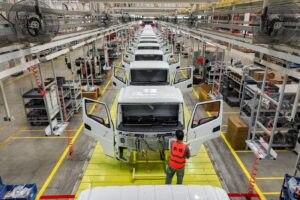
For example, several major steel manufacturers managed to be able to find ways to produce much lower-carbon steel products. In the aluminium [sector] they also tried and also batteries. Unfortunately, these remain as only pilot projects.
When we engage with them and ask why they didn’t expand production, they say that producing these items will have a “green premium”, but no one wants to pay for that. Their users only want to buy tiny volumes for their sustainability reports – for the rest, they just want the low-cost ones.
They said, the more we produce the green products, the bigger our losses. So we decided to leave these products in our warehouse.
Then we engaged with the brands – the real estate industry, the largest user of iron and steel – and the automobile industry, the second largest. They claimed that if they [purchase greener materials], they would pay a green premium, but their users and consumers have no idea about [green consumption]. They only want to buy the cheapest products – and the more [these manufacturers] produce, the more they suffer losses.
So this means we need a mechanism, with multi-stakeholder participation, to share the burden of that transition – to share that cost of the green transition.
That green premium can only be shared, not one single stakeholder can easily absorb all of this given all the breakneck competition in China – involution – it’s very, very serious and so companies are all stuck there.
What we’re trying to do is to help change that. We assessed the performance of 51 auto brands and tried to help all the stakeholders understand which ones could go low-carbon.
But it’s not enough just to score and rank them. We also need to engage with the public, to have them start gaining an understanding that their choice matters. So how – it’s more difficult, you know? Pollution is much easier. We told them: “Look, people are dumping all this waste.”
CB: It’s all visible.
MJ: Yeah, when people suffer so seriously from pollution – air, water and soil pollution – they feel strongly. They wrote letters to the brands, telling them that they like their products but they cannot accept this.
But on climate, it’s more abstract – [we’re talking about] the end of the century or the polar bears. People don’t feel that it’s linked with their own individual behaviour or consumption choices.
We decided to upgrade our green choice initiative to the 2.0 level. This new solution we developed is called product carbon scan. Basically, you take a picture of any product and services products and an AI [programme] will figure out what product that is and tell you the embodied carbon of that product.
Now, it’s getting particularly sophisticated with automobiles. The AI now – from this year – for most of the vehicles on the streets of China, can figure out not just which brand it is, but which model. We have all these models in our database – 700-800 models and 7,000-8,000 varieties of cars, all of which have specific carbon footprints.
CB: How do you account for all of the different variables? If something changes upstream, if a supplier changes – how do you account for that?
MJ: The idea is like this – now, this is mostly measured by third parties, our partners. We also have our emission factors database that we developed. So we know that, as you said, there are all these variables. For the past six months, we got our users to take pictures of 100,000 cars. We distributed them to 50 brands and [calculated] that the total carbon footprint was 4.2m tonnes, for the lifecycle of these 100,000 cars. Each brand got their own share of this.
So we wrote letters – and we’re still writing letters now, 10 NGOs in China, we’re writing letters now to the CEOs of these 50 brands – to tell them that this is happening. Our users, consumers of their products, are paying attention to this and are raising questions. We have two demands.
First, have you done your own measuring for the product you sell in China? Do you have plans to measure and disclose those specific details? Because if third parties can do it, so can they. It’s not space technology, they can do it and obviously they own all this data. They understand much better about the entire value chain and it’s much easier for them to get more accurate figures. With the “internet of things” and new technologies, for some products, they can get those details already, so the auto industry should be getting close to [achieving] that.
The second question is, you all have set targets for carbon reduction and carbon neutrality. We know that most of you are not on track. Even the best ones – Mercedes-Benz is at the top of our rankings – are seeing their carbon intensity going up. Not just the total volume [of emissions], but products’ carbon intensity is going up instead of going down. So, obviously, they haven’t really decarbonised their upstream – steel and aluminium. So [we ask them]: “What’s your plan? Can you give me an actionable, short- or mid-term plan on the decarbonisation of these upstream, hard-to-abate sectors?”
I think this is the way to try to tap into the success of pollution control and now extend that to cover carbon.
CB: It seems a challenge facing China’s climate action that policymakers often flag is MRV [monitoring, reporting and verification] and data in general. You’re the expert on this. Would you agree? Are there big challenges around MRV that China needs to address before it can progress further?
MJ: This is a prerequisite, in my view. To have [to] measure, disclose and allow access to data is a prerequisite for any meaningful multi-stakeholder effort. I wouldn’t underestimate the challenge in the follow-up process – the solutions, the innovations, the new technologies that need to be developed to decarbonise – but it will be impossible to get started without proper, more comprehensive measuring and disclosure, and without having more credible data available.
I take this as a starting point – a most important starting point. I’m so happy to see that there’s a growing consensus on that. In China, the government decided to embrace the concept of the ISSB, embrace the concept of ESG reporting, and to allow an NGO like us to try to help with the disclosure mechanism.
This is very powerful and very productive, and the reason that we could create that solution is because China pays so much attention to product carbon footprints, of course, motivated by the EU legislations, like the carbon border adjustment mechanism (CBAM) and others. In some ways, it’s quite interesting to see the EU set these very progressive rules, but then China responds and decides to create solutions and scale them up.
On the product carbon footprint alone, the Ministry of Ecology and Environment (MEE) coordinated 15 different ministries to work on it, with a very tight schedule – targets set for 2027 and then 2030 – [implying] very fast progress. We work together with our partners on a new book telling businesses – based on emission factors – how to handle it and how to proceed, in terms of practical solutions.
All this is just to say that, on the data and MRV side, China has already overcome its initial reluctance, or even resistance. Now [it] is in the process of not just making progress and expanding data transparency, but also trying to align that with international practice.
And at COP30, I actually launched a new report [titled the Global City Green and Low-Carbon Transparency Index]…The transparency index actually highlighted that, of course, developed cities are still doing better, but a whole group of Chinese cities are quickly catching up. Trailing behind are other global south cities.
When China decides to do something, it isn’t just individual businesses or even individual cities [that see action taken]. There will be more of a platform-based system – meaning there is an [underlying] national requirement, which can help to level the playing field, with regions or sectors possibly taking up stricter requirements, but not being able to compromise the national ones [by setting lower targets].
So, with MRV, I have some confidence. That doesn’t mean it’s easy. Particularly on the product carbon footprint, there are so many challenges. Trying to make emission factors more accurate is quite difficult, because products have so many components and the whole value chain can be very long and complicated. But with determination, with consensus, I’m still confident that China can deliver.
And in the meantime, what is now going on in China, increasingly, could become a contribution to global MRV practice.
CB: It’s interesting that you mentioned that. Talking to people at the COP30 China pavilion, people from global south countries see China as a climate leader and want to learn about what’s going on in China. By contrast, developed countries seem more focused on the level of ambition in China’s NDC [its climate pledge, known as a nationally determined contribution]. How would you view China’s role in climate action in the next five years?
MJ: On the NDC, my personal observation – I come from an NGO, so I don’t represent the government’s decision here – is that culturally, there’s some sort of differences, nuanced differences – or very obvious differences – here.
In the west, the cultural tendency is that if you want to show that you’re serious, you need to set an ambitious target. Even if, at the end of the day, you fail, it doesn’t mean that you’re bad, you still achieve more than if you’d set a lower target. That’s the mentality.
But in China, the culture is that it is embarrassing if you set a target and you fail to fully honour that commitment. So they tend to set targets in a slightly more conservative way.
I’m glad to see that [China’s] NDC is leaving space for flexibility – it said that China will try to achieve a higher target. This is the tone, and in my view it gives us the space and the legitimacy to try to motivate change and develop solutions to bend the curve faster. Even if the target is not that high, we know that we will try to beat that.
And then, there’s the renewables target for 1,200 gigawatts (GW) by 2030, a target that was achieved last year – six years early. Now we’ve set a target of 3,600GW – that means adding 180GW every year. But, as you know, over the past several years [China’s renewable additions] have been above 200GW.
So you can see that there’s a real opportunity there and we know that China will try to overdeliver. There’s no kind of a good or bad, or right or wrong, with these two different cultural [approaches].
But one thing I hope that we all focus more on is implementation – on action. Because we do see that, for some of the global targets that have already been set, no-one seems to be paying any real attention to them – such as the tripling of [global] renewable capacity.
We all witnessed that, in Dubai at COP28, a target was agreed and accepted by the international community. China’s on track, but what about the others? Most countries are not on track.
The global south, it’s not only for their climate targets – the [energy] transition is essential for their SDG [sustainable development goal] targets. But now they lag so far behind. That’s a pity, because now there’s enough capacity – and even bigger potential – to help them access all this much faster.
But geopolitical divides, resource competition, nationalism, protectionism – all of this is dividing us. It’s making global climate governance a lot more difficult and delaying the process to help [others in the] global transition. It’s very difficult to overcome these problems – probably it will get worse before it gets better.
But if we truly believe that climate change is an existential threat to our home planet, then we should try to find a way to collaborate a bit more. The starting point could be transparency – that could be one of the ways to help bridge the gap.
In China, we used to have a massive gap of distrust between different stakeholders. People hated polluting factories, but they also had suspicions around government agencies giving protection to those factories. So there’s all this distrust.
With transparency, it’s easier for trust to be built, gradually, and the government started gaining confidence [in sharing data] because they saw with their own eyes that people came together behind them. Before, [people] always suspected that [the government] were sheltering the polluters. But from that moment, they realised that the government was serious and so gave them a lot of support.
Globally – maybe I’m too negative – I do think that it would [improve the chances for us all to collaborate] if we had a global data infrastructure and a global data platform, that doesn’t just give [each country’s] national data but drills down – province by province, city by city, sector by sector and, eventually, to individual factories, facilities and mines. For each one of these, there would be a standardised reporting system, giving people the right to know. I think through this we could build trust and use it as a starting point for collaboration.
I sit on several international committees – on air, water, the Taskforce on Nature-related Financial Disclosures (TFND), transition minerals, and so on. In each of these, I often make suggestions on building global data infrastructure. Increasingly, I see more nodding heads, and some have started to make serious efforts. TNFD is one example. They already have a proposal to develop a global data facility on data. The International Chamber of Commerce also put forward a proposal on the global data infrastructure on minerals and other commodities.
Of course, in reality, there will be many difficulties – data security, for example. So maybe it cannot be totally centralised, we need to allow for decentralised regional systems, but you could also create catalogues to allow the users to [dig into] all this data.
CB: And that then inspires people to look into issues they care about?
MJ: Yes and through that process, we will create more consensus, create more trust and gradually formulate unified rules and standards.
And we need innovative solutions. In today’s world, security is something that’s not just paid attention to by China, in the west it’s a similar [story]. There are a lot of concerns about data security – growing concerns – so I think eventually there will be innovation to solve them. I’m still hopeful!
CB: Speaking of international cooperation, how has the withdrawal of the US from the Paris Agreement affected prospects for China-EU cooperation?
MJ: It will have a mixed impact, of course. Having the largest economy and second-largest emitter withdraw will have a big impact on global climate governance, and will in some way create negative pressure on other regions, because we’re all facing the question of: “If they don’t do it, why should we?” We also have those questions back home. I’m sure the EU is also facing this question.
But in the meantime, I hope that China and the EU realise that they have no choice but to work together – if they still, as they claim, truly believe in [the importance of] recognising the existential threat posed by climate change, then what choice do they have but to work together?
Fundamentally, we need a multilateral process to deal with this global challenge. The Paris Agreement, with all its challenges, still managed to help us avoid the worst of the worst. We still need this UNFCCC process and we need China and the EU to help maintain it.
At the last COP[29 in Azerbaijan], for the first time, it was not China and the US who saved the day. Before, it was always the US and China that made a deal and helped [shepherd] a global agreement. But last year, it was China and the EU that made the agreement and then helped to reach [a global deal] in Azerbaijan.
I do think that China and the EU have both the intention and the innovative capacity, as well as a very, very powerful business sector. I’m still hopeful that these two can come together at this COP [in Brazil].
CB: We’ve spoken a lot about heavy industry and industrial processes. Coal is a very big part of China’s emissions profile. In the short term, how do you see China’s coal use developing over the next five to 10 years?
This ties into that complicated issue of the geopolitical divide. The original plan was to use natural gas as the transition [fuel], which would make things much easier. But geopolitical tensions means gas is no longer considered safe and secure, because China has very little of this resource and has to depend on the other regions, including the US, for gas.
That, in some way, pushed towards authorising new coal power plants and, in some way, we are all suffering for that. In the west as well. We all have to create massive redundancies for so-called insecurity, we’re all bearing higher costs and we’re all facing the risk of stranded assets, because we have such a young coal-power fleet.
The only thing we can do is to try to make sure that these plants increasingly serve only as a backup and as a way to help absorb high penetration of renewables, because now this is a new challenge. Renewables have been expanding so fast that it’s very difficult – because of its intermittent nature – to integrate it into the power grid. New coal power can help absorb, but only if we can make [it] a backup and not use it unless there’s a need. Of course, that means we have to pay to cover the cost for those coal plants.
The funny thing is that there’s no business interest for the coal sector to carry on, because increasingly the market will trend towards using renewables, because it’s getting cheaper and cheaper. So the coal sector, for security and integration of renewables, will be kept. But it will play an increasingly smaller role. In the meantime, the coal sector can help balance the impact through making chemicals, rather than just energy.
In the meantime, [we need to] try to find ways to accelerate the whole energy transition and electrify our economy even faster. That’s a clear path towards both carbon peaking and carbon neutrality in China.
It’s already going on. Carbon Brief’s research already highlights some of the key issues, such as from March [2024] emissions are actually going down. That cannot happen without renewables, because our electricity demand is still going up significantly. In the meantime, the cost of electricity is declining.
This allows China to find its own logic to stick to the Paris Agreement, to stick to climate targets and even try to expand its climate action, because it can benefit the economy. It can benefit the people.
I think Europe probably could also learn from that, because Europe used to focus on climate for the climate’s sake. With [the Russia-Ukraine] war going on, that makes it even more difficult.
CB: You mean the green economy narrative?
MJ: Yes, the green economy narrative is not highlighted enough in Europe. Now, suddenly, it’s about affordability, it’s about competition, and suddenly they feel that they’re not in a very good position. But China actually focuses more on the green economy side. China and the EU could – hand-in-hand – try to pursue that.
CB: That leads perfectly to my last question. How important is the role of civil society now in developing climate and environmental policy in China?
MJ: We all trust in the importance of civil society. This is our logo, which we designed 20 years ago. Here are three segments: the government, business and civil society.

Civil society should be part of that. But we all, realistically, understand that the government is very powerful, businesses have all the resources, but civil society is still very limited in terms of its capacity to influence things.
But still, I’m glad to see that we have a civil society and NGOs like us continue to have the space in China to do what we’re doing. What we’re doing is based on these principles of transparency, the right to know. It’s based on the participation of the public. It’s based on the rule of law. We cherish that and we still have the space to work [on these issues].
We’re lucky, because the environment – including climate – is the area with the biggest consensus view in our society. It could be a test run for having more multi-stakeholder governance in our country. I hope that, increasingly, this can help build social trust between stakeholders and to see [climate action] benefit society in this way.
I know it’s not easy – there are still a lot of challenges [for NGOs] and not just in China. We work with partners in other regions – south-east Asia, south Asia, Africa and Latin America – and it’s hard to imagine the challenges they could face, such as serious challenges to their personal safety.
Now, even in the global north, NGOs are under pressure. So we have a common challenge. Back to the issue of transparency. I hope that transparency also can be a source of protection for NGOs.
When all of us need to [take action to address climate issues], whether that be taking samples of water, protesting on the ground – being face-to-face and on the front line – without some sort of multi-stakeholder governance, then it will be far more difficult for NGOs to participate.
If the government can provide environmental monitoring data to the public, if corporations can make self-disclosures, then it will help with this, to some extent. Because it’s not new – environmental blacklists in China are managed by the government, based on data, based on a legal framework. That can be a source of protection.
So I hope that NGO partners in other parts of the world can recognise that we should work together to promote transparency.
CB: Thank you.

The post Ma Jun: ‘No business interest’ in Chinese coal power due to cheaper renewables appeared first on Carbon Brief.
Ma Jun: ‘No business interest’ in Chinese coal power due to cheaper renewables
