

The body running the new UN Fund for Responding to Loss and Damage (FRLD) caused by climate change has recommended that it should focus initially on helping governments rather than local communities deal with the aftermath of climate-driven disasters like floods and droughts.
A proposal by the FRLD’s secretariat, which will be debated at the fund’s board meeting in Barbados next week, says that its 2025-2026 start-up phase should prioritise government support and only later give small grants to communities – something activists have called for – and pay for insurance.
The secretariat aims to launch the fund’s start-up phase by the fourth quarter of 2025, with the first allocations of money for countries likely to be handed out in 2026, just over three years since the fund was agreed at COP27 in Egypt after years of resistance from rich polluting nations.
The FRLD secretariat, led by Senegalese-American banker Ibrahima Cheikh Diong, says its early activities should be “programmatic approaches for long-term needs”, “readiness support for country-led approaches” and “rapid disbursement via direct budget support”. These are all ways to help governments tackle loss and damage by preparing and bolstering their national systems.
Finance for renewable energy in sub-Saharan Africa is defying the odds
Harjeet Singh, founding director of the India-based Satat Sampada Climate Foundation, welcomed the secretariat’s three priority areas, adding that they align with developing countries’ demands.
But he criticised the deferral of “critical” small grants for local people. “Delaying the operationalisation of small grants, as advocated by civil society, sidelines frontline communities who are already bearing the brunt of climate impacts. Their inclusion cannot be postponed,” he told Climate Home.
“The board must recognise that advancing climate justice requires frontline communities not only to be supported,” he added, “but meaningfully empowered as key actors in both immediate and long-term responses to loss and damage.”
Start with governments
Programmatic approaches are broader, longer-term partnerships with a government that address complex, systemic issues rather than project-based funding which is usually short-term and deals with a single situation.
Readiness support means improving governments’ abilities to respond to climate impacts. The FRLD’s proposal gives examples like conducting risk assessments, setting up early warning systems for extreme weather, making schools and hospitals more resilient to climate change, and educating people on slow-developing climate threats like sea level rise.
Fossil fuel nations to see value of their economies shrink under new UN-agreed measure
Direct budget support is sending money to governments after a climate disaster to fund their response, which they can spend how they choose. The FRLD says the money could be used for temporary housing for displaced people, cash-for-work schemes and reconnecting power supplies, water and sanitation.
The secretariat proposes that small grants for community-led initiatives may be considered towards the end of the two-year start-up period, when the capacity of the secretariat – whose executive director was only appointed in September – has expanded.
The same would apply to risk-sharing and insurance mechanisms, where the fund subsidises insurance against climate disasters, and performance-based payment initiatives where funds are handed out when milestones in minimising loss and damage are achieved.
The fund’s board has decided that decisions made about the start-up phase will not necessarily set precedents for how the fund works permanently. But Lien Vandamme, a campaigner with the Center for International Environmental Law, told Climate Home that “choices made during this phase will demonstrate where the Board’s priorities lie”.
How much for the most vulnerable countries?
Governments have already agreed that small island developing states (SIDS) and the world’s least developed countries (LDCs) should get a minimum share of the fund’s resources, with donor pledges currently standing at less than $800 million.
The secretariat proposes two options to ensure this. One is a floor for SIDS and LDCs together of somewhere between a quarter and a half of the money. The other is two separate floors – one for SIDS and one for LDCs.
After the start-up period, the fund proposes several options to ensure that one country or group of countries don’t take too much of the money.
One is a percentage cap per country or region, another is a percentage threshold above which the secretariat will monitor allocations, and the third has no percentages but agrees that the secretariat will try to ensure funding is allocated across regions in a balanced manner.
After the start-up phase, there could also be caps on the three different streams of funding – programmatic approaches, rapid disbursement and readiness support.
The secretariat proposes that the start-up phase will prioritise grants, with loans on better-than-market terms coming in later, and that 155 entities accredited to other UN funds like the Green Climate Fund and Adaptation Fund will automatically be accredited to the FRLD.
Need billions, got millions
Despite pledging around $766 million to the fund, governments have so far only signed contribution agreements for $469 million and actually paid in $261 million. The United Arab Emirates has not turned its $100-million commitment – which made headlines at COP28 in Dubai – into a contribution agreement or made a bank transfer.
The US did pay its $17.5-million pledge before Donald Trump took office. Since Trump came to power, vowing to walk away from the UN climate process, the US has surrendered its seat on the FRLD board, which will now go to another developed country.
The Loss and Damage Collaboration, a network of NGOs working on the issue, has estimated that developing countries’ loss and damage needs add up to around $400 billion a year. One climate disaster alone – the 2022 floods in Pakistan – inflicted $30 billion in damage and economic losses, with an additional $16 billion needed to rebuild, according to an international assessment.
Compared with these numbers, the initial amounts wealthy governments have offered to the FRLD fall far short of the rising costs of responding to and repairing the negative impacts of climate change on economies and people.
The post Loss and damage fund proposes helping governments first, local communities later appeared first on Climate Home News.
Loss and damage fund proposes helping governments first, local communities later

The conference is one of the largest aimed at preparing for hurricane season, which begins June 1. A task force report on potential reforms to the agency also remains on hold.
ORLANDO, Fla.—A major conference to help communities prepare for hurricane season kicked off Monday without the agency that coordinates federal disaster response.
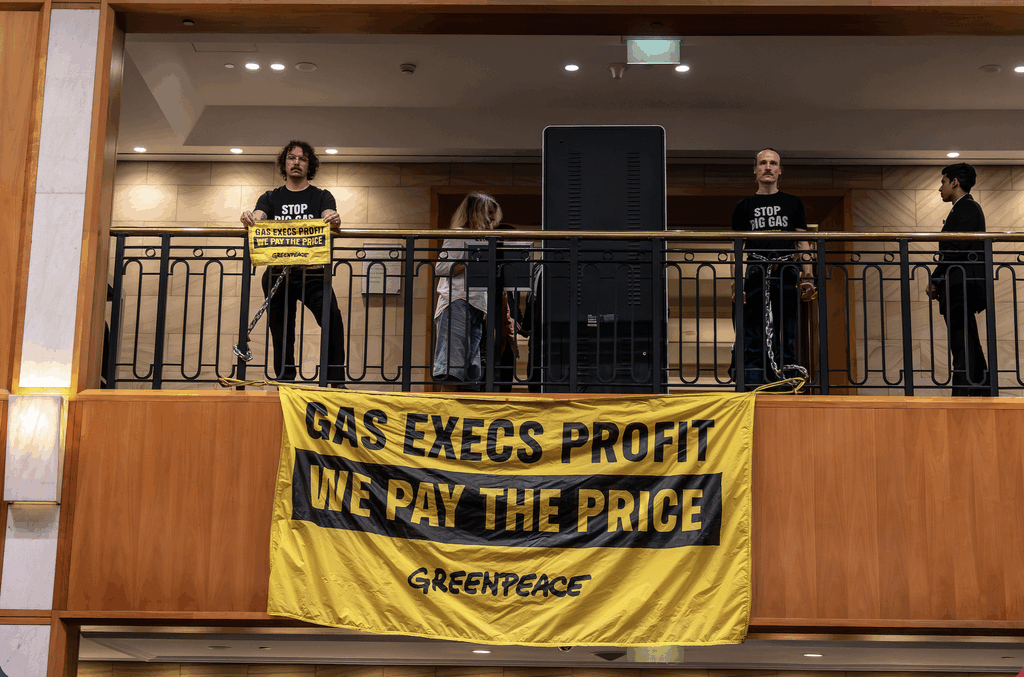
Right now, Greenpeace activists are standing up to Big Gas at a major gas conference in Sydney.
Inside the Sheraton Grand Hotel, executives from fossil fuel companies have gathered alongside lobbyists, investors and political allies to plan the future of gas in Australia – and how to maximise their profits.
So Greenpeace has stepped in to call it out. Activists have dropped a banner inside the venue with a clear message: Gas Execs Profit. We Pay The Price.
We need your help to spread the message that we won’t stand by and let this happen.
What’s really going on
Gas corporations are making billions in windfall profits from global conflicts – from Ukraine to Iran – while Australians pay the price with higher energy bills and climate damage.
And they want more.
More drilling. More exports. More profit.
Why Greenpeace took action today
This conference is where it all comes together. Behind closed doors, gas executives, lobbyists, investors and political allies are meeting to push for more gas expansion, no doubt using global instability as their justification.
That’s why Greenpeace couldn’t let this gathering go uninterrupted.
Big Gas is counting on people not paying attention. Let’s prove them wrong.
Share the video to call out Big Gas.
What needs to happen now
Gas is expensive. It’s volatile. And it ties our energy system to global instability.
But there is a better way. Renewable energy is already cheaper, more reliable, and made right here in Australia. It’s the fastest path to lower bills, real energy security and a safer climate.
To get there, we need to:
- properly tax the gas industry and its exports
- stop expanding gas
- and speed up the transition to homegrown renewable energy.
Share this video far and wide to show just how much support there is to tax Big Gas properly and speed up the transition to renewable energy.
This is just the beginning
This action is part of a growing movement to stand up to Big Gas and challenge the power it holds over our government and society. The Federal Government has a role to play – starting by taxing gas corporations properly and then accelerating the transition to homegrown renewable energy.
Together, we can show just how much support there is for change and make it impossible for decision-makers to ignore.
What you can do
- Follow along on our social channels.
- Share the video far and wide to show how much support there is.
- Sign the petition to tell Albo to stand up to Big Gas – because if we can, he can.
BREAKING: Greenpeace activists disrupt major gas conference in Sydney
SYDNEY, Tuesday 31 March 2026 — Two Greenpeace Australia Pacific activists have been arrested following a peaceful protest at the Australian Domestic Gas Outlook conference in Sydney, where they dropped a banner that said — “Gas Execs Profit. We Pay The Price” and held banners saying “Tax Gas Profits”.
Photos and B Roll video of the protest and arrests are available here
Live updates on Greenpeace Instagram
The two activists were arrested by police around 9:00am AEDT and taken to Day Street Police Station. Information on this morning’s gas conference disruption can be found here.
Solaye Snider, Campaigner at Greenpeace Australia Pacific, said: “Greenpeace activists have taken a strong stand today against profit hungry gas corporations and lobbyists, who see horrific global wars as an opportunity to price gouge and profiteer, while everyday people pay the price.
“Australians have had enough of gas corporations like Santos and ConocoPhillips ripping us off, leaving us with nothing but empty pockets and climate damage. The gas industry is aggressively lobbying against being fairly taxed and pushing to drill for more gas. Change requires showing up and speaking out, and that’s what these activists have done today.
“Greenpeace Australia Pacific stands by our activists, and stands with all communities who are peacefully fighting for a safe and clean energy future. The right to peaceful protest is a fundamental pillar of a healthy democracy and a basic right of all Australians.”
-ENDS-
Media contacts:
Lucy Keller: +61 491 135 308 or lkeller@greenpeace.org or Kate O’Callaghan: +61 406 231 892 or kate.ocallaghan@greenpeace.org
Greenpeace activists arrested after disrupting major gas conference in Sydney



-
Greenhouse Gases8 months ago
Guest post: Why China is still building new coal – and when it might stop
-
Climate Change8 months ago
Guest post: Why China is still building new coal – and when it might stop
-

 Greenhouse Gases2 years ago
嘉宾来稿:满足中国增长的用电需求 光伏加储能“比新建煤电更实惠”
-
Climate Change2 years ago
Bill Discounting Climate Change in Florida’s Energy Policy Awaits DeSantis’ Approval
-

 Climate Change2 years ago
嘉宾来稿:满足中国增长的用电需求 光伏加储能“比新建煤电更实惠”
-
Climate Change Videos2 years ago
The toxic gas flares fuelling Nigeria’s climate change – BBC News
-

 Renewable Energy5 months ago
Sending Progressive Philanthropist George Soros to Prison?
-

 Carbon Footprint2 years ago
US SEC’s Climate Disclosure Rules Spur Renewed Interest in Carbon Credits