


Lithium, a crucial element in energy storage, holds immense significance in powering various industries. With metal prices soaring, the demand for lithium has surged over recent years.
This article delves into the intricate world of lithium dynamics, exploring the factors influencing lithium prices, recent trends, and future projections.
Key Factors Impacting Lithium Prices
Supply and Demand
Global production of lithium has seen a remarkable increase. In 2020, the total demand for lithium worldwide was 292 thousand metric tons of lithium carbonate equivalent.
Forecasts indicate a substantial rise to over 2.1 million metric tons by 2030, highlighting the industry’s exponential growth. This surge is primarily due to the rising battery demand for electric vehicles, which is expected to reach 3.8 million tons by 2035.

Data from the US Geological Survey shows that global lithium production reached 180,000 metric tons in 2021, with about 90% coming from just three countries.
Market Demand
Despite robust demand for lithium, growth experienced a decline year-on-year in 2023 due to economic slowdowns, particularly affecting the electric vehicle market in China. Additionally, accelerated capacity expansions led to an oversupply situation. These fluctuations underscore the delicate balance between supply and demand that significantly impacts lithium prices globally.
Economic Factors
Economic factors such as inflation rates and currency fluctuations also influence lithium prices considerably. These macroeconomic indicators directly impact production costs and subsequently affect pricing strategies within the lithium market.
Major Trends in Lithium Pricing
Recent Price Trends
Lithium prices have recently experienced a notable downward trajectory. As of December 18, prices plummeted by 80% within a year, and as of May 7, CIF North Asia price at $14,600/t. This decline has sparked discussions about the sustainability of this trend.

Expert insights suggest that low prices may lead to reduced supply and hesitant new investments amidst strong demand and cautious predictions.
Effect on the EV Sector
The lithium price drop has a significant impact on the EV sector. Reduced input costs present opportunities for manufacturers to recalibrate pricing strategies, potentially driving down EV costs and increasing consumer adoption rates. This shift highlights the interconnected nature of commodity pricing and its far-reaching consequences on diverse industries.
What’s the Future of Lithium Prices?
As the lithium market navigates significant fluctuations, industry experts provide valuable insights into future price trajectories. By examining expert predictions and analyzing market opportunities and challenges, stakeholders can comprehensively understand the dynamic landscape ahead.
In a recent interview, industry analyst Joe Lowry predicts that the lithium chemical supply is nearing equilibrium, with prices expected to rise by mid-2024 as inventories rebuild in key markets like China. Similarly, Andy Leyland emphasizes that the lithium market’s balance is delicate and that a projected surplus of 24,000 tonnes LCE in 2024 could quickly change due to market dynamics.
Staying informed about lithium carbonate and hydroxide prices is crucial for industry participants to capitalize on opportunities and navigate challenges. Monitoring real-time lithium prices and commodity trends provides invaluable insights for strategic positioning amidst market uncertainty.
The post Lithium Prices Today: What Are the Factors That Affect Them? appeared first on Carbon Credits.


The UK government recently released its Fusion Energy Strategy 2026, where it has laid out a bold plan to turn fusion into a commercial, clean power source while building a strong domestic industry.
The key vision is a £2.5 billion investment over five years. The goal is clear: make the UK the first country with a real pathway to commercial fusion energy. At the same time, the strategy connects clean power goals with economic growth, job creation, and long-term energy security.
A Clear Push Toward Energy Independence
The UK’s strategy comes at a time when global energy markets remain volatile. Fossil fuel dependence continues to create risks. As a result, the government sees fusion as a long-term solution for energy sovereignty.
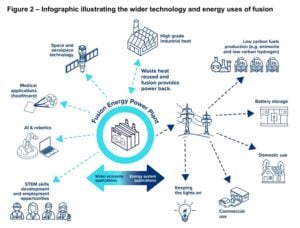
Fusion offers several advantages. It is clean, abundant, and reliable. Unlike solar or wind, it can provide constant power. Because of this, it could play a major role in meeting future electricity demand, especially as industries and AI systems consume more energy.
The government believes that reducing reliance on fossil fuels is the only way to secure long-term stability. Fusion, therefore, is not just a research goal—it is a strategic priority.
Investing Across the Fusion Ecosystem
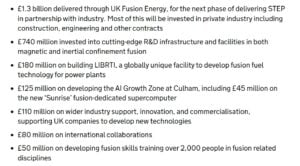
Together, these investments aim to strengthen the entire value chain—from early research to final deployment.
At the same time, the UK is working closely with the private sector. More than 500 companies are already involved in the fusion space. This number is expected to grow as global competition increases.
The potential market is massive. Estimates suggest that fusion could become a £3 trillion to £12 trillion global industry. Therefore, countries are racing to secure leadership positions early.
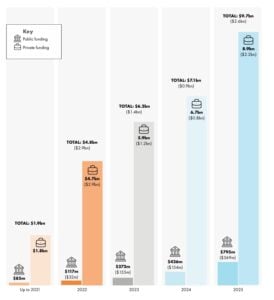
Five-Year Fusion Trends: Total Funding Till 2025
STEP Program: Building the First Fusion Power Plant
A major part of the funding—£1.3 billion—will go to the Spherical Tokamak for Energy Production (STEP) program. This initiative aims to design and build the UK’s first prototype fusion power plant.
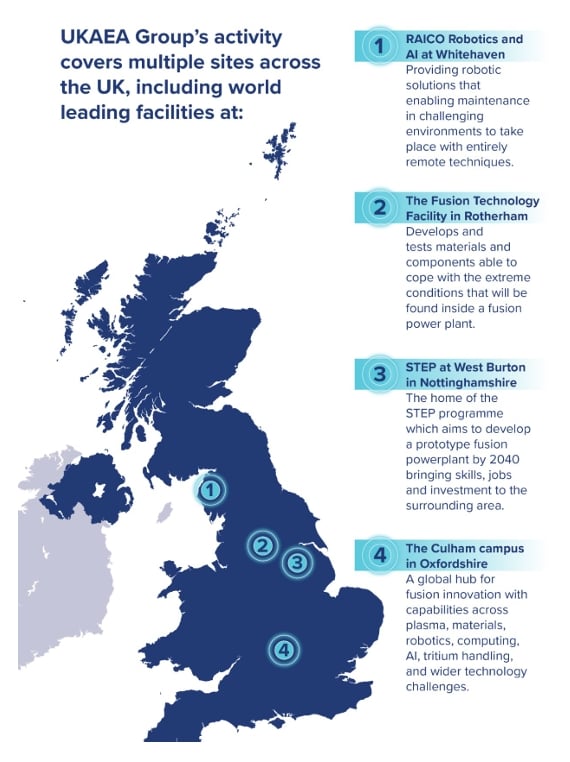
The plant will be located at a former coal site in Nottinghamshire. Construction is expected to begin in 2030, with completion targeted for 2040. The mission is ambitious: generate net energy from fusion and prove that the technology can work at a commercial scale.

To deliver this, the UK has partnered with a consortium called ILIOS. This group, led by Kier and Nuvia, will handle construction, engineering, and supply chain management. Their role covers everything from design integration to infrastructure development.
Importantly, STEP is meant to act as a catalyst. By building this prototype, the UK hopes to stimulate a broader fusion ecosystem, including suppliers, engineers, and technology firms.
UK Fusion Energy
A key part of this shift is the creation of UK Fusion Energy, a subsidiary responsible for delivering the STEP program. This organization will act as a systems integrator. It will bring together multiple technologies and partners to build a complete fusion power plant.
In summary, the three main goals for UK Fusion Energy are:
- Make future fusion power plants safer and more reliable
- Build strong UK industries and supply chains
- Bring lasting economic benefits and energy security to the UK
UKAEA Group: The Backbone of the UK’s Fusion Ambition
The backbone of the UK’s fusion strategy is the UK Atomic Energy Authority (UKAEA Group). It acts as the country’s main public body driving fusion research, innovation, and delivery.
The UKAEA operates the National Fusion Laboratory based in Culham, Oxfordshire. This facility leads advanced research in plasma science, robotics, materials, tritium systems, and high-performance computing. Over time, it has built a strong global reputation for technical excellence.
However, the UKAEA’s role is now expanding. Other than research, it is actively helping to turn scientific progress into commercial outcomes.
- Neutral beam systems are used for plasma heating
- Robotics for remote maintenance in extreme environments
- Advanced diagnostics and sensor technologies
- Fusion fuel cycle systems and materials
This approach ensures that public research does not remain in the lab. Instead, it flows into real-world applications, supporting both fusion and other industries.
- ALSO SEE: France Shocks Energy Sector and Rewrites Energy Future: New Law Boosts Nuclear, Cuts Renewables
Building a Strong Industrial Base
The UK’s strategy goes beyond technology. It focuses heavily on building a full industrial ecosystem.
The plan supports companies of all sizes—from startups to multinational firms. It also aims to develop strong supply chains within the country. By doing so, the UK wants to become a top destination for fusion investment.
Key areas of opportunity include:
- High-temperature superconducting magnets
- Advanced materials
- Robotics and remote maintenance
- Plasma systems and lasers
- AI-driven control systems
These technologies are not limited to fusion. They also have applications in sectors like aerospace, automotive, healthcare, and telecommunications. As a result, fusion investment could drive innovation across multiple industries.
For example, UK-based companies are already exploring how fusion-related technologies can be used in power grids and advanced manufacturing. This creates near-term economic benefits, even before fusion becomes fully commercial.
AI Meets Fusion: A Game-Changing Combination
One of the most forward-looking parts of the strategy is its focus on artificial intelligence. The government sees AI as a key tool for unlocking fusion energy.
Fusion systems are highly complex. They involve extreme temperatures, fast reactions, and dynamic plasma behavior. Managing these systems requires advanced data analysis and real-time decision-making. This is where AI becomes critical.
Revealing an AI supercomputer: Sunrise
The UK plans to invest £45 million in a dedicated AI supercomputer called Sunrise. This system will support fusion research by accelerating simulations, improving designs, and optimizing operations.
In addition, the UKAEA’s Culham campus will become an AI Growth Zone. This hub will bring together scientists, engineers, and AI experts. The goal is to create a collaborative environment where innovation can thrive.
The government’s broader AI strategy supports this effort. It focuses on building strong data systems, expanding computing power, and encouraging multidisciplinary research. Fusion stands out as one of the priority sectors where AI can deliver rapid breakthroughs.
Interestingly, the relationship works both ways. While AI helps make fusion possible, fusion could eventually power energy-intensive AI data centers. This creates a strong link between future clean energy and digital growth.
DESNZ Sets Clear Rules for Fusion Development
Investors and developers need clear rules to plan fusion projects with confidence. This includes understanding safety, environmental, and planning approvals, as well as which UK organizations must be involved.
To provide clarity, DESNZ (Department for Energy Security and Net Zero) will release a roadmap for the UK fusion regulatory process by Summer 2026. This will guide developers on how to get approvals and engage with regulators early.
The plan also aims to help regulators understand fusion technologies better and support early collaboration, reducing risks in plant design. Fusion regulators are already working with industry and will continue reviewing processes as the sector grows.
The post UK Fusion £2.5B Strategy Links AI Growth with Clean Energy Breakthroughs appeared first on Carbon Credits.
Carbon Footprint
Chery Hits Record Earnings as It Bets Big on NEVs, Overseas Sales, and Clean Energy

Chery Automobile is steering full speed ahead. The Chinese carmaker posted record revenues and profits for Q4 2025, backed by a stronger global presence and growing investments in new energy vehicles (NEVs) and smart technology. While the future looks bright, investors should keep an eye on the challenges of NEV profitability and the costs of rapid expansion.
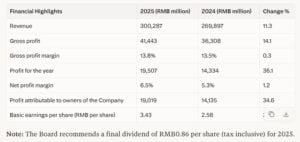
Last year, Chery’s net income jumped 34.6% to 19.02 billion yuan ($2.77 billion). This surge came on the back of record global deliveries of 2.63 million vehicles, an 8% rise from 2024.
Revenue also climbed 11.3% to 300.29 billion yuan. Despite tough competition in China’s passenger car market, Chery managed to slightly lift its overall gross margin to 13.8% from 13.5% the year before.
Financial highlights for the year ended 31 December 2025
NEVs Take the Spotlight
- Passenger vehicles made up the major revenue at 272.4 billion yuan, or 90.7% of total sales. NEVs stole the spotlight, with sales soaring 66.4% to 98 billion yuan, now making up almost a third of passenger vehicle revenue.
Traditional internal combustion engine (ICE) vehicles fell 7.2% to 174.3 billion yuan, reflecting the ongoing industry shift toward electrification. The surge in NEV sales shows how the market is changing fast, and Chery is clearly keeping pace.
Chery Going Global Pays Off
Chery’s international strategy is paying off.
- For the first time, overseas revenue outpaced domestic sales, jumping to 157.4 billion yuan from 100.9 billion yuan, while China’s sales dropped to 142.9 billion yuan.
This milestone highlights how Chery’s global expansion is more than a strategy—it’s a real driver of growth. It also shows the brand’s rising appeal outside China, particularly in markets that value affordable, high-tech, and energy-efficient vehicles.
A Rise in Gross Profit
Overall gross profit increased 14.1% to 41.4 billion yuan, but NEVs still lag behind ICE vehicles on margins, earning 8.8% compared to 15% for ICEs. As NEVs took up a larger share of the passenger vehicle mix, the core business margin slipped slightly to 12.8%.
The EV maker is investing heavily to meet rising global demand, pushing up capital expenditure, marketing, and R&D spending to build capacity and future models. Selling and distribution costs jumped 32.6% due to aggressive marketing campaigns, while research and development spending rose 23.8% as the company accelerated innovation for its next-generation vehicles.
Brand Performance Highlights
- Among Chery’s brands, Luxeed and iCar saw the fastest growth. Luxeed sold 90,493 vehicles, up 56% year-on-year, while iCar delivered 96,989 units, a 47% increase.
- Meanwhile, the premium Exeed brand fell 15% to 120,369 units, showing that not all segments are booming equally.
This show, Chery is clearly experimenting with a multi-brand approach, pushing emerging names forward while keeping an eye on premium offerings.
Chery’s Solid-State Batteries on the Horizon
Chery is doubling down on technology to stay ahead. According to the CnEV report, the company planned to unveil its solid-state battery technology at its upcoming “Battery Night,” promising ranges over 1,200 kilometers—a potential game-changer in the EV market.
The solid-state battery module showcased in October 2025 signals Chery’s serious step toward longer-range, high-performance electric vehicles, which could help it compete with international EV leaders.
Chery’s Emissions and Energy Use
Chery is ambitious about cutting emissions and using energy more efficiently. In its 2024 ESG Report, the company tracks greenhouse gas emissions, energy consumption, and ways to make operations cleaner.
It reports both Scope 1 and Scope 2 emissions—direct emissions from the fuel it uses and indirect emissions from electricity.
- Scope 1 emissions rose from 140,000 to 203,000 tonnes of CO₂e in 2024, and total emissions for Scopes 1 and 2 reached over 733,000 tonnes.
- Emission intensity, which measures CO₂e per vehicle, rose slightly to 0.30 tCO₂e, reflecting changes in production and energy use.
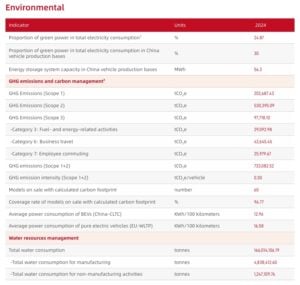
Chery’s energy strategy focuses on cleaner electricity and renewables, aligning with China’s targets for carbon peak by 2030 and carbon neutrality by 2060. About 30% of energy at China plants comes from green sources, and the company has installed 210 MW of solar panels across its facilities. It also improves energy efficiency in factories, cutting energy use and emissions.
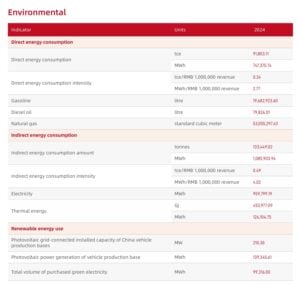
On the vehicle side, it assesses the full lifecycle carbon footprint of nearly all models, from production to end-of-life, helping the company target areas with the highest impact.
To further reduce emissions, Chery is investing in hybrids, NEVs, and supply chain efficiency. Low-carbon materials, energy-efficient manufacturing, and renewable adoption are part of a multi-year transition to greener operations. This approach shows that Chery is serious about sustainability while scaling up production globally.
Smart Mobility and AI
Chery’s guiding philosophy, “Technology Shapes the Future,” reflects a clear commitment to electrification and intelligent mobility. The company is building cross-industry alliances and pushing innovations in AI and smart vehicles.
Its AI governance framework aligns with international standards, covering intelligent cockpits, driver assistance, and quality prediction tools. This ensures that Chery’s vehicles are not only electric but also smart, safe, and ready for future mobility trends.
Innovation in Hybrids and Ethanol Fuel
Chery focuses on hybrid powertrains, next-gen battery tech, and expanding electric vehicle options. The Fulwin, EXLANTIX, and JETOUR Shan Hai series offer hybrid and plug-in options for city driving, long trips, and off-road adventures.
Its fifth-generation Super Hybrid System powers multiple series, offering high fuel efficiency and long-range capabilities, tested under extreme conditions. The tri-motor architecture and 3-speed intelligent electric hybrid DHT enable the JETOUR Shan Hai T2 AWD to accelerate from 0 to 100 km/h in 5.5 seconds while covering over 1,200 kilometers.
Last year, the company rolled out plug-in hybrids compatible with high-ratio E32 ethanol fuel, further cutting carbon emissions and boosting energy flexibility. These moves highlight how the company blends innovation with environmental responsibility.
Looking Ahead
Chery’s 2025 performance shows a company in transition. Revenues and global sales are surging, NEVs are taking a larger share, and investment in technology and sustainability is accelerating.
However, challenges remain, including NEV profitability, execution risks, and cash flow management. But with strong finances, aggressive R&D, and a clear global strategy, Chery can become a major player in low-carbon, intelligent mobility.
- FURTHER READING: China Now Controls 69% of the Global EV Battery Market as CATL and BYD Surge in 2025
The post Chery Hits Record Earnings as It Bets Big on NEVs, Overseas Sales, and Clean Energy appeared first on Carbon Credits.

Google has signed a major deal to buy carbon removal credits from an affiliate of AMP Robotics. The agreement targets the removal of 200,000 metric tons of carbon dioxide equivalent (CO₂e) by 2030. It is one of Google’s largest carbon removal purchases to date.
The project uses artificial intelligence (AI) to sort municipal solid waste. Organic waste is separated before it reaches landfills. Instead of decomposing and releasing methane, the waste is turned into biochar. Biochar is a stable material that can store carbon for hundreds of years.
The deal shows how large companies are moving beyond simple offsets. They are now funding durable carbon removal solutions that can scale over time.
AI + Biochar: Turning Trash into Carbon Storage
The project’s approach tackles two problems at once. It reduces methane emissions in the short term. It also removes carbon dioxide for the long term. Methane is a powerful greenhouse gas. In the United States, landfilled waste is the third-largest source of human-caused methane emissions, according to the U.S. Environmental Protection Agency.
Reilly O’Hara, Program Manager, Carbon Removal at Google, remarked:
“Beyond the carbon removal itself, we are excited to explore the dual-action impact of AMP’s approach on methane – a superpollutant 80x more potent than CO2. By diverting organic matter before it decomposes and utilizing biochar in landfill soil covers to neutralize existing gases, this partnership could serve as a blueprint for eliminating emissions at the source, leveraging existing industry, and creating a scalable model for the circular economy.”
The AMP system uses AI to identify and sort materials from mixed waste streams. The company says its platform has already identified more than 200 billion items and processed 2.9 million tons of recyclables globally.
In this project, the system will process up to 540,000 tons of waste per year in Virginia. At least 50% of this waste will be diverted from landfills. Each ton of waste diverted can reduce or remove more than 0.7 tons of CO₂e. That adds up to over 378,000 tons of CO₂ avoided or removed each year. This is equal to taking about 88,000 cars off the road annually.
The project is backed by a 20-year contract with a regional waste authority serving 1.2 million people. Over time, AMP aims to convert 5 million tons of organic waste into biochar over 20 years.
image here….
Biochar also has added uses. It can be used in landfills to reduce odors and control pollution. It may also be used in construction and cement. This creates new value streams while storing carbon.
Carbon Removal Market Gains Momentum
The deal reflects a wider shift in the carbon market. Companies are now focusing on carbon dioxide removal (CDR) instead of traditional offsets. Carbon removal captures CO₂ from the atmosphere and stores it for long periods.
The market is still small but growing fast. A coalition backed by major companies, including Google, has committed to spending $1 billion on carbon removal credits by 2030.
Recent deals show rising demand:
- Google agreed to buy 100,000 tons of carbon removal credits from an agricultural biochar project in India.
- It also signed a deal for 50,000 tons of removal credits using underground waste storage technology.
Prices for high-quality removal credits remain high. Some deals have reached around $362 per ton, reflecting early-stage technology and limited supply.

At the same time, developers are working to scale production and lower costs. Biochar is seen as one of the more practical options today because it uses existing waste streams and proven processes.
Methane Matters: Quick Wins for the Climate
One reason this deal matters is its focus on methane. Methane causes much faster warming than CO₂ in the short term. Reducing methane can deliver quick climate benefits.
Waste is a major methane source. When organic waste breaks down in landfills, it releases methane gas. By diverting this waste early, AMP’s system prevents methane from forming at all.
This makes waste-based carbon removal different from many other methods. It combines emissions avoidance and carbon removal in one process.
This dual benefit is attracting attention from companies and policymakers. Many climate strategies now include methane reduction as a priority. Technologies that can do both removal and avoidance may scale faster than single-purpose solutions.
Beyond market impact, the deal highlights how Google is managing its rising emissions.
How This Fits Google’s Climate Strategy
The deal is part of Google’s wider plan to reduce its climate impact. The company has set a goal to reach net-zero emissions across its operations and value chain by 2030. It also aims to run on 24/7 carbon-free energy by 2030, meaning every hour of electricity use is matched with clean energy.

However, Google’s emissions have risen in recent years. In its 2024 environmental report, the company noted around 11.5 million tonnes of ambition-based CO₂e emissions. This marks an 11% rise from 2023 and is about 51% higher than in 2019. The increase shows ongoing growth in energy use, mainly from AI-powered data centers and expanded infrastructure.
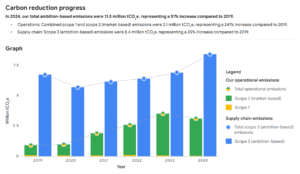
Because of this, Google is using carbon removal to address emissions it cannot fully eliminate. The company has said it will rely on high-quality carbon removal credits instead of traditional offsets. These credits must remove carbon from the atmosphere and store it for long periods.
The tech giant is also a founding member of Frontier, a coalition of companies committed to spending $1 billion on carbon removal by 2030. The group helps fund early-stage technologies and scale supply.
This strategy reflects a broader shift among tech companies. As energy use grows, especially from AI and cloud computing, firms are investing more in carbon removal to meet climate targets.
Carbon Removal Demand Surges, But Supply Falls Short
The Google–AMP deal shows how fast the carbon removal market is growing. But the market is still far from the scale needed to meet climate goals. Today, global emissions remain high at about 38 gigatonnes of CO₂ in 2024, according to the International Energy Agency.
To balance these emissions, demand for carbon removal is rising quickly. Estimates show the market could reach 40 to 200 million tonnes of CO₂ removal per year by 2030, and as much as 80 to 900 million tonnes by 2040. This could create a $10 billion to $40 billion market by 2030, growing to as much as $135 billion by 2040.
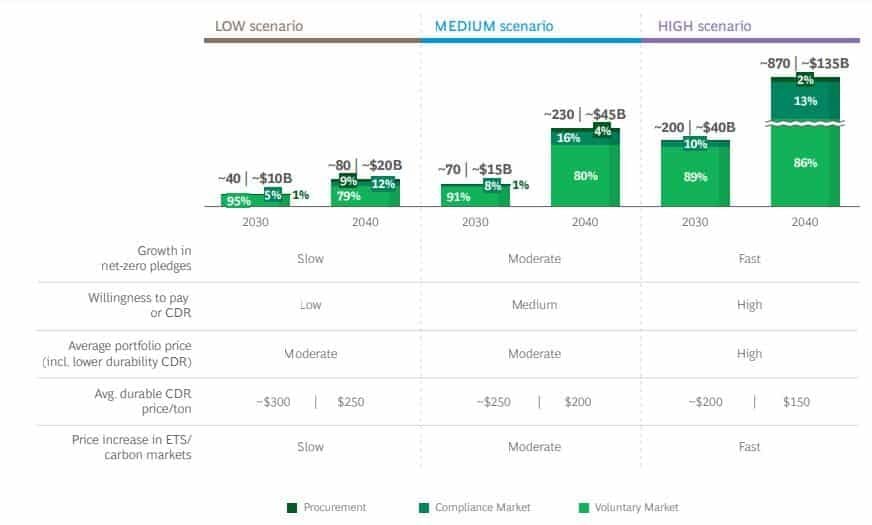
At the same time, supply is still limited. Current announced projects may only deliver around 33 million tonnes by 2030, far below expected demand. This gap is one reason large buyers like Google are signing long-term deals early. These agreements help scale new technologies and secure future supply.
Long-term, carbon removal will play a major role in climate strategy. Some projections show that removal capacity must reach around 1.7 gigatonnes per year by 2050 to meet global climate targets. Carbon capture alone could deliver about 12% of total emissions reductions between 2030 and 2050, especially in heavy industries like cement and steel.

Investment is also rising fast. In the past five years, the number of carbon removal startups has grown fivefold, and venture funding has increased sevenfold. This shows strong interest from both private investors and large companies.
Closing the Carbon Gap
Still, challenges remain. Costs are high, and standards are still evolving. Some forecasts suggest the market could reach up to $100 billion per year by the early 2030s, but only if policy support and financing improve.
In this context, the Google–AMP deal reflects a clear shift. Companies are moving early to secure high-quality carbon removal. They are also helping build the market from the ground up. Waste-based solutions like biochar may scale faster because they use existing systems and deliver both methane reduction and carbon storage.
Overall, carbon removal is moving from a niche idea to a core part of climate strategy. But the gap between current supply and future demand remains large. Closing that gap will require strong investment, clear rules, and continued innovation across the sector.
The post Google Inks Waste-to-Carbon Deal to Remove 200K Tons of CO₂ With AI and Biochar appeared first on Carbon Credits.

Corpus Christi Cuts Timeline to Disaster as Abbott Issues Emergency Orders
UK Fusion £2.5B Strategy Links AI Growth with Clean Energy Breakthroughs

Middle East war is another wake-up call for fossil fuel-reliant food systems
-
Greenhouse Gases7 months ago
Guest post: Why China is still building new coal – and when it might stop
-
Climate Change7 months ago
Guest post: Why China is still building new coal – and when it might stop
-

 Greenhouse Gases2 years ago
嘉宾来稿:满足中国增长的用电需求 光伏加储能“比新建煤电更实惠”
-
Climate Change2 years ago
Bill Discounting Climate Change in Florida’s Energy Policy Awaits DeSantis’ Approval
-

 Climate Change2 years ago
嘉宾来稿:满足中国增长的用电需求 光伏加储能“比新建煤电更实惠”
-
Climate Change Videos2 years ago
The toxic gas flares fuelling Nigeria’s climate change – BBC News
-

 Carbon Footprint2 years ago
US SEC’s Climate Disclosure Rules Spur Renewed Interest in Carbon Credits
-
Renewable Energy2 years ago
GAF Energy Completes Construction of Second Manufacturing Facility