

Italy plans to channel billions of euros from its climate fund into a development programme for Africa that observers fear could promote fossil fuels and “false solutions” to global warming.
At a summit in Rome with two dozen African and European leaders on Monday, Italian prime minister Giorgia Meloni unveiled a long-awaited initiative aimed at boosting economic ties and curbing migration.
The transformation of Italy into “an energy hub” that creates “a bridge between Europe and Africa” is a central plank of the ‘Mattei Plan’ – named after Enrico Mattei, founder of state oil and gas company Eni.
Meloni said initial resources for the scheme would total 5.5 billion euros ($5.95 billion), including loans, guarantees and grants. Over half of the budget would come from a climate fund set up in 2022 to finance international projects in line with the Paris Agreement, she added.
Widespread concerns
Campaigners in Italy and across Africa have expressed concerns over the initiative.
Silvia Francescon, from Italian think tank Ecco, told Climate Home that the plan presents “enormous ambiguities” that leave the door open to fossil fuel investment.
A document released by the Italian government indicated the initiative would strengthen the use of renewables and “accelerate the transition of electricity systems”, but did not explicitly rule out oil and gas projects.
Zimbabwe looks to China to secure a place in the EV battery supply chain
“There is no reference to the Paris Agreement or the Cop decisions. Based on what we currently know, there is undoubtedly a risk that funds meant for climate and international development could be used for projects managed by companies like Eni”, she added. “The ambiguity is very worrying”.
Eni’s long shadow
Eni has extensive oil and gas operations across a dozen African countries, including Nigeria, Mozambique, Ivory Coast and the Republic of Congo.
Its CEO Claudio Descalzi attended the launch of the Mattei Plan in the Italian Senate alongside executives of other state-controlled companies.
At a political event organised by Meloni’s right-wing populist party last December, he said Italy was “ready to invest in Africa both to get the energy needed for economic growth but also to tackle migration flows”.
Cop29 host Azerbaijan launches green energy unit to sceptical response
Concerns over Eni’s looming presence over the initiative have been widespread ever since Meloni named the plan after the company’s founder.
Enrico Mattei led the company’s quest in the mid-20th century to capture a significant share of the fast-expanding market.
His willingness to give oil-producing states a larger share of the profits than its American and British rivals is widely credited as a key reason behind Eni’s success at the time. Mattei died in 1962 in a plane crash caused by a suspected sabotage.
Mutual benefits
Meloni hailed Mattei as an inspiration for her plan that, she said, would be “a cooperation among equals” and “non-predatory”.
But African Union Commission Chairman Moussa Faki Mahamat told the summit that African countries would have liked to have been consulted beforehand.
“We need to pass from words to deeds,” he said, striking a cautious note. “You can understand that we cannot be happy with promises that often are not maintained.”
The Italian government has put energy at the centre of the partnership but details of which energy sources will be included have been very limited.
Governments fail to agree timeline for climate science reports in fraught IPCC talks
Italy signed several gas deals with African countries over the last two years as it sought to replace Russian supplies. But gas was the “elephant in the room” at the summit, as Kenyan president William Ruto described it in his address.
Ruto said he believed “that no African country can be asked to halt the exploration of its natural resources, including fossil fuels”. But “that does not mean that it makes economic sense to build a dependency on fossil fuels in our economies”, he added, calling gas “a temporary solution, primarily for export”.
‘False solutions’
Among a limited number of “pilot projects” referenced in Meloni’s speech is a biofuel production operation launched by Eni in Kenya in 2021.
Supporters of biofuels see them as an important contributor to the energy transition away from fossil fuels. But critics argue they can do more harm than good by diverting land away from food production, destroying forests, worsening water scarcity and unleashing significant amounts of emissions across their supply chains.
Amazon nations to tackle rainforest crime together in donor-funded new office
Dean Bhebhe, campaigns lead at Power Shift Africa, called Meloni’s focus “very problematic”. “Africa has an enormous amount of solar and wind – genuine renewable energy sources – and instead she chooses a false solution like biofuels”, he told Climate Home.
Concerns have also been raised over the lack of engagement with civil society representatives that were not invited to the summit. Ahead of the event, over 50 African groups wrote a letter to the Italian government asking for an “end of neo-colonial approaches” and “a more consultative approach”.
“Currently the Mattei plan does not offer Africa a path to escape the systematic traps that prevent its development”, said Bhebhe. “We need plans that rebalance Africa’s position globally in truly innovative ways, not convenings that keep it at the bottom of the food chain”.
The post Italy launches ‘ambiguous’ Africa plan fuelling fears over fossil fuels role appeared first on Climate Home News.
Italy launches ‘ambiguous’ Africa plan fuelling fears over fossil fuels role

Around 300 scientists, civil servants, journalists and climate experts took part in the 11th annual Carbon Brief quiz on Wednesday 18 March 2026.
For the second time, this year’s quiz was hosted by Octopus Energy at its headquarters in central London.
In total, 39 teams participated – 25 teams in person and 14 teams joining via Zoom.
Competing teams reflected a wide range of climate change and energy professionals. The list included journalists, civil servants, climate campaigners, policy advisers, energy experts and scientists.
Organisations represented included: Council on Energy, Environment and Water (CEEW) in India; New Scientist; the Times; Business Green; the Bartlett School of Environment, Energy and Resources (BSEER), UCL; Verisk Maplecroft; BBC; World Weather Attribution; Grantham Institute at Imperial; DESNZ; WWF; European Climate Foundation (ECF); the ENDS Report; C40 Cities; Ricardo; Met Office; Meliore; E3G; Danish Meteorological Institute (DMI); Energy Transitions Commission; Carbon Tracker; Ember; Royal Meteorological Society; Civil Service Climate and Environment Network (CSCEN); Changing Markets Foundation; Cerulogy; Oxford Sustainable Law Programme; Université de Lausanne; University of Exeter; Centre for Environment and Sustainability, University of Surrey; UK Parliament; Skeptical Science; ECIU (Energy and Climate Intelligence Unit); Octopus Energy; DeSmog; Department for Transport and Royal School of Mines.
Teams were tested with five rounds of questions – general knowledge, policy, science and two picture rounds. (See the slideshow of the questions and answers below).
After two hours of playing, this year’s winners were announced.
Comprised of players from the Council on Energy, Environment and Water (CEEW) in India, last time’s second place team, “Emissions Impossible” won the coveted Carbon Brief trophy with a total score of 76 out of 100 available points.

In joint second place, with 59 points, were the “Potato-sized nodules”, a mixed team of journalists from New Scientist, the Times and Business Green.
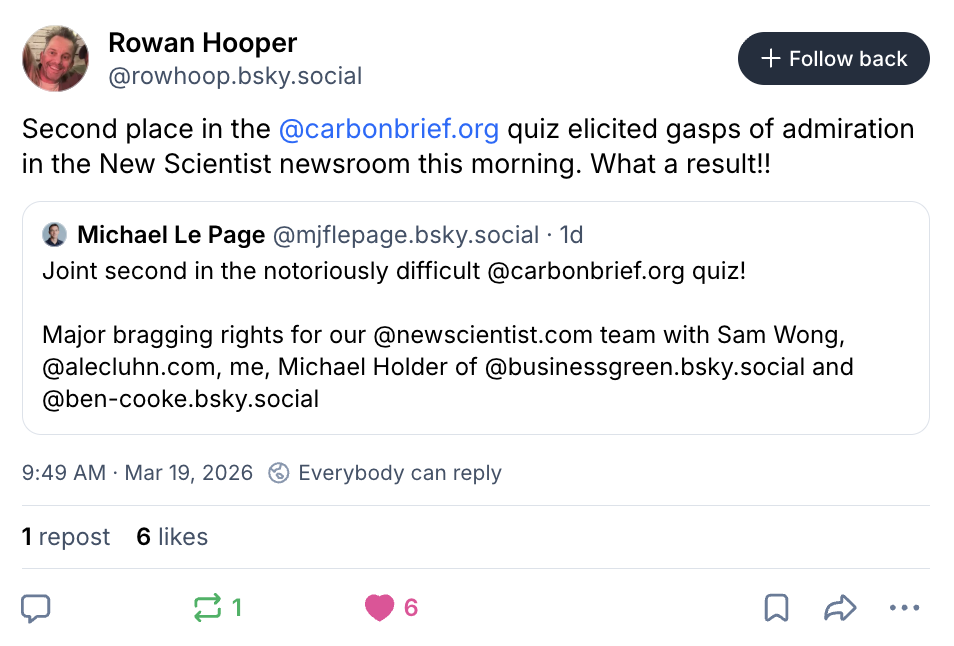
Sharing second place, after leading at the half-way point, were “You cannot BSEERious” from the Bartlett School of Environment, Energy and Resources at UCL.
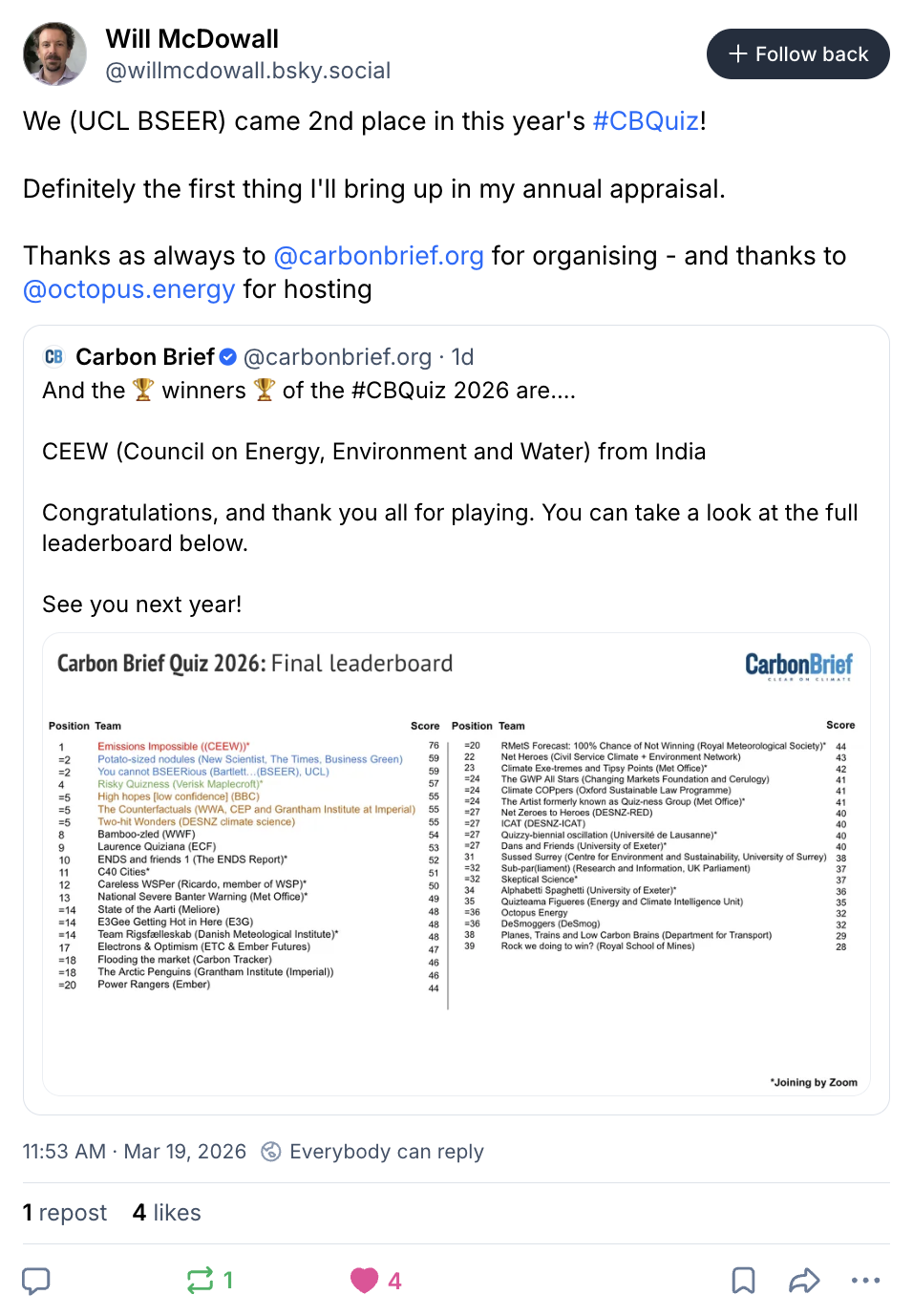
In fourth place, with 57 points, were “Risky Quizness”, from Verisk Maplecroft.
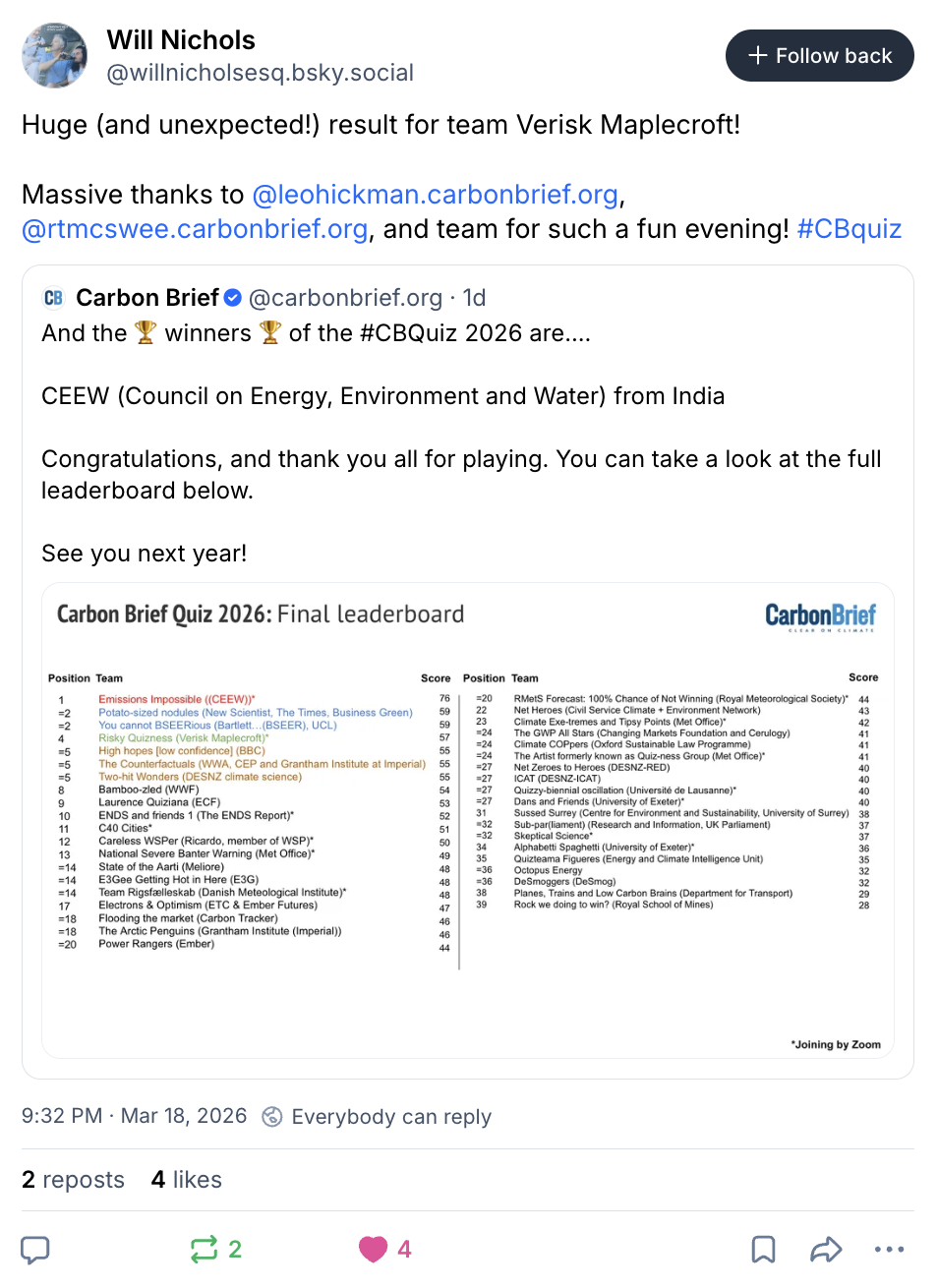
A certificate was awarded to the BBC for the best team name, as voted for by Carbon Brief staff: “High hopes [low confidence]”.
See the full leaderboard:

All the questions and answers from this year’s quiz can be found in this PDF document.
This year’s trickiest round was picture round two, which asked teams to match the quote to the author, with an average score of 5.9 out of 20 available points.
No team correctly guessed that “Chris Funk: Drought, Flood, Fire” was the source of the quote: “How greenhouse gases warm the atmosphere is pretty straightforward. It is really important that we understand this. But almost nobody does, because it is not something that we are taught in school.”
Science was the second hardest round, earning an average score of 6.1 points out of 20.
No team correctly guessed “religious leaders” as the least trustworthy source of climate information, according to a 2025 study using public polling from seven global south countries.
The highest-scoring round was general knowledge, with an average of 13.8 out of 20 questions answered correctly.
Carbon Brief would like to thank all the teams who took part and we look forward to hosting the quiz again in the spring of 2027.
If you would like to participate in next year’s quiz, please contact us in advance at quiz AT carbonbrief DOT org.
Photos by Kerry Cleaver






The post The Carbon Brief Quiz 2026 appeared first on Carbon Brief.
Just 1% of England’s land will be needed for renewables to help meet the UK’s climate goals by 2050, according to a first-of-its-kind framework.
There is enough land in England to meet climate and nature goals, while also producing more food and building new homes, according to the UK government’s new “land-use framework”.
Speaking at the framework’s launch on Wednesday, environment secretary Emma Reynolds said she hoped it would put an end to the idea that England faces “false choices” over “solar panels versus farmland”, or “growth versus environment”.
The policy was first planned by the Conservative government in 2022, but has been delayed many times.
It has been broadly welcomed by environmental groups, with Tony Juniper, the chair of Natural England, calling it a “vital step forward” towards “more joined-up approaches” to land use.
Below, Carbon Brief outlines the main points of the framework relating to climate change, nature restoration, food production, renewable energy and housing.
- What is the land-use framework?
- What does the plan say about how land in England should be used?
- What does the framework mean for different sectors?
What is the land-use framework?
The government’s land-use framework for England aims to set out a “coherent national vision” for using land.
The 56-page report is the first of its kind in England.
It focuses solely on England, but notes that the government will “work closely” with the devolved governments in Scotland, Wales and Northern Ireland to share best practice and “collaborate on cross-border issues”.
It is a “blueprint” to inform better decisions on optimising land use to produce food, host renewable energy, restore nature and build more homes, says environment secretary Emma Reynolds in the foreword of the framework.
The plan hopes to end the “fragmented approach” to tackling these issues, which has led to a “confused picture and missed opportunities for land to deliver multiple benefits”, Reynolds says in the foreword. She adds:
“We can plant trees to reduce flood risk to homes and farmland, locate energy infrastructure alongside nature-rich food production and ensure nature recovery is at the heart of resilient growth and development.”
The report says it will play a “critical role” in helping to deliver national and global commitments, such as carbon budgets and national biodiversity and climate plans.
The framework commits to creating a long-term assessment of climate change impacts on land use at 2C and 4C of global warming.
It also commits to setting up a “land-use unit” in the Department for Environment, Food & Rural Affairs to produce a map of “national spatial priorities” in England for, among other things, food production, nature and housing.
The government says it will update the framework every five years, outlining progress and next steps on implementation.
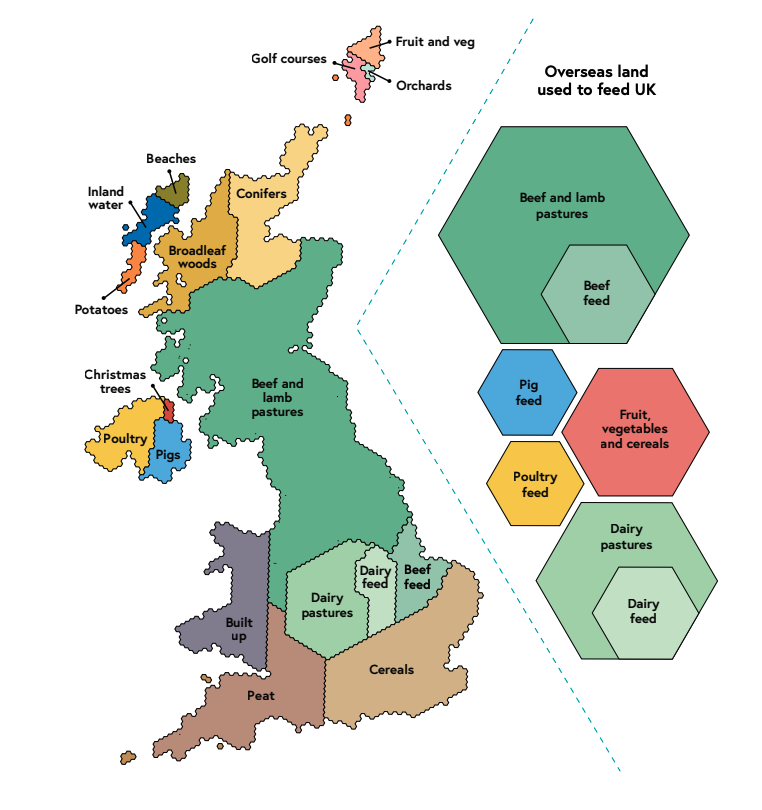
Currently, about 70% of land in the UK is used for agriculture – primarily livestock.
The chart below highlights how land is currently allocated in the UK (left) and how much overseas land is used to produce food for the UK (right).
The government’s land-use framework for England has been long-awaited and much-delayed.
The recommendation for the report first came in the 2021 National Food Strategy, an independent report led by businessman Henry Dimbleby.
It recommended creating a rural land-use framework to give “detailed assessments” of the best ways to use land in England.
The former Conservative government committed to produce such a report in a June 2022 food strategy.
This strategy said that a land-use framework for England would be released in 2023 “to ensure we meet our net-zero and biodiversity targets”, among other aims.
The publication was, however, delayed many times.
The Labour government launched a consultation on the framework in January 2025 and the final report was eventually released on 18 March 2026.
The framework is a “long-awaited opportunity for real change”, says Roger Mortlock, chief executive of the environmental charity Campaign to Protect Rural England (CPRE), in a statement.
Mortlock welcomes its “ambition”, but says that the way in which land tradeoffs are considered locally and nationally “will be key to its success”.
A report released by CPRE earlier this week, however, said that the framework is “unlikely to be the silver bullet many are hoping for”.
What does the plan say about how land in England should be used?
The framework uses high-resolution modelling – what it calls the “most sophisticated analysis” of its kind – to examine how England can use land to meet climate, nature, food and housing needs.
One key finding is that England has enough land to meet all of its objectives, if land is used efficiently.
This means that England has “enough land to deliver our objectives for nature restoration and development without reducing domestic food production or compromising on these objectives”, according to the framework.
It adds that efficient land use means “playing to the strengths” of England’s varied landscape. This involves, for example, prioritising the restoration of peatlands in north-west England and temperate rainforests in the south-west.
The chart below shows the percentage of land in England currently used for different purposes, as well as how this distribution will need to change by 2030 and 2050, if the UK is to meet its goals, according to the framework.
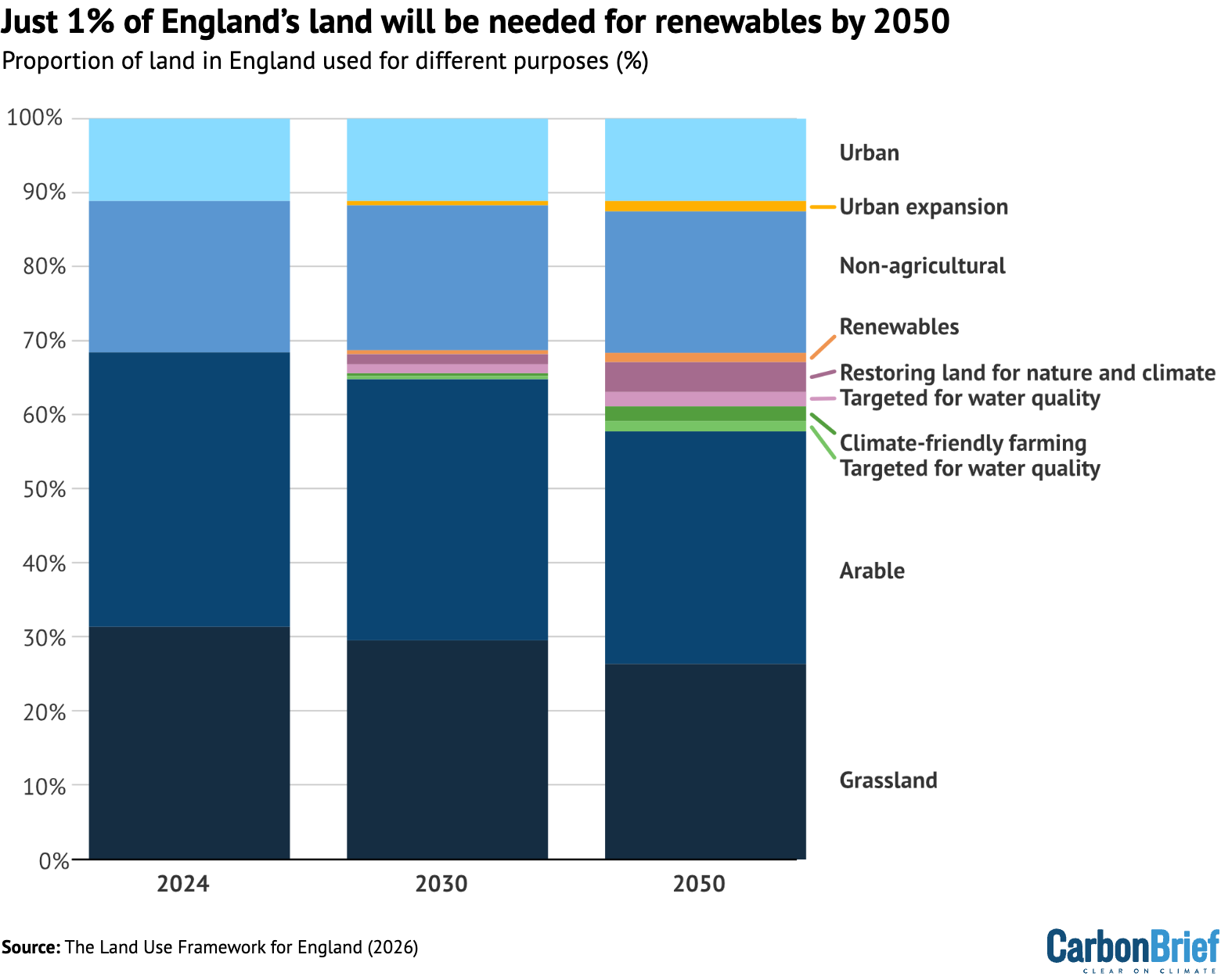
According to the framework, just 1% of England’s land will need to be taken up by renewables, such as solar and onshore wind, by 2050.
However, the framework does note that there is “inherent uncertainty” in projecting energy use by 2050 and says that the amount of land required for renewables may be nearer to “more than 2%”, depending on how quickly solar and wind is deployed in the future.
A further 6% of England’s land should be used for achieving climate and nature goals, according to the framework.
(A Defra official tells Carbon Brief that the framework’s projections for renewable energy and tree-planting were not as ambitious as those in the Climate Change Committee’s central pathway to net-zero, but are in line with the government’s carbon budget delivery plan for 2035.)
Speaking at the launch of the framework, environment secretary Emma Reynolds said that the framework shows that there are no “false choices” between “solar panels versus farmland” or “growth versus environment”, adding:
“The problem has never been scarcity of land. It has been a shortage of clarity.”
What does the framework mean for different sectors?
The framework sets out a “vision” for land use in several areas, such as housing, energy, food and nature by 2030 and 2050.
It also details what the government is currently doing to achieve these aims and makes pledges for more action down the line.
Below, Carbon Brief has detailed the key points around renewable energy, tree-planting and nature restoration, food production and housing.
Renewable energy
The report notes that the need to produce extra electricity to meet growing demand from, among other things, electric vehicles, heat pumps and data centres is “changing the way land is used across England”.
The UK plans to produce at least 95% of electricity from low-carbon sources, such as wind, solar and nuclear, by 2030.
Despite this, the report says that solar and wind will continue to make up a “small proportion of land use”. It says that, by 2030, much of this land will be “managed sustainably” for dual purposes, such as placing solar panels on the same land as growing crops.
Currently, around 21,000 hectares of land in the UK is covered by solar panels – which, as Carbon Brief has previously noted, is much less than the land used for golf courses.
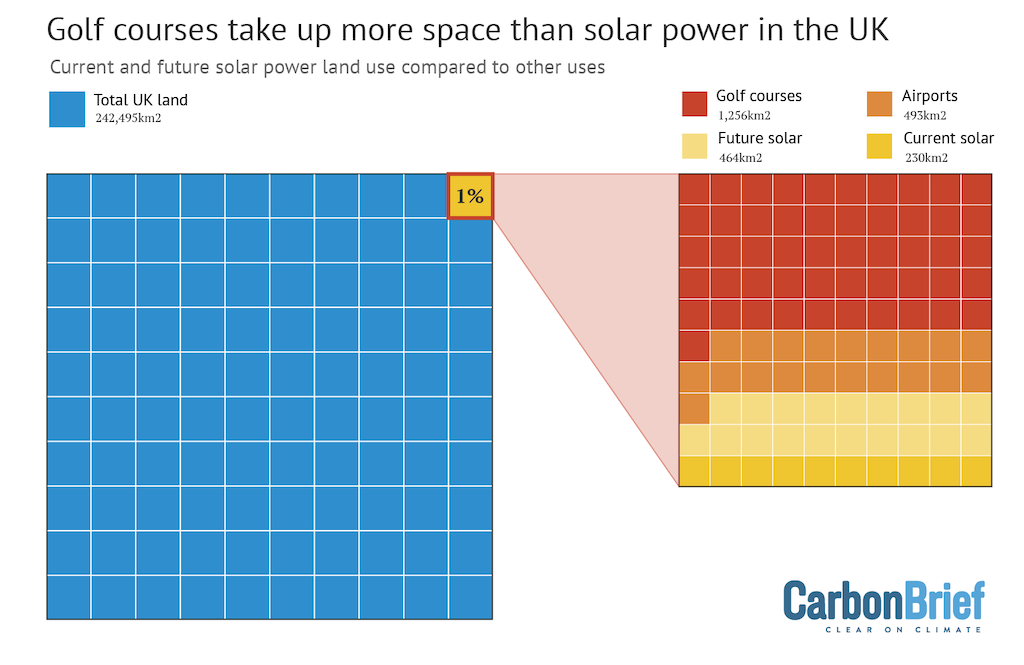
By 2035, an additional 129,000 hectares of land is estimated to be used for solar and wind energy in England, with some of this land also used to produce food at the same time.
If achieved, this will account for 1% of land in England and 2% of the UK’s agricultural area.
This estimate is based on the assumption that all extra solar will be installed on the ground, which the report says is a “highly conservative and unlikely scenario” given that many panels are anticipated to be placed on rooftops.
This makes the 2035 figure an “upper-bound” estimate, says the report.
By 2050, around 155,000 hectares – roughly equal to the size of Greater London – will be used for renewables, the report estimates, adding that this is based on trends from historical data and not future scenarios.
The report adds that it is possible that more land than this will be needed to meet energy goals past 2035, however, citing the “inherent uncertainty” in figuring out what the mix of electricity sources will look like by 2050.
By 2030, coordinated planning of electricity networks will encourage rural investment, “such as through new data centres”, the report claims.
By 2050, the report says that better land-use planning will lead to a “fairer and more efficient distribution of solar and wind infrastructure across England”.
There will also be better electricity connections to renewables, much of which will be delivered alongside “productive agriculture”, such as by installing solar panels above crops – known as agrivoltaic farming.
The report says that any land-use change decisions should be made based on a number of factors, drawing from “local knowledge, values, data and priorities”.
It notes that development of wind and solar infrastructure in rural areas should give local communities the “opportunity to benefit from local clean energy”.
Tree-planting and nature restoration
According to the framework, 6% of England’s land will need to be used for achieving climate and nature goals by 2050.
This kind of land use includes restoring England’s carbon-dense peatlands, planting new woodlands and restoring heathland habitats.
As part of the analysis, the framework takes a detailed look at what parts of England would be best suited for nature restoration. It says:
“Habitat creation and restoration should be directed to the places where it can have the greatest ecological impact, help to reconnect fragmented landscapes, support priority species and deliver the greatest contribution to nature recovery.”
The chart below, taken from the framework, shows where in England has the greatest potential for nature restoration in dark green.
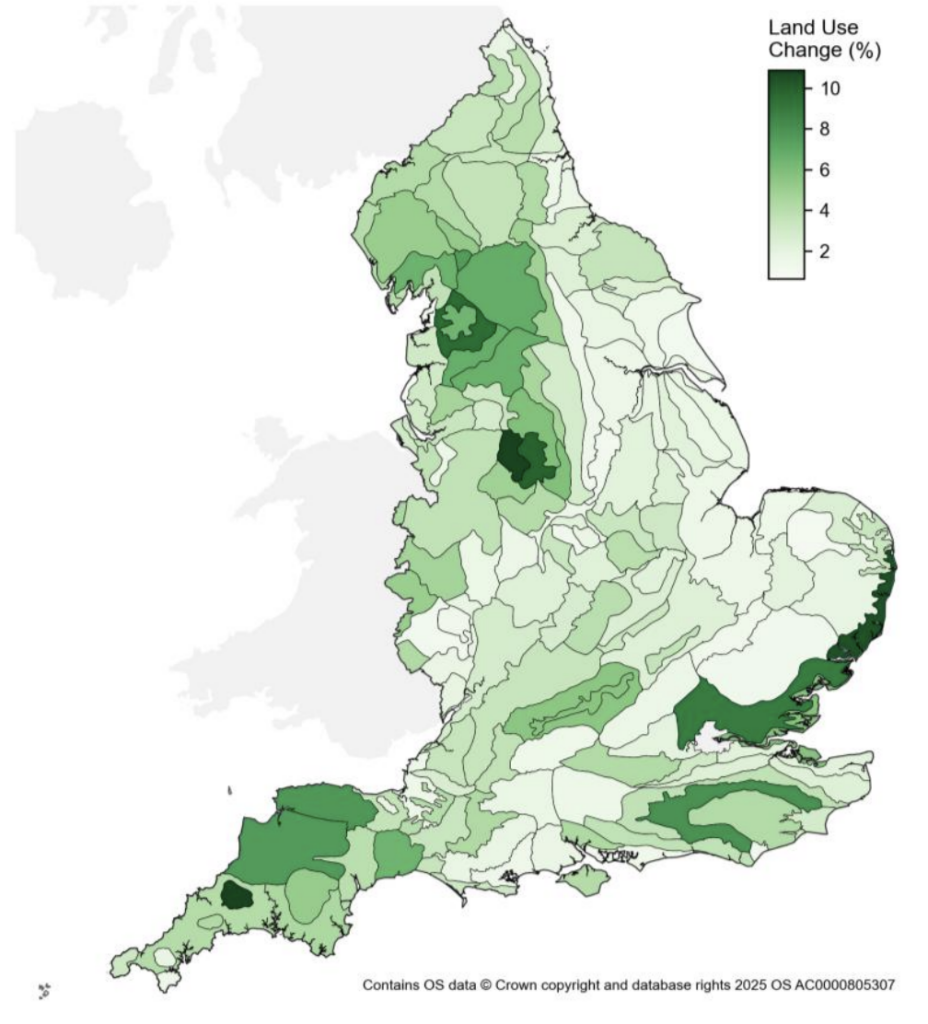
The analysis finds that north-west England has high potential for nature restoration, largely because it is home to the vast majority of the country’s carbon-rich, but degraded, peatlands.
Other areas identified include the south-west, which could be suitable for “grassland restoration and broadleaf woodland creation” and the south-east, where new grasslands could be planted, according to the framework.
The framework adds that the UK government remains committed to protecting 30% of land for nature by 2030, an international goal set under the Kunming-Montreal Global Biodiversity Framework.
However, it notes that, at present, just 7% of England’s land is protected for nature – with just four years to go until the deadline.
Speaking at the launch of the framework, nature minister Mary Creagh acknowledged that meeting the target remains a large challenge.
She added that her department was currently on a “data sprint” to try to account for all kinds of land that may not currently be classified as being protected for nature, despite serving this purpose.
Food production
The new framework extensively discusses how to balance food production with other uses for land, such as producing renewable energy and building homes.
The government says it is generally not suggesting land-use change on the country’s “best agricultural land”.
The framework focuses instead on using farmland to fulfil dual purposes, “rather than taking land out of production entirely”.
The goals outlined in the framework include increasing domestic food production in England, which the report says is “feasible according to our projections”.
Currently, the UK produces around 60% of its own food, importing the rest from abroad.
By 2030, the “vision” outlined in the framework says that farmers and other land managers will have better long-term clarity and more information on improved ways to use their land.
By 2050, meanwhile, farmlands will be managed to prioritise “sustainable food production and environmental benefits”, it says.
At this stage, the framework estimates that 480,000 hectares of farmland could be used primarily for food production, while also bringing environmental and climate benefits such as planting trees or restoring grassland habitats.
Agricultural land will be used to balance food production and other outcomes. A footnote in the report says that this will broadly lead to a “mosaic of different landscapes” – semi-natural land, low-intensity farmland and higher-intensity farmland.
It also says that, by 2050, farmland will be more resilient to climate change impacts through actions such as planting trees for flood and drought resilience.
All projected scenarios in the analysis behind the framework focus on producing food “more sustainably from less land”, the report notes.
The agricultural land-use change recommendations in the framework differ across the country. If focusing on improvements to water quality and biodiversity, for example, it recommends looking at areas with intensive agricultural production in the east of England.
This is due to these areas using high quantities of fertilisers, which can wash off fields and run into rivers and other waterways. This lowers water quality and harms plants and animals.
The government commits to developing sectoral growth plans, starting with horticulture and poultry, to provide a framework to boost production and “maintain food security”.
The government also promises to support making “under-used land” available for communities to grow food and recover nature, “where appropriate”. This refers to inactive land that is not suitable for other developments.
The report is a “step in the right direction”, says Tom Bradshaw, president of the National Farmers’ Union. He adds that it is “positive” to have “explicit recognition” of using land for multiple purposes and a government commitment to maintain food production.
Bradshaw notes that “challenges remain about delivering against the ambitious objectives as the first 2030 milestone approaches”.
Housing
Reynolds says that this framework can help to “speed up house-building and infrastructure delivery”.
The report says that, by 2030, improved planning will enable areas to facilitate housing and development “whilst protecting and enhancing the environment”.
It adds that, where appropriate, developments will be higher-density to “make the best use of land within our towns and cities”.
By 2030, biodiversity net gain – a planning requirement to improve habitats while building developments – and nature-based solutions will also be used to ensure development “leaves the natural environment in a measurably better state than it was in beforehand”, the report says.
It adds that timber production will be expanded to provide “low-carbon building materials”.
By 2050, meanwhile, the framework says planners will be able to more easily assess how suitable areas are for development “using a streamlined digital planning service and decision support tools”.
These tools – built on a range of data sources – are intended to reduce the number of homes built in areas at risk of flooding, the report says.
One in four homes in England are projected to be at risk of flooding by 2050, under a high-emissions scenario, the report outlines.
The report notes that the government is proposing a “default yes” to some planning applications for developments near well-connected transport stations.
High-demand areas “need to be powered locally and sustainably”, it notes, and using technologies such as rooftop solar to “make use of existing built land for electricity generation” can reduce land pressures elsewhere.




The post Q&A: What England’s new ‘land-use framework’ means for climate, nature and food appeared first on Carbon Brief.
Q&A: What England’s new ‘land-use framework’ means for climate, nature and food
The Tropical Forest Forever Facility (TFFF) – a major new rainforest protection fund launched by Brazil at COP30 – is unlikely to make payments to rainforest countries until at least 2028, experts said, while it raises funds in financial markets.
The proposed new mechanism aims to pay rainforest countries for achieving low deforestation rates. Rather than depending on grants, the TFFF would seek to raise public and private capital to make investments in financial markets, and then use part of the returns to reward countries which protect their rainforests.
But raising the US$125 billion of public and private investment needed to make meaningful payments could take years, according to Andrew Deutz, managing director of Global Policy and Partnerships at WWF, one of the organisations involved in the fund’s design.
He said it will likely take two or three years for the fund to raise private capital by issuing bonds, invest the money and generate enough returns to make significant payments. “So I don’t think we’re going to see payments to rainforest countries until 2028 or 2029,” Deutz said.
-
UK cuts support for climate action abroad to fund military instead
The UK’s foreign minister said the cuts to the aid budget would “deliver the biggest increase in defence spending since the Cold War” -
Roadmap launched to restart deadlocked UN plastics treaty talks
The chair of the negotiations proposes informal meetings through 2026 to bridge deep divisions among countries, following the collapse of talks in Geneva last year


Norway’s climate minister Andreas Bjelland Eriksen, another of the fund’s early backers, told Climate Home News that “the TFFF requires scale, which will take some time”, but added that it “is a historic opportunity” to finance the protection of tropical forests “for generations”.
The delay is not necessarily bad, according to Deutz, as it will allow communities to build capabilities and legal structures to handle the new flow of funds. “There needs to be a capacity-building process over the next couple of years with Indigenous organisations and local communities to be able to manage the flow of funds at that level,” he added.
At the COP26 climate summit in 2021, over 140 countries – covering 85% of the world’s forests – pledged to end deforestation by 2030. At last year’s COP30, the Brazilian government promised to create a roadmap towards ending deforestation by that same date.
But governments are far off track, with a yearly review showing that deforestation rates are currently 63% higher than what they should be to reach this goal. An estimated $570 billion funding gap for nature protection has contributed to the deficient results.
First step: raising $10 billion
While the TFFF has a long-term goal of raising $125bn in public and private capital, its proponents say the key goal for the fund in 2026 will be to raise the total amount of public investment to $10bn so that it can start to scale up.
The fund has already raised $6.7bn, but Norway’s $3bn pledge requires that the TFFF raises about $10bn mostly from other funders by the end of 2026 or they will not invest.
Before scaling up to the long-term $125bn goal – of which $25bn is public and $100bn private – the TFFF will have to prove that it can be successful in paying back investors and channeling funds for rainforest protection. The whole process can take years, Deutz said.
If this $10bn target is reached, the fund could begin raising private finance – up to an estimated $40bn, Deutz said. This initial $50bn tranche would serve to start making investments and show that the model works and can generate returns.
Bjelland Eriksen also said that reaching the $10bn target will be “an important priority” this year. “Only a handful of countries had the opportunities to assess it in detail before the [COP30] Belém summit – now is the time for more countries to do so,” the Norwegian minister said.
Public finance from governments is key for the TFFF model because it would act as a guarantee to lower risk for private investors, something very common in the financial sector, said Charlotte Hamill, partner at hedge fund Bracebridge Capital and one of the fund’s financial advisors, at an event earlier in January in Davos.
“Being able to do this at scale is actually really important, not only to be able to make the payments that are necessary for rainforest preservation but also, in a funny way, it allows you to buy slightly less risky assets because you’re gonna have a much larger pool to buy them off of,” she added.
New contributions?
João Paulo de Resende, TFFF Leader at Brazil’s Ministry of Finance, told Climate Home News that the country will continue fundraising efforts throughout this year, and said he has recently concluded a tour in East Asia speaking with government officials from Japan, South Korea and China.
Conversations with the Chinese government have become “a lot more serious”, said Felix Finkbeiner, founder of the non-profit Plant-for-the-Planet, which operates the online tracking platform TFFF Watch. He added that a Chinese investment would likely be similar in size to the French or German contributions, which would grant the country a seat on the TFFF board. France has pledged a €500m ($578m) investment while Germany has promised €1bn ($1.17bn).
While China is categorised as a developing country at UN climate talks, and thus has no legal responsibility to grant climate finance, the TFFF has been seen as an opportunity for the Asian country to contribute because it’s not an official mechanism within the UN. Deutz said that, for the Chinese government to contribute, they will need reassurance that the funds will not be counted as formal climate finance.
The UK is another of the countries expected to announce a contribution in the coming months, both Finkbeiner and Deutz said. The country announced cuts to climate finance this week as it ramps up defense spending, but Deutz noted that it could still contribute with funds to the TFFF.
“I’m still somewhat optimistic that [the $10bn goal] can happen despite the geopolitical turmoil because the TFFF does not require grant money. We’re not competing with humanitarian assistance,” Deutz explained. “Because governments are being asked to make a loan that would be paid back with interest, this comes out of a different pile of money”.
Multilateral banks such as the European Bank for Reconstruction and Development (EBRD) and the Asian Infrastructure Investment Bank (AIIB) also reportedly considered contributions.
Brazil sharing leadership
Despite having led the official launch of the fund and spearheading its fundraising efforts, Brazil is now aiming to “share leadership” as other countries join the TFFF’s steering committee and establish a new board.
De Resende told Climate Home News that “the project no longer belongs solely to Brazil”, and added that the group of countries that have pledged contributions to the TFFF are also now playing a larger role in “finding ways to jointly promote sponsor outreach”.
Deutz said that Brazil wants to move towards a “shared leadership model”. “They are now asking the European countries to have one of them set up to be the co-chairs so that this is not seen as a Brazilian initiative but is rather seen as owned by all of them,” he added.
The fund will now have to form a steering committee, likely chaired by Brazil and one European country, which will instruct the World Bank on setting up the formal structures of the fund.
Bjelland Eriksen said there is “important work” ongoing to formally establish the fund’s investment arm (known as the TFIF), while de Resende said he expects to “have the fund incorporated in some European jurisdiction by the beginning of the second semester.”
The post COP30 rainforest fund unlikely to make first payments until 2028 appeared first on Climate Home News.
COP30 rainforest fund unlikely to make first payments until 2028



-
Greenhouse Gases7 months ago
Guest post: Why China is still building new coal – and when it might stop
-
Climate Change7 months ago
Guest post: Why China is still building new coal – and when it might stop
-

 Greenhouse Gases2 years ago
嘉宾来稿:满足中国增长的用电需求 光伏加储能“比新建煤电更实惠”
-
Climate Change2 years ago
Bill Discounting Climate Change in Florida’s Energy Policy Awaits DeSantis’ Approval
-

 Climate Change2 years ago
嘉宾来稿:满足中国增长的用电需求 光伏加储能“比新建煤电更实惠”
-
Climate Change Videos2 years ago
The toxic gas flares fuelling Nigeria’s climate change – BBC News
-

 Carbon Footprint2 years ago
US SEC’s Climate Disclosure Rules Spur Renewed Interest in Carbon Credits
-
Renewable Energy2 years ago
GAF Energy Completes Construction of Second Manufacturing Facility