

Last week’s Intergovernmental Panel on Climate Change (IPCC) meeting in Hangzhou, China, marked the third time that governments have failed to agree on a timeline for the organisation’s seventh assessment cycle (AR7).
A large group of countries pushed for the reports to be published by the end of 2028, to allow them to feed into the UN’s second global stocktake – a mechanism that will gauge progress towards the Paris Agreement goals.
However, others – including the Chinese hosts – pushed for a longer deadline, warning of “compression in the timeline” that could affect participation, particularly from developing countries.
The meeting ran over by more than 30 hours, meaning that many small delegations – especially small-island developing states and least-developed countries – were unable to stay to the end.
As a result, the final decisions were made without their participation.
According to the Earth Negotiations Bulletin (ENB), reporting from inside the meeting, timeline discussions will be taken up again in the next IPCC meeting in late 2025, “with hope that the panel can finally break its deadlock”.
“The absence of a timeline puts potential contributing scientists in a difficult position,” one IPCC scientist tells Carbon Brief.
He notes that the “call for authors” will open soon, but warns how challenging it will be to accept a nomination “if there is no clarity on when a massive time commitment for the IPCC is expected”.
The meeting also saw outlines agreed for AR7’s three main reports – despite the “entrenched positions” of some delegations “complicating efforts to find consensus”, the ENB reports.
Speaking to Carbon Brief, IPCC chair Prof Jim Skea says the process was “probably the most difficult session I can recall”.
In a further complication, reports emerged ahead of the meeting that US officials had been denied permission to attend and a contract for the technical support unit of one of the working groups had been terminated.
It was the first US absence in IPCC history.
Skea says that the IPCC will “have to start thinking more seriously” about how to manage a potential US withdrawal, but the priority last week had been to “get through” the meeting and its lengthy agenda.
He adds that the IPCC has still “had no formal communication from the US at all”.
Below, Carbon Brief unpacks the deliberations at the meeting and the decisions that were made.
- Splits in Sofia
- US no-show
- AR7 schedule
- Assessment report outlines
- CDR report
- Expert meetings
- China host
Splits in Sofia
IPCC “sessions” are meetings that bring together officials and experts from member countries and observer organisations.
Collectively, they decide on the work of the IPCC, including the scope, outline and timeline for reports – all overseen by the IPCC’s “bureau” of elected scientists.
With its sixth assessment report (AR6) completed in 2023, the focus of the IPCC has turned to the seventh assessment (AR7) and the reports it will deliver over the next five years.
At its meetings in Istanbul and Sofia in 2024, the IPCC agreed that AR7 should include – among other outputs – the traditional set of three “working group” reports, one “special” report on cities and two “methodology” reports on “short-lived climate forcers” and “carbon dioxide removal technologies, carbon capture utilisation and storage”.
The three working group reports – each typically running to thousands of pages – focus on climate science (WG1), impacts and adaptation (WG2) and mitigation (WG3).
However, the timeline for these reports was not agreed at either meeting. Countries were split on whether the working group reports should be published in time to inform the UN’s second global stocktake, which will be completed in 2028. The stocktake will gauge international progress towards the Paris Agreement goals. (See: AR7 schedule)
The final decision on the AR7 timeline was, thus, postponed to 2025. As a result, the Hangzhou meeting would need to revisit the timeline – as well as approve the scope and outline of the working group reports themselves.
The Hangzhou meeting, originally slated for five days over 24-28 February, brought together almost 450 participants from governments, international organisations and civil society – including 300 delegates from 124 member countries and 48 observer organisations.
IPCC chair Prof Jim Skea tells Carbon Brief that the agenda contained “six days’ worth [of items] rather than five” and they “started with three sessions a day right from the beginning to try and get ahead”.
US no-show
Just a few days before the meeting opened, Axios reported that government officials from the US had been “denied” permission to attend. Furthermore, it said, the contract for the technical support unit for WG3 had been “terminated” by its provider NASA, meaning its staff “will also not be traveling to China or supporting the IPCC process moving forward”.
(Each working group has a technical support unit, or TSU, which provides scientific and operational support for report authors and the group’s leadership.)
In further reporting, Nature quoted a NASA spokesperson, who said that the move was prompted by guidance “to eliminate non-essential consulting contracts”. The Washington Post reported that the group of 10 TSU staff “still have their jobs…but have been blocked from doing any IPCC-related work since 14 February”. Bloomberg added that WG3 co-chair and NASA chief scientist Dr Kate Cavlin would also not attend the meeting.
Axios speculated that the move “could be the beginning of a bigger withdrawal from US involvement in international climate science work”.
Carbon Brief analysis suggests that the US has provided around 30% of the voluntary contributions to IPCC budgets since it was established in 1988. Totalling more than 53m Swiss francs (£46m), this is more than four times that of the next-largest direct contributor, the European Union.
The first Trump administration cut its contributions to the IPCC in 2017, with other countries stepping up their funding in response. The US subsequently resumed its contributions.
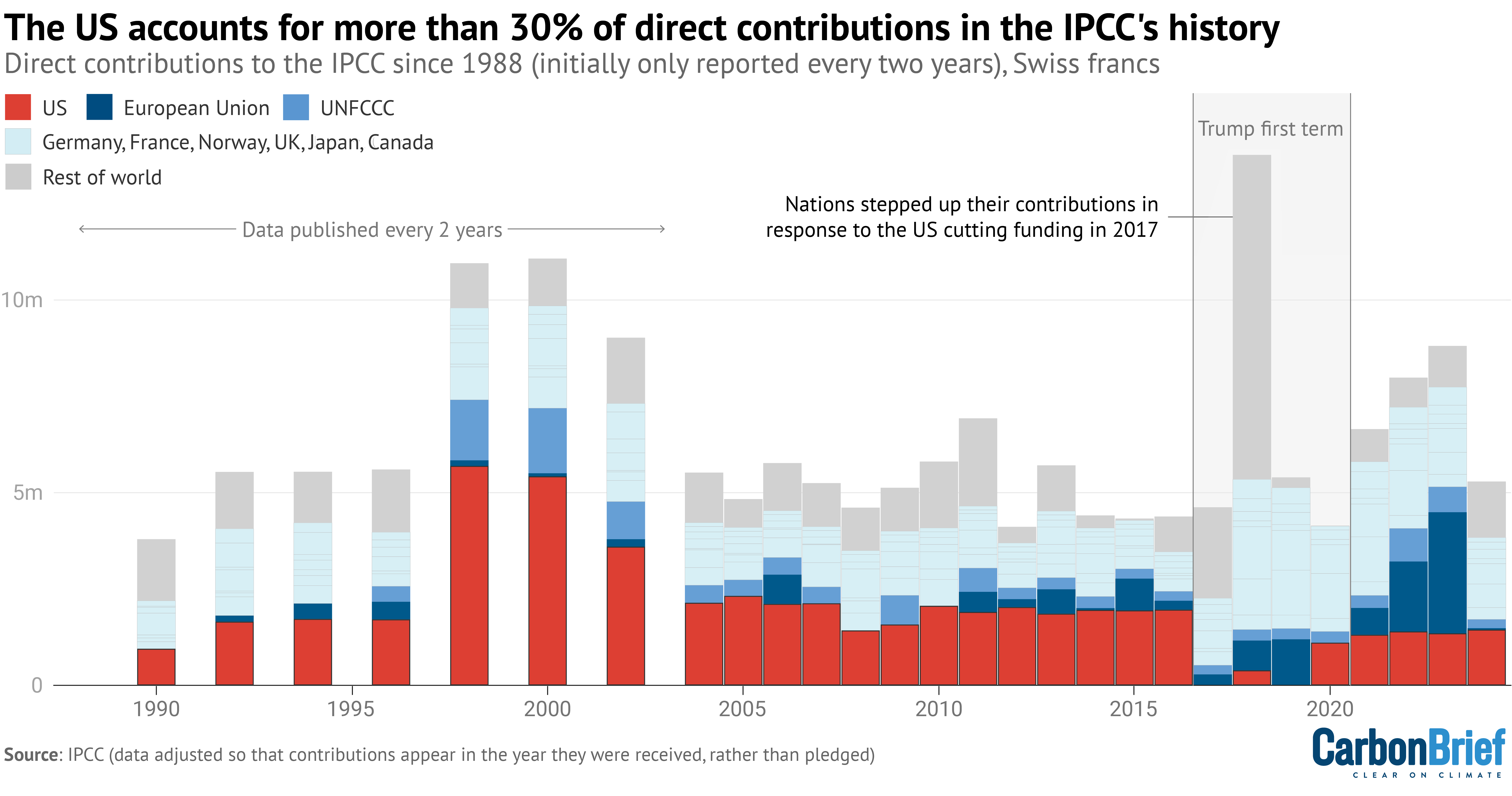
Chart showing the 10 largest direct contributors to the IPCC since its inception in 1988, with the US (red bars), European Union (dark blue) and UNFCCC (mid blue) highlighted. Grey bars show all other contributors combined. Source: IPCC (2025) and (2010). Contributions have been adjusted, as per IPCC footnotes, so they appear in the year they are received, rather than pledged.
Speaking to Carbon Brief, Skea says the absence of the US at the meeting itself “didn’t disturb the basic way that the meeting operated”. He adds:
“Every meeting we have 60 countries that don’t turn up out of our membership – the US was now one of that group. I mean, frankly, nobody within the meeting mentioned the US absence. We just got on and did it.”
On the longer-term implications, Skea says that “we didn’t spare an awful lot of time for thinking about”. However, the IPCC will “have to start thinking more seriously” once they have more information, he says, noting that “we have had no formal communication from the US at all”.
Regarding the WG3 TSU, there is no “comparable circumstance” in the IPCC’s history, Skea says. Typically, the co-chair from a developed country is “supposed to bring support for a TSU with them”, he says. (Each working group has two co-chairs – one from a developed country and one from a developing country.) However, the WG3 TSU is already partly supported in Malaysia, where co-chair Prof Joy Jacqueline Pereira is based.
(As an IPCC progress report for the Hangzhou meeting points out, the WG3 TSU has already “taken shape”, although it is not yet fully staffed. The “node” in Malaysia was established with the donor support of the US, Norway and New Zealand. There is also a job advert for a “senior science officer” in the WG3 TSU currently on the IPCC’s website.)
Skea suggests that the situation can be resolved with “creative solutions”, adding that the IPCC “can take any decision, regardless of past principles or past decisions. So I think, with ingenuity, there will be ways around it.”
Prof Frank Jotzo, a professor of environmental economics at the Australian National University’s Crawford School of Public Policy and WG3 lead author on AR5 and AR6, describes the situation as “highly unusual”. He tells Carbon Brief:
“I would expect that other developed countries will come to the rescue to fund the WG3 TSU, to rescue the process and to demonstrate that Trump will not upend this multilateral process. Staff positions could then presumably be either in those countries or in Malaysia, home of the other WG3 co-chair.”
On the US involvement in the IPCC more broadly, CNN reported the comments of a “scientist involved in the report”, who said they were “not sure” what the block on US officials will mean for the planned work going forward, or “if US scientists will participate in the writing of the IPCC reports”.
Science reported that, although US contributions to the IPCC are “typically run out of the White House by the Global Change Research Programme, NASA is the lead on managing GCRP’s contracts”. It added that “NASA leadership, not GCRP, decided to end the TSU contract”.
Following the China meeting, member states are set to solicit nominations of scientists to author the working group reports in AR7, Science explained:
“GCRP usually runs the process [for the US], but the administration’s moves have some wondering whether it will proceed as normal. If not, IPCC does allow scientists to self-nominate without their country’s involvement. But US authors might be shut out anyway if travel funding ends.”
For example, the US nominated 250 scientists to be authors on the special report on cities, which will be part of the AR7 cycle. (Authors can also be nominated by other countries, observer organisations and the IPCC bureau.)
Dr Gavin Schmidt, director of the NASA Goddard Institute for Space Studies, posted on social media last week that, “despite some reports, there is no blanket prohibition on US scientists interacting with or serving with the IPCC”.
AR7 schedule
A key agenda item for the Hangzhou meeting was to finalise the timeline for publishing AR7 reports. This is a contentious point on which delegates were unable to reach an agreement at either the Istanbul or Sofia meetings.
Heading into the meeting, countries were split on whether the working group reports should be published in time to inform the UN’s second global stocktake, which will be completed in 2028.
In the IPCC plenary on Saturday afternoon, Skea emphasised the “enormous effort and time” taken over this decision – including during the scoping meeting at Kuala Lumpur – and stressed the importance of an integrated approach to planning across the three working groups.
The working head of the WG2 TSU put forward the proposed schedule for AR7 cycle, which would see all working group reports published in time to feed into the second global stocktake in 2028.
A long list of countries underscored the importance of a “timely, policy-relevant” AR7 cycle, urging the adoption of the schedule put forward by the IPCC bureau in order to avoid failing to reach an agreement, according to the ENB. These included the UK, EU, Australia, Japan, Luxembourg, Turkey and Jamaica. (Jamaica was speaking on behalf of the other small island developing states who were unable to stay past the scheduled close of the plenary session.)
However, India, Saudi Arabia, Algeria and South Africa called for the schedule to be revised, citing “time compression in the timeline and challenges for scientists from developing countries to produce literature”, the ENB reports. And Kenya “expressed concern about inclusivity and called for more flexibility on timing”.
At this point, many countries raised concern about the number of countries who had already left the session, with Australia noting that “many of them are precisely those who lack capacity and depend on IPCC’s assessments”.
Skea stressed the need to agree a timeline in this meeting so that work on the main reports – including author selection – could progress. Discussions continued in a huddle throughout Saturday afternoon and into the evening.

Late on Saturday evening, Italy and Ireland, supported by a handful of other countries, suggested an additional option to stretch the timeline to allow an extra month of “wiggle room”.
However, India and South Africa “said the addition of one or two months did not make it a viable counter-suggestion”, according to the ENB. The three countries instead suggested completing the WG1 report by July 2028, WG2 in December 2028, WG3 in April 2029 and the synthesis report in the second half of 2029.
To move forward, Skea proposed agreeing on the outlines of the working groups and inviting experts to start their work, including putting out the call for author nominations and convening the first lead authors meeting in 2025. However, he said that the timeline decision would be deferred until the next IPCC meeting in late 2025.
Skea tells Carbon Brief that the meeting was helpful for “clarifying where different groups of countries were coming from”. He says that the opposition to a stocktake-aligned timeline was “not about the outcome and the synchronisation with the political process”, but, rather, “the needs of countries for doing their reviews of the [report] drafts – how frequently, how rapidly, they were coming”.
Even with the two options – a proposed timeline and a counter suggestion – resolving remaining differences won’t be “easy”, Skea says, adding that “I think we will be off to do a little bit of consultation offline before we get to IPCC-63 to see how we resolve it”.
“The absence of a timeline puts potential contributing scientists in a difficult position,” Rogelj tells Carbon Brief. He adds:
“My understanding is that a call for authors will be launched soon. However, how can one accept a nomination or subsequent selection if there is no clarity on when a massive time commitment for the IPCC is expected. It shows how political games regarding the timing of scientific evidence for the negotiations dominate considerations for authors and considerations of delivering the best possible report.”
WG2 co-chair Prof Bart van den Hurk tells Carbon Brief that the failure to agree on a timeline means that experts invited to take part in reports “will not receive a schedule for all the meetings they’re supposed to attend”, leading to possible agenda clashes later.
It also means that they “don’t know for how long they’re signed up for this time-intensive yet voluntary role, which is a big ask”, he adds.
Assessment report outlines
Heading into the Hangzhou meeting, countries had agreed to produce a full set of assessment reports with a synthesis report, along with a special report on climate change and cities and two methodology reports.
The scope, outlines and titles for WG1, WG2 and WG3 reports were prepared at a meeting in Kuala Lumpur in December 2024, to be reviewed and approved in Hangzhou.
At the scoping meeting, some experts suggested that reports should include “plain-language summaries”, because local authorities, companies and the general public often do not know the “jargon”, the ENB reports.
When brought to the Hangzhou meeting, countries including Australia, France and Vanuatu supported this suggestion, stressing the importance of accessibility. Some countries also called for shorter reports focused on new science.
However, the Russian Federation, India and Saudi Arabia were opposed, the ENB says. The Russian Federation argued that the report is intended for an expert audience and India said that these summaries “would compete with the [summary for policymakers] and IPCC outreach mechanisms”, adding that any plain-language summaries would need to be approved line-by-line.
Later, the WG1 co-chairs suggested changing “plain-language summaries” to “plain-language overviews,” in which authors provide a chapter overview, including graphics, in a similar manner to the FAQs sections.
About 20 countries, including the UK, Canada, Ukraine, Chile, China and Libya, supported the suggestion. However, Algeria, Russian Federation, India and Saudi Arabia continued to oppose it, the ENB says.
A “huddle” was convened to find consensus, which, ultimately, agreed to delete any reference to “plain language overviews” and instead encouraged authors to ensure that the executive summary of each report is clear.
The countries then discussed the proposed outline for each working group report in turn. Skea tells Carbon Brief that this process “had some of the quality of an approval session” for a finished report, adding:
“But people did compromise in the end and we did get the outlines of the reports agreed, which, for me, was the real objective of the meeting.”
For WG1, many countries welcomed the proposed outline and some suggested changes. For example, Switzerland called for addressing the unique challenges faced by high altitude and latitude environments. And India asked for the inclusion of a chapter on monsoons and deletion of a chapter on climate information and services, the ENB says.
When discussing the chapter on abrupt changes, tipping points and high-impact events in the Earth system, Saudi Arabia and India objected to singling out “tipping points” in the title and suggested deleting them, the ENB says. However, Switzerland, supported by a handful of other countries, highlighted their relevance for policy and science and called for them to be kept in.
On Friday, after a huddle, the title was changed to: “Abrupt changes, low-likelihood high-impact events and critical thresholds, including tipping points, in the Earth system.”
Delegates agreed on the following chapters for the WG1 report:
- Chapter 1: Framing, methods and knowledge sources;
- Chapter 2: Large-scale changes in the climate system and their causes;
- Chapter 3: Changes in regional climate and extremes and their causes;
- Chapter 4: Advances in process understanding of Earth system changes;
- Chapter 5: Scenarios and projected future global temperatures;
- Chapter 6: Global projections of Earth system responses across time scales;
- Chapter 7: Projections of regional climate and extremes;
- Chapter 8: Abrupt changes, low-likelihood high impact events and critical thresholds, including tipping points, in the Earth system;
- Chapter 9: Earth system responses under pathways towards temperature stabilisation, including overshoot pathways; and
- Chapter 10: Climate information and services.
On the WG2 report outline, Kenya said AR6 definition of maladaptation is “limiting” and called for the term to be redefined for the new report, the ENB says. Meanwhile, Brazil and Switzerland called for the report to assess the risks of solar radiation management, given its cross-cutting nature and potential impacts on sectors, such as agriculture.
Senegal underscored the need for a focus on losses and damages, expressing hope that this will “help showcase those in greatest need”. And Saudi Arabia called for a full assessment of the potential of carbon dioxide removal (CDR) technologies.
Delegates agreed on the following chapters for the WG2 report:
Global assessment chapters:
- Chapter 2: Vulnerabilities, impacts and risks;
- Chapter 3: Current adaptation progress, effectiveness and adequacy;
- Chapter 4: Adaptation options and conditions for accelerating action;
- Chapter 5: Responses to losses and damages; and
- Chapter 6: Finance.
- Chapters 7-13 are regional assessment chapters on Africa, Asia, Australasia, Central and South America, Europe, North America and small islands.
Thematic assessment chapters:
- Chapter 14: Terrestrial, freshwater and cryospheric biodiversity, ecosystems and their services;
- Chapter 15: Ocean, coastal, and cryospheric biodiversity, ecosystems and their services;
- Chapter 16: Water;
- Chapter 17: Agriculture, food, forestry, fibre and fisheries;
- Chapter 18: Adaptation of human settlements, infrastructure and industry systems;
- Chapter 19: Health and well-being; and
- Chapter 20: Poverty, livelihoods, mobility and fragility
Among the comments on the WG3 outline, the Russian Federation cautioned against discussing national policies – describing this as “beyond [WG3’s mandate], the ENB says. Belgium suggested including social tipping points in the report, the ENB says, while Saudi Arabia argued the IPCC reports “should be neutral with respect to policy and called for a full assessment of the potential of carbon dioxide removal (CDR) technologies”.
Delegates agreed on the following chapters for the WG3 report:
- Chapter 1: Introduction and framing;
- Chapter 2: Past and current anthropogenic emissions and their drivers;
- Chapter 3: Projected futures in the context of sustainable development and climate change;
- Chapter 4: Sustainable development and mitigation;
- Chapter 5: Enablers and barriers;
- Chapter 6: Policies and governance and international cooperation;
- Chapter 7: Finance;
- Chapter 8: Services and demand;
- Chapter 9: Energy systems;
- Chapter 10: Industry;
- Chapter 11: Transport and mobility services and systems;
- Chapter 12: Buildings and human settlements;
- Chapter 13: Agriculture, forestry and other land uses (AFOLU);
- Chapter 14: Integration and interactions across sectors and systems; and
- Chapter 15: Potentials, limits and risks of carbon dioxide removal.
CDR report
Among the other items on the Hangzhou agenda was the finalisation of the scope and outline of a methodology report on carbon dioxide removal (CDR) and carbon capture, utilisation and storage (CCUS) technologies, slated for publication in 2027.
At a scoping meeting held in Copenhagen in October, the IPCC’s task force on national greenhouse gas inventories – which is coordinating the methodology report – agreed on a title, scope and outline for the forthcoming report.
Delegates in Hangzhou failed to reach agreement on the plan for the report, after disagreements emerged around chapter seven of the proposed outline – which looks at carbon removals from oceans, lakes and rivers.
A number of delegations – including India, France, Belgium, Chile and Turkey – objected to the inclusion of a standalone chapter in the methodology report on carbon removal from waterbodies, the ENB says. The countries argued there is insufficient understanding of the environmental impacts and effectiveness of certain marine CDR technologies, including ocean alkalinity enhancement.
Saudi Arabia was among the countries that argued in favour of a chapter on carbon removal from waterbodies. The Gulf nation said that its removal would set a “worrying precedent” and be a “bad sign” for emerging technologies, according to the ENB.
With no consensus reached, delegates agreed on the title and chapters one to six of the report, but postponed further deliberations on chapter seven until the next plenary meeting.
IPCC chair Skea tells Carbon Brief that delegates “were extremely close to getting agreement” on the report, but had been hampered by a lack of “ingenuity and time”.
He adds that a solution which helped broker agreement on the outline for the special report on short-lived climate forcers at the last IPCC plenary meeting could offer a path forward for the methodology report. (After a debate arose around the inclusion of hydrogen emissions in that report, country delegations compromised on a footnote stating the matter would be addressed in a future cycle.) Skea explains:
“The [IPCC’s] task force on national greenhouse gas inventories always has this issue as to whether there’s enough scientific evidence to justify bringing a technology or a technique in. If there are doubts about the quality of the basic evidence for bringing it in, there are devices for kicking the can down the road just a little bit.”
Some insiders speculated that the standoff over the methodology report in Hangzhou could have consequences for the overall AR7 timeline. They told Carbon Brief the delay to the report’s start could result in shifted review periods and necessitate an extra approval plenary in 2028.
Expert meetings
A number of expert meetings and workshops were approved in Hangzhou.
This included two workshops designed to explore “new and extended” methods of assessment at the IPCC. One will focus on the incorporation of diverse knowledge systems, including Indigenous and local knowledge, while the other will look at the use of emerging technologies, such as artificial intelligence.
An expert meeting on methodologies, metrics and indicators for assessing climate change impacts was also approved.
Proposals to hold an expert meeting on high-impact events and Earth system tipping points, however, proved contentious and were deferred to a later session. Rifts emerged around the concept of “tipping points” and the format of the event, the ENB says.
The lengthy nature of discussions about expert meetings and workshops prompted a number of countries – and IPCC chair Skea – to articulate concerns around the general state of decision-making at the meeting, according to the ENB.
In a “progress report” session where the IPCC bureau updated members on its activities, Saudi Arabia voiced concern about briefings given by the IPCC to the International Court of Justice (ICJ), which is drawing up an advisory opinion on states’ climate-related obligations. Skea said that briefings had been limited to “purely scientific” information, the ENB says.
In a session which took place as talks overran into Saturday morning, a number of countries called for greater collaboration between the IPCC and its biodiversity-focused counterpart, the Intergovernmental Science-Policy Platform on Biodiversity and Ecosystem Services (IPBES). However, others pointed to the difference between IPBES and IPCC review processes.
China host
The Hangzhou meeting marks the first time an IPCC bureau meeting has been held in China. It is also the first major climate conference hosted by the nation since the Tianjin talks organised by the UNFCCC in 2010 after negotiations faltered at the COP15 climate summit in Copenhagen.
The 34-member IPCC bureau features one scientist from China – meteorologist Dr Zhang Xiaoye, who is co-chair of WG1.
Coverage of the meeting in national and local Chinese media focused largely on statements and comments from government officials, including national climate envoy Liu Zhenmin and spokespeople for the foreign ministry and the China Meteorological Association.
Officials stressed China’s “active” contribution to global climate action, but stopped short of characterising the nation as a climate leader.
For example, in comments captured by the Economic Observer, foreign ministry spokesperson Lin Jian characterised China as a “fellow traveller” in the “green transformation” of the global south.
China Meteorological Administration director Chen Zhenlin said the nation stood willing to “cooperate extensively with all parties to jointly respond to extreme weather and climate risk challenges” and “jointly build a community with a shared future for mankind in the field of climate change”, according to Science and Technology Daily.
A number of Chinese publications – including the Paper, Xinhua and China Daily – reported on closing comments made by IPCC chair Jim Skea, which emphasised China’s critical role in international climate governance.
Yao Zhe, policy analyst at Greenpeace East Asia, says that hosting the conference allowed China to demonstrate “its support for climate science and its genuine interest in continuing international engagement on climate”. However, she tells Carbon Brief that she saw a “gap in expectations”:
“China sees itself mainly as a hospitable host, but others at the conference expect it to help build consensus and take a more progressive stance. I think this points to an emerging question in the broader landscape: The bar for China’s climate leadership will only rise as its influence on climate policy and cleantech markets grows. But when will China be ready to meet these expectations?”
Observers told Climate Home News they had witnessed a disconnect between Chinese officials’ public statements of support for cooperation on climate change and their positions in closed-door negotiations, which included a push to keep the next round of IPCC reports out of the next global stocktake.
On the last official day of the conference, Peru announced its offer to host the next session of the IPCC in the final quarter of this year. The exact date is still to be determined as there is “still some debate about where it sits in relation to COP30 – for example, before or after”, says Skea.


The post IPCC report timeline still undecided after ‘most difficult’ meeting in China appeared first on Carbon Brief.
IPCC report timeline still undecided after ‘most difficult’ meeting in China

N.C. Gov. Josh Stein wants state lawmakers to rethink tax breaks for data centers. The industry’s opacity makes it difficult to evaluate costs and benefits.
Tax breaks for data centers in North Carolina keep as much as $57 million each year into from state and local government coffers, state figures show, an amount that could balloon to billions of dollars if all the proposed projects are built.
The Global Environment Facility (GEF), a multilateral fund that provides climate and nature finance to developing countries, has raised $3.9 billion from donor governments in its last pledging session ahead of a key fundraising deadline at the end of May.
The amount, which is meant to cover the fund’s activities for the next four years (July 2026-June 2030), falls significantly short of the previous four-year cycle for which the GEF managed to raise $5.3bn from governments. Since then, military and other political priorities have squeezed rich nations’ budgets for climate and development aid.
The facility said in a statement that it expects more pledges ahead of the final replenishment package, which is set for approval at the next GEF Council meeting from May 31 to June 3.
Claude Gascon, interim CEO of the GEF, said that “donor countries have risen to the challenge and made bold commitments towards a more positive future for the planet”. He added that the pledges send a message that “the world is not giving up on nature even in a time of competing priorities”.
-
UK imports of “green” jet fuel linked to Amazon deforestation
A Texas refinery shipping sustainable aviation fuel to Europe has sourced beef tallow with links to a meatpacking firm fined over illegal cattle purchases -
Italy pushes coal exit back after gas prices rise
Analysts say the move sends a negative signal, but its impact will be limited given coal’s marginal role in Italy’s energy mix


Donors under pressure
But Brian O’Donnell, director of the environmental non-profit Campaign for Nature, said the announcement shows “an alarming trend” of donor governments cutting public finance for climate and nature.
“Wealthy nations pledged to increase international nature finance, and yet we are seeing cuts and lower contributions. Investing in nature prevents extinctions and supports livelihoods, security, health, food, clean water and climate,” he said. “Failing to safeguard nature now will result in much larger costs later.”
At COP29 in Baku, developed countries pledged to mobilise $300bn a year in public climate finance by 2035, while at UN biodiversity talks they have also pledged to raise $30bn per year by 2030. Yet several wealthy governments have announced cuts to green finance to increase defense spending, among them most recently the UK.
As for the US, despite Trump’s cuts to international climate finance, Congress approved a $150 million increase in its contribution to the GEF after what was described as the organisation’s “refocus on non-climate priorities like biodiversity, plastics and ocean ecosystems, per US Treasury guidance”.
The facility will only reveal how much each country has pledged when its assembly of 186 member countries meets in early June. The last period’s largest donors were Germany ($575 million), Japan ($451 million), and the US ($425 million).
The GEF has also gone through a change in leadership halfway through its fundraising cycle. Last December, the GEF Council asked former CEO Carlos Manuel Rodriguez to step down effective immediately and appointed Gascon as interim CEO.
Santa Marta conference: fossil fuel transition in an unstable world
New guidelines
As part of the upcoming funding cycle, the GEF has approved a set of guidelines for spending the $3.9bn raised so far, which include allocating 35% of resources for least developed countries and small island states, as well as 20% of the money going to Indigenous people and communities.
Its programs will help countries shift five key systems – nature, food, urban, energy and health – from models that drive degradation to alternatives that protect the planet and support human well-being by integrating the value of nature into production and consumption systems.
The new priorities also include a target to allocate 25% of the GEF’s budget for mobilising private funds through blended finance. This aligns with efforts by wealthy countries to increase contributions from the private sector to international climate finance.
Niels Annen, Germany’s State Secretary for Economic Cooperation and Development, said in a statement that the country’s priorities are “very well reflected” in the GEF’s new spending guidelines, including on “innovative finance for nature and people, better cooperation with the private sector, and stable resources for the most vulnerable countries”.
Aliou Mustafa, of the GEF Indigenous Peoples Advisory Group (IPAG), also welcomed the announcement, adding that “the GEF is strengthening trust and meaningful partnerships with Indigenous Peoples and local communities” by placing them at the “centre of decision-making”.
The post GEF raises $3.9bn ahead of funding deadline, $1bn below previous budget appeared first on Climate Home News.
GEF raises $3.9bn ahead of funding deadline, $1bn below previous budget
Tropical cyclones that rapidly intensify when passing over marine heatwaves can become “supercharged”, increasing the likelihood of high economic losses, a new study finds.
Such storms also have higher rates of rainfall and higher maximum windspeeds, according to the research.
The study, published in Science Advances, looks at the economic damages caused by nearly 800 tropical cyclones that occurred around the world between 1981 and 2023.
It finds that rapidly intensifying tropical cyclones that pass near abnormally warm parts of the ocean produce nearly double – 93% – the economic damages as storms that do not, even when levels of coastal development are taken into account.
One researcher, who was not involved in the study, tells Carbon Brief that the new analysis is a “step forward in understanding how we can better refine our predictions of what might happen in the future” in an increasingly warm world.
As marine heatwaves are projected to become more frequent under future climate change, the authors say that the interactions between storms and these heatwaves “should be given greater consideration in future strategies for climate adaptation and climate preparedness”.
‘Rapid intensification’
Tropical cyclones are rapidly rotating storm systems that form over warm ocean waters, characterised by low pressure at their cores and sustained winds that can reach more than 120 kilometres per hour.
The term “tropical cyclones” encompasses hurricanes, cyclones and typhoons, which are named as such depending on which ocean basin they occur in.
When they make landfall, these storms can cause major damage. They accounted for six of the top 10 disasters between 1900 and 2024 in terms of economic loss, according to the insurance company Aon’s 2025 climate catastrophe insight report.
These economic losses are largely caused by high wind speeds, large amounts of rainfall and damaging storm surges.
Storms can become particularly dangerous through a process called “rapid intensification”.
Rapid intensification is when a storm strengthens considerably in a short period of time. It is defined as an increase in sustained wind speed of at least 30 knots (around 55 kilometres per hour) in a 24-hour period.
There are several factors that can lead to rapid intensification, including warm ocean temperatures, high humidity and low vertical “wind shear” – meaning that the wind speeds higher up in the atmosphere are very similar to the wind speeds near the surface.
Rapid intensification has become more common since the 1980s and is projected to become even more frequent in the future with continued warming. (Although there is uncertainty as to how climate change will impact the frequency of tropical cyclones, the increase in strength and intensification is more clear.)
Marine heatwaves are another type of extreme event that are becoming more frequent due to recent warming. Like their atmospheric counterparts, marine heatwaves are periods of abnormally high ocean temperatures.
Previous research has shown that these marine heatwaves can contribute to a cyclone undergoing rapid intensification. This is because the warm ocean water acts as a “fuel” for a storm, says Dr Hamed Moftakhari, an associate professor of civil engineering at the University of Alabama who was one of the authors of the new study. He explains:
“The entire strength of the tropical cyclone [depends on] how hot the [ocean] surface is. Marine heatwave means we have an abundance of hot water that is like a gas [petrol] station. As you move over that, it’s going to supercharge you.”
However, the authors say, there is no global assessment of how rapid intensification and marine heatwaves interact – or how they contribute to economic damages.
Using the International Best Track Archive for Climate Stewardship (IBTrACS) – a database of tropical cyclone paths and intensities – the researchers identify 1,600 storms that made landfall during the 1981-2023 period, out of a total of 3,464 events.
Of these 1,600 storms, they were able to match 789 individual, land-falling cyclones with economic loss data from the Emergency Events Database (EM-DAT) and other official sources.
Then, using the IBTrACS storm data and ocean-temperature data from the European Centre for Medium-Range Weather Forecasts, the researchers classify each cyclone by whether or not it underwent rapid intensification and if it passed near a recent marine heatwave event before making landfall.
The researchers find that there is a “modest” rise in the number of marine heatwave-influenced tropical cyclones globally since 1981, but with significant regional variations. In particular, they say, there are “clear” upward trends in the north Atlantic Ocean, the north Indian Ocean and the northern hemisphere basin of the eastern Pacific Ocean.
‘Storm characteristics’
The researchers find substantial differences in the characteristics of tropical cyclones that experience rapid intensification and those that do not, as well as between rapidly intensifying storms that occur with marine heatwaves and those that occur without them.
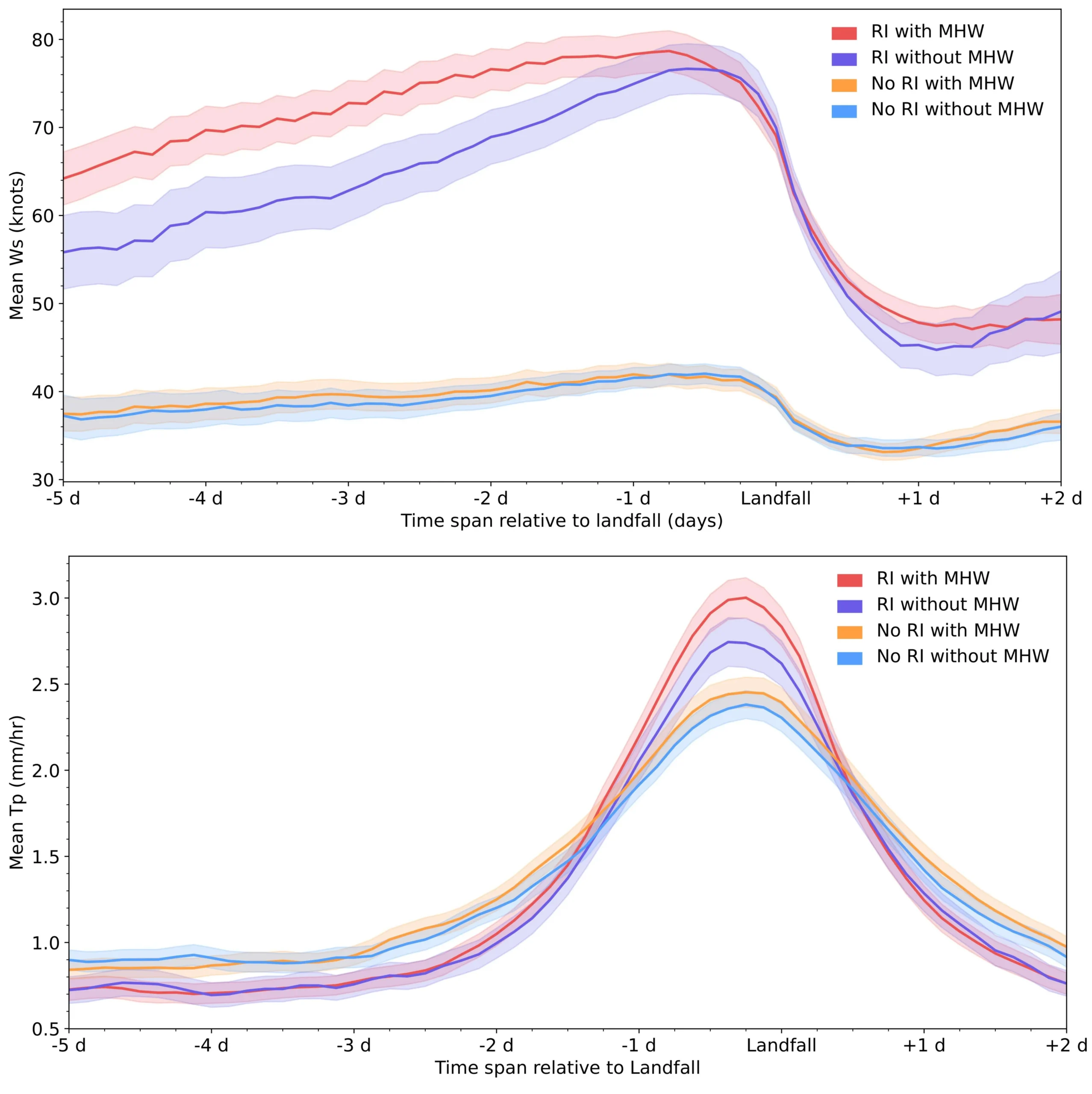
For example, tropical cyclones that do not experience rapid intensification have, on average, maximum wind speeds of around 40 knots (74km/hr), whereas storms that rapidly intensify have an average maximum wind speed of nearly 80 knots (148km/hr).
Of the rapidly intensifying storms, those that are influenced by marine heatwaves maintain higher wind speeds during the days leading up to landfall.
Although the wind speeds are very similar between the two groups once the storms make landfall, the pre-landfall difference still has an impact on a storm’s destructiveness, says Dr Soheil Radfar, a hurricane-hazard modeller at Princeton University. Radfar, who is the lead author of the new study, tells Carbon Brief:
“Hurricane damage starts days before the landfall…Four or five days before a hurricane making landfall, we expect to have high wind speeds and, because of that high wind speed, we expect to have storm surges that impact coastal communities.”
They also find that rapidly intensifying storms have higher peak rainfall than non-rapidly intensifying storms, with marine heatwave-influenced, rapidly intensifying storms exhibiting the highest average rainfall at landfall.
The charts below show the mean sustained wind speed in knots (top) and the mean rainfall in millimetres per hour (bottom) for the tropical cyclones analysed in the study in the five days leading up to and two days following a storm making landfall.
The four lines show storms that: rapidly intensified with the influence of marine heatwaves (red); those that rapidly intensified without marine heatwaves (purple); those that experienced marine heatwaves, but did not rapidly intensify (orange); and those that neither rapidly intensified nor experienced a marine heatwave (blue).
Dr Daneeja Mawren, an ocean and climate consultant at the Mauritius-based Mascarene Environmental Consulting who was not involved in the study, tells Carbon Brief that the new study “helps clarify how marine heatwaves amplify storm characteristics”, such as stronger winds and heavier rainfall. She notes that this “has not been done on a global scale before”.
However, Mawren adds that other factors not considered in the analysis can “make a huge difference” in the rapid intensification of tropical cyclones, including subsurface marine heatwaves and eddies – circular, spinning ocean currents that can trap warm water.
Dr Jonathan Lin, an atmospheric scientist at Cornell University who was also not involved in the study, tells Carbon Brief that, while the intensification found by the study “makes physical sense”, it is inherently limited by the relatively small number of storms that occur. He adds:
“There’s not that many storms, to tease out the physical mechanisms and observational data. So being able to reproduce this kind of work in a physical model would be really important.”
Economic costs
Storm intensity is not the only factor that determines how destructive a given cyclone can be – the economic damages also depend strongly on the population density and the amount of infrastructure development where a storm hits. The study explains:
“A high storm surge in a sparsely populated area may cause less economic damage than a smaller surge in a densely populated, economically important region.”
To account for the differences in development, the researchers use a type of data called “built-up volume”, from the Global Human Settlement Layer. Built-up volume is a quantity derived from satellite data and other high-resolution imagery that combines measurements of building area and average building height in a given area. This can be used as a proxy for the level of development, the authors explain.
By comparing different cyclones that impacted areas with similar built-up volumes, the researchers can analyse how rapid intensification and marine heatwaves contribute to the overall economic damages of a storm.
They find that, even when controlling for levels of coastal development, storms that pass through a marine heatwave during their rapid intensification cause 93% higher economic damages than storms that do not.
They identify 71 marine heatwave-influenced storms that cause more than $1bn (inflation-adjusted across the dataset) in damages, compared to 45 storms that cause those levels of damage without the influence of marine heatwaves.
This quantification of the cyclones’ economic impact is one of the study’s most “important contributions”, says Mawren.
The authors also note that the continued development in coastal regions may increase the likelihood of tropical cyclone damages over time.
Towards forecasting
The study notes that the increased damages caused by marine heatwave-influenced tropical cyclones, along with the projected increases in marine heatwaves, means such storms “should be given greater consideration” in planning for future climate change.
For Radfar and Moftakhari, the new study emphasises the importance of understanding the interactions between extreme events, such as tropical cyclones and marine heatwaves.
Moftakhari notes that extreme events in the future are expected to become both more intense and more complex. This becomes a problem for climate resilience because “we basically design in the future based on what we’ve observed in the past”, he says. This may lead to underestimating potential hazards, he adds.
Mawren agrees, telling Carbon Brief that, in order to “fully capture the intensification potential”, future forecasts and risk assessments must account for marine heatwaves and other ocean phenomena, such as subsurface heat.
Lin adds that the actions needed to reduce storm damages “take on the order of decades to do right”. He tells Carbon Brief:
“All these [planning] decisions have to come by understanding the future uncertainty and so this research is a step forward in understanding how we can better refine our predictions of what might happen in the future.”


The post Marine heatwaves ‘nearly double’ the economic damage caused by tropical cyclones appeared first on Carbon Brief.
Marine heatwaves ‘nearly double’ the economic damage caused by tropical cyclones



-
Climate Change8 months ago
Guest post: Why China is still building new coal – and when it might stop
-
Greenhouse Gases8 months ago
Guest post: Why China is still building new coal – and when it might stop
-

 Greenhouse Gases2 years ago
嘉宾来稿:满足中国增长的用电需求 光伏加储能“比新建煤电更实惠”
-
Climate Change2 years ago
Bill Discounting Climate Change in Florida’s Energy Policy Awaits DeSantis’ Approval
-

 Climate Change2 years ago
嘉宾来稿:满足中国增长的用电需求 光伏加储能“比新建煤电更实惠”
-
Climate Change Videos2 years ago
The toxic gas flares fuelling Nigeria’s climate change – BBC News
-

 Renewable Energy6 months ago
Sending Progressive Philanthropist George Soros to Prison?
-

 Carbon Footprint2 years ago
US SEC’s Climate Disclosure Rules Spur Renewed Interest in Carbon Credits