

Delegates at the 61st meeting of the Intergovernmental Panel on Climate Change (IPCC) in Sofia, Bulgaria have failed to agree on a timeline for the upcoming seventh assessment report.
The week-long meeting saw more than 230 delegates from 195 member governments revisit an unresolved topic from the previous meeting in January – finalising the timeline for the IPCC’s seventh assessment report (AR7) cycle.
AR7 will be the IPCC’s latest round of reports summarising the most recently published climate science.
First published in 1990, the assessment reports typically take 6-7 years to complete. AR6’s concluding “summary for policymakers” was published in March last year.
Many countries said in Sofia that they favoured an accelerated timeline, in which all three “working group” reports would be completed by June 2028. This deadline would allow the findings to inform the UN’s second global stocktake, which will gauge progress towards the Paris Agreement goals.
Ahead of last week’s meeting, a group of 40 IPCC authors from developing countries published an open letter arguing that the AR7 reports “can and must” be produced by this date in order to remain policy-relevant.
However, countries including Kenya, India, China and South Africa opposed the accelerated timeline, warning that “haste leads to shoddy work” and saying that raising concerns that the decision was being rushed through.
Ultimately, the decision was delayed. The issue will be picked up again after the AR7 scoping meeting in December.
Delegates in Sofia had more success in agreeing outlines for the special report on “climate change and cities” and the methodology report on “short-lived climate forcers”, both of which will be published in 2027.
Tricky talks in Turkey
Following the completion of its sixth assessment report (AR6) last year, the IPCC’s attention has now turned to its seventh assessment (AR7).
In a four-day meeting in Istanbul in January, which focused on the IPCC’s “programme of work” for AR7, governments decided against adopting a new structure and instead committed to the traditional set of three “working group” reports and a final synthesis report.
Before the Istanbul meeting, governments had already agreed that the AR7 cycle would include a special report on climate change and cities, as well as a methodology report on short-lived climate forcers.
The meeting then saw the addition of a second methodology report on carbon dioxide removal technologies, carbon capture utilisation and storage, plus a revision to the IPCC’s 1994 technical guidelines on impacts and adaptation.
However, while there was agreement between government delegates on the selection of reports, a timeline for their delivery was not agreed.
The majority of countries meeting in Istanbul favoured delivering the working group reports on an “accelerated” timeline, which would see them published by the end of 2028. This would allow the reports to “inform” the UN’s second global stocktake (GST), which will gauge progress towards the Paris Agreement goals.
However, a few countries, including Saudi Arabia, India and China, “strenuously objected” to this timetable, reported the Earth Negotiations Bulletin (ENB), which has unique access to the closed talks.
It reported, for example, that Saudi Arabia “opposed the shorter timeline, saying this would lead to compromised working groups reports both in content and inclusivity”. While China “emphasised that AR7 aims to be inclusive and developing country scientists should be given time to make their contributions”.
As opposition to the accelerated timeline “held fast” – despite the meeting overrunning into a fifth day – no decision was made.
The final “decisions adopted” document instead requested that the IPCC bureau – experts with more managerial roles, including vice and co-chairs – prepare a document “outlining the month and year of delivery on the basis of an AR7 strategic plan, taking into account the different views expressed” in the meeting.
The instruction included an “oblique reference” to taking “into account” the GST, noted ENB. The report, it was decided, would be presented at the Sofia meeting “for consideration and decision”.
Decision delayed
A key goal of the meeting in Sofia last week was to nail down a timeline for AR7. Ahead of the meeting, a group of 40 IPCC authors from developing countries sent a letter arguing that the AR7 reports “can and must” be produced by 2028, in time to inform the second GST report.
On 31 July, former IPCC vice chair Dr Youba Sokona – a co-author of the letter – published a commentary in Climate Home News summarising its main arguments. He argued that “ensuring the IPCC cycle aligns with GST timelines is crucial for maintaining the integrity of international climate cooperation”, adding that, without input from the IPCC, the stocktake “may lack essential southern perspective”.
He also dismissed concerns that accelerating the timeline would compromise the robustness of the reports, or lead to under-representation of developing countries. The article also outlined ways these concerns could be addressed while implementing an accelerated timeline.
Dr Frederieke Otto – a senior lecturer in climate science at the Grantham Institute for Climate Change and the Environment and IPCC AR6 author – tells Carbon Brief that, in her view, the Working Group II (WG2) and III (WG3) reports are “really needed before the GST”.
Typically, the three working group reports focus on “the physical science basis”, “impacts, adaptation and vulnerability” and “mitigation of climate change”.
On the morning of 31 July, Dr Jim Skea – the IPCC chair for AR7 – presented a proposed schedule for AR7. The proposal was requested by the IPCC panel at the 60th session in Istanbul in January. It was developed by the co-chairs of the IPCC working groups and the Task Force on National Greenhouse Gas Inventories (TFI), then reviewed by the IPCC bureau.
Under this schedule, the AR7 cycle would last six-and-a-half years – similar to the fifth and sixth assessment cycles.
In the discussion that followed, a long list of countries supported the schedule as proposed, with many underscoring the importance of feeding into the second GST, according to the ENB’s summary of the entire meeting.
Belize, supported by the US, the Netherlands and the UK, said IPCC reports need to be ready for the Bonn Climate Change Conference in June 2028, according to the ENB. Belize added that “an inclusive cycle is only meaningful if it can feed into the GST”.
Saint Kitts and Nevis argued that the absence of “crucial” IPCC input into the GST would mean the IPCC would lose policy relevance. The country also argued that the schedule for AR7 is “neither compressed nor rushed”, because, while it is shorter than the schedule for AR6, it also contains fewer special reports.
The AR6 cycle included three special reports – on 1.5C of global warming in 2018, then, successively in 2019, on climate change and land, and the ocean and cryosphere.
(Discussions about linking IPCC reports with the GST are long-standing. During 2016-18, the IPCC panel “agreed to draft terms of reference for a task group on the organisation of future work of the IPCC in light of the GST under the Paris Agreement”, according to the ENB.)
Finland argued that “if we want science-based policymaking, the faster we have the next report, the faster policymakers are able to take science-based policy action”, according to the ENB. And many small-island developing nations also “underscored the critical importance of timely reports from small island developing states [SIDS] and less-developed countries”.
Several countries, including Brazil, Peru and the UK, “stressed that inclusivity concerns could be addressed in ways other than an extended timeline”.
However, several countries, including India, Algeria, Kenya, the Russian Federation and South Africa, argued that a longer timeline is needed to ensure “robust, rigorous scientific outputs, and to ensure greater inclusivity”.
India called the proposed schedule “unprecedented,” saying that the fourth and fifth assessment cycles had similar timeframes, but did not include special reports. It also argued that “producing the best science needs time, haste leads to shoddy work and retracted publications”, according to the ENB.
Kenya, supported by India and South Africa, warned that there are “major” gaps in literature on adaptation in Africa. It said that the “short time” between AR7 scoping meetings and the first author meetings may not be sufficient to identify and fill “literature gaps” for the continent.
And South Africa and Saudi Arabia opposed expediting the schedule to feed into the stocktake, suggesting this would not make the IPCC more “policy-relevant,” but more “policy-prescriptive.”
Dr David Lapola is a research scientist at the University of Campinas in Brazil and AR6 contributing author. He tells Carbon Brief that, “while inclusiveness is super important to bring more legitimacy to the process, it also slows down decisions when you have to have the agreement of all members”. He says that it is a “great challenge to imprint more agility to the IPCC decision processes without compromising inclusiveness”.
On the evening of 1 August, Skea “noted how difficult it had been to find a solution that satisfied all delegations” and he proposed to postpone a decision on the timeline until after the AR7 scoping meeting in December 2024.
In a press release published after the meeting closed, the IPCC stated that “at its next plenary in early 2025, the panel will agree on their respective scope, outlines and work plans, including schedules and budgets”.
“While some expressed disappointment about the lack of consensus, others were quick to point out that determining the timeline after the scoping meeting for the working groups is consistent with past practice and the IPCC’s principles and procedures”, says the ENB.
Dr Hannah Hughes is a senior lecturer in international politics and climate change at Aberystwyth University, who has written extensively about the IPCC. She tells Carbon Brief that it is “not surprising” that the decision has been further postponed. She explains that the IPCC is “balancing complex and competing dynamics”.
She adds:
“Delaying the finalisation of the timeline until after the scoping of reports offers the advantage of having a clear sense of the advances in science and the level of urgency in communicating these.”
However, Otto tells Carbon Brief that it will be “difficult to scope without a timeline”. She says that “with the decision postponed, it seems that conflicts could not be resolved, but everything is just postponed”.
What additional reports were discussed in Sofia?
Earlier this year, IPCC held scoping meetings (in Latvia and Australia, respectively) for a special report on climate change and cities and a methodology report on short-lived climate forcers – both of which are due for publication in 2027. The proposals suggested at these meetings were discussed in Sofia.

Special report on climate change and cities
In 2016, the IPCC decided to produce a special report on climate change and cities. A “cities and climate change science conference” was held in Canada in 2018 to “inspire the next frontier of research focused on the science of cities and climate change”. A scoping meeting was held in Latvia over 16-19 April 2024 to develop a proposed outline for the report.
On 27 July in Sofia, Diana Ürge-Vorsatz – IPCC vice-chair and chair of the scientific steering committee (SSC) for the cities report – presented the proposal.
Under the proposal, the report will have five main chapters. The first will provide framing for the report, the second will discuss “trends, challenges and opportunities” in a changing climate and the third will be called “actions and solutions to reduce urban risks and emissions”. The final two chapters will focus on facilitating change and solutions.
Ürge-Vorsatz also suggested a timeline in which authors for the report will be selected by the end of 2024 and the first meetings of lead authors will be held in 2025. The expert review of the first order draft will take place by the end of 2025, and 15-19 March 2027 will see the “approval of the summary for policymakers and acceptance of the special report”.
In Sofia, many countries proposed changes or raised queries, according to ENB. For example, countries including India, South Africa and Malawi questioned how cities are defined. Burundi, Kenya and Mauritius said early warning systems should be given more prominence. And countries including Burundi, Malaysia and Kenya called for a more “balanced consideration of adaptation and mitigation”.
Over the following days, there were multiple more rounds of comments and drafts. For example, India questioned the shift from “loss and damage” to “losses and damages” implemented in one of the drafts, noting IPCC precedents for use of the latter terminology are limited to one document.
Saudi Arabia opposed the use of “net-zero goals” for cities, saying that these are country-level objectives. And Kenya, supported by India and Algeria, “called for improvements in the way adaptation was addressed throughout the outline”, including the removal of a reference to “maladaptation”.
By 31 July, most countries had accepted the proposal. But others – including Saudi Arabia, India and Kenya – were continuing to raise concerns and to call for a chapter-by-chapter discussion of the report outline.
Skea said the situation was “at a crossroads, given the difficulty of opening only a few non-consensual issues without risking an unravelling, and [he] invited the SSC to confer on whether the issues expressed could be somehow incorporated without unacceptable implications”, according to the ENB.
Timor-Leste, supported by the US and the Netherlands, urged countries to reach a compromise in time for the end of the meeting, noting their delegation consists of a single person. But India, Saudi Arabia and Kenya “expressed concern with other delegations’ ‘refusal to engage’ with their concerns”.
A “huddle” was set up to address some of the key concerns and, on 2 August, the delegates approved a draft decision.
Dr Aromar Revi is the founding director of the Indian Institute for Human Settlements and author on multiple IPCC reports. He tells Carbon Brief that the approval of the outline for an IPCC special report on cities is “a historic step that brings the urban and infrastructure transition, up front and centre of the climate action solutions space”.
He adds:
“It has taken almost a decade of preparation by a wide range of urban and climate actors to make this possible, since it was first suggested in 2016 as a special report in the AR6 cycle…
“This report will be especially important to cities and urban areas in Asia, Africa and Latin America and the SIDS, where 90% of the incremental urban population will live over the next 30-odd years, often in informal settlements with poor services and high vulnerability.”
Revi adds that the proposed timescale, which would see the work completed by March 2027, sets a “high bar” for the authorship team.
Prof Lisa Schipper – a professor of development geography at the University of Bonn and IPCC AR6 author – tells Carbon Brief that the cities report “will be a critical meeting point of adaptation, mitigation and development agendas”.
She adds:
“I was happy to see the level of detail in the cities [report] outline. Normally, the IPCC report outlines are a shopping list of topics without any normative framing. This makes it challenging to write the report with a consistent narrative. I think IPCC member countries will find more relatable and usable content in the cities report.”
The report “will be arriving at a crucial time”, adds Dr Zachary Labe – a scientist at the NOAA Geophysical Fluid Dynamics Laboratory, noting that many cities are “leading examples of how to design and implement evidence-based climate action through adaptation and mitigation practices”.
“The calls for nominations of authors are scheduled for release as early as next week,” according to the IPCC press release.
Short-lived climate forcers methodology report
In 2019, the IPCC decided that the TFI should produce a methodology report on short-lived climate forcers (SLCFs) – gases and particulates, such as methane and carbon, that cause global warming, but typically only stay in the atmosphere for less than two decades.
At the 60th session in January 2024, the panel decided to produce the report by 2027. A scoping meeting for the report was held on 26-28 February 2024 in Brisbane, Australia.
On the first day of the 61st session, Dr Takeshi Enoki, the co-chair of the TFI, presented an overview of the group’s recommendations. He suggested a title for the report of “2027 supplement to the 2006 IPCC guidelines for national greenhouse gas inventories: short-lived climate forcers (2027 supplement on SLCFs)”, and said the report would be a supplement to the 2006 guidelines.
They added that the report would be made up of an overview chapter and five “volumes” following the format of the 2006 IPCC guidelines. These five volumes will focus on “general guidance”, the energy sector, industrial processes and product use, the agriculture, forestry and other land use sector, and waste, he said.
However, many countries raised concerns. First, there was disagreement about whether or not to include hydrogen and PM2.5 – particulate matter with a diameter of under 2.5 micrometres – in the report.
China, India, Iraq and Saudi Arabia, among others, argued that they should not be included, as the literature supporting their inclusion is not robust enough, the ENB says. However, it adds that many other countries – including the US, Canada and Chile – supported its inclusion.
Second, the title of the report was called into question. India said that linking the report to the 2006 guidelines “creates a whole new set of obligations and commitments through other channels”. It, along with Saudi Arabia, called for the report to be changed back to a standalone document. However, Denmark, Germany, Spain and Morocco expressed support for the current format.
A series of huddles were held to iron out these disagreements. On 2 August, the delegates agreed to change the name of the report to “2027 IPCC methodology report on inventories for short-lived climate forcers”.

However, in the absence of consensus on the case for including PM2.5 and hydrogen, the panel decided to come back to this discussion in the future.
What else was agreed in Sofia?
Updates on a range of other IPCC activities were also given, including the IPCC scholarship programme, terms of reference for the IPCC publication committee, and progress reports aimed at increasing accountability and transparency in the IPCC process.
Expert meetings
Ahead of the meeting in Sofia, the IPCC had already decided to limit the production of new special reports in line with the reported preferences of IPCC chair Jim Skea, who previously promised that he would strongly resist pressure to produce more reports.
The limited number of special reports was, in part, to allow more time for expert meetings or workshops. On 2 August, working group one co-chair Prof Xiaoye Zhang introduced the options for expert meetings and workshops for AR7, “highlighting the need for cross-working group collaboration”, according to the ENB.
He noted that expert meetings on reconciling land-use emissions and on CO2 removal technologies had been held in July 2024. Another meeting on gender, diversity and inclusivity has already been “tentatively” scheduled for later this year, and a workshop on the IPCC inventory software will be held in late August 2024.
Ahead of the meeting in Sofia, IPCC co-chairs and their working group bureaus had also proposed a range of extra meetings for 2025-26.
IPCC co-chair for working group one – Dr Robert Vautard – outlined the proposal for a meeting on high impacts and tipping points. The proposal suggests that 60 experts meet in April 2025 to “prepare consensus for the working group-specific assessments addressing
this important topic subject to intense research and debates in the community”.
Vautard explained that the meeting would be led by WG1, but include contributions from all working groups. He added that the meeting will receive financial support from the World Climate Research Programme.
Many countries supported this meeting, with Ukraine calling tipping points “the elephant in the room”. However, India opposed the meeting, saying it spans too many topics. And Saudi Arabia said the meeting is not needed as tipping points will be discussed in the WG1 report.
A meeting on “adaptation guidelines, metrics and indicators” was also proposed. Several countries, including Kenya and Saudi Arabia, said adaptation should be a priority in this cycle, according to the ENB
Finally, a meeting on “novel approaches to assessing knowledge on climate change and society’s responses” was suggested. Australia, Chile, France and others expressed support of this meeting, with many highlighting the importance of Indigenous knowledge and collaboration with the Intergovernmental Science-Policy Platform on Biodiversity and Ecosystem Services.
Health, overshoot and science communication were also identified among other key areas of interest for AR7.
Improving inclusivity
“The one issue on which all delegates seemed to agree was the need to enhance the inclusivity of the IPCC’s work in both its process and products,” the ENB says.
WG3 co-chair Prof Joy Pereira stressed that the bureau is committed to AR7 products being inclusive in terms of author representation and literature assessment, and pointed to a document on improving inclusivity in AR7.
The document suggests setting the agenda for the expert meeting on gender, diversity and inclusivity – which is planned in late 2024 or early 2025 – and providing training on inclusive practices for lead authors and contributing lead authors during the first lead author meeting.
Efforts will also be taken to sponsor measures such as internet access and access to literature for IPCC scientists, according to the document.
(Carbon Brief’s analysis on the change in diversity of IPCC authors over the past three decades highlights access to literature as a key barrier for IPCC authors from less wealthy institutions.)


The post IPCC meeting in Sofia fails to agree timeline for seventh assessment report appeared first on Carbon Brief.
IPCC meeting in Sofia fails to agree timeline for seventh assessment report

With the U.S. bombing Iran and the Strait of Hormuz closed, energy experts say countries transitioning to renewables will be more resilient in the “face of the shock.”
The United States’ war on Iran could fundamentally alter how countries consume and generate energy and hamper international progress in combating climate change, a panel of energy experts said today.
The Global Energy Supply in a Decade ‘Is Not a World We’re Going to Recognize’
One month into the US and Israel’s war on Iran, at least 60 countries have taken emergency measures in response to the subsequent global energy crisis, according to analysis by Carbon Brief.
So far, these countries have announced nearly 200 policies to save fuel, support consumers and boost domestic energy supplies.
Carbon Brief has drawn on tracking by the International Energy Agency (IEA) and other sources to assess the global policy response, just as a temporary ceasefire is declared.
Since the start of the war in late February, both sides have bombed vital energy infrastructure across the region as Iran has blocked the Strait of Hormuz – a key waterway through which around a fifth of global oil and liquified natural gas (LNG) trade passes.
This has made it impossible to export the usual volumes of fossil fuels from the region and, as a result, sent prices soaring.
Around 30 nations, from Norway to Zambia, have cut fuel taxes to help people struggling with rising costs, making this by far the most common domestic policy response to the crisis.
Some countries have stressed the need to boost domestic renewable-energy construction, while others – including Japan, Italy and South Korea – have opted to lean more on coal, at least in the short term.
The most wide-ranging responses have been in Asia, where countries that rely heavily on fossil fuels from the Middle East have implemented driving bans, fuel rationing and school closures in order to reduce demand.
‘Largest disruption’
On 28 February, the US and Israel launched a surprise attack on Iran, triggering conflict across the Middle East and sending shockwaves around the world.
There have been numerous assaults on energy infrastructure, including an Iranian attack on the world’s largest LNG facility in Qatar and an Israeli bombing of Iran’s gas sites.
Iran’s blockade of the Strait of Hormuz, a chokepoint in the Persian Gulf, is causing what the IEA has called the “largest supply disruption in the history of the global oil market”.
A fifth of the world’s oil and LNG is normally shipped through this region, with 90% of those supplies going to destinations in Asia. Without these supplies, fuel prices have surged.
Governments around the world have taken emergency actions in response to this new energy crisis, shielding their citizens from price spikes, conserving energy where possible and considering longer-term energy policies.
Even with a two-week ceasefire announced, the energy crisis is expected to continue, given the extensive damage to infrastructure and continuing uncertainties.
Asian crunch
Carbon Brief has used tracking by the IEA, news reports, government announcements and internal monitoring by the thinktank E3G to assess the range of national responses to the energy crisis roughly one month into the Iran war.
In total, Carbon Brief has identified 185 relevant policies, announcements and campaigns from 60 national governments.
As the map below shows, these measures are concentrated in east and south Asia. These regions are facing the most extreme disruption, largely due to their reliance on oil and gas supplies from the Middle East.
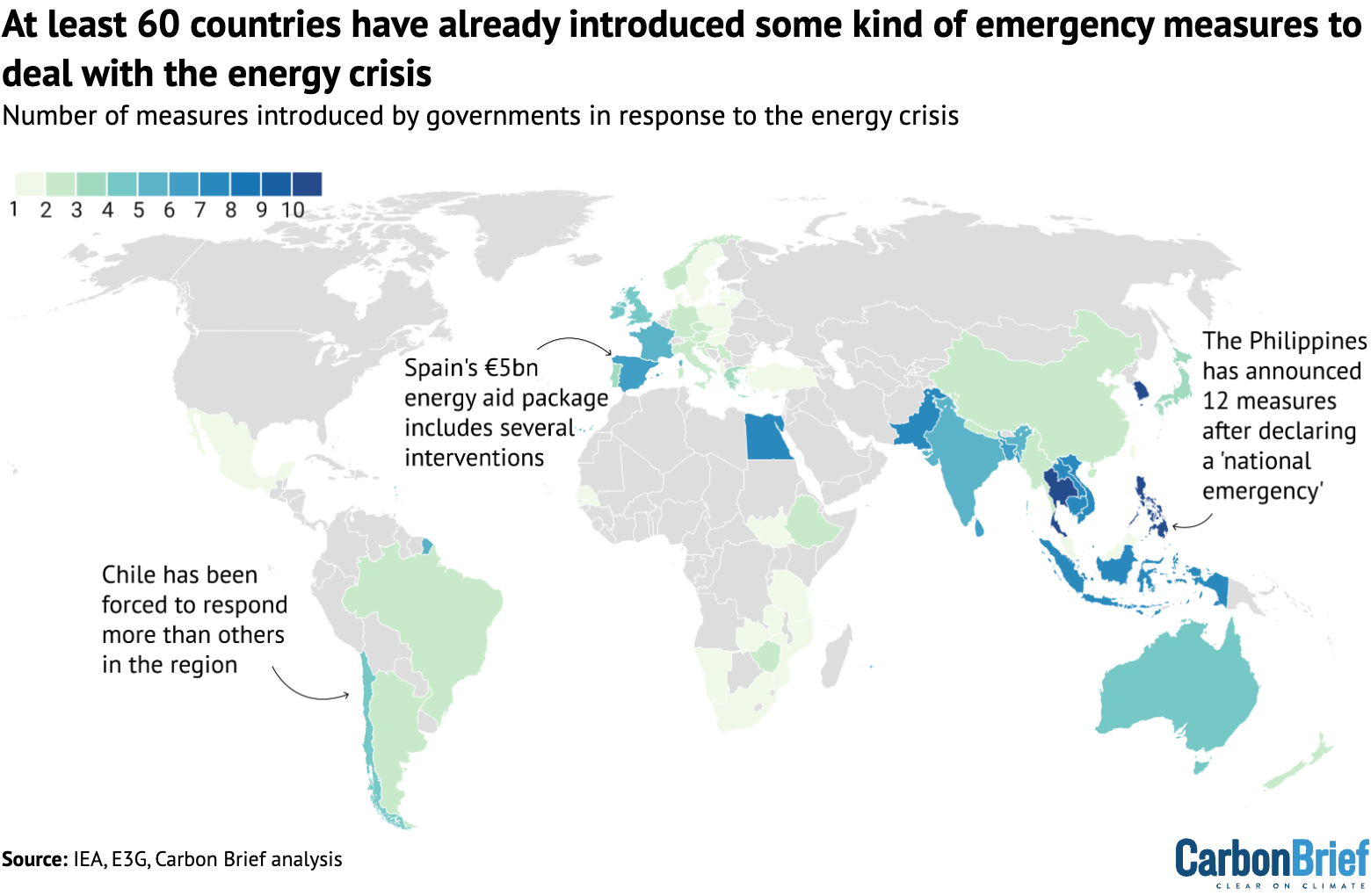
Nations including Indonesia, Japan, South Korea and India are already spending billions of dollars on fuel subsidies to protect people from rising costs.
At least 16 Asian countries are also taking drastic measures to reduce fuel consumption. For example, the Philippines has declared a “state of national emergency”, which includes limiting air conditioning in public buildings and subsidising public transport.
Other examples from the region include the government in Bangladesh asking the public and businesses to avoid unnecessary lighting, Pakistan reducing the speed limit on highways and Laos encouraging people to work from home.
Europe – which was hit hard by the 2022 energy crisis due to its reliance on Russian gas – is less immediately exposed to the current crisis than Asia. However, many nations are still heavily reliant on gas, including supplies from Qatar.
The continent is already feeling the effects of higher global energy prices as countries compete for more limited resources.
At least 18 European nations have introduced measures to help people with rising costs. Spain, which is relatively insulated from the crisis due to the high share of renewables in its electricity supply, nevertheless announced a €5bn aid package, with at least six measures to support consumers.
Many African countries, while also less reliant on direct fossil-fuel supplies via the Strait of Hormuz than Asia, are still facing the strain of higher import bills. Some, including Ethiopia, Kenya and Zambia, are also facing severe fuel shortages.
There have been fewer new policies across the Americas, which have been comparatively insulated from the energy crisis so far. One outlier is Chile, which is among the region’s biggest fuel importers and is, therefore, more exposed to global price increases.
Tax cuts
The most common types of policy response to the energy crisis so far have been efforts to protect people and businesses from the surge in fuel prices.
At least 28 nations, including Italy, Brazil and Australia, have introduced a total of 31 measures to cut taxes – and, therefore, prices – on fuel.
Even across Africa, where state revenues are already stretched, some nations – including Namibia and South Africa – are cutting fuel levies in a bid to stabilise prices.
Another 17 countries, including Mexico and Poland, have directly capped the price of fuel. Others, such as France and the UK, have opted for more targeted fuel subsidies, designed to support specific vulnerable groups and industries.
These measures are all shown in the dark blue “consumer support” bars in the chart below.
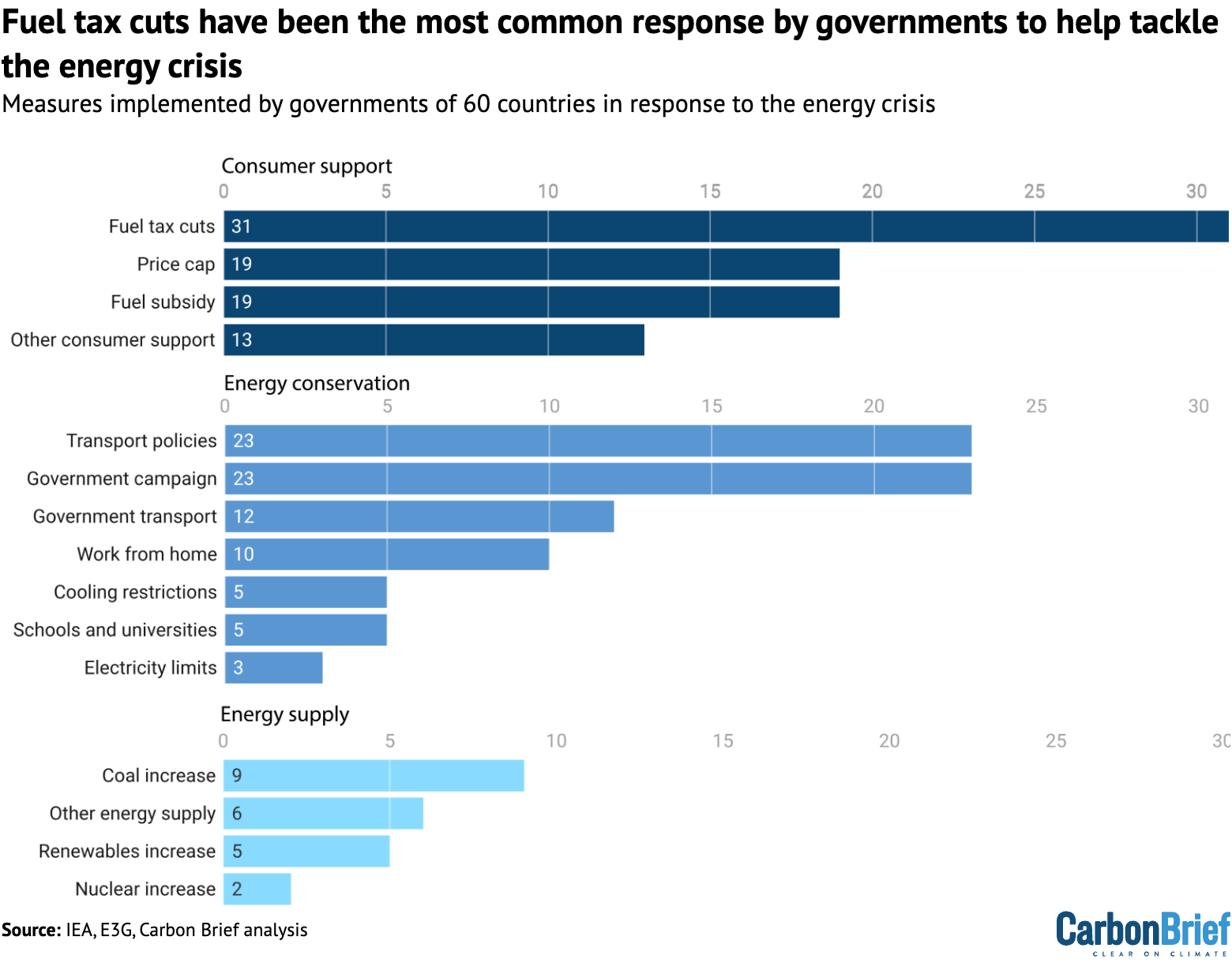
Such measures can directly help consumers, but some leaders, NGOs and financial experts have noted that there is also the risk of them driving inflation and reinforcing reliance on the existing fossil fuel-based system.
Christine Lagarde, president of the European Central Bank, spoke in favour of short-term measures to “smooth the shock”, but noted that “broad-based and open-ended measures may add excessively to demand”.
Measures to conserve energy, of the type that many developing countries in Asia have implemented extensively, have been described by the IEA as “more effective and fiscally sustainable than broad-based subsidies”.
So far, there have been at least 23 such measures introduced to limit the use of transport, particularly private cars.
These include Lithuania cutting train fares, two Australian states making public transport free and Myanmar and South Korea asking people to only drive their cars on certain days.
Clean vs coal
At least eight countries have announced plans to either increase their use of coal or review existing plans to transition away from coal, according to Carbon Brief’s analysis. These include Japan, South Korea, Bangladesh, the Philippines, Thailand, Pakistan, Germany and Italy.
These measures broadly involve delaying coal-plant closure, as in Italy, or allowing older sites to operate at higher rates, as in Japan – rather than building more coal plants.
There has been extensive coverage of how the energy crisis is “driving Asia back to coal”. However, as Bloomberg columnist David Fickling has noted, this shift is relatively small and likely to be offset by a move to cheap solar power in the longer term.
Indeed, some countries have begun to consider changes to the way they use energy going forward, amid a crisis driven by the spiralling costs of fossil-fuel imports.
Leaders in India, Barbados and the UK have explicitly stressed the importance of a structural shift to using clean power. Governments in France and the Philippines are among those linking new renewable-energy announcements with the unfolding crisis.
New renewable-energy capacity will take time to come online, albeit substantially less time than developing new fossil-fuel generation. In the meantime, some nations are also taking short-term measures to make their road transport less reliant on fossil fuels.
For example, the Chilean government has enabled taxi drivers to access preferential credit for purchasing electric vehicles (EVs). Cambodia has cut import taxes on EVs and Laos has lowered excise taxes on them.
Finally, there have been some signs that countries are reconsidering their future exposure to imported fossil fuels, given the current economics of oil and gas.
The New Zealand government has indicated that a plan to build a new LNG terminal by 2027 now faces uncertainty. Reuters reported that Vietnamese conglomerate Vingroup has told the government it wanted to abandon a plan to build a new LNG-fired power plant in Vietnam, in favour of renewables.


The post Iran war analysis: How 60 nations have responded to the global energy crisis appeared first on Carbon Brief.
Iran war analysis: How 60 nations have responded to the global energy crisis
Seven Senate Democrats launched the probe over controversial tax credits to the country’s largest exporter of liquefied natural gas.
Seven Democratic U.S. senators have launched a probe into a $370 million “alternative fuel” payout to Cheniere Energy, made earlier this year by the IRS, that critics say the liquefied natural gas export company never should have received.
US Senators Investigate $370 Million IRS Payout to Cheniere Energy

Boeing Locks in 40,000 Tons of Soil Carbon Removal with Texas-Based Grassroots Carbon
Tesla Reclaims EV Sales Crown from BYD in Q1 2026, Heating Up the EV Race
The Global Energy Supply in a Decade ‘Is Not a World We’re Going to Recognize’
-
Climate Change8 months ago
Guest post: Why China is still building new coal – and when it might stop
-
Greenhouse Gases8 months ago
Guest post: Why China is still building new coal – and when it might stop
-

 Greenhouse Gases2 years ago
嘉宾来稿:满足中国增长的用电需求 光伏加储能“比新建煤电更实惠”
-
Climate Change2 years ago
Bill Discounting Climate Change in Florida’s Energy Policy Awaits DeSantis’ Approval
-

 Climate Change2 years ago
嘉宾来稿:满足中国增长的用电需求 光伏加储能“比新建煤电更实惠”
-
Climate Change Videos2 years ago
The toxic gas flares fuelling Nigeria’s climate change – BBC News
-

 Renewable Energy6 months ago
Sending Progressive Philanthropist George Soros to Prison?
-

 Carbon Footprint2 years ago
US SEC’s Climate Disclosure Rules Spur Renewed Interest in Carbon Credits