


Governments and private investors are investing heavily in quantum computing. This is pushing the technology toward real-world applications. Experts predict the market will hit about $4.24 billion by 2030. It is expected to grow roughly 20.5% each year from 2025 to 2030.
Artificial intelligence has changed investing. When paired with quantum computing, it may create big wealth-building chances in the coming decades.
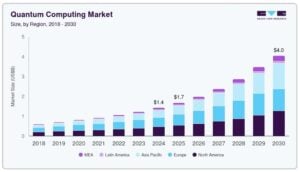
Investing in Top Pure-Play Quantum Stocks: The Next Tech and Climate Revolution
Recent breakthroughs in qubit stability and new partnerships for larger quantum networks are driving growth. Leading pure-play quantum stocks have risen as investors bet on widespread commercial use.
These companies are at the forefront, turning advanced research into real solutions. They could reshape industries like pharmaceuticals and energy.
Investors can now position themselves in top pure-play quantum stocks. This lets them capitalize on rapid innovation and a growing market.
Quantum computing is ushering in a new era of technological innovation—and nowhere is this impact more pronounced than in climate solutions. The leading pure-play quantum stocks – IonQ (IONQ), D-Wave Quantum (QBTS), Quantum Computing Inc. (QUBT), and Rigetti Computing (RGTI) – are actively driving advances in clean energy, carbon reduction, and climate science. Here’s how each company plays a vital role:
1. IonQ (IONQ): Betting Big on Quantum’s Future
Strong Cash Position Fuels Growth
As of July 2025, IonQ had $1.6 billion in cash and raised a record $1 billion in equity from a single institutional investor—the largest in the industry. This fund allows IonQ to grow rapidly. Additionally, the company’s market cap stands at $16.5 billion.
Tempo Hits AQ-64, Expanding Quantum Horizons
IonQ recently revealed that its Tempo system achieved a record AQ-64 ahead of schedule. This achievement doubles the useful computational space with each step. Now, the system can address real-world challenges like energy optimization, drug discovery, and supply chain modeling. At #AQ 64, IonQ is 36 quadrillion times more powerful than IBM’s current systems.
Investor Outlook
Recent acquisitions in networking, sensing, and space, including Oxford Ionics and Capella Space, enhance IonQ’s ecosystem. Significantly, it has been broadening its cloud presence through integrations with Amazon Web Services, Microsoft Azure Quantum, and Google Cloud Marketplace.
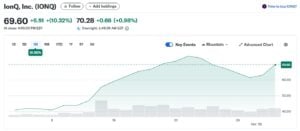
Making Energy Cleaner and Models Smarter
IonQ is helping make energy cleaner using quantum computers. In 2025, IonQ’s technology made power grid simulations up to 50 times faster than before. This helps cities use wind and solar power without losing energy. When energy managers used IonQ’s computers, they found ways to reduce pollution by as much as 15%.
IonQ is also working with scientists to design better batteries and materials that can capture pollution out of the air. Their computers solved problems that regular computers could not, making new discoveries up to 70% quicker. That means new green tech, like battery storage and pollution capture, could become available sooner and help fight climate change.
By speeding up climate models and helping companies plan their energy use, IonQ is playing a big role in lowering emissions and helping the world become greener.
2. D-Wave (QBTS) Poised for Growth with Quantum Advantage
D-Wave (NYSE: QBTS) is charting its own path. Rather than developing general-purpose quantum computers, it specializes in quantum annealing. This method excels in optimization tasks like logistics and statistical modeling. This focused strategy helps D-Wave capture valuable use cases without trying to cover the whole quantum market.
Notably, it stands out as the only company offering both annealing and gate-model systems. Over 100 clients, including government and enterprise customers, are using its solutions.
Additionally, the company announced in March that Ford Otosan has used D-Wave’s technology to improve production sequencing for its Ford Transit line.
Revenue and Cash Boost
The company reported a record Q1 fiscal 2025 revenue of $15 million. This is a 509% increase from $2.5 million last year. Its cash balance climbed to $304.3 million, bolstered by $146.2 million raised through its ATM program.
Advantage2 Expands Commercial Reach
D-Wave launched its sixth-generation Advantage2 system. It has over 4,400 qubits, making it the most powerful quantum computer they’ve created so far. This system addresses real-world issues that classical computers struggle with. Commercial adoption is accelerating, with bookings in APAC rising 83% in 2025.
Investor Outlook
Wall Street is optimistic. We also see that Piper Sandler raised its target to $22, Stifel set a $26 target, and Benchmark maintained its $20 Buy rating. Strong demand, solid funding, and growing commercial applications make QBTS a leader in the quantum field. Most significantly, analysts see the revenue jump as a solid path to profitability.
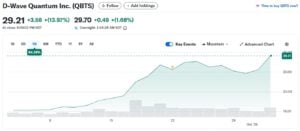
Quantum Solutions for Cleaner Cities
D-Wave’s technology and quantum computers help save energy and cut down pollution. D-Wave worked with a utility company in Europe to manage solar and wind power, making those clean energy sources more reliable and efficient. Their computers help balance the flow of energy so that less is wasted, meaning fewer fossil fuels are needed.
In Tokyo, D-Wave helped set up smart trash collection. Their computers figured out how trucks could use shorter routes and fewer vehicles. This cut down driving by 57% and saved a lot of fuel. In other tests, D-Wave’s technology helped reduce traffic jams by 17% and cut emissions in supply chains by 20%.
D-Wave’s newest computers use much less energy than big data centers. Their systems let companies manage energy and deliveries in ways that were never possible before, helping cities get cleaner and businesses save money.
3. Quantum Computing Inc. (QUBT): A High-Risk, High-Reward Quantum Play
Quantum Computing Inc. (Nasdaq: QUBT) focuses on photonic chip integration. It also launches Quantum AI and cybersecurity products. Currently, its early revenues are low. The company relies on government and industry partnerships. This dependence brings execution and adoption risks.
The company recently disclosed that it has $850 million cash position, strengthened by a $500 million private placement in September 2025. These funds support fab scaling, hiring, strategic acquisitions, and commercialization efforts.
Some commendable product developments include delivering a quantum photonic vibrometer to Delft University of Technology. It also shipped its first entangled photon source to a lab in South Korea. Meanwhile, a top-five U.S. bank adopted the Quantum Cybersecurity Solution. These wins show that QUBT’s products solve real-world challenges.
Foundry Powers Scale and Performance
The company’s thin-film lithium niobate (TFLN) foundry in Tempe, AZ, is now fully operational. It integrates nano-photonic chips into quantum systems. This improves size, weight, power, cost, and performance. External services also boost revenue in datacom, telecom, sensing, and quantum computing.
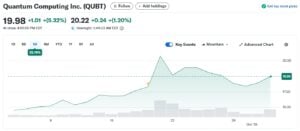
However, QUBT faces strong competition from IonQ and D-Wave. High risks in execution and adoption make this suitable for risk-tolerant investors. They seek asymmetric upside in early-stage quantum photonics.
Tracking Pollution and Saving Energy
QUBT builds quantum computers that help track pollution and save energy every day. Their machines are easier and cheaper to run than the biggest supercomputers. In 2024, QUBT invested millions to help forecast climate changes and make electric grids better. Their computers measure carbon pollution in the air almost twice as accurately as older methods, which means cities and governments can know what’s happening and act faster.
By working with power companies, QUBT found ways to cut energy waste by 37%. They believe their technology will help make big improvements – up to 52% – in just a few years. QUBT computers are also making it easier for countries and companies to test how well climate laws work and fix problems quickly.
With better data and faster answers, QUBT is helping people support a cleaner future through smarter science and technology.
4. Rigetti Computing (RGTI): The Future of Quantum Hardware
Rigetti Computing (NASDAQ: RGTI) is a top quantum computing stock drawing strong investor interest. The company is pushing forward with superconducting qubit technology and bold innovations. However, its revenue is small compared to its high valuation.
Leading in Quantum Hardware
Rigetti employs a chiplet-based approach to scale its quantum processors, distinguishing it from IBM and Google. Its Cepheus™-1-36Q system is live on Rigetti’s Quantum Cloud Services and will soon be on Microsoft Azure.
In September 2025, the company launched a 36-qubit processor that cut two-qubit errors in half and achieved 99.5% gate fidelity. This progress shows it can scale to over 100 qubits.
Market Momentum and Funding
Revenue for Q2 2025 is $1.8 million, which is modest. Shares are trading around $32, up over 4,000% in the past year. Rigetti has about $571 million in cash and no debt. This provides a strong runway for research, partnerships, and production.
Key collaborations include Quanta Computer’s $35 million investment, contracts with the U.S. Air Force, and ties with India’s C-DAC for hybrid quantum systems.
Risks and Outlook
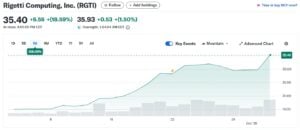
Most analysts rate RGTI stock a “Buy,” but its stock price exceeds many targets. The price-to-sales ratio is around 900x. This means Rigetti offers high-risk, high-reward exposure to next-generation quantum computing. It suits investors willing to bet on long-term breakthroughs and tolerate short-term volatility.
Building Better Batteries and Clean Tech
Rigetti is building quantum computers that help scientists create new batteries, solar panels, and even machines to capture pollution. Their computer chips work with very few mistakes, so testing new clean tech designs is quicker and cheaper. In 2025, Rigetti joined with governments and technology companies to set up projects using quantum computers in clean energy labs.
Rigetti’s computers helped make battery and solar designs three times as fast as before. A recent U.S. Air Force project spent $5.8 million to test Rigetti’s computers for national security and energy grid science. With international orders for their systems, Rigetti’s technology is helping researchers all over the world find the fastest ways to cut pollution and improve clean energy.
Rigetti is proving that new quantum computers can help jumpstart the next wave of green inventions.
Power Needs and Efficiency of Quantum Computing
Quantum computers demand significant energy to operate, especially superconducting qubit systems that must stay near absolute zero—about 0.015 Kelvin. And cooling consumes a significant 70% of the total power.
- A single quantum system can consume 220,000 to 438,000 kWh annually, similar to the energy use of 20 to 40 average homes.
As qubit numbers grow, larger systems may need hundreds of kilowatts continuously. Researchers are testing energy-efficient cooling methods and developing qubits that can work at higher temperatures, which could significantly lower energy demand.
However, even with these requirements, quantum computers still use far less electricity than traditional supercomputers. Companies are also adopting sustainability measures, using renewable energy, modular hardware designs, and recycling rare materials to reduce their carbon footprint.
Accelerating Clean Tech and Materials Innovation
Quantum computing is changing how we approach materials and clean energy. A McKinsey report highlighted the following:
- It is helping develop sustainable batteries, high-efficiency solar panels, and improved catalysts for carbon capture.
- Researchers are creating battery chemistries that rely less on lithium and cobalt and designing solar materials that are safer and more effective.
- Quantum simulations can also uncover compounds that make CO₂ capture and storage cheaper and more energy-efficient.
- In energy systems, quantum machine learning and annealing help forecast supply and demand, optimize production, and integrate renewables into the grid.
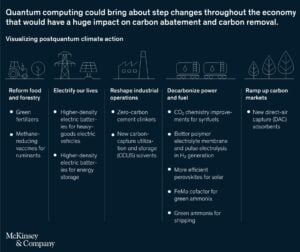
These advances boost reliability, cut emissions, and make clean energy solutions more affordable, moving the world closer to sustainability goals.
As these companies advance their technology and scale operations, these pure-play quantum stocks may unlock massive growth. This makes it one of the most exciting sectors to watch.
Quantum computing is more than just a high-tech idea – it’s becoming a real-world tool for solving tough climate problems. Companies like IonQ, D-Wave, QUBT, and Rigetti are leading the way. Their computers let us model and fix energy systems, track pollution, and invent new green technologies faster than ever. This means not just a smarter future – but a cleaner, healthier planet for everyone.
The post Investing in Quantum Computing: How IONQ, QUBT, RGTI & QBTS Stocks Are Revolutionizing Technology and Climate Solutions appeared first on Carbon Credits.

EU carbon credit claims changed on 27 September 2026, the day the Directive (EU) 2024/825 began to apply across the European Union. The change is narrow. It changes how a company can talk about the credits it buys. A product can no longer be called neutral on the strength of compensation alone; however, every specific, evidenced statement about what a company measured, reduced, and funded stays fully available.

The post Promoting Improved Cooking Practices in Nigeria appeared first on Terrapass.



