
Connect with us

Published

on

Carbon Credit Market Gains Integrity With ICVCM's Approval of 6 New Removal Standards

The voluntary carbon market (VCM) has taken a major step forward. The Integrity Council for the Voluntary Carbon Market (ICVCM) has approved six new carbon removal methodologies under its Core Carbon Principles (CCPs). These methods come from two programs: Isometric and Gold Standard. Both are known for meeting the council’s strict requirements.

This approval signals a shift toward stronger credibility in carbon removal credits. For years, the voluntary carbon market faced doubts about quality, transparency, and permanence.

Many companies hesitated to use credits due to fears of overstated benefits. The ICVCM names specific methods that meet high integrity standards. This helps businesses, investors, and governments have a clearer framework to trust. In the words of Annette Nazareth, ICVCM Chair:

“We are pleased to announce these new approvals for methodologies in a variety of emissions reductions and removals categories. The science is clear that both reductions and removals are critical to effective climate action. These latest approvals will open up new options for integrity-focused buyers to broaden their portfolios of carbon credits across a range of high-impact categories.”

The New Approved Standards

The six approved carbon removal methodologies include the following:

  • Gold Standard — Carbon Sequestration Through Accelerated Carbonation of Concrete Aggregate (v1.0)
  • Isometric — Biomass Geological Storage (v1.0–v1.1)
  • Isometric — Bio-oil Geological Storage (v1.0–v1.1)
  • Isometric — Subsurface Biomass Carbon Removal and Storage (v1.0)
  • Isometric — Biogenic Carbon Capture and Storage (v1.1)
  • Isometric — Direct Air Capture (v1.1)

In addition, the ICVCM confirmed two nature-based methodologies under other programs: CAR Mexico Forest Protocol v3 for improved forest management and VM0047 v1.1 for afforestation and reforestation.

These approvals matter because they are linked to very specific versions of methodologies. Not all projects under Isometric or Gold Standard automatically qualify. Only those that follow these approved versions can carry the CCP label.

From Doubts to Trust: Raising the Bar on Carbon Credits

So far, projects under these new removal methods have issued around 30,000 credits. While this number is small, the pipeline is much larger. ICVCM data show that:

  • 24 projects under the Isometric methods are expected to issue over 3.2 million credits annually in the coming years.
  • 15 projects under the Gold Standard method could issue over 9,000 credits annually.

In forestry, the CAR Mexico Forest Protocol v3 already has more than 8.1 million credits issued. However, not all will automatically qualify under the CCP label because of new permanence and leakage rules. For example, the protocol now requires a 40-year permanence commitment and allows leakage rates of up to 40%.

This level of detail adds clarity and accountability. It helps ensure that CCP-approved credits represent real, measurable, and durable climate outcomes.

From Billions to Trillions: The Future of Carbon Removal

The carbon removal market is still small compared to the scale of global emissions. Today, VCMs are valued at about $2 billion annually. Forecasts suggest they could reach up to $100 billion by 2030. Carbon removal will be central to that growth.

voluntary carbon credit demand growth
Source: McKinsey & Company

Currently, removals make up less than 1% of all credits sold. Most credits still come from avoided emissions, such as preventing deforestation. But future sales are shifting toward removals.

Buyers are showing stronger interest in forward contracts for engineered removals, like direct air capture, bio-oil storage, and biomass geological storage.

Analysts project that DAC capacity could reach 60–100 million tons per year by 2035, up from near zero today. Meanwhile, biochar, enhanced weathering, and subsurface storage are also scaling. These new CCP approvals provide the quality assurance needed to attract investment at this level.

Carbon market growth rates are projected at 25–30% annually through the next decade. By 2050, the sector could generate more than $1 trillion annually, reflecting the scale of removals needed to reach climate goals.
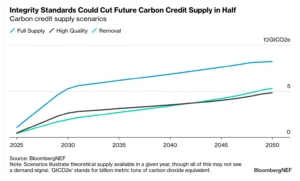
  • BloombergNEF projects that carbon credit supply will expand 20- to 35-fold by 2050, with engineered removals gaining share. Current supply sits near 243 million tons in 2024, rising to 2.6 billion tons by 2030 and 4.8 billion by 2050.
carbon credit supply 2050 BNEF
Source: BNEF

DAC is forecasted to deliver about 21% of credits by 2050. Prices for credits may increase to $60 per ton by 2030 and $104 by 2050, reflecting greater demand and higher quality standards.

Four Forces Powering the Carbon Removal Boom

Several forces are pushing removals into the mainstream.

  • Corporate Net-Zero Goals – More than 5,000 companies worldwide have pledged to reach net zero. Many will rely on removals to balance emissions they cannot fully cut.
  • Government Policy – U.S. and European policies, such as the Inflation Reduction Act and the EU Green Deal, provide tax credits and funding for carbon capture.
  • Investor Confidence – Clear CCP standards make investors more willing to finance high-quality projects.
  • Technology Scaling – Costs for engineered removals like DAC and bio-oil storage are expected to fall as projects scale up.

These trends show why carbon removal is becoming not just a side option but a pillar of climate strategy.

The Price of Permanence: Barriers Still Loom

Even with new approvals, challenges remain. Engineered removals are expensive. Current costs for direct air capture range from $300 to $600 per ton. Experts say this needs to fall below $100 per ton for widespread adoption.

Nature-based removals, while cheaper, raise other questions. Land use, biodiversity impacts, and long-term monitoring must be managed carefully. For example, requiring 40-year permanence adds credibility but also creates financial and operational hurdles for project developers.

The Integrity Council will need to enforce ongoing monitoring, verification, and auditing. Without strong oversight, credibility could erode again.

Why This Matters for Business and Capital

For companies, the approval of Isometric and Gold Standard removals offers more reliable ways to meet net-zero targets. Purchasing CCP-approved carbon credits reduces reputational risks and demonstrates a commitment to real climate action.

For investors, these standards provide a clearer signal about which projects are worth funding. Capital can flow toward technologies and practices that deliver measurable and permanent removals.

Carbon Markets 2030 and Beyond

The ICVCM decision is a foundation for growth. By 2030, analysts expect carbon removal to represent a much larger share of the voluntary market.
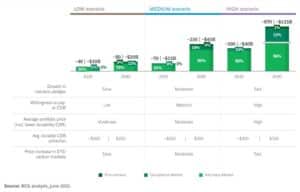
BCG carbon removal credit demand projection 2030-2040

Government integration will be another milestone. Both the UK and EU are exploring whether to allow carbon removals in their compliance systems within the next five years. If CCP-approved removals are included, demand could rise sharply.

The Integrity Council’s approval of six new methodologies from Isometric and Gold Standard represents a turning point for carbon markets. These decisions provide greater transparency, stronger safeguards, and a clearer path for scaling carbon removal.

While challenges remain in cost, permanence, and oversight, the foundation for trust is stronger than before. With new standards in place, the carbon removal market can grow from thousands to millions—and eventually billions—of tons of CO₂ removed. This shift is critical to balancing global emissions and moving closer to a net-zero future.

The post Carbon Credit Market Gains Integrity With ICVCM’s Approval of 6 New Removal Standards appeared first on Carbon Credits.

Continue Reading

Carbon Footprint

DOE’s $303M Bet on Kairos Power Signals America’s Advanced Nuclear Push

Published

on

The U.S. nuclear sector just received another strong signal of federal backing.

On February 21, the U.S. Department of Energy (DOE) finalized a $303 million Technology Investment Agreement with Kairos Power to advance its Hermes demonstration reactor in Oak Ridge, Tennessee. The deal supports the company’s selection under the Advanced Reactor Demonstration Program (ARDP), first announced in December 2020.

But this is not a traditional federal grant. Instead, DOE structured the agreement as a performance-based, fixed-price milestone contract. Kairos will only receive payments once it achieves clearly defined technical milestones.

This funding model was previously used by the Department of Defense and NASA’s Commercial Orbital Transportation Services (COTS) program. It aims to accelerate innovation while protecting public funds. Now, DOE is applying that same discipline to advanced nuclear technology.

smr installed capacity
Source: IEA

Hermes: The First Gen IV Reactor Approved in Decades

At the center of the agreement is Hermes — a low-power demonstration reactor based on Kairos Power’s fluoride salt-cooled high-temperature reactor (KP-FHR) design.

kairos hermes
Source: Kairos

In December 2023, the U.S. Nuclear Regulatory Commission (NRC) granted Hermes a construction permit. That approval marked a historic milestone. Hermes became the first non-light-water reactor approved for construction in the United States in more than 50 years. It is also the first Generation IV reactor cleared for building.

The reactor is expected to be operational in 2027. While it will not generate commercial electricity, it serves a critical role. Hermes will demonstrate Kairos Power’s ability to safely deliver low-cost nuclear heat and operate a fully integrated advanced nuclear system.

Its design combines two established technologies that originated in Oak Ridge: TRISO-coated particle fuel and Flibe molten fluoride salt coolant. Together, these systems enhance safety and simplify operations.

The molten salt coolant improves heat transfer and stability, while TRISO fuel provides strong containment of radioactive materials. The result is a reactor design that emphasizes inherent safety without relying on overly complex backup systems.

Significantly, Hermes represents Kairos Power’s first nuclear build, and it acts as a stepping stone toward commercial deployment.

Mike Laufer, Kairos Power co-founder and CEO, said:

“With the use of fixed-price milestone payments, this innovative contract provides real benefits to both Kairos Power and DOE to ensure the successful completion of the Hermes reactor. It allows us to remain focused on achieving the most important goals of the project while retaining agility and flexibility to move quickly as we learn key lessons through our iterative development approach.”

Risk Reduction and Private Capital Alignment

The DOE’s investment complements significant private funding already committed by Kairos Power. Since its ARDP selection, the company has built extensive testing facilities and manufacturing infrastructure to support its Engineering Test Unit series. It has also advanced its fuel development and molten salt coolant systems.

Unlike traditional large-scale nuclear projects that often suffer cost overruns, Kairos is pursuing an iterative development pathway. This approach allows the company to test, refine, and improve reactor components before full commercial rollout.

Fuel manufacturing plays a key role in that strategy. Kairos Power is working in partnership with Los Alamos National Laboratory to produce fuel for Hermes. Through its Low Enriched Fuel Fabrication Facility (LEFFF), the company aims to control quality, reduce delays, and manage costs more effectively.

Vertical integration is central to its business model. By managing more of the supply chain internally, Kairos hopes to deliver greater cost certainty for future commercial reactors — an area where traditional nuclear projects have struggled.

           Key Features

kairos
Source: Kairos

Nuclear’s Return to the Energy Spotlight

The Hermes agreement comes at a time when nuclear energy is regaining political and investor attention.

Federal policy has shifted in favor of accelerating the development of next-generation reactors. In 2025, the U.S. administration introduced measures to shorten licensing timelines and rebuild domestic nuclear fuel supply chains. The Department of Energy has articulated an ambitious goal: expand U.S. nuclear capacity from roughly 100 gigawatts in 2024 to 400 gigawatts by 2050.

Programs such as the Energy Dominance Financing initiative aim to provide additional support for nuclear infrastructure. Once built, reactors can operate for up to 80 years, making them long-term strategic assets.

At the same time, electricity demand is rising. According to the International Energy Agency (IEA), U.S. electricity demand grew 2.8% in 2024 and another 2.1% in 2025. The country is projected to add more than 420 terawatt-hours of new demand over the next five years.

electricity genration

Data centers are driving much of that growth. The rapid expansion of artificial intelligence and cloud computing infrastructure could account for nearly half of total demand growth through 2030.

This dynamic is reshaping energy investment decisions. Technology companies require reliable, always-on power. However, they must also meet emissions reduction targets. Nuclear energy provides steady, low-carbon electricity, making it increasingly attractive for both policymakers and corporate buyers.

Small Reactors, Big Strategic Impact

Small modular and advanced reactors are the keys to this renewed momentum. Compared to traditional gigawatt-scale plants, smaller reactors offer shorter construction timelines and lower upfront capital requirements. Developers can deploy them incrementally, reducing financial risk and improving flexibility.

Hermes, although it is a demonstration project, it represents a critical validation step. If successful, it could pave the way for commercial-scale KP-FHR reactors that supply industrial heat and electricity at competitive costs.

Dr. Kathryn Huff, Assistant Secretary, Office of Nuclear Energy, made an important statement, noting:

“The Hermes reactor is an important step toward realizing advanced nuclear energy’s role in ushering forward the nation’s clean energy transition. Partnerships like this one play a significant role in making advanced nuclear technology commercially competitive.”

For investors, this shift signals opportunity. Supportive government policy, rising electricity demand, AI-driven load growth, and decarbonization commitments are converging. Nuclear power, once viewed as a legacy industry, is re-emerging as a strategic solution.

SMR
Source: IEA

A Measured Step Toward a Nuclear Renaissance

The DOE-Kairos agreement does not guarantee success. Advanced reactor development remains technically complex and capital-intensive. However, the deal’s structure reflects lessons learned from past nuclear projects.

By tying federal funding to performance milestones, DOE is promoting accountability. By combining public and private capital, the government is reducing financial risk while accelerating innovation.

Hermes now stands as one of the most closely watched advanced reactor projects in the United States. If Kairos delivers on schedule, the project could mark a turning point. Not just for one company but for the broader U.S. nuclear renaissance that policymakers increasingly envision.

In a world of rising electricity demand and tightening climate targets, advanced nuclear energy is inevitably essential. And with Hermes moving forward, it is becoming tangible infrastructure.

The post DOE’s $303M Bet on Kairos Power Signals America’s Advanced Nuclear Push appeared first on Carbon Credits.

Continue Reading

Carbon Footprint

Amazon Tops Global Clean Energy Rankings With 40GW Renewable Projects Says BNEF

Published

on

Amazon Tops Global Clean Energy Rankings With 40GW Renewable Projects Says BNEF

Amazon, once again, is one of the top corporate buyers of clean and renewable energy in the world. For the fifth year in a row, the company leads global corporate renewable energy procurement. BloombergNEF again recognized Amazon as a top corporate purchaser of carbon-free power, with a portfolio that adds significant new clean energy to grids.

Amazon’s clean energy projects now span more than 700 global initiatives. These include utility-scale solar and wind farms, battery storage, onsite solar, and other carbon-free energy sources across 28 countries.

So far, Amazon has invested in over 40 gigawatts (GW) of carbon-free energy capacity. This amount of power could supply the annual electricity needs of more than 12.1 million U.S. homes if it were used for residential demand.

These investments make Amazon not just a buyer of clean power for itself, but a major driver of new renewable energy build-out around the world.

From First PPA to 40GW Global Portfolio

Amazon’s renewable energy footprint has expanded rapidly over the past decade. The big tech company was the biggest corporate buyer of renewable energy in 2025, based on BloombergNEF data. It signed multiple power purchase agreements (PPAs) and grew its clean energy portfolio.

corporate clean energy purchases BNEF 2025
Source: BNEF
  • Amazon has backed over 700 wind and solar projects around the world. This clean energy can power more than 12.1 million U.S. homes each year.

This expansion includes utility-scale wind and solar farms. It also covers renewable energy bought through PPAs. Additionally, it features on-site rooftop and ground-mount solar projects at Amazon facilities.

Over time, these efforts have helped the tech giant use more clean energy for its electricity, which is a key part of its climate strategy.

Amazon renewable energy portfolio 2025

Solar, Wind, Storage — and Next-Gen Power

Amazon’s clean energy portfolio includes a broad mix of technologies:

  • Solar power: 300+ utility-scale solar and wind farms and 300+ onsite solar projects.
  • Wind energy: Large wind farms in multiple countries, with 6 offshore wind farms in Europe. 
  • Energy storage: Battery storage projects that help balance intermittent renewable output. It has 11 utility-scale battery storage projects. 
  • Emerging technologies: Amazon has invested in advanced options like nuclear small modular reactors (SMRs), with 4 nuclear power agreements. These help provide firm, low-carbon baseload power. 

These investments help replace fossil fuel generation on local grids. They also support grid reliability and reduce electricity costs over the long term.

In Mississippi, for example, Amazon worked with a utility to enable 650 megawatts (MW) of new renewable energy on the grid. Once operational, this capacity will serve the equivalent of over 150,000 homes and improve grid reliability.

Moreover, the company’s 253 MW Amazon Wind Farm Texas contributes around 1,000 GWh of clean power annually. Meanwhile, its European solar and wind assets alone total about 4,600 MW of capacity.

All these efforts form part of the e-commerce’ push for its 2040 net zero targets.

Powering the Path to Net Zero 2040

Amazon has set multiple climate and sustainability targets. The company aims to reach net-zero carbon emissions by 2040 — a goal it committed to early as part of The Climate Pledge.

Amazon net zero emissions 2040
Source: Amazon

To work toward that long-term target, Amazon set a goal to match its electricity use with renewable energy. It reached 100% renewable electricity for its operations ahead of schedule, well before its original 2030 goal.

This means Amazon is purchasing an amount of renewable electricity equal to its total annual consumption. Clean power comes from renewable projects connected to the grid. These projects are supported by long-term PPAs and other contracts.

The renewable energy purchases lower Amazon’s Scope 2 emissions, which come from the electricity it buys. They also help decarbonize the grids where the company operates.

Corporate Buyers Now Rival National Grids

Amazon’s clean energy efforts are part of a larger shift across the corporate world.

Since 2008, companies have bought almost 200 GW of renewable energy worldwide through corporate PPAs and other agreements. This capacity exceeds the total electricity generation of some countries, like France or the United Kingdom.

In 2023, companies revealed a record 46 GW of clean energy deals. These renewable power commitments support new solar and wind farms.

Large tech companies, including Amazon, Google, Microsoft, and Meta, are some of the most active buyers. Those tech firms accounted for a significant share of corporate clean energy procurement over the last decade.

This trend shows that corporate demand can speed up the clean energy shift by providing renewable power developers with long-term revenue certainty.

 Jobs, Grid Stability, and Market Transformation

Corporate clean energy procurement, though slowed down in 2025, has broader economic and energy-system impacts. Investments in renewable projects contribute to job creation, local economic growth, and grid resilience.

Amazon’s solar and wind farms create many construction and operation jobs. They also boost the economy in rural areas. For example, the Great Prairie Wind Farm in Texas has 350 wind turbines. These turbines provide over 1,000 MW of capacity and are one of the largest assets in Amazon’s portfolio.

Also, Amazon’s clean energy deals boost renewable capacity. These projects are in Brazil, India, China, Australia, and Europe, which support markets with different grid mixes. These projects can cut down on fossil fuel-based electricity. They also help local grids stay cleaner and stronger.

Permitting, Policy, and the Next Growth Wave

Despite strong progress, corporate clean energy procurement still faces challenges.

Renewable projects often depend on grid capacity, permitting, and supportive policy frameworks. In some regions, complex regulations or limited grid access can slow project development and clean energy adoption.

Nevertheless, the trend of corporate power purchasing is expected to grow. Data from the Clean Energy Buyers Association (CEBA) shows that U.S. businesses have signed contracts for 100 GW of clean energy. This milestone highlights how important companies are in today’s energy landscape.

Global renewable capacity is also expanding rapidly. According to IRENA, global renewable power capacity reached 4,448 GW at end-2024 after adding a record 585 GW. That’s 15.1% growth with solar leading 75%+ of additions. The 2025 additions are expected to maintain record growth toward the 2030 tripling goal.

Renewables are now growing faster than fossil fuels in new capacity. Looking ahead, strong demand from companies for clean energy will boost growth. Better policies and tech advancements will also help renewable power buying and grid decarbonization.

Private Capital Driving Public Energy Changeaction

Amazon’s clean energy leadership shows how corporate buyers can influence the global energy transition. By securing large portfolios of renewable power, the tech giant and other major corporations are investing in the future of clean electricity. These investments not only help reduce their own emissions but also fund new clean energy capacity that benefits broader society.

As corporate renewable procurement grows, so does the clean energy market. This can lower costs, stimulate innovation, and increase the pace of emission reductions across power systems worldwide.

With more companies setting clean energy goals and signing long-term agreements, the private sector continues to be a powerful force in the shift toward a low-carbon economy.

The post Amazon Tops Global Clean Energy Rankings With 40GW Renewable Projects Says BNEF appeared first on Carbon Credits.

Continue Reading

Carbon Footprint

NVIDIA Hits Almost $216 Billion Revenue as AI Boom Tests Its Climate Strategy

Published

on

NVIDIA Hits Almost $216 Billion Revenue as AI Boom Tests Its Climate Strategy

NVIDIA’s latest earnings report shows the scale of the AI boom. The chipmaker reported record revenue and became the fourth U.S. tech company to exceed $100 billion in annual profit. Alongside financial growth, Nvidia continues to push renewable energy use and efficiency gains. The results highlight the growing link between AI expansion and sustainability challenges.

NVIDIA reported record revenue of $68.1 billion for the fourth quarter of fiscal 2026, ending January 25, 2026. This figure was up 73% from a year earlier and up 20% from the prior quarter. Data center sales, which fuel artificial intelligence (AI) growth, were $62.3 billion, or about 91% of total revenue in the quarter.

For the full fiscal year, NVIDIA posted $215.9 billion in revenue, a jump of 65% from the prior year. Net income reached tens of billions, $120,067 million for the full year and $42,960 for the 4th quarter. Earnings per share also grew significantly.

These results exceeded most analysts’ expectations and underscored NVIDIA’s continued leadership in AI compute hardware. The company also forecast strong revenue for the first quarter of fiscal 2027.

NVIDIA financial results 2025
Source: NVIDIA

NVIDIA’s Sustainability Commitments at a Glance

NVIDIA has increasingly highlighted its environmental and sustainability goals in recent years. For the fiscal year 2025, the company achieved 100% renewable energy use for all offices and data centers it directly controls.

The renewable supply came from a mix of:

  • On-site generation
  • Purchased renewable electricity
  • Energy attribute certificates (EACs)
  • Power purchase agreements (PPAs)

This milestone eliminates the company’s market-based Scope 2 emissions tied to electricity use in those facilities.

While operational emissions from electricity have been addressed, total emissions figures remain complex. NVIDIA reported that its total greenhouse gas emissions increased. This includes Scope 3 emissions linked to its supply chain and purchased goods. Scope 3 emissions accounted for the bulk of its emissions inventory, and they rose significantly year-over-year.

Nvidia GHG emissions 2024

NVIDIA has also incorporated science-based targets and reduction plans into its public disclosures. The company aims to cut direct (Scope 1) and electricity-related (Scope 2) emissions by about 50% by 2030. This is based on its baseline figures. These science-based targets are consistent with internationally recognized climate frameworks.

Beyond energy use, NVIDIA has implemented other environmental actions. Closed-loop liquid cooling systems in data centers help cut water use. Also, there are significant increases in recycling electronic waste each year.

AI Performance Per Watt: NVIDIA’s Efficiency Edge

NVIDIA’s technology can influence emissions well beyond its own operations. The company’s GPUs and systems power AI infrastructure around the world. Many of these systems are designed to be energy efficient.

For example, NVIDIA-based systems dominate rankings of the most energy-efficient supercomputers globally. The Green500 list ranks systems based on energy efficiency.

Many top entries use NVIDIA GPUs, especially the advanced Grace Hopper architecture. These systems deliver high computing performance per watt of power, helping labs and data centers run complex workloads with less energy.

Record Profits, Cautious Market Reaction

Despite the strong financial performance, NVIDIA’s share price movement highlights market nuances. Some reports noted that after an initial uptick in after-hours trading, the stock’s gains flattened or reversed. This response came even as NVIDIA beat revenue and profit expectations.

NVIDIA nvda stock price

Analysts point to broader concerns about the valuation of high-growth AI stocks. Investors are cautious despite strong earnings. They worry about how fast AI demand will grow and whether valuations show future risks.

In early 2026, NVIDIA’s stock had also seen uneven performance year-to-date. Some analysts believe the trading pattern after earnings shows sector sentiment more than the company’s actual results.

NVIDIA’s profit scale also stands out compared with other major U.S. tech firms. For fiscal year 2026, the tech giant reported $120 billion in net income. This made it the fourth U.S. tech company ever to exceed $100 billion in annual profit, joining Alphabet, Apple, and Microsoft.

  • NVIDIA’s result trails only Alphabet’s $132 billion profit in 2025, which remains the largest annual profit ever recorded by a U.S. company.

The speed of NVIDIA’s rise is also notable. Just three years ago, the company’s annual net income was $4.4 billion. In its most recent quarter, the chipmaker generated that amount in less than 10 days.

Nvidia annual profit 2025 vs other big tech
Source: Statista

By comparison, Apple took 18 years to grow from $5 billion in annual profit to $112 billion, beginning around the launch of the iPhone in 2007. Microsoft took 27 years to move from $5 billion to more than $100 billion in annual profit. Alphabet first crossed the $100 billion mark in 2024. NVIDIA hit this milestone in under three years. CEO Jensen Huang pointed out the company’s AI gains in May 2023.

Efficiency Gains vs. Expanding Energy Footprint

NVIDIA’s external ESG ratings are similar to those of other tech companies for environmental and governance metrics. However, the scores vary in social and supply chain areas. These ratings consider things like how well companies disclose information, their plans for cutting emissions, and their governance. They also look at challenges related to wider supply chain emissions.

One sustainability ranking highlighted a “paradox” in NVIDIA’s performance. It noted that NVIDIA’s chips are among the most energy-efficient in the world, which boosts its sustainability profile. The quick rise in total energy use for AI infrastructure is increasing overall environmental impacts. This happens even as per-unit efficiency improves.

NVIDIA’s renewable energy goals and efficiency gains have positioned it as a leader. It combines strong finances with sustainable growth. For instance, in a 2026 list of top firms for sustainable growth, NVIDIA stood out. It achieved 100% renewable energy for its offices and data centers. Plus, its GPU platforms are energy efficient.

Can AI Hypergrowth Align With Climate Targets?

NVIDIA’s sustainability strategy focuses on three key areas:

  • Reducing direct and indirect emissions.
  • Improving energy use.
  • Enhancing reporting transparency.

The company has achieved important goals. It now uses renewable energy for its facilities. It has also improved chip efficiency. These steps show progress toward environmental goals.

Still, rising Scope 3 emissions and the booming demand for AI compute make tackling environmental impacts more complex. NVIDIA’s sustainability reports highlight that energy use in data centers is a major barrier. This limits both digital infrastructure growth and climate progress.

Energy-intensive “AI factories” — large data centers running training and inference workloads — require large power supplies, often on par with traditional industrial factories. This growth in demand puts pressure on energy systems to shift toward low-carbon sources.

NVIDIA’s efforts to work with suppliers on emissions targets and its investments in energy efficiency aim to address parts of this challenge. But the company has not yet announced a full net-zero emissions target with a fixed date.

So, What Comes Next for NVIDIA?

In the near term, NVIDIA will likely continue to be a focal point for both earnings performance and ESG debate. Future earnings releases and sustainability reports will show whether the company’s actions keep pace with its growth.

Investors and stakeholders will watch how NVIDIA manages AI demand, emissions challenges, and energy efficiency together.

On the sustainability side, developing and reporting progress on Scope 3 emissions, supplier engagement, and potential net-zero pathways will shape ESG evaluations. As AI energy use rises worldwide, companies like NVIDIA will face more scrutiny over how they balance growth with their emissions and climate impact.

Overall, NVIDIA’s record earnings and sustainability efforts highlight its role in tech innovation and environmental change. The company balances rapid AI growth with a commitment to lowering its environmental impact.

The post NVIDIA Hits Almost $216 Billion Revenue as AI Boom Tests Its Climate Strategy appeared first on Carbon Credits.

Continue Reading

Trending

Copyright © 2022 BreakingClimateChange.com

