

Weather Guard Lightning Tech
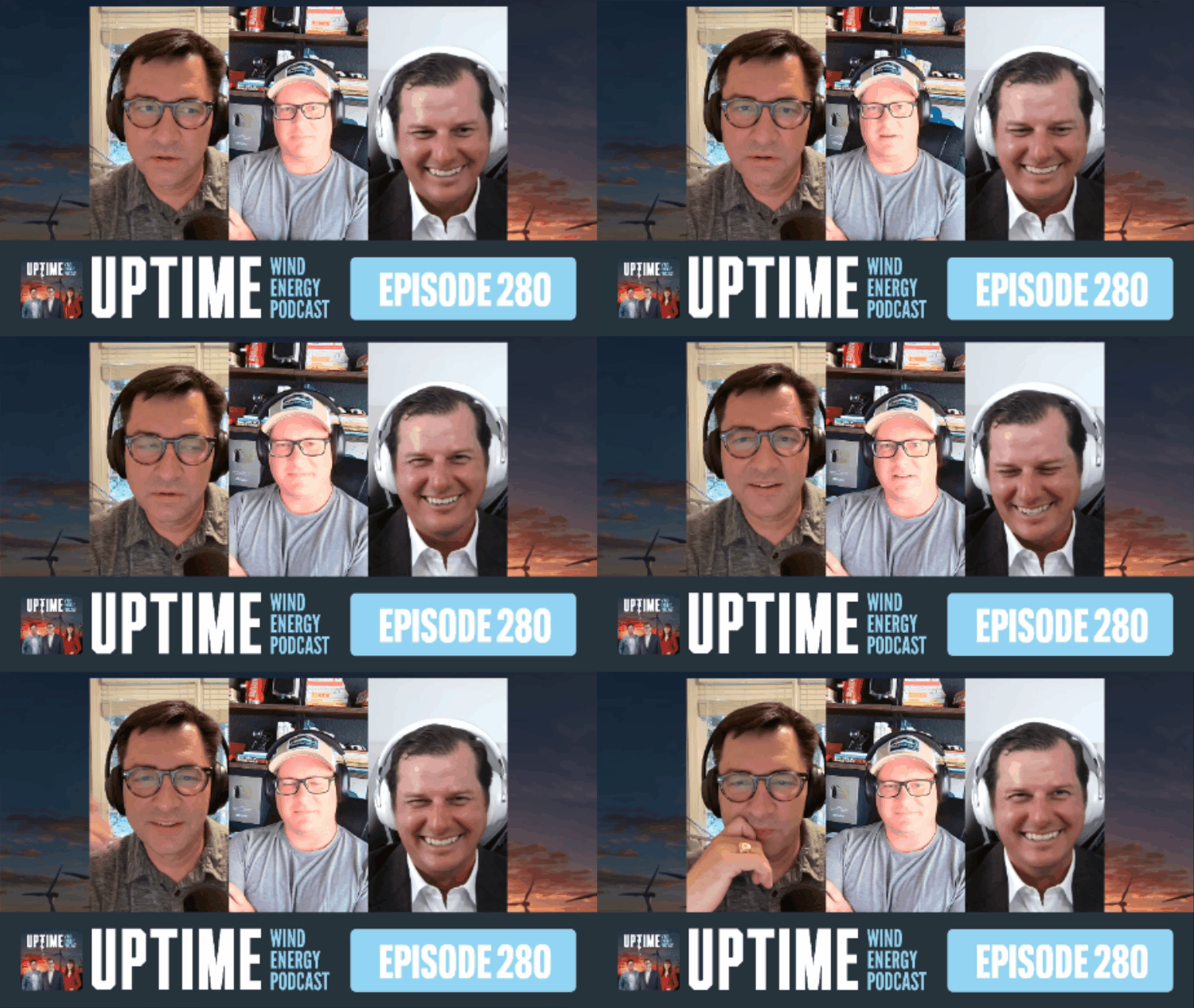
Indian Domestic Wind Regulation, German Offshore Bid
Allen, Joel and Phil discuss Germany’s failed offshore wind auction, India’s new regulations for domestic wind turbine components, and the need for renewable energy in the US to meet AI data center demands. They also highlight Ohio’s efforts to plug abandoned oil and gas wells and feature Quebec’s Rivière-du-Moulin as the Wind Farm of the Week.
Sign up now for Uptime Tech News, our weekly email update on all things wind technology. This episode is sponsored by Weather Guard Lightning Tech. Learn more about Weather Guard’s StrikeTape Wind Turbine LPS retrofit. Follow the show on Facebook, YouTube, Twitter, Linkedin and visit Weather Guard on the web. And subscribe to Rosemary Barnes’ YouTube channel here. Have a question we can answer on the show? Email us!
You are listening to the Uptime Wind Energy Podcast brought to you by build turbines.com. Learn, train, and be a part of the Clean Energy Revolution. Visit build turbines.com today. Now here’s your hosts, Allen Hall, Joel Saxon, Phil Totaro, and Rosemary Barnes.
Allen Hall: Well, welcome to the Uptime Wind Energy Podcast.
I’m Allen Hall from the Queen City, Charlotte, North Carolina. Joel Saxum is down in Texas, and Phil Totaro of IntelStor is in Cali. Phil, you had a tsunami alert just recently. Did you see any waves in your neighborhood?
Phil Totaro: No ’cause it didn’t actually amount to anything. And that’s good, right?
Phil Totaro: It it, have you had tsunami warnings like that in the past?
Y yes. And actually more serious ones from earthquakes that are smaller than the 8.8 that was in Russia that caused this one. [00:01:00] Um, but we’ve had earthquakes off the coast of. California where, you know, they’re like four point something or five something, and that actually triggers a tsunami warning that’s potentially more serious because of the close proximity.
Uh, so we actually developed, uh, in California an early detection and warning system that is triggered, um, you know, mobile phone, uh, alerts and updates based on the, the detection of the P waves from an earthquake.
Allen Hall: What’s a P wave?
Joel Saxum: P Wave is down, ShearWave is left and right. So sheer wave would be moving this way.
P wave would be moving up and down.
Phil Totaro: The P waves, um, are the first indication on, you know, like for the US geological survey, they’ve got those things that, you know, monitor the, the, um, vibration of the earth or whatever it is that they’re monitoring. Um, a P wave will be the first thing triggered when there’s an actual earthquake.
[00:02:00] That’s the thing that happens fast, like super fast, and they can detect it. Anyway, so we’ve de we’ve developed an early warning system when, when we have issues and inclusive of, uh, you know, tsunami warnings. But I’m, I’m kind of, you know, 300 feet up, so I have less to worry about.
Allen Hall: It’s a good place to be.
Well, there’s some offshore warnings off the coast of Germany because, uh, they held their latest offshore wind auction. And it was for about two and a half gigawatts of capacity in about 180 square kilometers of water. And they didn’t have any bidders at all. Zero bidders and the industry from wind Europe to the, uh, German Offshore Wind Association or, or saying like, yeah, no one’s gonna bid on these things because there’s too much risk and there’s negative bidding, quote unquote negative bidding, which means that you have to.
Pay money for the rights [00:03:00] to build out the wind farm and everybody in at least Germany. And when Europe is saying that CFD contract for difference is, is the way to go. And until Germany switches over to a CFD model, you’re gonna continue to have no bidders. Now Phil, this is a big problem because Germany is planning to develop a, a.
Significant amount of offshore wind gigawatts worth many gigawatts worth by 2030. Is there gonna be a change into the German auction system? Will they move to A
Phil Totaro: CFD? We certainly hope so, because what they’ve been doing up to this point with, you know, trying to attract like zero subsidy bids is clearly not working.
Germany’s economy minister, uh, came out after the, the auction result and said, um, well, we’ll have to look at this and why that happened. Um, you know, were the designed areas actually appropriate and did we. Consider the potential risks for [00:04:00] developers? Were they underestimated? Um, well, yes, they were, uh, first of all, and there was nothing wrong with the design areas of the, you know, the 10.1 and 10.2 that they were trying to auction off.
It’s the fact that. You know, in a high interest rate environment, nobody’s gonna wanna make, uh, a zero subsidy bid on something where they’re not gonna necessarily be guaranteed the, the PPA that they need. Um, and when you’re not willing to, to guarantee them the PPA in advance of the auction, that’s, that’s one part of it.
Um, the other part is that, you know, with uncertainty and, and risk associated with, um, you know. Access to supply chain components and things like that. Um, you know, you’ve got countries like Germany and the EU in general saying that they wanna wean themselves off of China and, and Chinese parts. Well, good luck with that, first of all.
Second, second. If you’re gonna domesticate everything that’s [00:05:00]necessarily gonna raise the cost. So you’ve gotta be in a position to, you know, accept, uh, a higher price and, and give, you know, if you’re the government, you have to be able to give some kind of certainty.
Joel Saxum: I’d love for someone from, from that, uh, how do I say this?
Like, not organization, but from that area, from who’s been involved in this to reach out to the podcast. ’cause uh, what I’d like to be a fly on the wall. ’cause this is what I don’t understand, Germany. Big wind market onshore, big wind market, offshore, large player, and wind in general, right? Big companies over there.
We got RWE over there. That has done a lot of offshore things like where was the consultation between the government and trade groups, organizations, because you know, like there should be a feedback mechanism in the early stages of planning this that says, Hey, potential suitors, what do you think about this process?
Will it work? And I have to imagine that they all emailed back and said. This isn’t gonna work for me. Um, I don’t know though. Right? So I’d love to hear from someone involved in that process to be able to kind of share with [00:06:00] us this is how it went, because we’ve watched it happen now time and time again.
There was another one of these not too long ago, Denmark had the one that was, had basically zero subscribers, right? So, hey, governments, uh, you have a great trade organization over there. Wind Europe, you have, um, a lot of players local to you. It’s not like you’re trying to figure this out, uh, blindly. Why not
Allen Hall: collaborate?
Oh yeah, that’s totally true. We had just had MAD and Andres Nash on, uh, who were talking about the Nord project up in Norway, and that’s going through a bidding process sort of starting now. It’s in September. It really gets serious. But even there, there’s a significant number of changes that are happening in companies that are dropping out because they’re raising the stakes and trying to get companies that have a lot of offshore wind experience and not.
Bring somebody new into the game where they were gonna make mistakes. They, they figure if you have developed a, was it 200 megawatts or 500 megawatts [00:07:00] Joel Offshore already? It was some significant number. I think it was 500.
Phil Totaro: I mean, if, if there was any way that they could try and like, make this about like, we only wanna work with eor.
Like that’s basically what they’re trying to do. I mean, like, I mean, you know, I mean, yeah, sure. But like if Simply Blue Group comes in there and says that they wanna be able to develop if Stat Craft who had previously been involved in that, was in there and then pulled out because they weren’t getting the, the, you know, guarantees from the Norwegian government either.
I mean, this is, this is kind of the, the systematic. Uh, issue within Europe at the moment anyway, because they’re the ones talking about, well, we wanna wean ourselves off of Russian gas. Well then do it. Like, don’t sit there and say, you can only do it if you’re doing it with, you know, 18,000 criteria in place.
Like, make it easy for the developers. Um, the money will flow, like investors will want to plow money into, you know, the development of these [00:08:00]projects, but get outta your own way and, and make it happen.
Joel Saxum: It’s kind of reminiscent to me. I guess this is for our US listeners. I was reading an article today about the, the, uh, no offense Phil, but the flight out of California.
It was the amount of people leaving there and there, and it was a, it was a, it was a, uh, letter written from a CEO of a development company that was saying basically like. It’s the hardest place in the United States to do business, and businesses are leaving in droves. People are leaving in droves. It’s like last year, 920,000 people left the state of California like a net loss.
Wow. Yeah. It was crazy. Like there’s 52, 50 5 million people there. But to lose. Basically 2% of your population in one year. That’s crazy. But the reason being is, is it’s the hardest place to do business in the United States. There’s barriers all the time. There’s, there’s permitting issues, there’s this, there’s that.
For real estate development companies, taxes, all this stuff that makes things difficult. Taxes is a big one. Right. But, but that’s what this, that’s what this to me looks like over in the, the EU right now is like you’re making it difficult for people to [00:09:00] do. And no wonder why people don’t want to do it.
They’re gonna look for the easiest place to stick their capital, or the easiest and safest place to stick their capital.
Allen Hall: Are you worried about unexpected blade root failures and the high cost of repairs? Meet Eco Pitch by Onyx Insight, the standard in blade root monitoring. Onyx state-of-the-art sensor tracks blade root movement in real time, delivering continuous data to keep your wind farm running smoothly and efficiently.
With eco Pitch, you can catch problems early, saving hundreds of thousands of dollars. Field tested on over 3000 blades. It’s proven reliability at your fingertips. Choose Eagle Pitch for peace of mind. Contact Onyx Insight today. To schedule your demo of Eco Pitch and experience the future of blade monitoring?
Well, India has implemented new sweeping regulations that will shape the global wind turbine supply chain for at least a little while. The [00:10:00]ministry of New and renewable energy now requires all wind turbine manufacturers to source key components including blades, towers, generators, gear boxes, and some of the bearings from.
Government approved domestic suppliers. Now, I talked about this in newsflash a couple of days ago. Uh, but more information is coming out as we learn about it. The rules also mandate that all turbine performance and operational data must be stored on servers within India, uh, prohibiting real-time data transfers abroad.
So that forces Phil remote operation centers to be. Within India and they’re also talking about research centers that they must be within the country also. So, um, Sulan couldn’t have their research center in Pakistan. Not that that would happen, but they would have to have
Phil Totaro: it in India. But they actually have one in Germany.
Um, for those that don’t know, uh, and you know, there are several. There are several other, [00:11:00] um, Indian OEMs that, or who have licensed, uh, technology from Western companies that you could argue that they would have to domesticate, including, you know, a Donny group, which license and. Licenses, uh, a wind turbine design from, uh, wind to energy based in Rostock, Germany.
So you, you’ve got a situation there where what they’re really trying to do is kind of curb the rise of the Chinese in the market. Um, because at the end of the day, what a lot of those things are geared towards is precluding, um, China from just dumping. Um, goods in, into India. The data thing is interesting though because as you mentioned, they have to have, uh, everything kind of, um, co-located within India and that’s to prevent the realtime data flowing back to China, um, for these Chinese OEMs to be able to analyze it or, you know, remote operate and [00:12:00] control, uh, turbines from China.
Um, they want that, um, within India so that the people who are performing those kind of remote, you know, working in the remote operations center are, you know, either Indian nationals or would be subject to Indian law.
Joel Saxum: I think there’s, there’s something to be aware of here though, too. And, and Phil, we’ve had, this is a much larger macro conversation.
We’ve had this one before, but it’s about, uh, protectionism and growth. Because, you know, there has been countries that have been taken advantage of in the, in the history, and India’s definitely one of them that has been taken advantage of in the past, over the last 300 years, um, that we know that to be true.
Um, but sometimes when the pendulum swings and you start putting regulations and things like that, you can actually hurt yourself a little bit. And I’m just thinking about like, you know, we, you talk about like wanting to preclude some of the Chinese involvement. Okay. But there is West, there’s a lot of Western stuff there.
There is like say, even in, does it go this far? Envision in Vision has a presence in India, big time. [00:13:00] Envisions blades are designed in Boulder, Colorado. Right. So does that affect that? And, and they’re built, a lot of ’em are built by LM and lm, but LM has factories in India, so there’s a little bit of a change there.
Um, we did see in, and I don’t know if it’s a maybe leading up to the, the, the, this Siemens GAA sold their services unit in India couple, 4, 5, 6 months ago. So maybe they heard some whispers in the, in the waiting in the wings going like, well, we’re gonna have to relocate there anyways. We might as well sell this thing.
Well, they, they
Phil Totaro: had to, but that was, yeah, I, I, your, your point is made. But yeah, I, the, the reality of this is what it, what it does is it necessitates. A CapEx investment in the country, and the only way that somebody justifies making a CapEx investment in the country, any country, it doesn’t matter if it’s India, Brazil, the us, anywhere, people need to see visibility to a return.
This actually kind of ties in to what we were talking about with with the German [00:14:00] offshore wind auction. If anybody that wants to invest money, they need to be given a certain amount of EE. Even if you’re not gonna give ’em a guarantee, you have to give ’em a certain amount of, uh, credibility that they’re going to get some kind of a return on the investment they’re making because you’re asking people to spend hundreds of millions on domesticating production If you wanna create a domestic.
Market, you still have to facilitate the technology transfer, the knowledge transfer and the investment, the, the foreign investment that’s necessarily going to facilitate that. If, if you don’t have domestic companies that are competent enough and capable enough to, to build something themselves, so whether it’s wind turbines or solar or battery storage or whatever, then you’re necessarily trying to attract.
That capability from someplace else.
Joel Saxum: I’ve, I’ve, I’ve watched this in, uh, oil and gas in Africa. Oil and gas Africa, early [00:15:00] years, man, it came in and, and all of the majors came down, their Exxon, bp, shell, like, they, but they came from abroad because they, the expertise was not in country to do it. And then once it was like kind of pseudo established, you saw all of these governments, which there’s, there’s they, there’s this own problem in government relations in, in Africa anyways, but, um, you saw these governments set up all this, these barriers and these things to, to try to.
Benefit for the people that corruption got brought into it and all kinds of things. And after a while, a lot of these players like you see over there, like you see small players and local players. You don’t see. Exxon and Chevron and stuff making big splashes down in Africa anymore. They’re just not playing in it.
They have their existing assets. They’ve sold a lot of ’em to smaller companies. They’re running ’em. That’s, that’s still being, and they’ve moved on. They’re in Guyana, they’re in Brazil because they don’t have to deal with the stuff that they got barriers put in place over there.
Allen Hall: What will Europe think about the India supply chain if it does get up and running to the level they want it [00:16:00] to?
In relationship to leaving China and the components that come from China, would India be that source then? I think they kind of already are, aren’t they? I mean, there’s a lot of stuff comes from India.
Phil Totaro: A little bit, not as much as they want to be. It. That’s your next best option in terms of affordability and certainly India wants to be a major export hub, but this whole concept of that they’ve put in place of make it India is really to support their, their domestic growth in their domestic industry.
Basically, if you’re not already in India as a western company or even a Chinese company, the barrier to entry in the market is going up. As I mentioned, you know, you’re talking about hundreds of millions of dollars in CapEx and investment, and the only way you’re going to pull the trigger on that is if you’re seeing a trillion dollar return because you, you know, a lot of these companies want like at least a five x [00:17:00] multiple on whatever CapEx they’re plunking down.
Again, especially in this kind of an interest rate environment. Now, if interest rates go down, their threshold goes down.
Allen Hall: Don’t let blade damage catch you off guard. OGs. Ping sensors detect issues before they become expensive. Time consuming problems from ice buildup and lightning strikes to pitch misalignment in internal blade cracks.
OGs Ping has you covered The cutting edge sensors are easy to install, giving you the power to stop damage before it’s too late. Visit eLog ping.com and take control of your turbine’s health today. Well over in Pennsylvania, a wind farm upgrade is demonstrating how renewable energy is responding to. AI data center demands excess renewables.
North America received over $158 million in financing to upgrade the Twin Ridges wind farm in Somerset County. I know where that is. Uh, boosting capacity to a hundred. 70 [00:18:00] megawatts, that’s a 30% capacity increase. And comes as data centers nationwide are looking for power and that that tends to be the area where a lot of data centers are located or will be located.
Uh, president Trump was just there in Pennsylvania and said, uh, wind energy in particular is not gonna power these data centers, these AI centers. But that doesn’t seem to be stopping anybody. Uh, excess renewables. CEO Jim Spencer reports strong demand from data centers across North America for wind and solar power.
Uh, so even if President Trump is in the neighborhood complaining about wind turbines, what is actually happening on the ground is wind and solar are gonna be powering a lot of those data centers because it’s lower cost and easier to install.
Phil Totaro: And it’s available electrons. I mean, at the end of the day, you know, do you really care what electrons are feeding?
You know, your refrigerator.
Joel Saxum: At the end of the day, this is just gonna be business cases that are gonna win [00:19:00] out, right? You want an AI data center online, you need power. Where are you gonna get it? So your business case, like do you want it built in the next six to nine months or do you wanna wait five years?
Okay. Business case wins out. We want
Phil Totaro: it now. You’d be lucky to get it in 2031. We’re gonna have a nuclear power station on the moon before we get gas powered, you know, AI data centers.
Allen Hall: Why are we doing that? Why are we, why are we spending money for nuclear power on the moon space, race, Allen space race, with whom?
China, because China’s gonna put a nuclear reactor on the moon. Is that what’s
Joel Saxum: gonna happen? Maybe we’ll figure out how to beam it back, shoot electrons through. Vacuum space back to earth or something.
Phil Totaro: But it, it actually, let, let’s tie this back in because that’s kind of the point. You, you can, you can say that you’re gonna go build something and, and it might be a pie in the sky thing, but you’re gonna be out of office by the time somebody wants to even start building that.
Because once you’ve figured out all the technical requirements to be able to even go do that. The administration’s gonna change, and then that’s just gonna be on the scrap [00:20:00] heap. So it, and it’s the same thing. It’s like, you know, like Joel just said, you want your power and you want it fast. You’re gonna go with wind and solar.
You’re gonna go with whatever electrons are available to you. You know, you’re, you’re not gonna be picky. You’re not gonna wait six or seven years for gas.
Joel Saxum: Yeah. When we’re talking gas plants for six or 7, 5, 6, 7 years down the line, we’re talking about these big ge big, big, you know, like the 500 megawatt machines, right?
Yeah. The nine nine series. I read an article the other day about, uh, a data center in, I think it was Ohio, Alan, we’ve been talking a lot about data centers in Ohio lately, on and on and off there, but I think it was in Ohio and it was, it was fired by like. 28 of these little gas turbines. Like they were little ones, right?
They were little like the si, like I looked, I saw the picture. It was like a drone flying over and like each of these little gas turbines was like the size of my pickup. Where are those coming from? [00:21:00] A
Allen Hall: DIY
Joel Saxum: project? No, no. They were bigger than that. They weren’t a Generac, it wasn’t a Honda Whisper. Quiet.
Yeah. They’re, they’re aero derivative generators. So what’s the, who’s building those? What’s the capacity on those? Like where is that gonna be a thing? GE builds those and Siemens, so you can get those. What’s the timeline on one of them? What’s the, what’s the wait time on. A queue list for that.
Phil Totaro: It’s shorter than, you know, the bigger units like a ge you know, seven FA or seven F whatever now.
Uh, or a nine FA or nine F whatever. Now, um, those are the ones that are like five, six years. Um, you know, wait list. The, a derivative engines are cheaper, less complex, easier. To make and faster to deploy, but then we get into the same, I mean, Joel, like, if you were gonna build a wind farm, do you build it with one, you know, five megawatt turbine, or do you build it with, you know, 25, you know, kilowatt size things,
Joel Saxum: but I think [00:22:00] you’re just, you’re, you’re up against the supply chain problem, right?
So like it’s, if you want to do this quick, like you can do that, but at the end of the day, does it really make. Does it make sense or should you just put, I mean, okay. In Ohio you’re not, there’s not a whole lot of wind farms. There’s a whole lot of wind resource. So if you’re gonna build ’em there, you need some kind of power.
Phil Totaro: But also the reason why we, we chase economies of scale and wind energy with, with turbine size is that. It’s less footprint and less to maintain. It’s, yes, it’s a single point of failure, so you need higher reliability with the one turbine instead of, you know, 25 smaller turbines. But you’re, you’re talking about, you know, the, the trade off between redundancy versus, you know, o and m complexity.
And cost.
Joel Saxum: Well, I, I completely agree with you, but I’m just thinking at the end of the day where the majority of data centers are going in the United States, Virginia, that kind of place, like Ohio, you need power. Your, your option right now is like [00:23:00] solar and batteries over there. Right? Or aero derivative engines where you’re gonna be burning fuel like bastard.
Do they sound like an airplane?
Phil Totaro: Sort of, yeah. I mean. They’re loud. They’re all loud anyway.
Joel Saxum: Yeah, that’s true.
Phil Totaro: That’s how, I mean, that’s how they came into being was they, they basically adapted an aircraft engine for power gen, you know, static land-based power generation use. Well, speaking of
Allen Hall: Ohio, Ohio’s Orphan Well program has dramatically increased its cleanup efforts from our friends over in the oil and gas business.
Uh, there are a lot of abandoned wells. Ohio and in the last five years they plugged about 1200 holes from oil and gas and about 2300 since 1977. So every year, Ohio is plugging several hundred oil and gas holes. And Joel, I guess I didn’t [00:24:00] think of Ohio as an oil and gas center. If you move a little bit to the East Pennsylvania.
Obviously oil and gas central for a long time in the United States, but there’s a lot of abandoned oil and gas wells in Ohio. To the point where, uh, they received about $80 million in federal funding from the bipartisan infrastructure law, uh, with up to about $300 million available through 2030 to help fill some of these wells.
And they’re still looking for them because they’re long abandoned. It could be under buildings, they could be covered with trees at this point. Who knows where they are, except from the emissions. That’s the only way they’re gonna be able to find them.
Joel Saxum: Yeah, the trouble here, and this is something that a lot of people don’t think about, um, okay, so Ohio is on the edge of the Marcellus Shale, right?
It’s the same shale play that’s in West Virginia, Pennsylvania, Southern New York. It’s just that same edge, right? So when they found in the early ages of the United States and we started getting petroleum from [00:25:00] onshore resources, Pennsylvania was ground zero and it kind of flowed over into there. So you end up with this situation where you have rugged.
Remote terrain hills, uh, you know, tough to get to where they, these, some of these wells are, you know, a hundred years old where there’s no, you know, there’s, there’s, there’s terracotta pipe and stuff. Like, there’s not good metal pipe in those things. So then, and they are leaking because they were not plugged, right?
The companies have dissolved. There’s all kinds of stuff that’s just gone, right? There’s no records. Uh, we didn’t do a good job of record keeping in the early days. So how you find most of these. Is there’s a two to take a two stage approach. You look, you can look at classical maps and stuff, but that’s only gonna get you so far.
But you look at satellite imagery for methane gas detection, and you can find methane gas plumes from satellite imagery, the US government can, and they’ll get you narrowed down to like a, uh, depending on how bad the plume is, a one to 40 acre chunk. Then [00:26:00] you take a drone that has a methane sniffer on it, and you fly around with a methane sniffer until you kind of narrow in on the plume.
Then you use a metal detector and you find the area that’s time consuming, right? But the risk reward here is, and this is what people don’t understand when we talk about why we’re plugging these wells, it’s because we’re plugging them to get rid of greenhouse gases. Greenhouse gases leak into the environment.
Climate change, all this bad stuff, right? So we always think about CO2, CO2, CO2, but what’s coming outta these wells, because of the way that oil and gas wells work, they are co-located with natural gas and coal beds, coal bed methane. When methane leaks outta the ground, methane comes outta the ground and it’s about 30 times worse than CO2 30 times worse than CO2 per unit.
For as a greenhouse gas for, uh,
Phil Totaro: atmospheric problems. And when we deorbit that satellite that tracks the methane emissions, I think it’s gonna make things a lot harder to do. Are [00:27:00] we doing that, Phil? Apparently. I mean, that was one of the other little rants that he went on the other day. He was like, we’re gonna blow up this satellite that’s for tracking climate change, but it’s actually tracking like the methane emissions from oil and gas.
Allen Hall: I thought Google. Posted those emissions, right. Didn’t Google open up the satellite imagery to see where, uh, methane or as Rosie calls it, methane originated from
Joel Saxum: uh, uh, CH four plus? I know that there’s resources online where you can go look. Uh, and why I know that is because I was actually a part of a research project that was a really cool laser interferometer on a fixed wing drone to find methane concentrations and then automatically map them with a fixed wing drone down to the source.
Um, and while we were in the middle of that project is when they, the government released the ability for this satellite to do it. And I was like, well, there goes that. We don’t need this thing anymore.
Allen Hall: Well, why wouldn’t these billion dollar oil and gas companies take responsibility for the holes they previously dug, or at least be [00:28:00]responsible and say, all right, there’s some abandoned wells in my general vicinity.
Why wouldn’t I plug those as a service to humanity?
Joel Saxum: I think there is a few players that do that. But the gov, because they’re not forced to do it. They’re not spending the money outrightly. Right. There is a couple of like, uh, grassroots organizations. There’s one up in Montana, I can’t remember the name of it, that has taken this on, and they will take donations from some of these oil and gas companies, and they’re like, we’re doing good, and we’re plugging these wells.
And this guy, this guy, and his team goes and does it. But I mean, you can’t, you can’t put a dent in what’s out there.
Allen Hall: Well, just think about the Ohio numbers. $82 million. It is plugged about 1200 wells. So do the math. It’s not that much money per Well, I think, uh. Pick your oil and gas company throwing $80 million to help a state out plug these wells is nothing.
It’s a drop in the bucket.
Joel Saxum: That’s how much money in federal funding they’ve received. They’ve, they’re, it costs way more, costs way more [00:29:00] than $82 million to plug 1200 wells.
Allen Hall: Right. But you see what was done though, right? I, I assume the state of Ohio is pitching it a bunch of money to, to do this also, but I, I, I don’t understand.
If oil and gas is gonna be the responsible party, why they’re not responsible for the cleanup of the things they’ve left behind and on purpose, bankrupt and ll seeded and buried. Yeah.
Joel Saxum: And I think for the most part, like the, the, the players that had have control or do this, it’s a lot of Permian awesome cat drilling company.
Like it’s not Chevron and bp, right. It’s
Allen Hall: Oh sure. But eventually those wells ended up in a bigger player. They all do at some point. Unless they’re completely dry. I super frustrating watching that. Go on
Joel Saxum: this week’s Wind Farm of the Week is Reviere de Mulloon in Quebec. I probably got that wrong, sorry, to my EDF friends up there in Canada.
Um, but this [00:30:00] wind farm is near the town of Sine and Charlevoix in Ana, Las San John in re in, uh, Northern Quebec. So this. Wind farm. It was uh, two phases, 2014 and 2015, phase one and phase two built by EDF and at the time biggest wind farm in Canada and one of the largest in the United States. It was 175 GE 2.0107 meter rotor machines, which you don’t hear about that often.
Uh, so this was again built by EDF and it’s an interesting project ’cause it was built across rugged terrain. I’ve actually driven through this wind farm. And it is timber, it is hills. It’s beautiful, it’s beautiful country. But to be thinking about that project and how they built it, amazing. Uh, so they did, uh, this is cold climate, right?
So GE put, uh, all, all the turbines are equipped with low temperature packages, reliable for operation in Quebec winters. Including ice detection, icing systems and de-icing systems. So that being said, we are having a webinar, uh, shortly, I think in the [00:31:00] next few weeks. Correct me if I’m wrong, Alan, about de-icing systems.
Yes, we are with the OG ping. All right. So, um, in, in other interesting things about this wind farm, the extensive wildlife studies, because this is I think one of the only wind farms I know of that, uh, had a caribou migration path through the middle of it. So they, uh, not only monitored that for before construction, but they’re monitoring it through construction to make sure that don’t.
Um, affect any of those local populations of animals. Uh, but, uh, despite remote access and severe winters, uh, proactive o and m planning all the way to down to crazy things like specialized vehicles and track vehicles and covers over the top of trucks to watch for falling ice and using helicopters for inspections and access.
Um, really, really neat, uh, o and m planning up there. Uh, this wind farm actually has a really high availability rate. So, uh, the Riviere de mu lane is a rare combination of large scale engineering complexity and ecological responsibility. Congrats to our friends up at EDF in Quebec. [00:32:00] You are the Wind Farm of the Week.
Allen Hall: Well, that wraps up another episode of the Uptime Wind Energy Podcast. Thanks for joining us as we explore the latest in wind energy technology and industry insights. And if today’s discussion has sparked any question or ideas, we’d love to hear from you. Just reach out to us. On LinkedIn and we’re always on LinkedIn and don’t forget to subscribe so you never miss an episode.
And if you found value in today’s conversation, please leave us a review. It really helps other wind energy professionals discover the show. So we’ll catch you here. Next week on the Uptime Wind Energy Podcast.
https://weatherguardwind.com/indian-domestic-german-offshore/


College students have been protesting en masse against U.S. aggression abroad and suppression of human rights domestically since the 1960s. These institutions and their students cite “free speech,” as guaranteed by the First Amendment, as the basis for this basic American right.
Now, with the stupidification (my word) of this nation, this has suddenly become controversial.
 Does this guy have a solid point?
Is war a bad thing? What about rape and torture?
Do they point to weaknesses that must be strengthened?
Is Bullying a Bad Thing? Not if We Want a Society of Brutality
 Maybe the protestors are less concerned about length of time in office, and more with criminal authoritarianism.


-
Greenhouse Gases8 months ago
Guest post: Why China is still building new coal – and when it might stop
-
Climate Change8 months ago
Guest post: Why China is still building new coal – and when it might stop
-

 Greenhouse Gases2 years ago
嘉宾来稿:满足中国增长的用电需求 光伏加储能“比新建煤电更实惠”
-
Climate Change2 years ago
Bill Discounting Climate Change in Florida’s Energy Policy Awaits DeSantis’ Approval
-

 Climate Change2 years ago
嘉宾来稿:满足中国增长的用电需求 光伏加储能“比新建煤电更实惠”
-
Climate Change Videos2 years ago
The toxic gas flares fuelling Nigeria’s climate change – BBC News
-

 Carbon Footprint2 years ago
US SEC’s Climate Disclosure Rules Spur Renewed Interest in Carbon Credits
-

 Renewable Energy5 months ago
Sending Progressive Philanthropist George Soros to Prison?