Connect with us

Published

on

Solar energy is transforming Australia’s approach to sustainable living, and rebates are making it more accessible.  

Whether you’re a homeowner, a business owner, or part of a community group, understanding these rebates can help you make informed decisions to help reduce your reliance on non-renewable energy sources.  

So, how do you Maximise Solar Rebates in Victoria for 2025? This guide breaks down the available programs by state, their benefits, and how to maximise your savings. Now, let’s dive in and start saving.

What is a Solar Rebate?

Financial incentives are designed to reduce the upfront costs of installing photovoltaic systems, enabling more people to purchase them.  

Different federal and state incentives, including rebates, interest-free loans, and tax breaks, are available for homeowners and businesses, and they could save them thousands of dollars on their systems.  

It makes investing in renewable energy more effortless, and an increasing number of people are switching and reducing their reliance on the electrical grid and non-renewable energy sources.  

How Do Solar Rebates Work in Australia?

Australia offers federal and state rebates, so you may be eligible to use both systems to save even more.   

We have the Small-Scale Renewable Energy Scheme (SRES) at the federal level. Technically speaking, this is an incentive since the federal government doesn’t provide direct cash rebates.  

Instead, photovoltaic installations generate Small-scale Technology Certificates (STCs). The number of STCs you get depends on the size of your system when you install it and your location.  

Those STCs can be sold to offset installation costs, and their value depends on their current market value.  

To simplify this process for homeowners, photovoltaic installers usually offer to buy their STCs directly upon installation and credit the money to their bills.  

That way, it works like an instant rebate, helping lower those initial up-front costs so that more people can purchase photovoltaics.  

You can also save your STCs and shop around for a better price, but you must first pay your full up-front cost for your system. The best part is that the federal Australian solar rebate is available to anyone in Australia who installs a photovoltaic system.  

Different states also have their own rebates and incentive programs. The rebates by state section below provides more information on what is available in your state.  

When deciding on your system, consider your unique situation and the different types of panels available. Contact Cyanergy to get the best commercial solar panels for your business. 

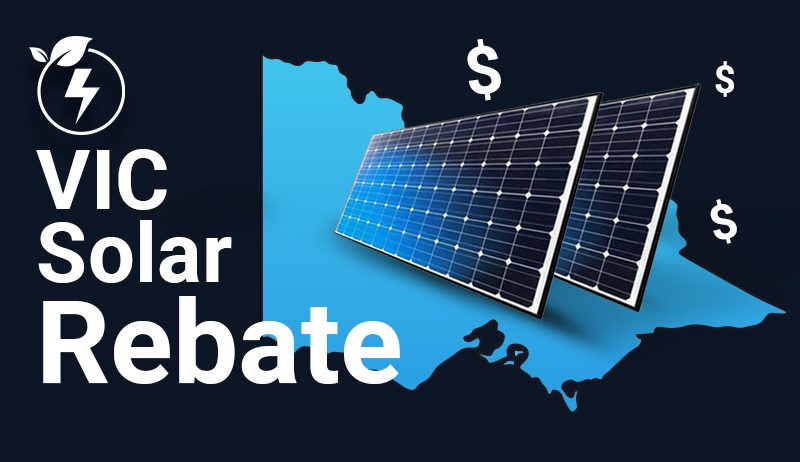
How to Maximise Solar Rebates in Victoria for 2025?

Solar Victoria Rebate

If you live in Victoria and want to save the most money when installing solar panels or batteries in 2025, there are several things you can do.  

The Victorian government offers rebates, interest-free loans, and feed-in tariffs to make solar energy more affordable.  

Following the proper steps can reduce your upfront costs and lower your electricity bills for years.   

1. Understand the Available Rebates and Incentives 

The Victorian Solar Homes Program is a federal government initiative that helps homeowners and landlords install solar panels and batteries.  

Here’s what it offers:   

Solar Panel Rebate: Get up to $1,400 off the solar panel cost.   

Battery Rebate: Get a discount on battery storage, but eligibility changes yearly, so check updates.   

Interest-Free Loan: Borrow the same amount as your rebate (up to $1,400) and repay it over four years.   

Feed-in Tariffs (FiT)   

Victoria’s feed-in tariff allows you to earn money by selling extra electricity from your solar panels back to the grid.  

The rate varies, but in 2025, the minimum FiT is expected to be around 4.9 cents per kWh, with higher rates for power exported during peak times.   

For example, if your solar panel system costs $5,000, you could receive a $1,400 rebate and borrow another $1,400 as an interest-free loan. Thus, you only need to pay $2,200 upfront, making solar more affordable.  

2. Check If You’re Eligible for Rebates

To qualify for the Solar Homes Program, you must:   

  • Be the owner of the property.   
  • Have a household income below $210,000 per year.   
  • Live in a property valued at under $3 million.   
  • Install a system from a government-approved supplier.   

The Battery Rebate may have additional conditions, such as requiring a minimum battery size and specific energy storage capacity.   

Tip: Check the Solar Victoria website before applying to see if the rules have changed in 2025.   

3. Choose the Right Solar System for Maximum Savings

Pick the Right Size System   

A more extensive solar panel system produces more electricity, reducing your power bills and increasing your feed-in tariff earnings. However, more significant systems cost more, so ensure they fit your budget.   

  • If you use a lot of electricity daily, a system around 6.6kW is an excellent choice.   
  • If you plan to add a battery, consider a 10kW system to store more energy.   

Consider Battery Storage   

Batteries allow you to store solar energy and use it at night, reducing your need for electricity from the grid. A battery storage can save you even more on power bills, especially if feed-in tariff rates are low.   

If your solar panels generate extra power during the day, you can store it in a battery and use it at night instead of buying electricity. This helps you avoid high evening electricity rates.   

government incentives

4. Find a Reliable Solar Installer

Only government-approved installers can offer rebates, so check the Solar Victoria list of accredited providers. Choosing a high-quality installer ensures your system is installed safely and efficiently.   

  • Compare quotes from different installers to find the best deal.   
  • Check reviews to make sure the company is trustworthy.   
  • Ask about warranties. Good solar panels should last at least 25 years, and batteries should last 10 years or more.   

5. Apply for Rebates and Loans Properly  

Once you have chosen your solar system and installer, apply for the rebate before installation. Here’s how:   

  • Get a quote from an accredited solar installer.   
  • Apply online through the Solar Victoria portal.   
  • Provide necessary documents, like proof of homeownership and income details.   
  • Wait for approval before installation begins.   
  • Install your system and pay the remaining balance after your rebate is applied.   

6. Maximise Your Savings with Smart Energy Use

To get the most benefits from your solar system:   

  • Use more electricity during the day when the sun is shining (e.g., run your washing machine dishwasher, or charge your EV).   
  • Switch to a time-of-use electricity plan if it helps lower your costs.   
  • Regularly clean your solar panels so they work efficiently.   

Extra Tips to Save the Most with Smart Choices 

By understanding your rebate options, choosing the right system, and applying correctly, you can save thousands on solar in Victoria for 2025.  

The key steps are:   

  • Apply for the Solar Homes Program early.   
  • Consider getting a battery for extra savings.   
  • Choose a reliable solar installer.   
  • Use more energy during the day to reduce power bills.   

With the right approach, you can reduce your electricity costs, increase the value of your home, and help the environment—all while receiving the best financial support available!  

Solar Rebates and Incentives All Around Australia

Australia offers different solar rebate programs to help reduce the cost of installing solar panels and batteries.  

These programs are available at both the national and state levels. Below is a summary of the available rebates, who can apply, and how much you can save.   

Federal Solar Incentives

Small-scale Renewable Energy Scheme (SRES) 

This national program provides Small-scale Technology Certificates (STCs), which can lower the cost of a solar system by around $400 to $600 per kW. The STCs apply to systems under 100kW installed by approved professionals.   

Large-scale Renewable Energy Target (LRET)  

For businesses with systems over 100kW, this program issues Large-scale Generation Certificates (LGCs) for every megawatt-hour of clean energy produced. LGCs are worth about $46.25 each and are issued monthly.   

Solar Rebates by State

solar rebates

New South Wales (NSW)   

Solar Battery Rebate: Get $1,600 to $2,400 for a battery and $250 to $400 for connecting to a Virtual Power Plant (VPP). Available for homes with existing solar systems.   

Grants and subsidies for Apartment Solar Projects cover up to 50% of installation costs, saving apartment residents up to $600 annually.   

Empowering Homes Program: Interest-free loans up to $14,000 for homeowners earning less than $180,000 annually to buy solar batteries.   

Victoria (VIC)   

Solar Homes Program: Up to $1,400 off solar panels and interest-free loans for battery purchases are available to homeowners and rental properties that meet income and property value limits.   

Queensland (QLD)   

Feed-in Tariff System: Queensland does not offer direct rebates but allows households to earn money by selling extra solar energy back to the grid. The amount paid depends on the electricity provider, so compare rates to get the best deal.   

Australian Capital Territory (ACT)   

Sustainable Household Scheme (SHS): This scheme offers rebates and no-interest loans for solar panels, batteries, and electric vehicle chargers. It is open to households and community groups that meet eligibility rules.   

Western Australia (WA)   

Distributed Energy Buyback Scheme (DEBS): A feed-in tariff program paying up to 10 cents/kWh for energy exported to the grid during peak hours.   

Switch Your Thinking Program: Offers discounts on sustainable products for residents in specific WA council areas.   

Northern Territory (NT)   

Home and Business Battery Scheme: Provides up to $5,000 for battery installations for homes, businesses, and non-profits.   

Apartment Solar Rebate: This rebate covers up to 50% of solar installation costs, with a cap of $7,500 per dwelling for apartments and shared buildings.   

Feed-in Tariff Program: Pays households and businesses for excess energy sent back to the grid. Payment rates depend on the energy provider.   

South Australia (SA)   

Incentives for Sustainability: A City of Adelaide program offering cash-back incentives for solar installations and sustainable homes. Available to residents, businesses, and community groups in Adelaide.   

Using these rebates and incentives, Australians can reduce the cost of their solar systems, save money, and switch to cleaner energy. 

Talk to an expert and enjoy all the rebates on your solar project! Contact Cyanergy Today! 

Your Solution Is Just a Click Away

The post How to Maximise Solar Rebates in Victoria for 2025? appeared first on Cyanergy.

https://cyanergy.com.au/blog/how-to-maximise-solar-rebates-in-victoria-for-2025/

Continue Reading

Renewable Energy

Vineyard Wind Sues GE Vernova, US Monopile Factory Bankrupt

Published

on

Weather Guard Lightning Tech

Vineyard Wind Sues GE Vernova, US Monopile Factory Bankrupt

Allen covers EEW American Offshore Structures’ Chapter 11 filing, Vineyard Wind suing GE Vernova for $545 million, Europe’s exit from Korea, and wind project wins in Australia and Canada.

Sign up now for Uptime Tech News, our weekly newsletter on all things wind technology. This episode is sponsored by Weather Guard Lightning Tech. Learn more about Weather Guard’s StrikeTape Wind Turbine LPS retrofit. Follow the show on YouTubeLinkedin and visit Weather Guard on the web. And subscribe to Rosemary’s “Engineering with Rosie” YouTube channel here. Have a question we can answer on the show? Email us!

There is a story unfolding across this industry right now. It is a story of two worlds. One world is closing its doors. The other is throwing them wide open.

Let us start in New Jersey. EEW American Offshore Structures filed for Chapter Eleven bankruptcy on April eighth. This was the first monopile manufacturing facility ever built in the United States. New Jersey Governor Phil Murphy announced a two hundred fifty million dollar investment in the Paulsboro Marine Terminal back in twenty twenty. It was called the largest industrial offshore wind investment in the country at the time. At full buildout… five hundred thousand square feet of production space. More than one hundred monopiles per year. Five hundred workers. They even built the first American-made monopile… for Orsted’s Ocean Wind project. It weighed three million pounds. It measured three hundred feet long.

Then Orsted canceled Ocean Wind One and Two. Then Shell pulled out of Atlantic Shores. Without contracted work… workers disassembled and recycled finished monopiles for scrap. Federal policy shifts removed the pipeline of future projects. A landlord eviction filing followed. And then… Chapter Eleven. That is a two hundred fifty million dollar facility… with nowhere left to go.

Now stay with us. Because just offshore… another American offshore wind story is fighting for its life. Vineyard Wind… the sixty-two turbine project fifteen miles south of Martha’s Vineyard… filed suit in Massachusetts against GE Renewables. GE Vernova says Vineyard Wind owes it three hundred million dollars for work already performed… and it wants to walk away at the end of April. Vineyard Wind says not so fast.

The developer says GE still owes five hundred forty-five million dollars for what it calls inexcusably poor performance after a catastrophic turbine blade collapse in July of twenty twenty-four. Fiberglass blade fragments washed onto Nantucket beaches during peak tourist season. Sixty-eight of seventy-two blades had to be removed and replaced. That set the project back nearly two years. Construction did reach completion in March… making Vineyard Wind the first offshore project to finish under the current administration. But now the only contractor capable of completing the remaining work… wants out. A court hearing was scheduled for Thursday.

And now… look eastward. Something similar is playing out in Korea. European offshore wind companies are exiting the Korean market one by one. Corio Generation, a British firm owned by Macquarie, disbanded its Korean unit and pulled out of joint projects in Busan and Ulsan. Germany’s RWE quit offshore wind projects in Taean and Sinan counties. Vestas postponed its turbine factory in Mokpo… indefinitely. Equinor began reducing its Korean workforce. Shell exited the Korean offshore market entirely in twenty twenty-four.

These companies point to worsening global profitability… and Korean government policies they say favor domestic companies over firms with greater experience. Korea had a target of three gigawatts of offshore wind by twenty thirty. That goal is now in serious doubt.

But here is where the story turns. Not every market is closing its door. Eight thousand miles from New Jersey… in the Sunshine State of Queensland, Australia… the final forty-one turbines just arrived at the Wambo wind project. Cubico Sustainable Investments and Stanwell are building a five hundred six megawatt project on the Darling Downs. Stage One… two hundred fifty-two megawatts… already feeding the Queensland grid. Stage Two deliveries are now complete. Commissioning and full operations are on track for the end of twenty twenty-six.

And up in Ontario, Canada… the province just approved fourteen new wind and solar projects totaling more than thirteen hundred megawatts. The average price… eight point eight cents per kilowatt hour. Compare that to twenty-one point four cents for some proposed nuclear projects… and more than thirty-two cents for certain new reactor designs. Contracts run for twenty years, with all projects online before twenty thirty.

So let us step back. In New Jersey… the first American monopile factory files for bankruptcy. Off Massachusetts… a completed offshore wind farm fights to keep its contractor. In Korea… European developers pack their bags. But in Australia… turbines arrive on schedule. And in Canada… wind power undercuts nuclear at the meter.

The wind energy industry is not in retreat. It is choosing its battlegrounds. And where the conditions are right… the blades are turning.

And now you know… the rest of the story.

That is the state of the wind industry for the 13th of April, twenty twenty-six. Join us for the Uptime Wind Energy Podcast tomorrow.

Vineyard Wind Sues GE Vernova, US Monopile Factory Bankrupt

Continue Reading

Renewable Energy

Criticizing Trump

Published

on

Did Jennifer Lawrence really say this? I hope not, because it’s complete stupidity.

People who didn’t criticize Hitler, Mussolini, or the dozens of other fascist dictators as they were rising to power merely ushered them into a position in which they could destroy the lives of millions of innocent lives.

Criticizing Trump

Continue Reading

Renewable Energy

Birthright Citizenship

Published

on

The author of the meme at left writes, “We’re the only ones.”

This is completely incorrect, not that you care about facts and truth. Over 30 countries, primarily in the Americas, offer unconditional birthright citizenship, granting citizenship to almost anyone born within their territory, regardless of their parents’ status.

Birthright Citizenship

Continue Reading

Trending

Copyright © 2022 BreakingClimateChange.com