

NVIDIA continues to cement its position as a leading force in the artificial intelligence (AI) industry. Its powerful chips are now the foundation of massive data centers and AI systems across the world. Recent deals worth more than $60 billion highlight how deeply the company is shaping the future of global computing.
Industries like healthcare and finance are turning to AI. NVIDIA’s hardware and software are now key to digital transformation. The company is both selling chips as well as designing the global infrastructure for smart technologies.
Growing Global Demand for AI Computing
Modern AI models demand enormous computing power. Training chatbots, autonomous driving systems, or image-recognition tools involves processing millions of calculations per second. NVIDIA’s graphics processing units (GPUs) are built for this type of workload.
Unlike traditional chips, GPUs can handle many tasks at once, making them ideal for AI training and inference. NVIDIA’s efficiency has made it the go-to supplier for big cloud providers, research institutions, and AI startups.
In 2025, global demand for AI computing surged. Governments and private companies are building large-scale data centers around NVIDIA’s technology. These facilities help create advanced AI models. They can be used for tasks like weather forecasting and logistics optimization.

Billions in Global Infrastructure Partnerships
NVIDIA has signed major partnerships worth about $60 billion in total. These include agreements across cloud services, chip deployment, and full-scale data center construction.
A key highlight is the $14 billion contract between Microsoft and Nscale, a British AI cloud company. This deal will deploy about 200,000 NVIDIA GB300 GPUs. The installations will span the United States and Europe, with 104,000 GPUs located at a 240-megawatt facility in Texas set to open in 2026. Additional sites include 12,600 GPUs in Portugal and 23,000 in England by 2027.
Another big deal includes BlackRock, Microsoft, NVIDIA, and Elon Musk’s xAI. They just announced a $40 billion purchase of Aligned Data Centers. The company operates over 50 campuses with more than 5 gigawatts of total capacity across North and South America. This is the biggest data center purchase ever. It also boosts NVIDIA’s role in the AI Infrastructure Partnership (AIP) initiative.
NVIDIA is more than a chip supplier now. These big collaborations show it’s a key partner in creating and powering the next generation of AI infrastructure.
Musk Bets Big on NVIDIA in a $20B Chip Pact
One of the most ambitious projects tied to NVIDIA is xAI’s $20 billion lease-to-own deal for AI chips. Led by Elon Musk, xAI plans to use the financing to build the Colossus 2 data center in Memphis, Tennessee.
The project will deploy 300,000 to 550,000 NVIDIA GB200 and GB300 chips, scaling up from xAI’s current 200,000-processor facility. The arrangement involves about $7.5 billion in equity and $12.5 billion in debt, using a special purpose vehicle (SPV) structure.
In a unique twist, NVIDIA is investing up to $2 billion in the SPV’s equity, effectively financing part of its own hardware. The debt is secured by the GPUs, not xAI’s corporate assets. This gives lenders direct security linked to the equipment.
This five-year lease model helps xAI access cutting-edge computing power without taking on the full debt burden. It also ensures NVIDIA a steady income stream and longer-term control over chip distribution.
NVIDIA Stock Moving Up, Market Going Up
NVIDIA’s stock went up a bit today. The market responded to corporate announcements and infrastructure deals. The gain shows that investors believe these big deals will increase future revenue and strengthen NVIDIA’s position in the AI ecosystem.
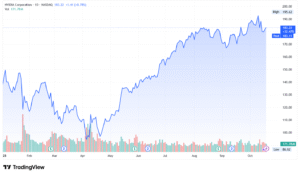
Although the increase isn’t dramatic, it shows that traders view this news as adding value. Stable stock gains can draw more interest from institutional investors. They look for long-term growth potential.
As news about these deals spreads, more people in the market may view NVIDIA as more than just a chipmaker. They might see it as a key player in AI infrastructure. That perception can help support longer-term stock strength.
The AI infrastructure market is growing fast and looks set to keep expanding for years. Analysts estimate the AI-infrastructure market hit $87.6 billion in 2025. It could almost double by 2030. This growth comes as companies invest in GPUs, networking, and cooling systems.
Data center power needs are rising fast. Forecasts suggest that by 2027, demand could hit about 92 GW. This growth is mainly due to AI workloads.
Firms and governments might need trillions in new capital to meet demand. One major study estimates that data-center investments could reach about $8 trillion by 2030 in a high-growth scenario.
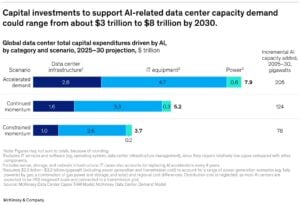
Market research groups predict that AI data centers will grow at a compound annual growth rate of 25–32% through 2030. This means strong ongoing investment in chips, facilities, and power.
ESG, Sustainability, and Environmental Impact
Large AI data centers, like those powered by NVIDIA’s chips, have significant environmental footprints. The energy they consume and the cooling systems they require can contribute to greenhouse gas emissions and heavy water use.
In the xAI Colossus 2 project, the energy demand alone is over 1 gigawatt, comparable to the power needs of nearly a million households. Cooling will use millions of gallons of water daily. The facility uses methane turbines. This has led to complaints from environmental groups about air pollution and regulatory issues.
Because of this, NVIDIA and its partners will need to address sustainability. They may invest in cleaner power sources like solar or wind. They might also implement advanced cooling technology that uses less water or captures waste heat. Efficient chip designs that consume less power will be critical, too.
These sustainability efforts can influence public perception, regulatory approvals, and long-term cost structure. If NVIDIA proves it’s cutting emissions and lowering environmental impact, it boosts its role as a tech leader and a responsible partner for a greener future.
The Heat Is On: Rivals, Regulation, and Rising Power Costs
Despite its momentum, NVIDIA faces real challenges. Global demand for GPUs still exceeds supply, leading to long waiting times for deliveries. The company depends on semiconductor foundries like TSMC. So, any delays in production can affect big projects.
Competition is growing as well. AMD, Intel, and new AI-focused startups are developing their own advanced processors. These firms aim to capture part of the rapidly expanding AI chip market.
NVIDIA also faces regulatory and environmental risks. Export limits might cut sales in important areas. Also, AI data centers use more energy, which brings up sustainability issues. Meeting demand responsibly will require cleaner energy sources and more efficient chip designs.
What’s Next: NVIDIA’s AI Empire Expands
Looking ahead, NVIDIA is expected to continue expanding its global partnerships and data center influence. The company could move deeper into AI infrastructure services, offering combined packages of chips, software, and cloud capacity.
Future growth may also come from:
- AI-as-a-Service platforms for governments and enterprises.
- Cloud partnerships that give smaller developers access to advanced GPUs.
- Next-generation chip designs with better performance per watt.
- Sustainability initiatives to reduce energy use and emissions in data centers.
NVIDIA’s new partnerships include $60 billion in infrastructure deals and $20 billion in chip leasing. These moves show its growing role in AI innovation. The company’s chips now support projects that define the next era of computing, from massive data centers to advanced autonomous systems.
While competition and environmental pressures will continue to test its leadership, NVIDIA’s global reach and ability to adapt ensure it will stay a key player in the race to build the world’s AI infrastructure.
The post How NVIDIA, Microsoft, Musk’s xAI, and BlackRock Are Driving the Next Wave of AI: $60 Billion in Mega Deals Explained appeared first on Carbon Credits.

EU carbon credit claims changed on 27 September 2026, the day the Directive (EU) 2024/825 began to apply across the European Union. The change is narrow. It changes how a company can talk about the credits it buys. A product can no longer be called neutral on the strength of compensation alone; however, every specific, evidenced statement about what a company measured, reduced, and funded stays fully available.

The post Promoting Improved Cooking Practices in Nigeria appeared first on Terrapass.



-
Climate Change1 year ago
Guest post: Why China is still building new coal – and when it might stop
-

 Greenhouse Gases2 years ago
嘉宾来稿:满足中国增长的用电需求 光伏加储能“比新建煤电更实惠”
-
Greenhouse Gases1 year ago
Guest post: Why China is still building new coal – and when it might stop
-

 Climate Change2 years ago
嘉宾来稿:满足中国增长的用电需求 光伏加储能“比新建煤电更实惠”
-

 Renewable Energy12 months ago
Sending Progressive Philanthropist George Soros to Prison?
-
Climate Change2 years ago
Bill Discounting Climate Change in Florida’s Energy Policy Awaits DeSantis’ Approval
-
Greenhouse Gases1 year ago
嘉宾来稿:探究火山喷发如何影响气候预测
-

 Climate Change2 years ago
Analysis: China’s CO2 falls 1% in Q2 2024 in first quarterly drop since Covid-19