

Solar geoengineering has been suggested as a temporary measure to buy time for the emissions cuts needed to stabilise global temperatures.
These arguments have generally considered geoengineering as an independent component of the “toolbox” of options for climate change mitigation.
However, this perspective overlooks the knock-on effects that pursuing solar geoengineering could have on reaching net-zero.
The idea of solar geoengineering is to reduce global temperatures by reflecting more of the sun’s incoming radiation away from the Earth’s surface. One of the most talked-about approaches is stratospheric aerosol injection (SAI), which involves the injection of aerosols in an upper layer of the atmosphere.
In a pair of studies, published in Earth System Dynamics and Earth’s Future, we explore the potential impact that deploying SAI could have on the potential to generate wind and solar energy.
Our findings show that SAI could slow decarbonisation efforts by reducing the output of these energy systems. In this way, solar geoengineering could create an additional challenge to reaching net-zero, thus creating further obstacles for avoiding dangerous warming.
Buying time with temporary geoengineering
One of the criticisms of solar geoengineering is that its pursuit could obstruct or discourage ongoing and future efforts to cut emissions, sometimes referred to as mitigation deterrence. While the evidence of this is limited, what about the technological implications that could constrain efforts to reduce emissions?
To tackle this question, we have undertaken two studies into how SAI could affect the potential for solar and wind energy – key renewable sources in the transition to net-zero.
Our experiments focus on a scenario where SAI is used to bring global temperatures down from a very high-warming pathway (SSP5-8.5) that represents a failure of climate policy – to a moderate-warming pathway broadly in line with current policies (SSP2-4.5).
We compare the scenarios in the last decade of the simulations, the 2090s, where the signal of human-caused climate change is strongest.
The chart below illustrates the absolute warming levels for these pathways – showing climate model simulations for the moderate (grey lines), high (black) and SAI (red). The red bar shows the decade of interest at the end of the 21st century.
Under these pathways, end of century warming would be 2.2C lower in the SAI scenario than under high warming.

We focus on three different dimensions that help determine renewable energy potential and calculate these for each grid cell and each timestep of our simulations:
- A politico-economic dimension that assesses suitability based on land cover, regulatory restrictions and distance to population.
- The physical entity that represents the unconstrained energy resource, such as radiation, wind speed and temperature.
- The technical aspects related to conversion losses from turning energy from the sun or wind into electricity. This depends on characteristics related to solar panels or wind turbines and the density of their placement in a wind or solar farm.
These dimensions, and their interactions, are illustrated in the figure below, divided between politico-economic (green), technical (blue) and physical (purple).

Extended periods of low solar
Our results indicate that the potential for solar energy, whether compared to a moderate emissions scenario or the high emissions baseline, would be reduced in almost all parts of the world if SAI is used.
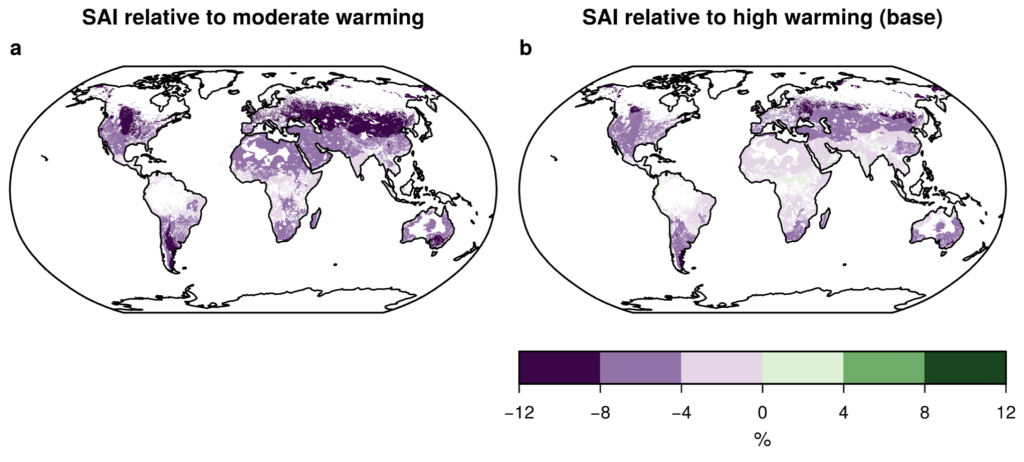
The maps below show the increase (green shading) and decrease (purple) in solar energy potential in the SAI scenario relative to the moderate (left) and high (right) warming scenarios.
We find typically larger differences under moderate warming than high warming because solar energy potential is larger in a world where global temperatures are not raised as high. Solar panel efficiency is reduced substantially in a much-warmer world.
Geographically, the largest relative reductions are in the mid-to-high latitudes. (This is due to solar geometry, which dictates that the sun’s rays arrive at a lower angle for higher latitudes, meaning they have to pass through more aerosol particles on their way to the surface.)
However, perhaps even more importantly, using SAI enhances the frequency of extended periods with low solar potential.
As the principle of SAI is to reduce incoming solar radiation, a fall in solar energy potential is to be expected.
Yet, there are actually two impacts of SAI that favour solar power: a thinning of tropical clouds, which compensates for some of the direct reduction of incoming sunlight, and lower ambient temperatures compared to the high-warming scenario, which benefit the efficiency of solar panels.
However, neither of these two impacts outweighs the overall reduction in solar power potential.
SAI may also affect how solar panels are positioned. Typically, panels are tilted to maximise the amount of direct radiation reaching the panels surface. However, under SAI, we find that radiation reaching the panels is less direct and increasingly diffuse. Therefore, tilting solar panels may become less useful.
Regional reductions in wind potential
Our findings suggest that changes in on- and offshore wind potential under SAI can be of a similar magnitude to those for solar, but whether the impact causes an increase or decrease in energy potential is highly variable depending on the location and season.
Overall, these changes lead to a negligible global impact on wind potential, but the regional charges can still be significant – with particular reductions in China and central Asia, along with Mexico, western US and many parts of the southern hemisphere.
This is shown in the maps below, which illustrate the increase (green) and decrease (purple) in offshore wind energy potential in the SAI scenario relative to the moderate (left) and high (right) warming scenarios.

The changes in wind potential under SAI are caused by changes in large-scale atmospheric circulation – mainly a result of the heat absorbed by the injected aerosols.
The impact on wind potential is more nuanced than for solar. For example, there is a general long-term slowing of surface winds under SAI. (This has also been observed in simulations using a different climate model from the one used in our study.)
However, due to the delicate range of wind speeds where wind turbines operate, slower winds can actually lead to either an increase or a decrease in potential.
Of course, changes in wind energy potential are only realised if the areas are actually exploited for wind energy. However, the large regional changes in wind potential may imply that a different strategy would be needed for siting windfarms in order to maximise the energy produced. However, this would cause problems later down the line if SAI is intended as a temporary measure.
Implications for decarbonisation
With a reduced potential for wind and solar when using SAI, there is a risk that deploying SAI would actually lead to a slowing of decarbonisation.
This, in turn, implies that solar geoengineering would need to be deployed for even longer – unless the gap could be met with higher amounts of carbon dioxide removal. Other research has found that, once started, geoengineering would be required for multiple centuries.
Such knock-on impacts put the concept of using geoengineering to “buy time” for climate change mitigation into question.
In fact, because of the reduced output of renewables under SAI, relatively more renewable capacity would need to be installed just to produce the same amount of energy as without SAI.
At the same time, renewable technology may also need to be adapted to SAI circulation and radiation conditions for optimal energy production. This could include adjusting the tilt of solar panels and adapting windfarm placement strategy and wind turbine characteristics.
The substantial impact geoengineering could have on mitigation – and vice versa – highlights the importance of considering such couplings when moving towards more comprehensive assessments of climate geoengineering.



The post Guest post: How solar geoengineering could disrupt wind and solar power appeared first on Carbon Brief.
Guest post: How solar geoengineering could disrupt wind and solar power

The Trump EPA’s repeal of the 2009 endangerment finding revokes the agency’s authority to regulate climate pollution. Environmental activists are mourning the loss while vowing to resurrect it.
A procession of mourners representing sea level rise, melting permafrost, ecocide and other climate calamities grieved the demise of a groundbreaking climate rule outside the Environmental Protection Agency’s Region 9 headquarters in downtown San Francisco on Tuesday.
Climate Activists Stage Mock Funeral for Landmark Climate Rule
Global oil demand is expected to be almost one million barrels per day less than was forecast before the Iran war, as shortages and soaring costs prompt drastic cutbacks by consumers and businesses, a report by the International Energy Agency (IEA) said on Wednesday.
With the closure of the Strait of Hormuz choking off supplies and keeping prices high, less oil is being used to make products such as jet fuel, LPG cooking gas and petrochemicals, the Paris-based IEA said in its monthly oil report, forecasting the biggest quarterly demand drop since the COVID pandemic.
The Iran war “upends our global outlook”, the government-backed agency said, adding that it now expects oil demand to shrink by 80,000 barrels per day in 2026 from last year.
Before the conflict began, the IEA said in February it expected oil demand to rise by 850,000 barrels per day this year, meaning the difference between the pre-war and current estimates is 930,000 barrels a day, or 340 million barrels a year.
That could have a significant impact on the outlook for planet-heating carbon emissions this year.
At an intensity of 434 kg of carbon dioxide per barrel of oil – the estimate used by the US Environmental Protection Agency – the annual reduction in carbon dioxide emissions from oil for 2026, compared with the pre-war forecast, is similar to the amount emitted by the Philippines each year.
Harry Benham, senior advisor at Carbon Tracker, told Climate Home News that he expects at least half of the reduction in oil demand to be permanent because of efficiency gains, behavioural change and faster electrification.
The oil shock is leading to oil being replaced, especially in transport, with electricity and other fuels, just as past oil shocks drove lasting reductions in consumption, he said. “The shock doesn’t delay the transition – it reinforces it,” he added.
Demand takes a hit
While demand for oil has fallen significantly, supplies have fallen even further. Supply in March was 10 million barrels a day less than February, the IEA said, calling it the “largest disruption in history”.
This forecast relies on the assumption that regular deliveries of oil and gas from the Middle East will resume by the middle of the year, the IEA said, although the prospects for this “remain unclear at this stage”.
-
Italy pushes coal exit back after gas prices rise
Analysts say the move sends a negative signal, but its impact will be limited given coal’s marginal role in Italy’s energy mix -
Charging worries, high prices put brakes on EV growth in Bangladesh
Sales of e-bikes and rickshaws are up amid queues at fuel stations, but a lack of charging infrastructure and high prices still deter many Bangladeshis from going electric -
Fossil Free Zones can be on-ramps to the clean energy transition
Oil and gas blocks overlap with a fifth of forests in the Amazon, Congo Basin and SE Asia – policies are needed to transition away from fossil fuels and halt deforestation together


Last month, US Energy Secretary Chris Wright told the CERAWeek oil industry conference that prices were not high enough to lead to permanent reductions in demand for oil, known as demand destruction.
But the IEA said on Wednesday that “demand destruction will spread as scarcity and higher prices persist”.
Industries contributing to weaker demand for oil include Asian petrochemical producers, who are cutting production as oil supplies dry up, the report said, while consumers are cutting back on liquefied petroleum gas (LPG), which is mainly used as a cooking gas in developing countries, the IEA said.
Flight cancellations caused by the war have dampened demand for oil-based jet fuel, the IEA said. As well as cancellations caused by risk from the conflict itself, airports have warned that fuel shortages could lead to disruption.
Across the world, governments, businesses and consumers have sought to reduce their oil use after the war. The government of Pakistan has cut the speed limit on its roads, so that people drive at a more fuel-efficient speed, and Laos has encouraged people to work from home to preserve scarce petrol and diesel.
Nepal’s EV revolution pays off as oil crisis causes pain at the pumps
Consumers in Bangladesh are seeking electric vehicles (EVs) to avoid fuel queues and, in Nigeria, more people are seeking to replace petrol and diesel generators with solar panels, Climate Home News has reported.
In the longer term, the European Union is considering cutting taxes on electricity to help it replace fossil fuels and France is promoting EVs and heat pumps.
IEA urged to help “future-proof” economies
Meanwhile, the IEA came under fire last week from energy security experts, including former military chiefs, who signed an open letter in which they accused the agency of offering “only a temporary response to turbulent markets”, calling for stronger structural action “to future-proof our economies”.
They said that besides releasing emergency oil stocks and offering advice on how to reduce oil demand in the short term, the IEA should show countries how to reduce their exposure to volatile oil and gas markets.
The IEA has also been under pressure from the Trump administration to talk less about the transition away from fossil fuels.
This article was amended on 15 April 2026 to correct the drop in 2026 forecast oil demand from “nearly a billion” to “nearly a million”
The post IEA slashes pre-war oil demand forecast by nearly a million barrels per day appeared first on Climate Home News.
IEA slashes pre-war oil demand forecast by nearly a million barrels per day
Climate lawsuits are a largely nonexistent threat to farmers in the state, but ethanol producers could benefit from the law.
DES MOINES, Iowa—Aaron Lehman has many concerns about the fate of Iowa’s farmers. Climate lawsuits aren’t one.
Iowa Moves to Shield Farmers, Ethanol Plants, From Lawsuits Over Emissions

-
Climate Change8 months ago
Guest post: Why China is still building new coal – and when it might stop
-
Greenhouse Gases8 months ago
Guest post: Why China is still building new coal – and when it might stop
-

 Greenhouse Gases2 years ago
嘉宾来稿:满足中国增长的用电需求 光伏加储能“比新建煤电更实惠”
-
Climate Change2 years ago
Bill Discounting Climate Change in Florida’s Energy Policy Awaits DeSantis’ Approval
-

 Climate Change2 years ago
嘉宾来稿:满足中国增长的用电需求 光伏加储能“比新建煤电更实惠”
-
Climate Change Videos2 years ago
The toxic gas flares fuelling Nigeria’s climate change – BBC News
-

 Renewable Energy6 months ago
Sending Progressive Philanthropist George Soros to Prison?
-

 Carbon Footprint2 years ago
US SEC’s Climate Disclosure Rules Spur Renewed Interest in Carbon Credits