

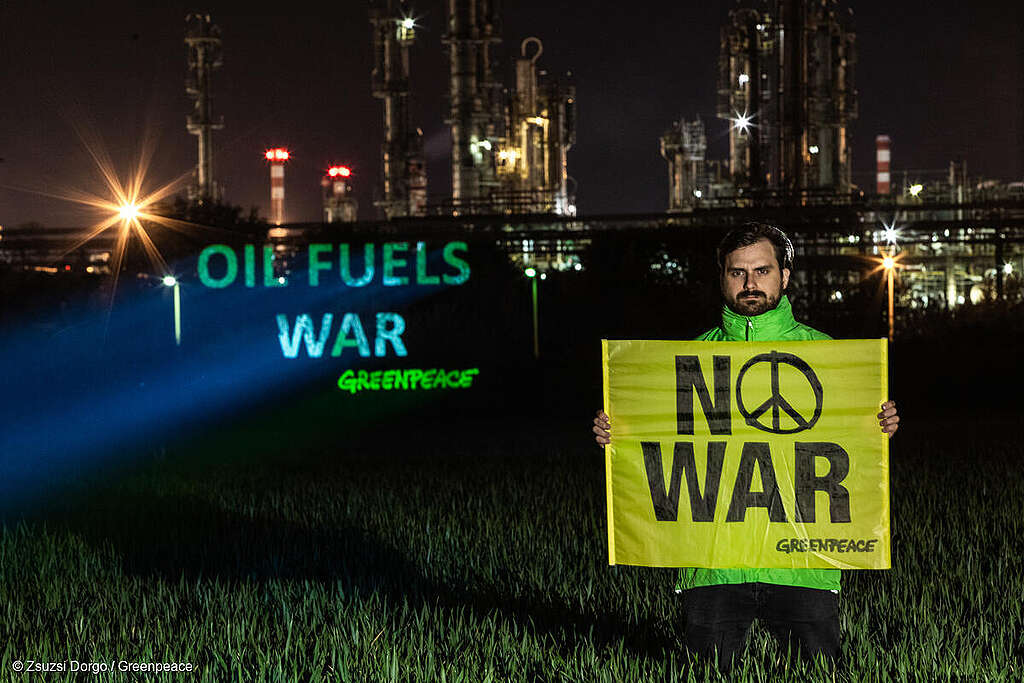
Like so many people around the world, I am experiencing a sense of horror at the escalating violence in Iran and the Middle East. Greenpeace has called for all parties to immediately halt further military action, for international law to be fully upheld, and for a return to diplomacy to stop the suffering of civilians. The people of Iran, and all people, everywhere, have the inalienable right to live free of violence, fear and coercion. As humans we grieve for lives lost, and for all those who suffer.
But while countless people experience the consequences of this latest mass violence, some interests will no doubt attempt to benefit from the crisis. We can expect that fossil fuel corporations and lobbyists will cynically use the closure of the Strait of Hormuz-a major shipping route for oil and gas-to propagandise for increased fossil fuel production.
The practical reality is that a country as rich in renewable sources of energy as Australia should not be hostage to the global fossil fuel trade. The pursuit of fossil fuels–coal, oil and gas–have been the source of vast scale conflict, violence and geopolitical volatility for far too long. This will only accelerate as the climate crisis–itself driven primarily by fossil fuel extraction and burning–continues to put greater pressure on natural and social systems.
The truth is that the only absolute way to provide true energy security for the world is to phase out fossil fuels rapidly and deliberately, at emergency speed and scale, and to accelerate the shift to modern, renewable energy.
It’s in the strategic interest of all countries, including Australia, to unhook from volatile sources of energy. As long as our world runs on oil and gas, our peace, security and our pockets will always be at the mercy of geopolitics. As Professor Hussein Dia argued in The Conversation yesterday, this latest war in the Middle East shows why quitting oil is more important than ever.
These events are another jarring reminder that Australia doesn’t need more fossil fuel investment–we need less.
Locally controlled renewables are the best way to address the structural vulnerability at the heart of this recurring crisis. Ultimately, our freedom and security, prosperity and sustainability, are all best served by shifting from fossil fuels to renewable energy.
Dependence on fossil fuels makes all of us hostage to geopolitics and the whims of tyrants.
Greenpeace Australia Pacific response to the Middle-East crisis







Climate Change
After a Slow Start on Climate, Zohran Mamdani Faces Scrutiny Over Parks Budget and Environmental Promises
Climate-conscious New Yorkers hope the mayor hasn’t forgotten them.
During his New York City mayoral campaign, Zohran Mamdani courted votes from environmentalists. He promised to expand green spaces in public schools and equip them with renewable energy, to meet the demands of the city’s building electrification laws and to increase investments in city parks.
That would be American ratepayers—i.e., you.
From our collaborating partner Living on Earth, public radio’s environmental news magazine, an interview by Jenni Doering with Katharine Kollins, the president of Southeastern Wind Coalition.
Who Loses in the Trump Administration’s $1 Billion ‘Deal’ to Abandon Offshore Wind?
County officials have said they will eventually close the incinerator, located in a predominantly Black community. Advocates want a concrete plan.
Minneapolis activists are escalating a decades-long fight by going on a hunger strike to demand that local officials shut down a polluting trash incinerator.
Minneapolis Activists Launch Hunger Strike to Protest Polluting Trash Incinerator

After a Slow Start on Climate, Zohran Mamdani Faces Scrutiny Over Parks Budget and Environmental Promises
Who Loses in the Trump Administration’s $1 Billion ‘Deal’ to Abandon Offshore Wind?
Minneapolis Activists Launch Hunger Strike to Protest Polluting Trash Incinerator
-
Climate Change8 months ago
Guest post: Why China is still building new coal – and when it might stop
-
Greenhouse Gases8 months ago
Guest post: Why China is still building new coal – and when it might stop
-

 Greenhouse Gases2 years ago
嘉宾来稿:满足中国增长的用电需求 光伏加储能“比新建煤电更实惠”
-
Climate Change2 years ago
Bill Discounting Climate Change in Florida’s Energy Policy Awaits DeSantis’ Approval
-

 Climate Change2 years ago
嘉宾来稿:满足中国增长的用电需求 光伏加储能“比新建煤电更实惠”
-
Climate Change Videos2 years ago
The toxic gas flares fuelling Nigeria’s climate change – BBC News
-

 Renewable Energy6 months ago
Sending Progressive Philanthropist George Soros to Prison?
-

 Carbon Footprint2 years ago
US SEC’s Climate Disclosure Rules Spur Renewed Interest in Carbon Credits